
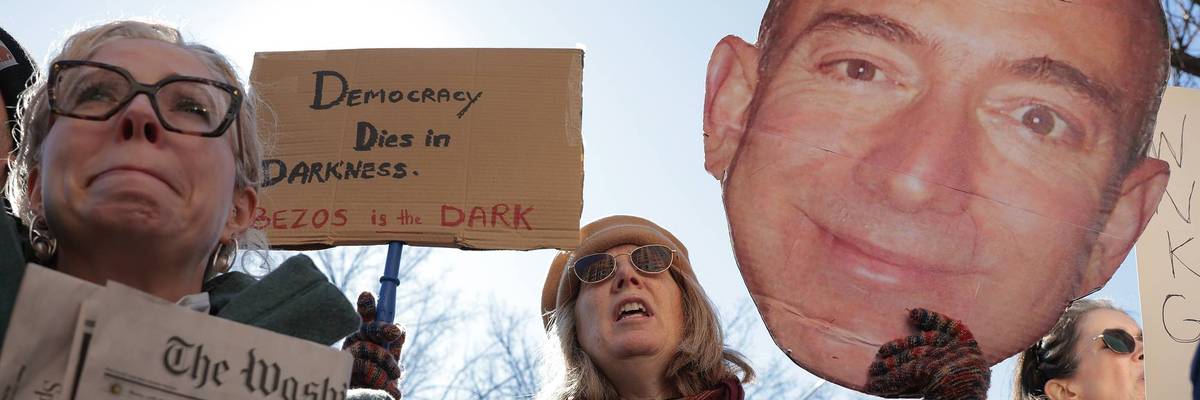
Local D.C. residents who read the Washington Post joined members of the guild to protest during a rally outside the Washington Post office building on February 05, 2026 in Washington, DC. The Washington Post, owned by billionaire Amazon founder Jeff Bezos, announced major job cuts on February 4, laying off more than 300 journalists.
It's No Coincidence That Authoritarianism Rises as Journalism Dies
Democracy will die if we have no good answer for funding hard-hitting and trustworthy journalism.
Journalism is experiencing one of its worst crises when it’s needed the most.
Overall, news consumption is dropping. And it’s worse among young people, who largely get their news through social media, not news outlets. People under 30, more than any other age group, trust social media sources of news.
The problem is that it’s hard to tell if your favorite social media source is a citizen journalist or a paid promoter. In a recent in-depth report, The New York Times revealed that social media platforms are rife with accounts that are paid to promote campaigns parading as personal opinion.
Study after study proves that journalism fuels and promote a strong democracy.
Rather than hire well-known influencers with huge followings, politicians and organizations are now hiring huge numbers of accounts with smaller followings. “Functioning more like birdshot than a single bullet,” the Times explained, “these high-volume social media campaigns represent the new vanguard of modern political influence, saturating the internet with a topic until it is all but unavoidable.”
A perspective that appears popular online may well be the result of this digital “astroturfing.” A decade ago, many Americans blamed the Russian government for insidious meddling in American politics using armies of paid content pushers. Now the same tactic is being deployed by campaigns and nonprofits.
This disturbing trend goes hand-in-hand with a shocking decimation of journalism. A June 2026 study found that the number of journalists per capita in the United States fell by more than 80 percent since 2002, and those jobs that remain are increasingly focused on sports and crime rather than public policy, government, or other issues.
As out-of-work journalists turn to freelancing, the situation for piecemeal work is equally grim. The National Writers Union recently found that freelance pay remains stagnant even as the cost of living has more than doubled.
Desperate to make ends meet, some independent journalists might attempt to garner large enough followings on social media to monetize their work—only to find that they have to play to algorithms designed to lift up rage bait and polarizing content.
If our views are shaped by paid content creators, and there are fewer than ever journalists to investigate issues of concern, we face a future where opinions are bought and paid for by those with the deepest pockets.
We cannot continue this way. Democracy will die if we have no good answer for funding journalism that is hard-hitting and trustworthy.
To address the crisis in journalism, California Gov. Gavin Newsom recently signed AB 2222 to strengthen local journalism. Under the law, qualifying news outlets in California will receive $20,000 per journalist, capped at five journalists, plus $15,000 for every additional journalist.
This might cover pay raises in a state where $100,000 a year is considered a “low-income” wage—and where the median salary for journalists is under $53,000. But while the bill’s intentions are laudable, this is too little too late. Thousands of journalists have already left their field.
For decades, the federal government diverted a minuscule sliver of the national budget to publicly fund broadcast media through the Corporation for Public Broadcasting. President Donald Trump took a sledgehammer to that modest and very limited source of funding, ending it in July 2025.
What then, is the answer? If New York City Mayor Mamdani can open city-run grocery stores, can localities do something similar for newsrooms, while preserving the critical editorial independence necessary for good journalism?
The answer is “yes.” Media expert Victor Pickard has touted an ambitious and innovative plan for “Public Media Centers” in local communities around the country that are “federally guaranteed but locally owned and controlled.”
Study after study proves that journalism fuels and promote a strong democracy. It’s no wonder that authoritarianism is rising at the same time that journalism is dying. If we want to save our democracy, we must save journalism.
We are at a crossroads
This country and this world are at a monumental crossroads. In a few short weeks, US voters will have an opportunity to beat back the forces of fascism and confront the billionaires who are rigging the economy, our media system, and our democracy, making it increasingly impossible for ordinary people to get by. We’re not just talking about the election. We’re talking about what must be done once these fascist elements are vanquished from power. We need a bolder set of solutions than what either major party has so far been willing to offer and a working-class movement ready to fight like hell for it. Trump didn't emerge from nowhere. The conditions that fueled MAGA authoritarianism were created by decades of radical neoliberal economic policies and a corrupt political system dominated by corporate interests. They slashed taxes on the super-rich, promising that the benefits would trickle down. They said giveaways to the corporate titans would make life more affordable for the rest of us. It was all bullshit. And when a bitter, betrayed populace searches for someone to blame, right-wing demagogues have little trouble finding scapegoats. People know when they're being lied to, but you won't hear any of this from the corporate media. Only independent journalism—powered and funded by people who believe in building a better world—can deliver truly trustworthy daily news. Our Fall Campaign is underway, and we need your help. To power our newsroom through the rest of the year, we need to raise $125,000 by midnight on October 31. So if you share our vision, please contribute whatever you can to sustain our work. |
Journalism is experiencing one of its worst crises when it’s needed the most.
Overall, news consumption is dropping. And it’s worse among young people, who largely get their news through social media, not news outlets. People under 30, more than any other age group, trust social media sources of news.
The problem is that it’s hard to tell if your favorite social media source is a citizen journalist or a paid promoter. In a recent in-depth report, The New York Times revealed that social media platforms are rife with accounts that are paid to promote campaigns parading as personal opinion.
Study after study proves that journalism fuels and promote a strong democracy.
Rather than hire well-known influencers with huge followings, politicians and organizations are now hiring huge numbers of accounts with smaller followings. “Functioning more like birdshot than a single bullet,” the Times explained, “these high-volume social media campaigns represent the new vanguard of modern political influence, saturating the internet with a topic until it is all but unavoidable.”
A perspective that appears popular online may well be the result of this digital “astroturfing.” A decade ago, many Americans blamed the Russian government for insidious meddling in American politics using armies of paid content pushers. Now the same tactic is being deployed by campaigns and nonprofits.
This disturbing trend goes hand-in-hand with a shocking decimation of journalism. A June 2026 study found that the number of journalists per capita in the United States fell by more than 80 percent since 2002, and those jobs that remain are increasingly focused on sports and crime rather than public policy, government, or other issues.
As out-of-work journalists turn to freelancing, the situation for piecemeal work is equally grim. The National Writers Union recently found that freelance pay remains stagnant even as the cost of living has more than doubled.
Desperate to make ends meet, some independent journalists might attempt to garner large enough followings on social media to monetize their work—only to find that they have to play to algorithms designed to lift up rage bait and polarizing content.
If our views are shaped by paid content creators, and there are fewer than ever journalists to investigate issues of concern, we face a future where opinions are bought and paid for by those with the deepest pockets.
We cannot continue this way. Democracy will die if we have no good answer for funding journalism that is hard-hitting and trustworthy.
To address the crisis in journalism, California Gov. Gavin Newsom recently signed AB 2222 to strengthen local journalism. Under the law, qualifying news outlets in California will receive $20,000 per journalist, capped at five journalists, plus $15,000 for every additional journalist.
This might cover pay raises in a state where $100,000 a year is considered a “low-income” wage—and where the median salary for journalists is under $53,000. But while the bill’s intentions are laudable, this is too little too late. Thousands of journalists have already left their field.
For decades, the federal government diverted a minuscule sliver of the national budget to publicly fund broadcast media through the Corporation for Public Broadcasting. President Donald Trump took a sledgehammer to that modest and very limited source of funding, ending it in July 2025.
What then, is the answer? If New York City Mayor Mamdani can open city-run grocery stores, can localities do something similar for newsrooms, while preserving the critical editorial independence necessary for good journalism?
The answer is “yes.” Media expert Victor Pickard has touted an ambitious and innovative plan for “Public Media Centers” in local communities around the country that are “federally guaranteed but locally owned and controlled.”
Study after study proves that journalism fuels and promote a strong democracy. It’s no wonder that authoritarianism is rising at the same time that journalism is dying. If we want to save our democracy, we must save journalism.