SUBSCRIBE TO OUR FREE NEWSLETTER
Daily news & progressive opinion—funded by the people, not the corporations—delivered straight to your inbox.
5
#000000
#FFFFFF
To donate by check, phone, or other method, see our More Ways to Give page.
Daily news & progressive opinion—funded by the people, not the corporations—delivered straight to your inbox.
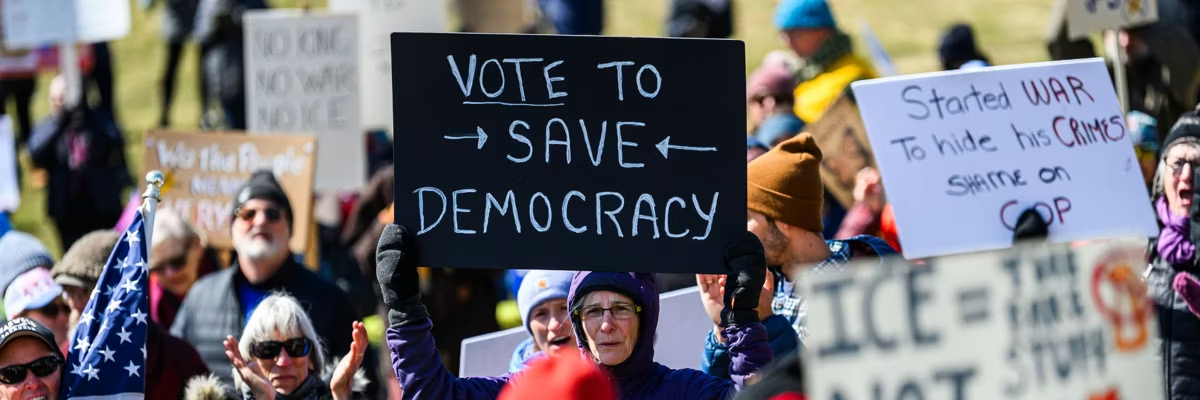
Protestors at a No Kings anti-Trump demonstration at the Vermont State House in Montpelier, Vermont on Saturday, March 28, 2026.
Trump's military gamble in the Middle East isn't just reckless foreign policy. It could be the opening move in the end of American democracy as we know it.
When Donald Trump ordered military action against Iran, the response from much of the political commentariat followed a familiar script. Reckless, they said. Destabilizing. A dangerous distraction from domestic failures. A president lashing out. All of these characterizations may be true. But they miss what may be the far more consequential story, one that connects the bombs falling on Tehran to a calculated, if desperate, effort to make democratic accountability in the United States structurally impossible.
This is not hyperbole. This is what the evidence, taken together, begins to suggest.
To understand why, we need to step back from the fog of the immediate crisis and ask a harder question: what does Donald Trump actually need right now? Not rhetorically. Not ideologically. Politically and structurally, what does a president with cratering poll numbers, a midterm catastrophe on the horizon, and a plutocratic agenda that depends entirely on his continued hold on power actually require to survive?
The answer, it turns out, looks a great deal like what we are watching unfold.
Trump's political coalition has always rested on an unusual alliance. Fossil fuel companies were early and enthusiastic backers. Big Tech, or at least significant factions of it, increasingly joined the fold, drawn by promises of deregulation and the intoxicating proximity to state power that Silicon Valley's more authoritarian-curious wing has found so appealing and profitable. These were the interests Trump understood, catered to, and rewarded.
The military-industrial complex, once ambivalent about Trump, now has enormous skin in the game.
But one pillar of American elite power remained conspicuously cool to the whole enterprise: the military-industrial complex. This was, in part, by design. Trump ran as the anti-war candidate, the scourge of "forever wars," the prophet of "America First," the man who would bring the troops home and stop pouring national treasure into conflicts that enriched Beltway contractors while delivering nothing to the working-class communities that voted for him. It was a potent message. It was also, we now know, a temporary one.
Consider what has happened in just the past week. Trump's proposed $1.5 trillion defence budget for fiscal year 2027 represents the largest military spending request in modern American history, a 44 percent increase over the previous year. As the Washington Post reports, this would be the biggest Pentagon budget in US history. Economists at Fortune describe it as rivaling the wartime mobilization of World War II. Johns Hopkins economist Steve Hanke put it bluntly: "MAGA was told an untruth by Trump. No foreign wars, no adventurism… This is a massive militarization—completely the opposite of what he told his base."
This is not a defense policy. It is a transaction.
And how is this historic spending increase being paid for? By gutting Medicaid, food assistance, housing programs, climate research, K-12 education, and virtually every program that materially supports the lives of the people who voted for Trump. The nonpartisan Committee for a Responsible Federal Budget estimates this expansion of the military budget will add more than $3.2 trillion to the national debt over the next decade. The president himself acknowledged his priorities plainly at an Easter luncheon this week for Christian religious leaders and Cabinet members: "We can't take care of daycare. We're a big country. We have 50 states. We're fighting wars."
This is not a defense policy. It is a transaction. It is the most expensive political consolidation in American history, aimed squarely at drawing the defense industry and the Pentagon into the corporate bloc that sustains this administration. The Iran war, whatever its strategic rationale, serves that consolidation perfectly. Wars need weapons. Weapons need contracts. Contracts need contractors. The military-industrial complex, once ambivalent about Trump, now has enormous skin in the game.
But there is a second and more chilling dimension to this realignment. The military is not just an economic constituency. It is, historically, the institution most capable of checking an executive that moves to seize unconstitutional power. Trump appears to understand this. Over two days last week, Defense Secretary Pete Hegseth fired Army Chief of Staff General Randy George, Army General David Hodne, and the chief of chaplains Major General William Green, all with immediate effect. George had been expected to serve until the summer of 2027. According to Axios, a US official described firing the Army's most senior general in the middle of a war as "insane." The general replacing George, Christopher LaNeve, was previously a personal aide to Hegseth himself.
It is... worth considering the possibility that removing independent-minded commanders serves purposes that go well beyond the prosecution of the current war.
These firings did not come from nowhere. Hegseth has now removed more than a dozen senior military leaders across multiple branches since taking office, including Joint Chiefs Chairman General Charles Q. Brown Jr., the Navy's top admiral, and the head of the Coast Guard. The pattern is unmistakable: experienced, independent commanders are being replaced by loyalists. This is not about military effectiveness. It is about ensuring that when the moment comes, the armed forces are led by people whose careers depend entirely on the man in the White House.
Senator Chris Murphy, a member of the Senate Foreign Relations Committee, offered his assessment on Friday: "It's likely that experienced generals are telling Hegseth his Iran war plans are unworkable, disastrous, and deadly." That interpretation deserves to be taken seriously. Yet it is also worth considering the possibility that removing independent-minded commanders serves purposes that go well beyond the prosecution of the current war.
To understand why a broader power consolidation may be coming sooner than most people think, you have to understand the structural trap that Trumpism has always been caught in, a trap that is now visibly closing in around the administration and threatening its political survival.
Trump won his second term, as he won his first, by weaponizing legitimate grievances. The slow strangulation of working-class communities. Decades of wage stagnation. The punishing weight of rising costs in housing, healthcare, and food. He named these things loudly and unapologetically, when much of the Democratic establishment was still insisting that the fundamentals were sound. That naming had real political power. It brought him the votes of people who had seen their lives get harder through multiple administrations of both parties and had concluded that someone willing to say the unsayable was better than another round of managed decline.
It also created a structural problem that no amount of political talent can solve: the conditions Trump identified are not the product of bad leadership or globalist betrayal. They are the inevitable result of capitalism, specifically of four decades of neoliberal restructuring that concentrated wealth, hollowed out labor protections, financialized the economy, and made the cost of living an ever-growing crisis for the majority of Americans. Trump had neither the intention nor the ideological framework to change any of this. His economic program, built on tax cuts for the wealthy, deregulation for corporations, and tariffs that function as a consumption tax on working people, does not address the underlying crisis. It accelerates it.
For a time, propaganda could paper over the gap between rhetoric and reality. The enemy was immigrants. The enemy was China. The enemy was the deep state, the fake news, the coastal elites. The culture war was stoked to a rolling boil to keep attention away from material conditions. But propaganda has a shelf life, and the Iran war has accelerated its expiry dramatically. Gas prices have broken four dollars a gallon for the first time in four years. Mortgage rates have risen for five consecutive weeks. Inflation expectations, already elevated, have worsened further.
Propaganda has a shelf life, and the Iran war has accelerated its expiry dramatically.
The polling numbers tell a story of collapse. Trump's approval rating on the economy has fallen to a new career low of 31 percent, according to CNN, with roughly two-thirds of Americans saying his policies have made economic conditions worse. His overall approval has dipped below 40 percent for the first time in his second term, with a net rating of minus 16.9. The University of Massachusetts Amherst poll put him as low as 33 percent overall, with researchers describing the numbers as "brutal" and noting drops of close to 20 points among men, working-class Americans, African Americans, moderates, and independents, the very groups whose support brought him back to the White House in 2024. For a politician who has always operated on the thinnest of margins, that number represents catastrophe.
The midterms loom, and they threaten to be devastating. Democrats have led the generic ballot in every single national poll taken since May 2025. The pattern, if it holds, points toward wave territory for Democrats by November. A significant takeover of the House or Senate would do more than slow Trump's legislative agenda. It would expose him to oversight, investigation, and the kind of accountability that his personal, family, and financial interests cannot survive. The MAGA project, which has always been as much about the enrichment of Trump and his inner circle as about any coherent political program, would face existential threat.
This is the contradiction that cannot be resolved through democratic competition. And that may be precisely why the response to it is ceasing to be democratic.
The moves are already underway, and they deserve to be named clearly, not as speculation, but as observable, documented fact.
The legislative effort to suppress voting began with the original SAVE Act in 2025 and has now evolved into the far more expansive SAVE America Act, which passed the House in February 2026. As the Center for American Progress documents, this legislation would require voters to present a passport or birth certificate in person to register to vote, disenfranchising potentially millions of citizens. Crucially, these Americans are disproportionately working-class people of color, married women who have changed their names, young people, and low-income voters. The bill would also implement extreme documentation requirements at polling places, restrict mail voting, and require all states to submit their voter registration rolls to the Department of Homeland Security. The Campaign Legal Center estimates that election officials could face criminal penalties of up to five years in prison for registering someone without the required documents, even if that person is a citizen.
The Brennan Center has stated the danger plainly: "The SAVE Act would stop millions of American citizens from voting. It would be the most restrictive voting bill ever passed by Congress. It is Trump's power grab in legislative garb." As the Senate stalls on the bill, Trump has insisted Republicans end the filibuster to force it through, while simultaneously pressuring Republican governors to enact state-level versions. Florida, Mississippi, South Dakota, and Utah have already complied. In the meantime, Steve Bannon has said aloud what many have thought privately, that ICE deployments to airports in recent months have been a "test run to really perfect ICE's involvement in the 2026 midterm elections."
Then there is JD Vance. This week, Trump formally designated his vice president as the national "fraud czar," heading a federally constituted task force with nationwide jurisdiction. Trump specified that while Vance's focus would be "everywhere," it would "primarily" target California, Illinois, Minnesota, Maine, New York, and other Democratic-led states. The move closely followed the swearing-in of a new Assistant Attorney General for National Fraud Enforcement who reports directly to Vance and the president. Whatever the stated rationale of combating healthcare and social services fraud, the political targeting is explicit. The administration is constructing federal law enforcement tools aimed with open precision at the states most likely to vote against it in November.
Taken individually, each of these moves can be rationalized away. Yet together, they describe something coherent and deeply alarming.
And then there is the firing of Attorney General Pam Bondi. Bondi was removed from office this week, not because she was too independent or insufficiently loyal, but because Trump felt she had not moved aggressively enough to prosecute his political enemies. Federal judges had thrown out indictments against former FBI Director James Comey and New York Attorney General Letitia James. Career prosecutors had warned that cases against other Trump targets lacked sufficient evidence. Courts had held DOJ officials in contempt. The president, frustrated, concluded that Bondi had not delivered. As a former DOJ attorney told NPR, Bondi "took a sledgehammer to the Justice Department and its workforce," and yet she was still not compliant enough. Her replacement is expected to be even more willing to use the department as a personal instrument of political retribution.
Taken individually, each of these moves can be rationalized away. Yet together, they describe something coherent and deeply alarming. They describe a government methodically removing or degrading the mechanisms, judicial, electoral, military, prosecutorial, by which a democratic system constrains and, when necessary, removes leaders who have lost public support.
Which brings us back to the war, and why it may not be separable from any of this.
Wars do things that are useful to leaders facing political collapse. They activate nationalism. They shift media attention. They generate a rally-around-the-flag dynamic that briefly suspends normal political gravity and makes ordinary voters feel, however fleetingly, that this is not the moment for partisan criticism. They make the argument, always available and always dangerous, that dissent is disloyalty, that the Commander-in-Chief must not be undermined while American forces are in the field and American lives are at stake.
They also, crucially, create conditions of emergency that can be used to justify the postponement or disruption of normal democratic procedures. We have seen this logic deployed before, in other countries, in other eras. The emergency that never quite ends. The election that needs to be delayed, just this once, for reasons of national security. The opposition party that finds itself accused not of political disagreement but of actively aiding the enemy. The president whose wartime authority, he insists, should not be constrained by normal constitutional limits.
We are not there yet. But the distance between where we are and where this logic leads has arguably never been shorter in modern American history.
The budget that funds the war was released simultaneously with the gutting of the domestic programs that might otherwise give Trump's voters a reason to keep faith with his project. The generals who might push back against both the war strategy and the broader authoritarian drift have been fired and replaced by loyalists. The attorney general who was not pursuing political enemies aggressively enough has been removed. The voting restrictions designed to reduce participation by those least likely to support the Republican Party are advancing at the state and federal level simultaneously. The vice president has been handed a law enforcement tool specifically calibrated to target Democratic states in an election year.
None of these things, by itself, constitutes definitive proof of an intention to cancel or subvert the 2026 midterm elections. But the pattern they form, when viewed as a whole, is not ambiguous. It is the pattern of a government that is preparing the ground, legally, institutionally, militarily, for the possibility that it will not accept an unfavorable electoral outcome.
Critics of Trump have spent nearly a decade describing him as an existential threat to democracy. That characterization has sometimes felt abstract, a warning about norms, institutions, and long-term trajectories that serious people took seriously but that never quite seemed to crystallize into something immediate and irreversible.
It no longer feels abstract.
What appears to be taking shape is a deliberate, multi-front effort to construct the conditions under which electoral democracy in the United States can be formally or informally suspended, and to build, through the military budget, through institutional purges, through legal mechanisms, through the systematic targeting of opposition strongholds, the structural supports that would make such suspension survivable for those carrying it out.
The Iran war may be reckless. It may be destabilizing. It may ultimately prove to be a catastrophic foreign policy blunder with devastating consequences for the region and the global economy. All of that can be true. It probably is true.
What appears to be taking shape is a deliberate, multi-front effort to construct the conditions under which electoral democracy in the United States can be formally or informally suspended...
But it may also be something else simultaneously. It may be a cornerstone, laid deliberately, at precisely this political moment, in a project whose ultimate aim is not victory in the Middle East, but the elimination of the political threat that a free and fair American election now represents to the people currently in power. A government that has lost public confidence, that faces the prospect of a wave election, and that has spent more than a year systematically hollowing out the institutions that might constrain it, does not need to announce its intentions in order for those intentions to become clear.
History is full of democracies that ended not with a single dramatic coup, but with a long sequence of individually explicable steps that combined proved irreversible. Each step seemed manageable. Each step could be rationalized. Each step was followed by warnings from critics that were dismissed as alarmism, right up to the moment when the warnings turned out to have been, if anything, not alarmed enough.
The question is no longer whether American democracy is under sustained and serious threat. The evidence for that is overwhelming and on the record. The question is whether enough people, in Congress, in the courts, in civil society, and in the streets, recognize the full scope of what is happening, and whether they are willing to act on that recognition before the window to act closes. That window, history suggests, does not stay open forever.
Dear Common Dreams reader, It’s been nearly 30 years since I co-founded Common Dreams with my late wife, Lina Newhouser. We had the radical notion that journalism should serve the public good, not corporate profits. It was clear to us from the outset what it would take to build such a project. No paid advertisements. No corporate sponsors. No millionaire publisher telling us what to think or do. Many people said we wouldn't last a year, but we proved those doubters wrong. Together with a tremendous team of journalists and dedicated staff, we built an independent media outlet free from the constraints of profits and corporate control. Our mission has always been simple: To inform. To inspire. To ignite change for the common good. Building Common Dreams was not easy. Our survival was never guaranteed. When you take on the most powerful forces—Wall Street greed, fossil fuel industry destruction, Big Tech lobbyists, and uber-rich oligarchs who have spent billions upon billions rigging the economy and democracy in their favor—the only bulwark you have is supporters who believe in your work. But here’s the urgent message from me today. It's never been this bad out there. And it's never been this hard to keep us going. At the very moment Common Dreams is most needed, the threats we face are intensifying. We need your support now more than ever. We don't accept corporate advertising and never will. We don't have a paywall because we don't think people should be blocked from critical news based on their ability to pay. Everything we do is funded by the donations of readers like you. When everyone does the little they can afford, we are strong. But if that support retreats or dries up, so do we. Will you donate now to make sure Common Dreams not only survives but thrives? —Craig Brown, Co-founder |
When Donald Trump ordered military action against Iran, the response from much of the political commentariat followed a familiar script. Reckless, they said. Destabilizing. A dangerous distraction from domestic failures. A president lashing out. All of these characterizations may be true. But they miss what may be the far more consequential story, one that connects the bombs falling on Tehran to a calculated, if desperate, effort to make democratic accountability in the United States structurally impossible.
This is not hyperbole. This is what the evidence, taken together, begins to suggest.
To understand why, we need to step back from the fog of the immediate crisis and ask a harder question: what does Donald Trump actually need right now? Not rhetorically. Not ideologically. Politically and structurally, what does a president with cratering poll numbers, a midterm catastrophe on the horizon, and a plutocratic agenda that depends entirely on his continued hold on power actually require to survive?
The answer, it turns out, looks a great deal like what we are watching unfold.
Trump's political coalition has always rested on an unusual alliance. Fossil fuel companies were early and enthusiastic backers. Big Tech, or at least significant factions of it, increasingly joined the fold, drawn by promises of deregulation and the intoxicating proximity to state power that Silicon Valley's more authoritarian-curious wing has found so appealing and profitable. These were the interests Trump understood, catered to, and rewarded.
The military-industrial complex, once ambivalent about Trump, now has enormous skin in the game.
But one pillar of American elite power remained conspicuously cool to the whole enterprise: the military-industrial complex. This was, in part, by design. Trump ran as the anti-war candidate, the scourge of "forever wars," the prophet of "America First," the man who would bring the troops home and stop pouring national treasure into conflicts that enriched Beltway contractors while delivering nothing to the working-class communities that voted for him. It was a potent message. It was also, we now know, a temporary one.
Consider what has happened in just the past week. Trump's proposed $1.5 trillion defence budget for fiscal year 2027 represents the largest military spending request in modern American history, a 44 percent increase over the previous year. As the Washington Post reports, this would be the biggest Pentagon budget in US history. Economists at Fortune describe it as rivaling the wartime mobilization of World War II. Johns Hopkins economist Steve Hanke put it bluntly: "MAGA was told an untruth by Trump. No foreign wars, no adventurism… This is a massive militarization—completely the opposite of what he told his base."
This is not a defense policy. It is a transaction.
And how is this historic spending increase being paid for? By gutting Medicaid, food assistance, housing programs, climate research, K-12 education, and virtually every program that materially supports the lives of the people who voted for Trump. The nonpartisan Committee for a Responsible Federal Budget estimates this expansion of the military budget will add more than $3.2 trillion to the national debt over the next decade. The president himself acknowledged his priorities plainly at an Easter luncheon this week for Christian religious leaders and Cabinet members: "We can't take care of daycare. We're a big country. We have 50 states. We're fighting wars."
This is not a defense policy. It is a transaction. It is the most expensive political consolidation in American history, aimed squarely at drawing the defense industry and the Pentagon into the corporate bloc that sustains this administration. The Iran war, whatever its strategic rationale, serves that consolidation perfectly. Wars need weapons. Weapons need contracts. Contracts need contractors. The military-industrial complex, once ambivalent about Trump, now has enormous skin in the game.
But there is a second and more chilling dimension to this realignment. The military is not just an economic constituency. It is, historically, the institution most capable of checking an executive that moves to seize unconstitutional power. Trump appears to understand this. Over two days last week, Defense Secretary Pete Hegseth fired Army Chief of Staff General Randy George, Army General David Hodne, and the chief of chaplains Major General William Green, all with immediate effect. George had been expected to serve until the summer of 2027. According to Axios, a US official described firing the Army's most senior general in the middle of a war as "insane." The general replacing George, Christopher LaNeve, was previously a personal aide to Hegseth himself.
It is... worth considering the possibility that removing independent-minded commanders serves purposes that go well beyond the prosecution of the current war.
These firings did not come from nowhere. Hegseth has now removed more than a dozen senior military leaders across multiple branches since taking office, including Joint Chiefs Chairman General Charles Q. Brown Jr., the Navy's top admiral, and the head of the Coast Guard. The pattern is unmistakable: experienced, independent commanders are being replaced by loyalists. This is not about military effectiveness. It is about ensuring that when the moment comes, the armed forces are led by people whose careers depend entirely on the man in the White House.
Senator Chris Murphy, a member of the Senate Foreign Relations Committee, offered his assessment on Friday: "It's likely that experienced generals are telling Hegseth his Iran war plans are unworkable, disastrous, and deadly." That interpretation deserves to be taken seriously. Yet it is also worth considering the possibility that removing independent-minded commanders serves purposes that go well beyond the prosecution of the current war.
To understand why a broader power consolidation may be coming sooner than most people think, you have to understand the structural trap that Trumpism has always been caught in, a trap that is now visibly closing in around the administration and threatening its political survival.
Trump won his second term, as he won his first, by weaponizing legitimate grievances. The slow strangulation of working-class communities. Decades of wage stagnation. The punishing weight of rising costs in housing, healthcare, and food. He named these things loudly and unapologetically, when much of the Democratic establishment was still insisting that the fundamentals were sound. That naming had real political power. It brought him the votes of people who had seen their lives get harder through multiple administrations of both parties and had concluded that someone willing to say the unsayable was better than another round of managed decline.
It also created a structural problem that no amount of political talent can solve: the conditions Trump identified are not the product of bad leadership or globalist betrayal. They are the inevitable result of capitalism, specifically of four decades of neoliberal restructuring that concentrated wealth, hollowed out labor protections, financialized the economy, and made the cost of living an ever-growing crisis for the majority of Americans. Trump had neither the intention nor the ideological framework to change any of this. His economic program, built on tax cuts for the wealthy, deregulation for corporations, and tariffs that function as a consumption tax on working people, does not address the underlying crisis. It accelerates it.
For a time, propaganda could paper over the gap between rhetoric and reality. The enemy was immigrants. The enemy was China. The enemy was the deep state, the fake news, the coastal elites. The culture war was stoked to a rolling boil to keep attention away from material conditions. But propaganda has a shelf life, and the Iran war has accelerated its expiry dramatically. Gas prices have broken four dollars a gallon for the first time in four years. Mortgage rates have risen for five consecutive weeks. Inflation expectations, already elevated, have worsened further.
Propaganda has a shelf life, and the Iran war has accelerated its expiry dramatically.
The polling numbers tell a story of collapse. Trump's approval rating on the economy has fallen to a new career low of 31 percent, according to CNN, with roughly two-thirds of Americans saying his policies have made economic conditions worse. His overall approval has dipped below 40 percent for the first time in his second term, with a net rating of minus 16.9. The University of Massachusetts Amherst poll put him as low as 33 percent overall, with researchers describing the numbers as "brutal" and noting drops of close to 20 points among men, working-class Americans, African Americans, moderates, and independents, the very groups whose support brought him back to the White House in 2024. For a politician who has always operated on the thinnest of margins, that number represents catastrophe.
The midterms loom, and they threaten to be devastating. Democrats have led the generic ballot in every single national poll taken since May 2025. The pattern, if it holds, points toward wave territory for Democrats by November. A significant takeover of the House or Senate would do more than slow Trump's legislative agenda. It would expose him to oversight, investigation, and the kind of accountability that his personal, family, and financial interests cannot survive. The MAGA project, which has always been as much about the enrichment of Trump and his inner circle as about any coherent political program, would face existential threat.
This is the contradiction that cannot be resolved through democratic competition. And that may be precisely why the response to it is ceasing to be democratic.
The moves are already underway, and they deserve to be named clearly, not as speculation, but as observable, documented fact.
The legislative effort to suppress voting began with the original SAVE Act in 2025 and has now evolved into the far more expansive SAVE America Act, which passed the House in February 2026. As the Center for American Progress documents, this legislation would require voters to present a passport or birth certificate in person to register to vote, disenfranchising potentially millions of citizens. Crucially, these Americans are disproportionately working-class people of color, married women who have changed their names, young people, and low-income voters. The bill would also implement extreme documentation requirements at polling places, restrict mail voting, and require all states to submit their voter registration rolls to the Department of Homeland Security. The Campaign Legal Center estimates that election officials could face criminal penalties of up to five years in prison for registering someone without the required documents, even if that person is a citizen.
The Brennan Center has stated the danger plainly: "The SAVE Act would stop millions of American citizens from voting. It would be the most restrictive voting bill ever passed by Congress. It is Trump's power grab in legislative garb." As the Senate stalls on the bill, Trump has insisted Republicans end the filibuster to force it through, while simultaneously pressuring Republican governors to enact state-level versions. Florida, Mississippi, South Dakota, and Utah have already complied. In the meantime, Steve Bannon has said aloud what many have thought privately, that ICE deployments to airports in recent months have been a "test run to really perfect ICE's involvement in the 2026 midterm elections."
Then there is JD Vance. This week, Trump formally designated his vice president as the national "fraud czar," heading a federally constituted task force with nationwide jurisdiction. Trump specified that while Vance's focus would be "everywhere," it would "primarily" target California, Illinois, Minnesota, Maine, New York, and other Democratic-led states. The move closely followed the swearing-in of a new Assistant Attorney General for National Fraud Enforcement who reports directly to Vance and the president. Whatever the stated rationale of combating healthcare and social services fraud, the political targeting is explicit. The administration is constructing federal law enforcement tools aimed with open precision at the states most likely to vote against it in November.
Taken individually, each of these moves can be rationalized away. Yet together, they describe something coherent and deeply alarming.
And then there is the firing of Attorney General Pam Bondi. Bondi was removed from office this week, not because she was too independent or insufficiently loyal, but because Trump felt she had not moved aggressively enough to prosecute his political enemies. Federal judges had thrown out indictments against former FBI Director James Comey and New York Attorney General Letitia James. Career prosecutors had warned that cases against other Trump targets lacked sufficient evidence. Courts had held DOJ officials in contempt. The president, frustrated, concluded that Bondi had not delivered. As a former DOJ attorney told NPR, Bondi "took a sledgehammer to the Justice Department and its workforce," and yet she was still not compliant enough. Her replacement is expected to be even more willing to use the department as a personal instrument of political retribution.
Taken individually, each of these moves can be rationalized away. Yet together, they describe something coherent and deeply alarming. They describe a government methodically removing or degrading the mechanisms, judicial, electoral, military, prosecutorial, by which a democratic system constrains and, when necessary, removes leaders who have lost public support.
Which brings us back to the war, and why it may not be separable from any of this.
Wars do things that are useful to leaders facing political collapse. They activate nationalism. They shift media attention. They generate a rally-around-the-flag dynamic that briefly suspends normal political gravity and makes ordinary voters feel, however fleetingly, that this is not the moment for partisan criticism. They make the argument, always available and always dangerous, that dissent is disloyalty, that the Commander-in-Chief must not be undermined while American forces are in the field and American lives are at stake.
They also, crucially, create conditions of emergency that can be used to justify the postponement or disruption of normal democratic procedures. We have seen this logic deployed before, in other countries, in other eras. The emergency that never quite ends. The election that needs to be delayed, just this once, for reasons of national security. The opposition party that finds itself accused not of political disagreement but of actively aiding the enemy. The president whose wartime authority, he insists, should not be constrained by normal constitutional limits.
We are not there yet. But the distance between where we are and where this logic leads has arguably never been shorter in modern American history.
The budget that funds the war was released simultaneously with the gutting of the domestic programs that might otherwise give Trump's voters a reason to keep faith with his project. The generals who might push back against both the war strategy and the broader authoritarian drift have been fired and replaced by loyalists. The attorney general who was not pursuing political enemies aggressively enough has been removed. The voting restrictions designed to reduce participation by those least likely to support the Republican Party are advancing at the state and federal level simultaneously. The vice president has been handed a law enforcement tool specifically calibrated to target Democratic states in an election year.
None of these things, by itself, constitutes definitive proof of an intention to cancel or subvert the 2026 midterm elections. But the pattern they form, when viewed as a whole, is not ambiguous. It is the pattern of a government that is preparing the ground, legally, institutionally, militarily, for the possibility that it will not accept an unfavorable electoral outcome.
Critics of Trump have spent nearly a decade describing him as an existential threat to democracy. That characterization has sometimes felt abstract, a warning about norms, institutions, and long-term trajectories that serious people took seriously but that never quite seemed to crystallize into something immediate and irreversible.
It no longer feels abstract.
What appears to be taking shape is a deliberate, multi-front effort to construct the conditions under which electoral democracy in the United States can be formally or informally suspended, and to build, through the military budget, through institutional purges, through legal mechanisms, through the systematic targeting of opposition strongholds, the structural supports that would make such suspension survivable for those carrying it out.
The Iran war may be reckless. It may be destabilizing. It may ultimately prove to be a catastrophic foreign policy blunder with devastating consequences for the region and the global economy. All of that can be true. It probably is true.
What appears to be taking shape is a deliberate, multi-front effort to construct the conditions under which electoral democracy in the United States can be formally or informally suspended...
But it may also be something else simultaneously. It may be a cornerstone, laid deliberately, at precisely this political moment, in a project whose ultimate aim is not victory in the Middle East, but the elimination of the political threat that a free and fair American election now represents to the people currently in power. A government that has lost public confidence, that faces the prospect of a wave election, and that has spent more than a year systematically hollowing out the institutions that might constrain it, does not need to announce its intentions in order for those intentions to become clear.
History is full of democracies that ended not with a single dramatic coup, but with a long sequence of individually explicable steps that combined proved irreversible. Each step seemed manageable. Each step could be rationalized. Each step was followed by warnings from critics that were dismissed as alarmism, right up to the moment when the warnings turned out to have been, if anything, not alarmed enough.
The question is no longer whether American democracy is under sustained and serious threat. The evidence for that is overwhelming and on the record. The question is whether enough people, in Congress, in the courts, in civil society, and in the streets, recognize the full scope of what is happening, and whether they are willing to act on that recognition before the window to act closes. That window, history suggests, does not stay open forever.
When Donald Trump ordered military action against Iran, the response from much of the political commentariat followed a familiar script. Reckless, they said. Destabilizing. A dangerous distraction from domestic failures. A president lashing out. All of these characterizations may be true. But they miss what may be the far more consequential story, one that connects the bombs falling on Tehran to a calculated, if desperate, effort to make democratic accountability in the United States structurally impossible.
This is not hyperbole. This is what the evidence, taken together, begins to suggest.
To understand why, we need to step back from the fog of the immediate crisis and ask a harder question: what does Donald Trump actually need right now? Not rhetorically. Not ideologically. Politically and structurally, what does a president with cratering poll numbers, a midterm catastrophe on the horizon, and a plutocratic agenda that depends entirely on his continued hold on power actually require to survive?
The answer, it turns out, looks a great deal like what we are watching unfold.
Trump's political coalition has always rested on an unusual alliance. Fossil fuel companies were early and enthusiastic backers. Big Tech, or at least significant factions of it, increasingly joined the fold, drawn by promises of deregulation and the intoxicating proximity to state power that Silicon Valley's more authoritarian-curious wing has found so appealing and profitable. These were the interests Trump understood, catered to, and rewarded.
The military-industrial complex, once ambivalent about Trump, now has enormous skin in the game.
But one pillar of American elite power remained conspicuously cool to the whole enterprise: the military-industrial complex. This was, in part, by design. Trump ran as the anti-war candidate, the scourge of "forever wars," the prophet of "America First," the man who would bring the troops home and stop pouring national treasure into conflicts that enriched Beltway contractors while delivering nothing to the working-class communities that voted for him. It was a potent message. It was also, we now know, a temporary one.
Consider what has happened in just the past week. Trump's proposed $1.5 trillion defence budget for fiscal year 2027 represents the largest military spending request in modern American history, a 44 percent increase over the previous year. As the Washington Post reports, this would be the biggest Pentagon budget in US history. Economists at Fortune describe it as rivaling the wartime mobilization of World War II. Johns Hopkins economist Steve Hanke put it bluntly: "MAGA was told an untruth by Trump. No foreign wars, no adventurism… This is a massive militarization—completely the opposite of what he told his base."
This is not a defense policy. It is a transaction.
And how is this historic spending increase being paid for? By gutting Medicaid, food assistance, housing programs, climate research, K-12 education, and virtually every program that materially supports the lives of the people who voted for Trump. The nonpartisan Committee for a Responsible Federal Budget estimates this expansion of the military budget will add more than $3.2 trillion to the national debt over the next decade. The president himself acknowledged his priorities plainly at an Easter luncheon this week for Christian religious leaders and Cabinet members: "We can't take care of daycare. We're a big country. We have 50 states. We're fighting wars."
This is not a defense policy. It is a transaction. It is the most expensive political consolidation in American history, aimed squarely at drawing the defense industry and the Pentagon into the corporate bloc that sustains this administration. The Iran war, whatever its strategic rationale, serves that consolidation perfectly. Wars need weapons. Weapons need contracts. Contracts need contractors. The military-industrial complex, once ambivalent about Trump, now has enormous skin in the game.
But there is a second and more chilling dimension to this realignment. The military is not just an economic constituency. It is, historically, the institution most capable of checking an executive that moves to seize unconstitutional power. Trump appears to understand this. Over two days last week, Defense Secretary Pete Hegseth fired Army Chief of Staff General Randy George, Army General David Hodne, and the chief of chaplains Major General William Green, all with immediate effect. George had been expected to serve until the summer of 2027. According to Axios, a US official described firing the Army's most senior general in the middle of a war as "insane." The general replacing George, Christopher LaNeve, was previously a personal aide to Hegseth himself.
It is... worth considering the possibility that removing independent-minded commanders serves purposes that go well beyond the prosecution of the current war.
These firings did not come from nowhere. Hegseth has now removed more than a dozen senior military leaders across multiple branches since taking office, including Joint Chiefs Chairman General Charles Q. Brown Jr., the Navy's top admiral, and the head of the Coast Guard. The pattern is unmistakable: experienced, independent commanders are being replaced by loyalists. This is not about military effectiveness. It is about ensuring that when the moment comes, the armed forces are led by people whose careers depend entirely on the man in the White House.
Senator Chris Murphy, a member of the Senate Foreign Relations Committee, offered his assessment on Friday: "It's likely that experienced generals are telling Hegseth his Iran war plans are unworkable, disastrous, and deadly." That interpretation deserves to be taken seriously. Yet it is also worth considering the possibility that removing independent-minded commanders serves purposes that go well beyond the prosecution of the current war.
To understand why a broader power consolidation may be coming sooner than most people think, you have to understand the structural trap that Trumpism has always been caught in, a trap that is now visibly closing in around the administration and threatening its political survival.
Trump won his second term, as he won his first, by weaponizing legitimate grievances. The slow strangulation of working-class communities. Decades of wage stagnation. The punishing weight of rising costs in housing, healthcare, and food. He named these things loudly and unapologetically, when much of the Democratic establishment was still insisting that the fundamentals were sound. That naming had real political power. It brought him the votes of people who had seen their lives get harder through multiple administrations of both parties and had concluded that someone willing to say the unsayable was better than another round of managed decline.
It also created a structural problem that no amount of political talent can solve: the conditions Trump identified are not the product of bad leadership or globalist betrayal. They are the inevitable result of capitalism, specifically of four decades of neoliberal restructuring that concentrated wealth, hollowed out labor protections, financialized the economy, and made the cost of living an ever-growing crisis for the majority of Americans. Trump had neither the intention nor the ideological framework to change any of this. His economic program, built on tax cuts for the wealthy, deregulation for corporations, and tariffs that function as a consumption tax on working people, does not address the underlying crisis. It accelerates it.
For a time, propaganda could paper over the gap between rhetoric and reality. The enemy was immigrants. The enemy was China. The enemy was the deep state, the fake news, the coastal elites. The culture war was stoked to a rolling boil to keep attention away from material conditions. But propaganda has a shelf life, and the Iran war has accelerated its expiry dramatically. Gas prices have broken four dollars a gallon for the first time in four years. Mortgage rates have risen for five consecutive weeks. Inflation expectations, already elevated, have worsened further.
Propaganda has a shelf life, and the Iran war has accelerated its expiry dramatically.
The polling numbers tell a story of collapse. Trump's approval rating on the economy has fallen to a new career low of 31 percent, according to CNN, with roughly two-thirds of Americans saying his policies have made economic conditions worse. His overall approval has dipped below 40 percent for the first time in his second term, with a net rating of minus 16.9. The University of Massachusetts Amherst poll put him as low as 33 percent overall, with researchers describing the numbers as "brutal" and noting drops of close to 20 points among men, working-class Americans, African Americans, moderates, and independents, the very groups whose support brought him back to the White House in 2024. For a politician who has always operated on the thinnest of margins, that number represents catastrophe.
The midterms loom, and they threaten to be devastating. Democrats have led the generic ballot in every single national poll taken since May 2025. The pattern, if it holds, points toward wave territory for Democrats by November. A significant takeover of the House or Senate would do more than slow Trump's legislative agenda. It would expose him to oversight, investigation, and the kind of accountability that his personal, family, and financial interests cannot survive. The MAGA project, which has always been as much about the enrichment of Trump and his inner circle as about any coherent political program, would face existential threat.
This is the contradiction that cannot be resolved through democratic competition. And that may be precisely why the response to it is ceasing to be democratic.
The moves are already underway, and they deserve to be named clearly, not as speculation, but as observable, documented fact.
The legislative effort to suppress voting began with the original SAVE Act in 2025 and has now evolved into the far more expansive SAVE America Act, which passed the House in February 2026. As the Center for American Progress documents, this legislation would require voters to present a passport or birth certificate in person to register to vote, disenfranchising potentially millions of citizens. Crucially, these Americans are disproportionately working-class people of color, married women who have changed their names, young people, and low-income voters. The bill would also implement extreme documentation requirements at polling places, restrict mail voting, and require all states to submit their voter registration rolls to the Department of Homeland Security. The Campaign Legal Center estimates that election officials could face criminal penalties of up to five years in prison for registering someone without the required documents, even if that person is a citizen.
The Brennan Center has stated the danger plainly: "The SAVE Act would stop millions of American citizens from voting. It would be the most restrictive voting bill ever passed by Congress. It is Trump's power grab in legislative garb." As the Senate stalls on the bill, Trump has insisted Republicans end the filibuster to force it through, while simultaneously pressuring Republican governors to enact state-level versions. Florida, Mississippi, South Dakota, and Utah have already complied. In the meantime, Steve Bannon has said aloud what many have thought privately, that ICE deployments to airports in recent months have been a "test run to really perfect ICE's involvement in the 2026 midterm elections."
Then there is JD Vance. This week, Trump formally designated his vice president as the national "fraud czar," heading a federally constituted task force with nationwide jurisdiction. Trump specified that while Vance's focus would be "everywhere," it would "primarily" target California, Illinois, Minnesota, Maine, New York, and other Democratic-led states. The move closely followed the swearing-in of a new Assistant Attorney General for National Fraud Enforcement who reports directly to Vance and the president. Whatever the stated rationale of combating healthcare and social services fraud, the political targeting is explicit. The administration is constructing federal law enforcement tools aimed with open precision at the states most likely to vote against it in November.
Taken individually, each of these moves can be rationalized away. Yet together, they describe something coherent and deeply alarming.
And then there is the firing of Attorney General Pam Bondi. Bondi was removed from office this week, not because she was too independent or insufficiently loyal, but because Trump felt she had not moved aggressively enough to prosecute his political enemies. Federal judges had thrown out indictments against former FBI Director James Comey and New York Attorney General Letitia James. Career prosecutors had warned that cases against other Trump targets lacked sufficient evidence. Courts had held DOJ officials in contempt. The president, frustrated, concluded that Bondi had not delivered. As a former DOJ attorney told NPR, Bondi "took a sledgehammer to the Justice Department and its workforce," and yet she was still not compliant enough. Her replacement is expected to be even more willing to use the department as a personal instrument of political retribution.
Taken individually, each of these moves can be rationalized away. Yet together, they describe something coherent and deeply alarming. They describe a government methodically removing or degrading the mechanisms, judicial, electoral, military, prosecutorial, by which a democratic system constrains and, when necessary, removes leaders who have lost public support.
Which brings us back to the war, and why it may not be separable from any of this.
Wars do things that are useful to leaders facing political collapse. They activate nationalism. They shift media attention. They generate a rally-around-the-flag dynamic that briefly suspends normal political gravity and makes ordinary voters feel, however fleetingly, that this is not the moment for partisan criticism. They make the argument, always available and always dangerous, that dissent is disloyalty, that the Commander-in-Chief must not be undermined while American forces are in the field and American lives are at stake.
They also, crucially, create conditions of emergency that can be used to justify the postponement or disruption of normal democratic procedures. We have seen this logic deployed before, in other countries, in other eras. The emergency that never quite ends. The election that needs to be delayed, just this once, for reasons of national security. The opposition party that finds itself accused not of political disagreement but of actively aiding the enemy. The president whose wartime authority, he insists, should not be constrained by normal constitutional limits.
We are not there yet. But the distance between where we are and where this logic leads has arguably never been shorter in modern American history.
The budget that funds the war was released simultaneously with the gutting of the domestic programs that might otherwise give Trump's voters a reason to keep faith with his project. The generals who might push back against both the war strategy and the broader authoritarian drift have been fired and replaced by loyalists. The attorney general who was not pursuing political enemies aggressively enough has been removed. The voting restrictions designed to reduce participation by those least likely to support the Republican Party are advancing at the state and federal level simultaneously. The vice president has been handed a law enforcement tool specifically calibrated to target Democratic states in an election year.
None of these things, by itself, constitutes definitive proof of an intention to cancel or subvert the 2026 midterm elections. But the pattern they form, when viewed as a whole, is not ambiguous. It is the pattern of a government that is preparing the ground, legally, institutionally, militarily, for the possibility that it will not accept an unfavorable electoral outcome.
Critics of Trump have spent nearly a decade describing him as an existential threat to democracy. That characterization has sometimes felt abstract, a warning about norms, institutions, and long-term trajectories that serious people took seriously but that never quite seemed to crystallize into something immediate and irreversible.
It no longer feels abstract.
What appears to be taking shape is a deliberate, multi-front effort to construct the conditions under which electoral democracy in the United States can be formally or informally suspended, and to build, through the military budget, through institutional purges, through legal mechanisms, through the systematic targeting of opposition strongholds, the structural supports that would make such suspension survivable for those carrying it out.
The Iran war may be reckless. It may be destabilizing. It may ultimately prove to be a catastrophic foreign policy blunder with devastating consequences for the region and the global economy. All of that can be true. It probably is true.
What appears to be taking shape is a deliberate, multi-front effort to construct the conditions under which electoral democracy in the United States can be formally or informally suspended...
But it may also be something else simultaneously. It may be a cornerstone, laid deliberately, at precisely this political moment, in a project whose ultimate aim is not victory in the Middle East, but the elimination of the political threat that a free and fair American election now represents to the people currently in power. A government that has lost public confidence, that faces the prospect of a wave election, and that has spent more than a year systematically hollowing out the institutions that might constrain it, does not need to announce its intentions in order for those intentions to become clear.
History is full of democracies that ended not with a single dramatic coup, but with a long sequence of individually explicable steps that combined proved irreversible. Each step seemed manageable. Each step could be rationalized. Each step was followed by warnings from critics that were dismissed as alarmism, right up to the moment when the warnings turned out to have been, if anything, not alarmed enough.
The question is no longer whether American democracy is under sustained and serious threat. The evidence for that is overwhelming and on the record. The question is whether enough people, in Congress, in the courts, in civil society, and in the streets, recognize the full scope of what is happening, and whether they are willing to act on that recognition before the window to act closes. That window, history suggests, does not stay open forever.