SUBSCRIBE TO OUR FREE NEWSLETTER
Daily news & progressive opinion—funded by the people, not the corporations—delivered straight to your inbox.
5
#000000
#FFFFFF
To donate by check, phone, or other method, see our More Ways to Give page.
Daily news & progressive opinion—funded by the people, not the corporations—delivered straight to your inbox.
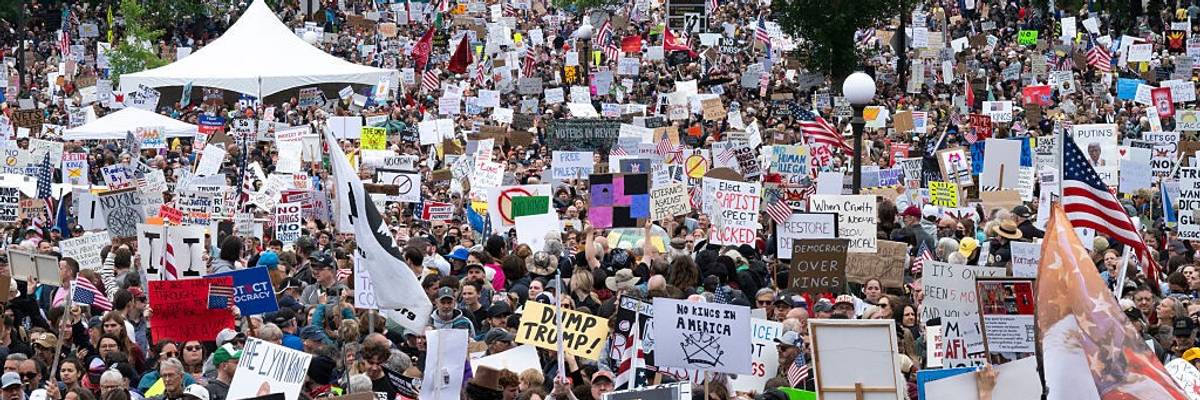
Demonstrators rally outside the Minnesota State Capitol building during a "No Kings" protest on June 14, 2025 in St Paul, Minnesota.
How a revolution in approaches to collective action can build a different future.
For anyone breathlessly wondering what artificial intelligence will achieve in the coming years, yesterday provided me with a remarkable answer.
Time travel.
Early in the morning, I received an email message from me in the year 2035, made possible by an AI agent that identified a suitable wormhole in the Canis Major Dwarf Galaxy. So far it can only send bits and bytes, but organic material seems just a matter of time. (I expect to bump into myself at the store any day now.)
The gist of the message from my future self? The United States in 2035 is actually doing okay.
Rather than writing shrill jeremiads to decry the current state of affairs and finishing them with vague admonitions to “act now,” the left needs to cultivate a habit of curiosity about alternative methods of collective action, drawing inspiration from around the world.
Apparently authoritarianism, greed, and disinformation reached all-time highs by the summer of 2026. Relentless attacks on democracy and voting rights, a spate of climate-related disasters, and a rise in unemployment caused by AI led to broad despair. The United States’ 250th birthday on July 4 was marked not by celebration but by simmering tension and polling that suggested the highest levels of pessimism in the nation’s history.
And then something unexpected occurred. Things got better—and fast. In fact, by some measures, Americans in 2035 are doing better than they ever have before. How did it happen?
It started with successive feats of staggering collective action, taking the spirit of Minnesota’s activists and multiplying it nationally. Responding to a leaked Trump administration memo that revealed a clear plan to use Immigration and Customs Enforcement forces to suppress midterm voting, millions moved beyond demonstrations, staging a general strike just after Labor Day that was then echoed by business across the country. The resulting economic disruption drew widespread attention, as well as concern from Wall Street and large corporations, who persuaded the government to completely stand down.
Then, on Thanksgiving, a coalition of 200 civil society organizations and labor unions (cumulatively representing more than 40 million people) announced that they had created a massive “health security fund” to cover health expenses for those in the United States expected to lose coverage because of the Trump administration’s One Big Beautiful Bill Act. Matched by high-net-worth individuals who agreed to donate their tax breaks from the bill to the fund, they pooled over $600 million and created an easy way for those facing medical emergencies to access it. The following spring they created a similar fund for those in areas rocked by climate catastrophes where insurance markets had collapsed.
This work drew enormous attention, and the group awakened to its power, realizing that the only chance it stood against unprecedented concentrations of power and wealth—and a sclerotic political system—was to keep combining in unprecedented ways. Calling itself the Movement of Movements (“MoM”), it became a perpetual engine for progress, joining forces behind a single charismatic action every quarter.
In one instance, the group orchestrated a major sell-off of AI-related stocks to protest the lack of safety standards for the new technology, resulting in the rapid introduction of new federal and state regulations. In another, it funded the construction of 25,000 affordable housing units in critical areas across the country and purchased over 600,000 acres of adjacent land, roughly the size of Rhode Island, for conservation. In another still, it enlisted its widely distributed membership to map threats to safe voting in real time, significantly reducing voter intimidation during the 2028 election. Next up, they will be carrying out a “coordinated unfollow” of the 200 most incendiary propagandists on social media (from both the political right and left) and buying out three major corporate polluters to shut down their plants (while providing compensation for all affected employees).
The organizations making up this coalition left behind their fragmented organizational agendas and competition for resources, first temporarily and then permanently. Their leaders—among them some of the most charismatic influencers in the social sector—expertly managed the territorialism and fights over credit that had undermined them in the past, creating something intentionally big and charismatic. A group of innovative young billionaires, many of them wealthy heirs, cast off the conventions (and self-aggrandizement) of their parents’ philanthropy to jointly underwrite the work, shoring up operational gaps for organizations joining the collaboration.
The group also benefited from a simple, overarching objective to guide its work—a return to decency, care, and well-being in American life. That translated into action in three areas, each embraced by more than 70% of Americans. The first is reducing autocracy and corruption in American government; by 2035, 99% of candidates running for office have signed a pledge to follow the rule of law, support fair elections, and recuse themselves from any policy questions that would directly enhance their family’s wealth. The second is catalyzing pro-social investment in science and technology, addressing the self-defeating disinvestment of the Trump administration by funding gaps in critical research that can save lives and stimulate the economy while introducing clear global safety standards for AI and similar advances. The third is making sure that everyone has access to free education, healthcare, and emergency recovery support—period.
The values and vibes of the movement have had as much resonance as its accomplishments. Always nonviolent and favoring in-person interaction, its leaders have summed up their operating principles in two sentences: "Ours is a movement rooted in two things: taking back power for the people and caring for our neighbors by sharing what we have so that no one suffers. There will be no violence, nastiness, or assertions without facts and we will respect all people." While this fairly generic statement drew criticism from some quarters, the way the group carried out its work and generated real results for disenfranchised groups—rather than merely nodding to them—converted most of those critics.
Above all, they made it fun. Jettisoning the rhetoric of despair, they got people in the country to once again believe that they had power, and they made exercising it collaborative and joyful. They realized that charismatic actions—increasingly sourced directly from the public—were important but perhaps less so than the habit of doing big things together, escaping from isolation and rampant mistrust. Older people made way for younger people, richer people made way for poorer people, whiter people made way for other people. They invested strenuously in joy and meaning and celebration, seizing the crisis to rebuild the solidarity and community that have deteriorated so much in recent decades. Their confidence and sense of security grew as their numbers did, and they created a permanent mindset shift in the American electorate, forming the basis for a permanent revival in Democratic politics and governing. Regularly joined and emulated by other groups (e.g., universities, supportive businesses, a surprising collection of progressive male athletes), their momentum now seems unstoppable.
I cannot wait for the next dispatch from the future.
* * *
Fanciful? Maybe.
But consider that every single one of the actions imagined above has already happened somewhere in the world, and often on a much larger scale. In the last decade alone, farmworkers in India achieved a 250-million person general strike, soccer fans in Europe joined together to put an immediate halt to a greedy scheme to defund all but the richest clubs on the continent, and donors pooled funds to relieve over $40 billion in medical debt for more than 27 million Americans. Fueled by incredible connectivity and growing worry, these efforts have shown that massive, sustained change is possible when action is sufficiently concentrated. They recognize the paramount importance of focus and cooperation in emergencies and gain confidence and safety through their numbers.
They have also introduced a remarkably innovative set of new tactics, jointly investing in financial markets (e.g., the “wallstreetbets” Reddit community), combining purchasing power (e.g., cooperative ownership and “buycotts”), withholding labor and attention (e.g., coordinated unfollowing and digital walkouts), and providing safety for those under political attack (e.g., protection funds for activists and whistleblowers) to foster great progress. The greatest examples of recent, massive collective action are captured here in a newly released report. While some of these approaches might be hard to reproduce—and all require hard work and organizing—none are out of reach.
They also build “on-ramps” for broader participation since traditional approaches like protests and petitions cannot alone meet the moment. Only a fraction of the public is comfortable taking to the streets—with a skew toward liberal elites—so these methods provide other options and give youth, in particular, new ways to engage. The best of these movements utilize hundreds of fresh techniques, which is especially important as suppression and surveillance from those in power become more sophisticated and pervasive.
Rather than writing shrill jeremiads to decry the current state of affairs and finishing them with vague admonitions to “act now,” the left needs to cultivate a habit of curiosity about alternative methods of collective action, drawing inspiration from around the world. This breaks us free of tired dogma about how change happens, building hope and agency and stimulating other new ideas. Activists from the Global South and former Eastern Bloc countries, consistently challenged by autocratic regimes, have particularly powerful insights to share.
Thorough analysis and intellectual fatalism won’t meet the moment. Simply put, President Donald Trump, his administration toadies, and a cabal of billionaires are hellbent on controlling the nation and, to the degree possible, the world. The only way to stop them is to come together—rapidly, morally, and joyfully—on a scale larger than anyone has seen before.
Dear Common Dreams reader, It’s been nearly 30 years since I co-founded Common Dreams with my late wife, Lina Newhouser. We had the radical notion that journalism should serve the public good, not corporate profits. It was clear to us from the outset what it would take to build such a project. No paid advertisements. No corporate sponsors. No millionaire publisher telling us what to think or do. Many people said we wouldn't last a year, but we proved those doubters wrong. Together with a tremendous team of journalists and dedicated staff, we built an independent media outlet free from the constraints of profits and corporate control. Our mission has always been simple: To inform. To inspire. To ignite change for the common good. Building Common Dreams was not easy. Our survival was never guaranteed. When you take on the most powerful forces—Wall Street greed, fossil fuel industry destruction, Big Tech lobbyists, and uber-rich oligarchs who have spent billions upon billions rigging the economy and democracy in their favor—the only bulwark you have is supporters who believe in your work. But here’s the urgent message from me today. It's never been this bad out there. And it's never been this hard to keep us going. At the very moment Common Dreams is most needed, the threats we face are intensifying. We need your support now more than ever. We don't accept corporate advertising and never will. We don't have a paywall because we don't think people should be blocked from critical news based on their ability to pay. Everything we do is funded by the donations of readers like you. When everyone does the little they can afford, we are strong. But if that support retreats or dries up, so do we. Will you donate now to make sure Common Dreams not only survives but thrives? —Craig Brown, Co-founder |
For anyone breathlessly wondering what artificial intelligence will achieve in the coming years, yesterday provided me with a remarkable answer.
Time travel.
Early in the morning, I received an email message from me in the year 2035, made possible by an AI agent that identified a suitable wormhole in the Canis Major Dwarf Galaxy. So far it can only send bits and bytes, but organic material seems just a matter of time. (I expect to bump into myself at the store any day now.)
The gist of the message from my future self? The United States in 2035 is actually doing okay.
Rather than writing shrill jeremiads to decry the current state of affairs and finishing them with vague admonitions to “act now,” the left needs to cultivate a habit of curiosity about alternative methods of collective action, drawing inspiration from around the world.
Apparently authoritarianism, greed, and disinformation reached all-time highs by the summer of 2026. Relentless attacks on democracy and voting rights, a spate of climate-related disasters, and a rise in unemployment caused by AI led to broad despair. The United States’ 250th birthday on July 4 was marked not by celebration but by simmering tension and polling that suggested the highest levels of pessimism in the nation’s history.
And then something unexpected occurred. Things got better—and fast. In fact, by some measures, Americans in 2035 are doing better than they ever have before. How did it happen?
It started with successive feats of staggering collective action, taking the spirit of Minnesota’s activists and multiplying it nationally. Responding to a leaked Trump administration memo that revealed a clear plan to use Immigration and Customs Enforcement forces to suppress midterm voting, millions moved beyond demonstrations, staging a general strike just after Labor Day that was then echoed by business across the country. The resulting economic disruption drew widespread attention, as well as concern from Wall Street and large corporations, who persuaded the government to completely stand down.
Then, on Thanksgiving, a coalition of 200 civil society organizations and labor unions (cumulatively representing more than 40 million people) announced that they had created a massive “health security fund” to cover health expenses for those in the United States expected to lose coverage because of the Trump administration’s One Big Beautiful Bill Act. Matched by high-net-worth individuals who agreed to donate their tax breaks from the bill to the fund, they pooled over $600 million and created an easy way for those facing medical emergencies to access it. The following spring they created a similar fund for those in areas rocked by climate catastrophes where insurance markets had collapsed.
This work drew enormous attention, and the group awakened to its power, realizing that the only chance it stood against unprecedented concentrations of power and wealth—and a sclerotic political system—was to keep combining in unprecedented ways. Calling itself the Movement of Movements (“MoM”), it became a perpetual engine for progress, joining forces behind a single charismatic action every quarter.
In one instance, the group orchestrated a major sell-off of AI-related stocks to protest the lack of safety standards for the new technology, resulting in the rapid introduction of new federal and state regulations. In another, it funded the construction of 25,000 affordable housing units in critical areas across the country and purchased over 600,000 acres of adjacent land, roughly the size of Rhode Island, for conservation. In another still, it enlisted its widely distributed membership to map threats to safe voting in real time, significantly reducing voter intimidation during the 2028 election. Next up, they will be carrying out a “coordinated unfollow” of the 200 most incendiary propagandists on social media (from both the political right and left) and buying out three major corporate polluters to shut down their plants (while providing compensation for all affected employees).
The organizations making up this coalition left behind their fragmented organizational agendas and competition for resources, first temporarily and then permanently. Their leaders—among them some of the most charismatic influencers in the social sector—expertly managed the territorialism and fights over credit that had undermined them in the past, creating something intentionally big and charismatic. A group of innovative young billionaires, many of them wealthy heirs, cast off the conventions (and self-aggrandizement) of their parents’ philanthropy to jointly underwrite the work, shoring up operational gaps for organizations joining the collaboration.
The group also benefited from a simple, overarching objective to guide its work—a return to decency, care, and well-being in American life. That translated into action in three areas, each embraced by more than 70% of Americans. The first is reducing autocracy and corruption in American government; by 2035, 99% of candidates running for office have signed a pledge to follow the rule of law, support fair elections, and recuse themselves from any policy questions that would directly enhance their family’s wealth. The second is catalyzing pro-social investment in science and technology, addressing the self-defeating disinvestment of the Trump administration by funding gaps in critical research that can save lives and stimulate the economy while introducing clear global safety standards for AI and similar advances. The third is making sure that everyone has access to free education, healthcare, and emergency recovery support—period.
The values and vibes of the movement have had as much resonance as its accomplishments. Always nonviolent and favoring in-person interaction, its leaders have summed up their operating principles in two sentences: "Ours is a movement rooted in two things: taking back power for the people and caring for our neighbors by sharing what we have so that no one suffers. There will be no violence, nastiness, or assertions without facts and we will respect all people." While this fairly generic statement drew criticism from some quarters, the way the group carried out its work and generated real results for disenfranchised groups—rather than merely nodding to them—converted most of those critics.
Above all, they made it fun. Jettisoning the rhetoric of despair, they got people in the country to once again believe that they had power, and they made exercising it collaborative and joyful. They realized that charismatic actions—increasingly sourced directly from the public—were important but perhaps less so than the habit of doing big things together, escaping from isolation and rampant mistrust. Older people made way for younger people, richer people made way for poorer people, whiter people made way for other people. They invested strenuously in joy and meaning and celebration, seizing the crisis to rebuild the solidarity and community that have deteriorated so much in recent decades. Their confidence and sense of security grew as their numbers did, and they created a permanent mindset shift in the American electorate, forming the basis for a permanent revival in Democratic politics and governing. Regularly joined and emulated by other groups (e.g., universities, supportive businesses, a surprising collection of progressive male athletes), their momentum now seems unstoppable.
I cannot wait for the next dispatch from the future.
* * *
Fanciful? Maybe.
But consider that every single one of the actions imagined above has already happened somewhere in the world, and often on a much larger scale. In the last decade alone, farmworkers in India achieved a 250-million person general strike, soccer fans in Europe joined together to put an immediate halt to a greedy scheme to defund all but the richest clubs on the continent, and donors pooled funds to relieve over $40 billion in medical debt for more than 27 million Americans. Fueled by incredible connectivity and growing worry, these efforts have shown that massive, sustained change is possible when action is sufficiently concentrated. They recognize the paramount importance of focus and cooperation in emergencies and gain confidence and safety through their numbers.
They have also introduced a remarkably innovative set of new tactics, jointly investing in financial markets (e.g., the “wallstreetbets” Reddit community), combining purchasing power (e.g., cooperative ownership and “buycotts”), withholding labor and attention (e.g., coordinated unfollowing and digital walkouts), and providing safety for those under political attack (e.g., protection funds for activists and whistleblowers) to foster great progress. The greatest examples of recent, massive collective action are captured here in a newly released report. While some of these approaches might be hard to reproduce—and all require hard work and organizing—none are out of reach.
They also build “on-ramps” for broader participation since traditional approaches like protests and petitions cannot alone meet the moment. Only a fraction of the public is comfortable taking to the streets—with a skew toward liberal elites—so these methods provide other options and give youth, in particular, new ways to engage. The best of these movements utilize hundreds of fresh techniques, which is especially important as suppression and surveillance from those in power become more sophisticated and pervasive.
Rather than writing shrill jeremiads to decry the current state of affairs and finishing them with vague admonitions to “act now,” the left needs to cultivate a habit of curiosity about alternative methods of collective action, drawing inspiration from around the world. This breaks us free of tired dogma about how change happens, building hope and agency and stimulating other new ideas. Activists from the Global South and former Eastern Bloc countries, consistently challenged by autocratic regimes, have particularly powerful insights to share.
Thorough analysis and intellectual fatalism won’t meet the moment. Simply put, President Donald Trump, his administration toadies, and a cabal of billionaires are hellbent on controlling the nation and, to the degree possible, the world. The only way to stop them is to come together—rapidly, morally, and joyfully—on a scale larger than anyone has seen before.
For anyone breathlessly wondering what artificial intelligence will achieve in the coming years, yesterday provided me with a remarkable answer.
Time travel.
Early in the morning, I received an email message from me in the year 2035, made possible by an AI agent that identified a suitable wormhole in the Canis Major Dwarf Galaxy. So far it can only send bits and bytes, but organic material seems just a matter of time. (I expect to bump into myself at the store any day now.)
The gist of the message from my future self? The United States in 2035 is actually doing okay.
Rather than writing shrill jeremiads to decry the current state of affairs and finishing them with vague admonitions to “act now,” the left needs to cultivate a habit of curiosity about alternative methods of collective action, drawing inspiration from around the world.
Apparently authoritarianism, greed, and disinformation reached all-time highs by the summer of 2026. Relentless attacks on democracy and voting rights, a spate of climate-related disasters, and a rise in unemployment caused by AI led to broad despair. The United States’ 250th birthday on July 4 was marked not by celebration but by simmering tension and polling that suggested the highest levels of pessimism in the nation’s history.
And then something unexpected occurred. Things got better—and fast. In fact, by some measures, Americans in 2035 are doing better than they ever have before. How did it happen?
It started with successive feats of staggering collective action, taking the spirit of Minnesota’s activists and multiplying it nationally. Responding to a leaked Trump administration memo that revealed a clear plan to use Immigration and Customs Enforcement forces to suppress midterm voting, millions moved beyond demonstrations, staging a general strike just after Labor Day that was then echoed by business across the country. The resulting economic disruption drew widespread attention, as well as concern from Wall Street and large corporations, who persuaded the government to completely stand down.
Then, on Thanksgiving, a coalition of 200 civil society organizations and labor unions (cumulatively representing more than 40 million people) announced that they had created a massive “health security fund” to cover health expenses for those in the United States expected to lose coverage because of the Trump administration’s One Big Beautiful Bill Act. Matched by high-net-worth individuals who agreed to donate their tax breaks from the bill to the fund, they pooled over $600 million and created an easy way for those facing medical emergencies to access it. The following spring they created a similar fund for those in areas rocked by climate catastrophes where insurance markets had collapsed.
This work drew enormous attention, and the group awakened to its power, realizing that the only chance it stood against unprecedented concentrations of power and wealth—and a sclerotic political system—was to keep combining in unprecedented ways. Calling itself the Movement of Movements (“MoM”), it became a perpetual engine for progress, joining forces behind a single charismatic action every quarter.
In one instance, the group orchestrated a major sell-off of AI-related stocks to protest the lack of safety standards for the new technology, resulting in the rapid introduction of new federal and state regulations. In another, it funded the construction of 25,000 affordable housing units in critical areas across the country and purchased over 600,000 acres of adjacent land, roughly the size of Rhode Island, for conservation. In another still, it enlisted its widely distributed membership to map threats to safe voting in real time, significantly reducing voter intimidation during the 2028 election. Next up, they will be carrying out a “coordinated unfollow” of the 200 most incendiary propagandists on social media (from both the political right and left) and buying out three major corporate polluters to shut down their plants (while providing compensation for all affected employees).
The organizations making up this coalition left behind their fragmented organizational agendas and competition for resources, first temporarily and then permanently. Their leaders—among them some of the most charismatic influencers in the social sector—expertly managed the territorialism and fights over credit that had undermined them in the past, creating something intentionally big and charismatic. A group of innovative young billionaires, many of them wealthy heirs, cast off the conventions (and self-aggrandizement) of their parents’ philanthropy to jointly underwrite the work, shoring up operational gaps for organizations joining the collaboration.
The group also benefited from a simple, overarching objective to guide its work—a return to decency, care, and well-being in American life. That translated into action in three areas, each embraced by more than 70% of Americans. The first is reducing autocracy and corruption in American government; by 2035, 99% of candidates running for office have signed a pledge to follow the rule of law, support fair elections, and recuse themselves from any policy questions that would directly enhance their family’s wealth. The second is catalyzing pro-social investment in science and technology, addressing the self-defeating disinvestment of the Trump administration by funding gaps in critical research that can save lives and stimulate the economy while introducing clear global safety standards for AI and similar advances. The third is making sure that everyone has access to free education, healthcare, and emergency recovery support—period.
The values and vibes of the movement have had as much resonance as its accomplishments. Always nonviolent and favoring in-person interaction, its leaders have summed up their operating principles in two sentences: "Ours is a movement rooted in two things: taking back power for the people and caring for our neighbors by sharing what we have so that no one suffers. There will be no violence, nastiness, or assertions without facts and we will respect all people." While this fairly generic statement drew criticism from some quarters, the way the group carried out its work and generated real results for disenfranchised groups—rather than merely nodding to them—converted most of those critics.
Above all, they made it fun. Jettisoning the rhetoric of despair, they got people in the country to once again believe that they had power, and they made exercising it collaborative and joyful. They realized that charismatic actions—increasingly sourced directly from the public—were important but perhaps less so than the habit of doing big things together, escaping from isolation and rampant mistrust. Older people made way for younger people, richer people made way for poorer people, whiter people made way for other people. They invested strenuously in joy and meaning and celebration, seizing the crisis to rebuild the solidarity and community that have deteriorated so much in recent decades. Their confidence and sense of security grew as their numbers did, and they created a permanent mindset shift in the American electorate, forming the basis for a permanent revival in Democratic politics and governing. Regularly joined and emulated by other groups (e.g., universities, supportive businesses, a surprising collection of progressive male athletes), their momentum now seems unstoppable.
I cannot wait for the next dispatch from the future.
* * *
Fanciful? Maybe.
But consider that every single one of the actions imagined above has already happened somewhere in the world, and often on a much larger scale. In the last decade alone, farmworkers in India achieved a 250-million person general strike, soccer fans in Europe joined together to put an immediate halt to a greedy scheme to defund all but the richest clubs on the continent, and donors pooled funds to relieve over $40 billion in medical debt for more than 27 million Americans. Fueled by incredible connectivity and growing worry, these efforts have shown that massive, sustained change is possible when action is sufficiently concentrated. They recognize the paramount importance of focus and cooperation in emergencies and gain confidence and safety through their numbers.
They have also introduced a remarkably innovative set of new tactics, jointly investing in financial markets (e.g., the “wallstreetbets” Reddit community), combining purchasing power (e.g., cooperative ownership and “buycotts”), withholding labor and attention (e.g., coordinated unfollowing and digital walkouts), and providing safety for those under political attack (e.g., protection funds for activists and whistleblowers) to foster great progress. The greatest examples of recent, massive collective action are captured here in a newly released report. While some of these approaches might be hard to reproduce—and all require hard work and organizing—none are out of reach.
They also build “on-ramps” for broader participation since traditional approaches like protests and petitions cannot alone meet the moment. Only a fraction of the public is comfortable taking to the streets—with a skew toward liberal elites—so these methods provide other options and give youth, in particular, new ways to engage. The best of these movements utilize hundreds of fresh techniques, which is especially important as suppression and surveillance from those in power become more sophisticated and pervasive.
Rather than writing shrill jeremiads to decry the current state of affairs and finishing them with vague admonitions to “act now,” the left needs to cultivate a habit of curiosity about alternative methods of collective action, drawing inspiration from around the world. This breaks us free of tired dogma about how change happens, building hope and agency and stimulating other new ideas. Activists from the Global South and former Eastern Bloc countries, consistently challenged by autocratic regimes, have particularly powerful insights to share.
Thorough analysis and intellectual fatalism won’t meet the moment. Simply put, President Donald Trump, his administration toadies, and a cabal of billionaires are hellbent on controlling the nation and, to the degree possible, the world. The only way to stop them is to come together—rapidly, morally, and joyfully—on a scale larger than anyone has seen before.