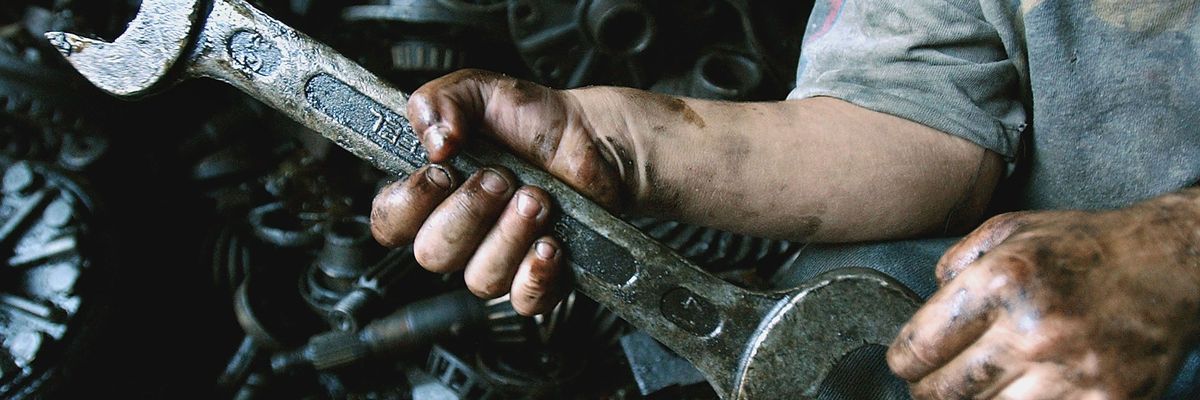
A child holds a wrench. Legislation in Iowa is particularly dangerous because it would exempt employers from civil liability in the event of a youth’s injury or death on the job — even in cases of employer negligence — if the teen was participating in a school-approved "work-based learning program."
The GOP's Abhorrent Attack on Child Labor Laws
Documented and preventable tragedies mean nothing to Republican legislators bent on helping employers pad their bottom lines at kids' expense.
Brad Greve has been a Scout leader for more than 20 years. The Davenport, Iowa retiree leads 50-mile canoe trips on Minnesota’s Boundary Waters that test teens’ mettle while teaching them essential skills.
Greve told a story recently where two boys, despite being warned repeatedly, let their canoe drift perilously close to a section of stream that swept over rapids into a lake below. They just barely recovered and made it to streambank.
That near-accident a few years ago, Greve said, underscores the vulnerability of young teens. And it fuels Greve’s anger at Republicans across the country who want to gut child labor laws and fill dangerous jobs with still-maturing high schoolers.
A GOP bill in Iowa, for example, would allow 14-year-olds to work in industrial freezers, meatpacking plants, and industrial laundry operations. The legislation would also put 15-year-olds to work on certain kinds of assembly lines, allow them to hoist up to 50 pounds, and allow employers to force kids into significantly longer work days.
In some cases, it would even permit young teens to work mining and construction jobs and use power-driven meat slicers and food choppers.
Make no mistake, this is dangerous work. Just three years ago, a 16-year-old in Tennessee fell more than 11 stories to his death while working construction on a hotel roof. Another 16-year-old lost an arm that same year while cleaning a meat grinder at a Tennessee supermarket.
But these preventable tragedies mean nothing to legislators bent on helping employers pad their bottom lines at kids’ expense. “It’s about businesses wanting cheap labor or more labor than they can currently get because they don’t want to pay reasonable wages or give any benefits,” Greve said.
COVID-19 prompted millions of Americans to ditch jobs lacking decent working conditions, sick leave, and affordable health care. The meatpacking industry, among many others, hemorrhaged workers after deliberately putting them at risk to protect profits during the pandemic.
Now, rather than provide the quality jobs needed to attract adults, Greve observed, companies want their cronies to “throw them a bone” and widen access to child labor.
Minnesota Republicans want to let 16- and 17-year-olds work construction. GOP legislators in Ohio are pushing legislation to expand teens’ work hours. In 2022, labor unions and Democratic officials in Wisconsin beat back a Republican proposal to lengthen work days for teens there.
The Iowa legislation is particularly dangerous because it would exempt employers from civil liability in the event of a youth’s injury or death on the job — even in cases of employer negligence — if the teen was participating in a school-approved “work-based learning program.”
Employers already flout child labor laws at record rates, according to the U.S. Department of Labor.
After the 16-year-old fell off the hotel roof, for example, Tennessee officials determined that the company not only illegally put the teen in harm’s way but also worked him more hours than allowed and cheated dozens of other workers out of overtime pay. Adding insult to injury, the company vowed to appeal the $122,000 fine it received for the teen’s death.
The poor, migrants, victims of trafficking, and other at-risk youths will be especially impacted. Last year, the news agency Reuters found migrant youths and other children as young as 12 working at Alabama companies supplying the auto industry.
The New York Times reported more recently that the illegal employment of minors from poor and migrant families had reached epidemic proportions, reflecting a “new economy of exploitation.” The paper found employers subjecting thousands of kids to some of the deadliest jobs in the country, including work in slaughterhouses and sawmills.
“Why would you want to weaken the law when you can see companies already taking advantage?” asked Greve. “The law should be strengthened.”
We are at a crossroads
This country and this world are at a monumental crossroads. In a few short weeks, US voters will have an opportunity to beat back the forces of fascism and confront the billionaires who are rigging the economy, our media system, and our democracy, making it increasingly impossible for ordinary people to get by. We’re not just talking about the election. We’re talking about what must be done once these fascist elements are vanquished from power. We need a bolder set of solutions than what either major party has so far been willing to offer and a working-class movement ready to fight like hell for it. Trump didn't emerge from nowhere. The conditions that fueled MAGA authoritarianism were created by decades of radical neoliberal economic policies and a corrupt political system dominated by corporate interests. They slashed taxes on the super-rich, promising that the benefits would trickle down. They said giveaways to the corporate titans would make life more affordable for the rest of us. It was all bullshit. And when a bitter, betrayed populace searches for someone to blame, right-wing demagogues have little trouble finding scapegoats. People know when they're being lied to, but you won't hear any of this from the corporate media. Only independent journalism—powered and funded by people who believe in building a better world—can deliver truly trustworthy daily news. Our Fall Campaign is underway, and we need your help. To power our newsroom through the rest of the year, we need to raise $125,000 by midnight on October 31. So if you share our vision, please contribute whatever you can to sustain our work. |
Brad Greve has been a Scout leader for more than 20 years. The Davenport, Iowa retiree leads 50-mile canoe trips on Minnesota’s Boundary Waters that test teens’ mettle while teaching them essential skills.
Greve told a story recently where two boys, despite being warned repeatedly, let their canoe drift perilously close to a section of stream that swept over rapids into a lake below. They just barely recovered and made it to streambank.
That near-accident a few years ago, Greve said, underscores the vulnerability of young teens. And it fuels Greve’s anger at Republicans across the country who want to gut child labor laws and fill dangerous jobs with still-maturing high schoolers.
A GOP bill in Iowa, for example, would allow 14-year-olds to work in industrial freezers, meatpacking plants, and industrial laundry operations. The legislation would also put 15-year-olds to work on certain kinds of assembly lines, allow them to hoist up to 50 pounds, and allow employers to force kids into significantly longer work days.
In some cases, it would even permit young teens to work mining and construction jobs and use power-driven meat slicers and food choppers.
Make no mistake, this is dangerous work. Just three years ago, a 16-year-old in Tennessee fell more than 11 stories to his death while working construction on a hotel roof. Another 16-year-old lost an arm that same year while cleaning a meat grinder at a Tennessee supermarket.
But these preventable tragedies mean nothing to legislators bent on helping employers pad their bottom lines at kids’ expense. “It’s about businesses wanting cheap labor or more labor than they can currently get because they don’t want to pay reasonable wages or give any benefits,” Greve said.
COVID-19 prompted millions of Americans to ditch jobs lacking decent working conditions, sick leave, and affordable health care. The meatpacking industry, among many others, hemorrhaged workers after deliberately putting them at risk to protect profits during the pandemic.
Now, rather than provide the quality jobs needed to attract adults, Greve observed, companies want their cronies to “throw them a bone” and widen access to child labor.
Minnesota Republicans want to let 16- and 17-year-olds work construction. GOP legislators in Ohio are pushing legislation to expand teens’ work hours. In 2022, labor unions and Democratic officials in Wisconsin beat back a Republican proposal to lengthen work days for teens there.
The Iowa legislation is particularly dangerous because it would exempt employers from civil liability in the event of a youth’s injury or death on the job — even in cases of employer negligence — if the teen was participating in a school-approved “work-based learning program.”
Employers already flout child labor laws at record rates, according to the U.S. Department of Labor.
After the 16-year-old fell off the hotel roof, for example, Tennessee officials determined that the company not only illegally put the teen in harm’s way but also worked him more hours than allowed and cheated dozens of other workers out of overtime pay. Adding insult to injury, the company vowed to appeal the $122,000 fine it received for the teen’s death.
The poor, migrants, victims of trafficking, and other at-risk youths will be especially impacted. Last year, the news agency Reuters found migrant youths and other children as young as 12 working at Alabama companies supplying the auto industry.
The New York Times reported more recently that the illegal employment of minors from poor and migrant families had reached epidemic proportions, reflecting a “new economy of exploitation.” The paper found employers subjecting thousands of kids to some of the deadliest jobs in the country, including work in slaughterhouses and sawmills.
“Why would you want to weaken the law when you can see companies already taking advantage?” asked Greve. “The law should be strengthened.”
- Critics Slam 'Reprehensible' Iowa Bill to Expand Child Labor ›
- Rather Than Pass Wage Increases, GOP Legislatures Move to Weaken Child Labor Laws ›
Brad Greve has been a Scout leader for more than 20 years. The Davenport, Iowa retiree leads 50-mile canoe trips on Minnesota’s Boundary Waters that test teens’ mettle while teaching them essential skills.
Greve told a story recently where two boys, despite being warned repeatedly, let their canoe drift perilously close to a section of stream that swept over rapids into a lake below. They just barely recovered and made it to streambank.
That near-accident a few years ago, Greve said, underscores the vulnerability of young teens. And it fuels Greve’s anger at Republicans across the country who want to gut child labor laws and fill dangerous jobs with still-maturing high schoolers.
A GOP bill in Iowa, for example, would allow 14-year-olds to work in industrial freezers, meatpacking plants, and industrial laundry operations. The legislation would also put 15-year-olds to work on certain kinds of assembly lines, allow them to hoist up to 50 pounds, and allow employers to force kids into significantly longer work days.
In some cases, it would even permit young teens to work mining and construction jobs and use power-driven meat slicers and food choppers.
Make no mistake, this is dangerous work. Just three years ago, a 16-year-old in Tennessee fell more than 11 stories to his death while working construction on a hotel roof. Another 16-year-old lost an arm that same year while cleaning a meat grinder at a Tennessee supermarket.
But these preventable tragedies mean nothing to legislators bent on helping employers pad their bottom lines at kids’ expense. “It’s about businesses wanting cheap labor or more labor than they can currently get because they don’t want to pay reasonable wages or give any benefits,” Greve said.
COVID-19 prompted millions of Americans to ditch jobs lacking decent working conditions, sick leave, and affordable health care. The meatpacking industry, among many others, hemorrhaged workers after deliberately putting them at risk to protect profits during the pandemic.
Now, rather than provide the quality jobs needed to attract adults, Greve observed, companies want their cronies to “throw them a bone” and widen access to child labor.
Minnesota Republicans want to let 16- and 17-year-olds work construction. GOP legislators in Ohio are pushing legislation to expand teens’ work hours. In 2022, labor unions and Democratic officials in Wisconsin beat back a Republican proposal to lengthen work days for teens there.
The Iowa legislation is particularly dangerous because it would exempt employers from civil liability in the event of a youth’s injury or death on the job — even in cases of employer negligence — if the teen was participating in a school-approved “work-based learning program.”
Employers already flout child labor laws at record rates, according to the U.S. Department of Labor.
After the 16-year-old fell off the hotel roof, for example, Tennessee officials determined that the company not only illegally put the teen in harm’s way but also worked him more hours than allowed and cheated dozens of other workers out of overtime pay. Adding insult to injury, the company vowed to appeal the $122,000 fine it received for the teen’s death.
The poor, migrants, victims of trafficking, and other at-risk youths will be especially impacted. Last year, the news agency Reuters found migrant youths and other children as young as 12 working at Alabama companies supplying the auto industry.
The New York Times reported more recently that the illegal employment of minors from poor and migrant families had reached epidemic proportions, reflecting a “new economy of exploitation.” The paper found employers subjecting thousands of kids to some of the deadliest jobs in the country, including work in slaughterhouses and sawmills.
“Why would you want to weaken the law when you can see companies already taking advantage?” asked Greve. “The law should be strengthened.”
- Critics Slam 'Reprehensible' Iowa Bill to Expand Child Labor ›
- Rather Than Pass Wage Increases, GOP Legislatures Move to Weaken Child Labor Laws ›