SUBSCRIBE TO OUR FREE NEWSLETTER
Daily news & progressive opinion—funded by the people, not the corporations—delivered straight to your inbox.
5
#000000
#FFFFFF
To donate by check, phone, or other method, see our More Ways to Give page.
Daily news & progressive opinion—funded by the people, not the corporations—delivered straight to your inbox.
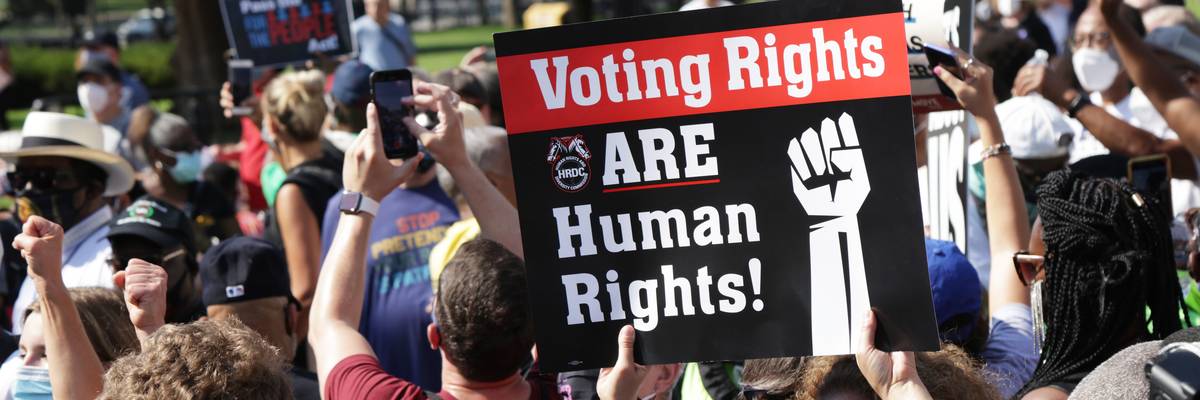
Activists participate in a March On For Voting Rights on August 28, 2021 in Washington, DC.
The suppression of Black votes and of women's votes are not separate struggles—they are the same assault, mounted by the same forces, to concentrate power permanently in the hands of those who hold it.
This month marks 61 years since Lyndon Johnson signed the Voting Rights Act into law. Fifty-four years ago, Congress sent the Equal Rights Amendment to the states—now ratified by the three-quarters of the states the Constitution requires. On August 26, the 19th Amendment granting women’s universal suffrage turns 106. Three anniversaries, one question: Why, in 2026, are we still fighting for rights already won—the right to vote, equal pay, the Equal Rights Amendment Congress refuses to recognize as ratified?
In April, the Supreme Court answered part of that question. In Louisiana v. Callais, a 6-3 majority ruled that challengers to a discriminatory voting map must prove intent to discriminate, not merely effect—the same sleight of hand the court used in Shelby County v. Holder (2013) to gut the Voting Rights Act's preclearance formula. The John R. Lewis Voting Rights Advancement Act, which would fix what Shelby County broke, still sits in Congress 13 years later. That is not neglect. It is a choice—and it is shameful.
The consequences are not abstract: At least six Black Democratic members of Congress face elimination through Republican redistricting this year, and one-third of the majority-minority districts under threat are held by women. The Congressional Black Caucus—grown from 13 members in 1971 to a historic high of 62 today—is being dismantled, district by district, ruling by ruling.
Then there's President Donald Trump's SAVE America Act, dressed up as election security: It requires documentary proof of citizenship to register. But an estimated 69 million American women hold a legal name that doesn't match their birth certificate—married, divorced, or changed. A woman may need a birth certificate, marriage license, divorce decree, passport, and driver's license just to prove she is herself: a paperwork tax that falls hardest on women with low incomes, survivors of domestic violence, and older women whose records are scattered across a lifetime.
You cannot protect the paycheck if you cannot protect the ballot. You cannot protect the ballot if you cannot protect the Constitution.
The suppression of Black votes and of women's votes are not separate struggles—they are the same assault, mounted by the same forces, to concentrate power permanently in the hands of those who hold it. Every woman in America who has changed her name is in the crosshairs. The attack on the Voting Rights Act, on women's economic security, and the fight for the Equal Rights Amendment are one battle.
What ties it together is economic justice: For the second consecutive year, the gender pay gap has widened. Women working full time now earn 81 cents for every dollar men earn—down from 83 cents, down from 84 the year before, the first back-to-back widening since the 1960s. For Black women, that figure drops to 65 cents, a gap of $28,340 a year. For Latinas, 58 cents—$33,620 a year. Over a lifetime, the gap costs a woman roughly half a million dollars—and for many women of color, more than $1 million.
That is not a gap. It’s a transfer of wealth—smaller Social Security checks, depleted retirement savings, less generational wealth. The root cause: Women lack the constitutional guarantee of equality that would force government, courts, and employers to treat these harms seriously.
That guarantee is the Equal Rights Amendment. The legal threshold for ratification has been met—all that remains is for Congress to pass a joint resolution affirming the ERA as the 28th Amendment. Every House Democrat has co-sponsored it. One Republican has joined them. Only one.
Our organizations are built on a truth that has not changed: Economic justice and political power are inseparable.
You cannot protect the paycheck if you cannot protect the ballot. You cannot protect the ballot if you cannot protect the Constitution.
Today we stand more than 100 years past the Suffrage Amendment, 61 past the Voting Rights Act, 54 past the day Congress sent the ERA to the states. A new Congress, elected in November, can choose which anniversary this country keeps: rights fought for and won, or rights quietly let go.
The forces of reaction aren't just trying to curtail our votes and reduce our paychecks. They’re trying to erase them. We will not stop until Congress acts.
This op-ed was distributed by American Forum.
Dear Common Dreams reader, It’s been nearly 30 years since I co-founded Common Dreams with my late wife, Lina Newhouser. We had the radical notion that journalism should serve the public good, not corporate profits. It was clear to us from the outset what it would take to build such a project. No paid advertisements. No corporate sponsors. No millionaire publisher telling us what to think or do. Many people said we wouldn't last a year, but we proved those doubters wrong. Together with a tremendous team of journalists and dedicated staff, we built an independent media outlet free from the constraints of profits and corporate control. Our mission has always been simple: To inform. To inspire. To ignite change for the common good. Building Common Dreams was not easy. Our survival was never guaranteed. When you take on the most powerful forces—Wall Street greed, fossil fuel industry destruction, Big Tech lobbyists, and uber-rich oligarchs who have spent billions upon billions rigging the economy and democracy in their favor—the only bulwark you have is supporters who believe in your work. But here’s the urgent message from me today. It's never been this bad out there. And it's never been this hard to keep us going. At the very moment Common Dreams is most needed, the threats we face are intensifying. We need your support now more than ever. We don't accept corporate advertising and never will. We don't have a paywall because we don't think people should be blocked from critical news based on their ability to pay. Everything we do is funded by the donations of readers like you. When everyone does the little they can afford, we are strong. But if that support retreats or dries up, so do we. Will you donate now to make sure Common Dreams not only survives but thrives? —Craig Brown, Co-founder |
This month marks 61 years since Lyndon Johnson signed the Voting Rights Act into law. Fifty-four years ago, Congress sent the Equal Rights Amendment to the states—now ratified by the three-quarters of the states the Constitution requires. On August 26, the 19th Amendment granting women’s universal suffrage turns 106. Three anniversaries, one question: Why, in 2026, are we still fighting for rights already won—the right to vote, equal pay, the Equal Rights Amendment Congress refuses to recognize as ratified?
In April, the Supreme Court answered part of that question. In Louisiana v. Callais, a 6-3 majority ruled that challengers to a discriminatory voting map must prove intent to discriminate, not merely effect—the same sleight of hand the court used in Shelby County v. Holder (2013) to gut the Voting Rights Act's preclearance formula. The John R. Lewis Voting Rights Advancement Act, which would fix what Shelby County broke, still sits in Congress 13 years later. That is not neglect. It is a choice—and it is shameful.
The consequences are not abstract: At least six Black Democratic members of Congress face elimination through Republican redistricting this year, and one-third of the majority-minority districts under threat are held by women. The Congressional Black Caucus—grown from 13 members in 1971 to a historic high of 62 today—is being dismantled, district by district, ruling by ruling.
Then there's President Donald Trump's SAVE America Act, dressed up as election security: It requires documentary proof of citizenship to register. But an estimated 69 million American women hold a legal name that doesn't match their birth certificate—married, divorced, or changed. A woman may need a birth certificate, marriage license, divorce decree, passport, and driver's license just to prove she is herself: a paperwork tax that falls hardest on women with low incomes, survivors of domestic violence, and older women whose records are scattered across a lifetime.
You cannot protect the paycheck if you cannot protect the ballot. You cannot protect the ballot if you cannot protect the Constitution.
The suppression of Black votes and of women's votes are not separate struggles—they are the same assault, mounted by the same forces, to concentrate power permanently in the hands of those who hold it. Every woman in America who has changed her name is in the crosshairs. The attack on the Voting Rights Act, on women's economic security, and the fight for the Equal Rights Amendment are one battle.
What ties it together is economic justice: For the second consecutive year, the gender pay gap has widened. Women working full time now earn 81 cents for every dollar men earn—down from 83 cents, down from 84 the year before, the first back-to-back widening since the 1960s. For Black women, that figure drops to 65 cents, a gap of $28,340 a year. For Latinas, 58 cents—$33,620 a year. Over a lifetime, the gap costs a woman roughly half a million dollars—and for many women of color, more than $1 million.
That is not a gap. It’s a transfer of wealth—smaller Social Security checks, depleted retirement savings, less generational wealth. The root cause: Women lack the constitutional guarantee of equality that would force government, courts, and employers to treat these harms seriously.
That guarantee is the Equal Rights Amendment. The legal threshold for ratification has been met—all that remains is for Congress to pass a joint resolution affirming the ERA as the 28th Amendment. Every House Democrat has co-sponsored it. One Republican has joined them. Only one.
Our organizations are built on a truth that has not changed: Economic justice and political power are inseparable.
You cannot protect the paycheck if you cannot protect the ballot. You cannot protect the ballot if you cannot protect the Constitution.
Today we stand more than 100 years past the Suffrage Amendment, 61 past the Voting Rights Act, 54 past the day Congress sent the ERA to the states. A new Congress, elected in November, can choose which anniversary this country keeps: rights fought for and won, or rights quietly let go.
The forces of reaction aren't just trying to curtail our votes and reduce our paychecks. They’re trying to erase them. We will not stop until Congress acts.
This op-ed was distributed by American Forum.
This month marks 61 years since Lyndon Johnson signed the Voting Rights Act into law. Fifty-four years ago, Congress sent the Equal Rights Amendment to the states—now ratified by the three-quarters of the states the Constitution requires. On August 26, the 19th Amendment granting women’s universal suffrage turns 106. Three anniversaries, one question: Why, in 2026, are we still fighting for rights already won—the right to vote, equal pay, the Equal Rights Amendment Congress refuses to recognize as ratified?
In April, the Supreme Court answered part of that question. In Louisiana v. Callais, a 6-3 majority ruled that challengers to a discriminatory voting map must prove intent to discriminate, not merely effect—the same sleight of hand the court used in Shelby County v. Holder (2013) to gut the Voting Rights Act's preclearance formula. The John R. Lewis Voting Rights Advancement Act, which would fix what Shelby County broke, still sits in Congress 13 years later. That is not neglect. It is a choice—and it is shameful.
The consequences are not abstract: At least six Black Democratic members of Congress face elimination through Republican redistricting this year, and one-third of the majority-minority districts under threat are held by women. The Congressional Black Caucus—grown from 13 members in 1971 to a historic high of 62 today—is being dismantled, district by district, ruling by ruling.
Then there's President Donald Trump's SAVE America Act, dressed up as election security: It requires documentary proof of citizenship to register. But an estimated 69 million American women hold a legal name that doesn't match their birth certificate—married, divorced, or changed. A woman may need a birth certificate, marriage license, divorce decree, passport, and driver's license just to prove she is herself: a paperwork tax that falls hardest on women with low incomes, survivors of domestic violence, and older women whose records are scattered across a lifetime.
You cannot protect the paycheck if you cannot protect the ballot. You cannot protect the ballot if you cannot protect the Constitution.
The suppression of Black votes and of women's votes are not separate struggles—they are the same assault, mounted by the same forces, to concentrate power permanently in the hands of those who hold it. Every woman in America who has changed her name is in the crosshairs. The attack on the Voting Rights Act, on women's economic security, and the fight for the Equal Rights Amendment are one battle.
What ties it together is economic justice: For the second consecutive year, the gender pay gap has widened. Women working full time now earn 81 cents for every dollar men earn—down from 83 cents, down from 84 the year before, the first back-to-back widening since the 1960s. For Black women, that figure drops to 65 cents, a gap of $28,340 a year. For Latinas, 58 cents—$33,620 a year. Over a lifetime, the gap costs a woman roughly half a million dollars—and for many women of color, more than $1 million.
That is not a gap. It’s a transfer of wealth—smaller Social Security checks, depleted retirement savings, less generational wealth. The root cause: Women lack the constitutional guarantee of equality that would force government, courts, and employers to treat these harms seriously.
That guarantee is the Equal Rights Amendment. The legal threshold for ratification has been met—all that remains is for Congress to pass a joint resolution affirming the ERA as the 28th Amendment. Every House Democrat has co-sponsored it. One Republican has joined them. Only one.
Our organizations are built on a truth that has not changed: Economic justice and political power are inseparable.
You cannot protect the paycheck if you cannot protect the ballot. You cannot protect the ballot if you cannot protect the Constitution.
Today we stand more than 100 years past the Suffrage Amendment, 61 past the Voting Rights Act, 54 past the day Congress sent the ERA to the states. A new Congress, elected in November, can choose which anniversary this country keeps: rights fought for and won, or rights quietly let go.
The forces of reaction aren't just trying to curtail our votes and reduce our paychecks. They’re trying to erase them. We will not stop until Congress acts.
This op-ed was distributed by American Forum.