SUBSCRIBE TO OUR FREE NEWSLETTER
Daily news & progressive opinion—funded by the people, not the corporations—delivered straight to your inbox.
5
#000000
#FFFFFF
To donate by check, phone, or other method, see our More Ways to Give page.
Daily news & progressive opinion—funded by the people, not the corporations—delivered straight to your inbox.
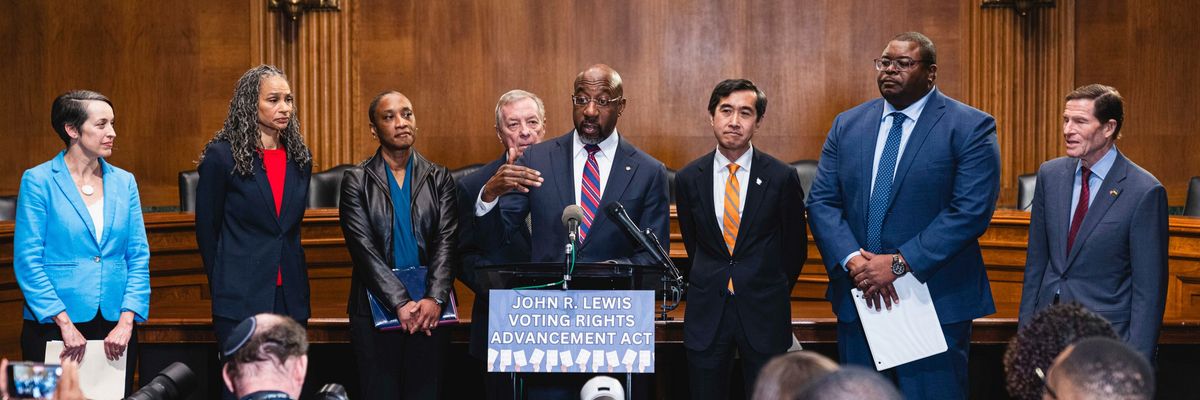
Sen. Raphael Warnock (D-Ga.) speaks while flanked with Senate co-sponsors and other supporters of the John R. Lewis Voting Rights Advancement Act on Capitol Hill in Washington, D.C. on Feburary 29, 2024.
One advocate said the John R. Lewis Voting Rights Advancement Act is "critically important for Congress to pass at a moment in our history when the freedom to vote is under attack in our nation."
Civil and voting rights advocates on Thursday cheered the reintroduction of the John R. Lewis Voting Rights Advancement Act, legislation its sponsors say will "update and restore critical safeguards of the original Voting Rights Act."
Introduced by Sens. Dick Durbin (D-Ill.), Raphael Warnock (D-Ga.), Chuck Schumer (D-N.Y.), Cory Booker (D-N.J.), Laphonza Butler (D-Calif.), and Richard Blumenthal (D-Conn.), S.B. 4—a companion to H.R. 14, introduced last September—is named in honor of John Lewis, a late civil rights icon and longtime Georgia congressman. Republicans filibustered the previous iteration of the bill.
"In our nation, there's no freedom more fundamental than the right to vote," said Durbin. "But over the past several years, there has been a sustained effort to chip away at the protections guaranteed to every American under the Voting Rights Act. That's why we've joined together today to reintroduce a bill that would not only restore the protections of the Voting Rights Act, but strengthen it."
We just re-introduced the John R. Lewis Voting Rights Advancement Act. I’m joined by @SenSchumer, @SenatorWarnock, and civil rights group leaders now.
Our message it’s clear: we must ensure that democracy works for all of us. https://t.co/SH7ujaLfjw
— Senator Dick Durbin (@SenatorDurbin) February 29, 2024
Warnock said: "I was Congressman Lewis' pastor, but he was my mentor and hero because he believed voting is a sacred undertaking that's about more than a person's voice, it's about their humanity. That's why this legislation is more important than ever, because the fight to protect voting rights and voting access for every eligible American remains unfinished and even worse, so much of the progress Congressman Lewis fought for is being rolled back."
NAACP Legal Defense Fund president Janai Nelson called the bill "a vital piece of legislation that will safeguard the fundamental right to vote by strengthening and restoring the Voting Rights Act, one of the most impactful civil rights laws in our nation's history."
"It is fitting that this critical legislation is put forward as we approach the 59th anniversary of Bloody Sunday, when Black Americans—including civil rights hero John Lewis—endured brutal state-sponsored violence while marching for basic rights, which led to the enactment of the Voting Rights Act."
"The fight to protect voting rights and voting access for every eligible American remains unfinished and even worse, so much of the progress Congressman Lewis fought for is being rolled back."
The landmark VRA was meant to ensure that state and local governments could not "deny or abridge the right of any citizen of the United States to vote on account of race or color."
However, the VRA has been eroded in recent decades by Republican-controlled state legislatures across the country, including with restrictions on voter registration, reduction in early voting options, and voter identification laws. These measures disproportionately disenfranchise minority voters, and some GOP officials have admitted that they are intended to give Republican candidates an electoral edge.
In 2013, the U.S. Supreme Court dealt a major blow to the VRA in Shelby County v. Holder, which eviscerated a key section of the law that required jurisdictions with a history of racist disenfranchisement to obtain federal approval prior to altering voting rules. In 2021, the nation's high court voted 5-4 in Brnovich v. Democratic National Committee to uphold Arizona's voting restrictions—even as Chief Justice John Roberts acknowledged that they disproportionately affect minorities.
"Since Shelby and more recently Brnovich v. DNC made it even harder to challenge discriminatory voting laws, states have continued to limit access to the ballot and use the redistricting process to dilute Black voters' voices," Nelson asserted. "States that were formerly protected—including Alabama, Georgia, Louisiana, Mississippi, South Carolina, and Texas—are all places where LDF has been forced to bring recent litigation to challenge unlawful racial discrimination in voting."
Common Cause president Virginia Kase Solomón asserted that the protections proposed in the new bill "are critically important for Congress to pass at a moment in our history when the freedom to vote is under attack in our nation."
"A bedrock of our democracy, the freedom to vote has been under sustained assault since the 2020 election with dozens of anti-voter laws passed in states all across the country to make it harder for Americans—particularly in Black and brown communities—to have a say in choosing their elected leaders," she added.
Arturo Vargas, CEO of the National Association of Latino Elected and Appointed Officials, said in a statement that "in the Shelby decision, the U.S. Supreme Court acknowledged that there is still discrimination in our nation's electoral process—and this bill would provide strong and robust safeguards to combat it."
"We urge Congress to work in a bipartisan manner to pass the John R. Lewis Voting Rights Advancement Act and help make our democracy more responsive to all of our nation's voices," he added.
Dear Common Dreams reader, It’s been nearly 30 years since I co-founded Common Dreams with my late wife, Lina Newhouser. We had the radical notion that journalism should serve the public good, not corporate profits. It was clear to us from the outset what it would take to build such a project. No paid advertisements. No corporate sponsors. No millionaire publisher telling us what to think or do. Many people said we wouldn't last a year, but we proved those doubters wrong. Together with a tremendous team of journalists and dedicated staff, we built an independent media outlet free from the constraints of profits and corporate control. Our mission has always been simple: To inform. To inspire. To ignite change for the common good. Building Common Dreams was not easy. Our survival was never guaranteed. When you take on the most powerful forces—Wall Street greed, fossil fuel industry destruction, Big Tech lobbyists, and uber-rich oligarchs who have spent billions upon billions rigging the economy and democracy in their favor—the only bulwark you have is supporters who believe in your work. But here’s the urgent message from me today. It's never been this bad out there. And it's never been this hard to keep us going. At the very moment Common Dreams is most needed, the threats we face are intensifying. We need your support now more than ever. We don't accept corporate advertising and never will. We don't have a paywall because we don't think people should be blocked from critical news based on their ability to pay. Everything we do is funded by the donations of readers like you. When everyone does the little they can afford, we are strong. But if that support retreats or dries up, so do we. Will you donate now to make sure Common Dreams not only survives but thrives? —Craig Brown, Co-founder |
Civil and voting rights advocates on Thursday cheered the reintroduction of the John R. Lewis Voting Rights Advancement Act, legislation its sponsors say will "update and restore critical safeguards of the original Voting Rights Act."
Introduced by Sens. Dick Durbin (D-Ill.), Raphael Warnock (D-Ga.), Chuck Schumer (D-N.Y.), Cory Booker (D-N.J.), Laphonza Butler (D-Calif.), and Richard Blumenthal (D-Conn.), S.B. 4—a companion to H.R. 14, introduced last September—is named in honor of John Lewis, a late civil rights icon and longtime Georgia congressman. Republicans filibustered the previous iteration of the bill.
"In our nation, there's no freedom more fundamental than the right to vote," said Durbin. "But over the past several years, there has been a sustained effort to chip away at the protections guaranteed to every American under the Voting Rights Act. That's why we've joined together today to reintroduce a bill that would not only restore the protections of the Voting Rights Act, but strengthen it."
We just re-introduced the John R. Lewis Voting Rights Advancement Act. I’m joined by @SenSchumer, @SenatorWarnock, and civil rights group leaders now.
Our message it’s clear: we must ensure that democracy works for all of us. https://t.co/SH7ujaLfjw
— Senator Dick Durbin (@SenatorDurbin) February 29, 2024
Warnock said: "I was Congressman Lewis' pastor, but he was my mentor and hero because he believed voting is a sacred undertaking that's about more than a person's voice, it's about their humanity. That's why this legislation is more important than ever, because the fight to protect voting rights and voting access for every eligible American remains unfinished and even worse, so much of the progress Congressman Lewis fought for is being rolled back."
NAACP Legal Defense Fund president Janai Nelson called the bill "a vital piece of legislation that will safeguard the fundamental right to vote by strengthening and restoring the Voting Rights Act, one of the most impactful civil rights laws in our nation's history."
"It is fitting that this critical legislation is put forward as we approach the 59th anniversary of Bloody Sunday, when Black Americans—including civil rights hero John Lewis—endured brutal state-sponsored violence while marching for basic rights, which led to the enactment of the Voting Rights Act."
"The fight to protect voting rights and voting access for every eligible American remains unfinished and even worse, so much of the progress Congressman Lewis fought for is being rolled back."
The landmark VRA was meant to ensure that state and local governments could not "deny or abridge the right of any citizen of the United States to vote on account of race or color."
However, the VRA has been eroded in recent decades by Republican-controlled state legislatures across the country, including with restrictions on voter registration, reduction in early voting options, and voter identification laws. These measures disproportionately disenfranchise minority voters, and some GOP officials have admitted that they are intended to give Republican candidates an electoral edge.
In 2013, the U.S. Supreme Court dealt a major blow to the VRA in Shelby County v. Holder, which eviscerated a key section of the law that required jurisdictions with a history of racist disenfranchisement to obtain federal approval prior to altering voting rules. In 2021, the nation's high court voted 5-4 in Brnovich v. Democratic National Committee to uphold Arizona's voting restrictions—even as Chief Justice John Roberts acknowledged that they disproportionately affect minorities.
"Since Shelby and more recently Brnovich v. DNC made it even harder to challenge discriminatory voting laws, states have continued to limit access to the ballot and use the redistricting process to dilute Black voters' voices," Nelson asserted. "States that were formerly protected—including Alabama, Georgia, Louisiana, Mississippi, South Carolina, and Texas—are all places where LDF has been forced to bring recent litigation to challenge unlawful racial discrimination in voting."
Common Cause president Virginia Kase Solomón asserted that the protections proposed in the new bill "are critically important for Congress to pass at a moment in our history when the freedom to vote is under attack in our nation."
"A bedrock of our democracy, the freedom to vote has been under sustained assault since the 2020 election with dozens of anti-voter laws passed in states all across the country to make it harder for Americans—particularly in Black and brown communities—to have a say in choosing their elected leaders," she added.
Arturo Vargas, CEO of the National Association of Latino Elected and Appointed Officials, said in a statement that "in the Shelby decision, the U.S. Supreme Court acknowledged that there is still discrimination in our nation's electoral process—and this bill would provide strong and robust safeguards to combat it."
"We urge Congress to work in a bipartisan manner to pass the John R. Lewis Voting Rights Advancement Act and help make our democracy more responsive to all of our nation's voices," he added.
Civil and voting rights advocates on Thursday cheered the reintroduction of the John R. Lewis Voting Rights Advancement Act, legislation its sponsors say will "update and restore critical safeguards of the original Voting Rights Act."
Introduced by Sens. Dick Durbin (D-Ill.), Raphael Warnock (D-Ga.), Chuck Schumer (D-N.Y.), Cory Booker (D-N.J.), Laphonza Butler (D-Calif.), and Richard Blumenthal (D-Conn.), S.B. 4—a companion to H.R. 14, introduced last September—is named in honor of John Lewis, a late civil rights icon and longtime Georgia congressman. Republicans filibustered the previous iteration of the bill.
"In our nation, there's no freedom more fundamental than the right to vote," said Durbin. "But over the past several years, there has been a sustained effort to chip away at the protections guaranteed to every American under the Voting Rights Act. That's why we've joined together today to reintroduce a bill that would not only restore the protections of the Voting Rights Act, but strengthen it."
We just re-introduced the John R. Lewis Voting Rights Advancement Act. I’m joined by @SenSchumer, @SenatorWarnock, and civil rights group leaders now.
Our message it’s clear: we must ensure that democracy works for all of us. https://t.co/SH7ujaLfjw
— Senator Dick Durbin (@SenatorDurbin) February 29, 2024
Warnock said: "I was Congressman Lewis' pastor, but he was my mentor and hero because he believed voting is a sacred undertaking that's about more than a person's voice, it's about their humanity. That's why this legislation is more important than ever, because the fight to protect voting rights and voting access for every eligible American remains unfinished and even worse, so much of the progress Congressman Lewis fought for is being rolled back."
NAACP Legal Defense Fund president Janai Nelson called the bill "a vital piece of legislation that will safeguard the fundamental right to vote by strengthening and restoring the Voting Rights Act, one of the most impactful civil rights laws in our nation's history."
"It is fitting that this critical legislation is put forward as we approach the 59th anniversary of Bloody Sunday, when Black Americans—including civil rights hero John Lewis—endured brutal state-sponsored violence while marching for basic rights, which led to the enactment of the Voting Rights Act."
"The fight to protect voting rights and voting access for every eligible American remains unfinished and even worse, so much of the progress Congressman Lewis fought for is being rolled back."
The landmark VRA was meant to ensure that state and local governments could not "deny or abridge the right of any citizen of the United States to vote on account of race or color."
However, the VRA has been eroded in recent decades by Republican-controlled state legislatures across the country, including with restrictions on voter registration, reduction in early voting options, and voter identification laws. These measures disproportionately disenfranchise minority voters, and some GOP officials have admitted that they are intended to give Republican candidates an electoral edge.
In 2013, the U.S. Supreme Court dealt a major blow to the VRA in Shelby County v. Holder, which eviscerated a key section of the law that required jurisdictions with a history of racist disenfranchisement to obtain federal approval prior to altering voting rules. In 2021, the nation's high court voted 5-4 in Brnovich v. Democratic National Committee to uphold Arizona's voting restrictions—even as Chief Justice John Roberts acknowledged that they disproportionately affect minorities.
"Since Shelby and more recently Brnovich v. DNC made it even harder to challenge discriminatory voting laws, states have continued to limit access to the ballot and use the redistricting process to dilute Black voters' voices," Nelson asserted. "States that were formerly protected—including Alabama, Georgia, Louisiana, Mississippi, South Carolina, and Texas—are all places where LDF has been forced to bring recent litigation to challenge unlawful racial discrimination in voting."
Common Cause president Virginia Kase Solomón asserted that the protections proposed in the new bill "are critically important for Congress to pass at a moment in our history when the freedom to vote is under attack in our nation."
"A bedrock of our democracy, the freedom to vote has been under sustained assault since the 2020 election with dozens of anti-voter laws passed in states all across the country to make it harder for Americans—particularly in Black and brown communities—to have a say in choosing their elected leaders," she added.
Arturo Vargas, CEO of the National Association of Latino Elected and Appointed Officials, said in a statement that "in the Shelby decision, the U.S. Supreme Court acknowledged that there is still discrimination in our nation's electoral process—and this bill would provide strong and robust safeguards to combat it."
"We urge Congress to work in a bipartisan manner to pass the John R. Lewis Voting Rights Advancement Act and help make our democracy more responsive to all of our nation's voices," he added.