SUBSCRIBE TO OUR FREE NEWSLETTER
Daily news & progressive opinion—funded by the people, not the corporations—delivered straight to your inbox.
5
#000000
#FFFFFF
To donate by check, phone, or other method, see our More Ways to Give page.
Daily news & progressive opinion—funded by the people, not the corporations—delivered straight to your inbox.
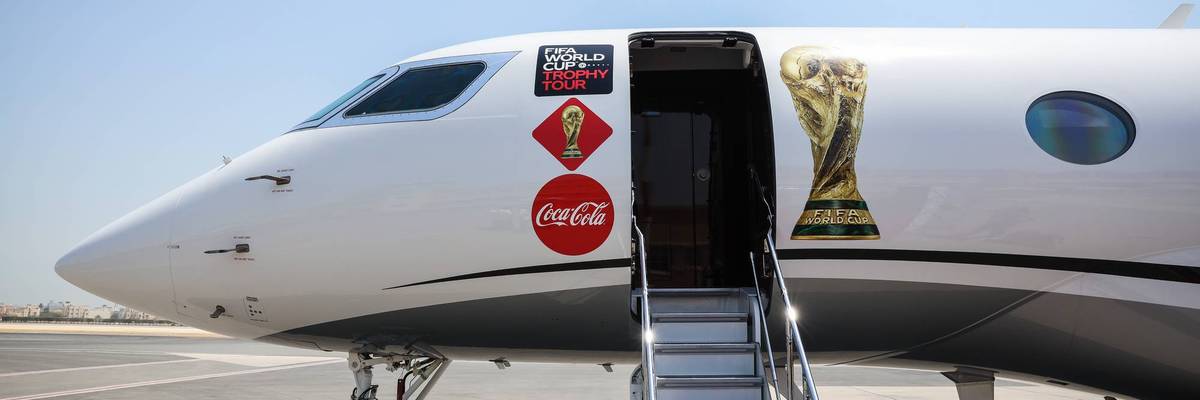
The World Cup Trophy is brought within the 2022 FIFA World Cup Trophy Tour by Brazilian former football player Juliano Belletti at Bahrain International Airport in Manama, Bahrain on June 4, 2022.
A new private jet emissions tracker shows 136 kilotonnes of additional emissions before the final match.
As fans gather for the FIFA World Cup final match, pitting Spain against defending champion Argentina, New York City has been engulfed in a shroud of wildfire smoke.
At the same time, thousands of wealthy fans are arriving in luxury private jets, the most carbon-emissions polluting form of transportation. This seems an appropriate image for what may prove to be the most polluting sports tournament in world history, thanks in part to private jet excess.
The wildfire smoke, from several hundred uncontrolled blazes across Ontario and northern Minnesota, have contributing to air quality emergencies across the northern U.S. On Thursday, the city of Detroit registered a whopping 724 on the Air Quality Index. Index ratings over 300 are considered a health emergency for all living things.
Scientists are often cautious about attributing blame to climate change, but there is little doubt these wildfires are supercharged by global climate change, as forests dry out and atmospheric rain cycles are disrupted.
On Saturday, the air quality in East Rutherford, New Jersey registered 157, an “unhealthy” level. The pollution index is anticipated to improve for the Finals, with weather shifts and a thunderstorm scrubbing the air. This may bring the pollutant index to 100, considered “moderate” but posing risks for sensitive groups including older adults, children, and those with lung or heart disease.
Compounding the injustice, ordinary fans, taxpayers, and the flying public subsidize the pollution spewing activity of the high-flying private jet class. Private jets don’t chip in their fair share of the cost of airspace, let alone their environmental impact. And last year, the U.S. Congress slathered on more tax breaks for private jets and their ultra-wealthy users.
These tax breaks don’t even address the biggest subsidy: the ability of private jets to avoid any responsibility for the health and environmental costs of their pollution impacts.
With an assist from our new IPS Private Jet Emission Tracker, designed to assess the impact of special events, we know that thousands of private jets have already attended the first 102 matches of the FIFA World Cup. Prior to the final match, the private jets attending the tournament have spewed an estimated 136 kt of additional carbon pollution into the atmosphere, the equivalent of driving 31,723 gasoline powered cars for a year. The Tracker looks at private jet activity in match-host cities over five years and documents the spike in activity.
In our assessment, Red Card for Private Jets at the FIFA World Cup, we document the excessive emissions and the costs to everyone else. We call on FIFA to ban private jets at matches and live up to their pledge to be carbon neutral by 2040.
FIFA should also stop designing tournaments that span continents and cater to the ultra-wealthy private jet class and not ordinary fans. The 2030 FIFA World Cup will be played in six different countries, with most matches in Morocco, Portugal, and Spain. But in honor of the 100th anniversary of the World Cup, the opening matches will be played in the South American nations of Uruguay, Argentina and Paraguay.
FIFA is clearly competing to produce the world’s most polluting sport competition. They must do more to protect the players, the fans, and our planet. The World Cup belongs to everyone, not just the private jet class.
Dear Common Dreams reader, It’s been nearly 30 years since I co-founded Common Dreams with my late wife, Lina Newhouser. We had the radical notion that journalism should serve the public good, not corporate profits. It was clear to us from the outset what it would take to build such a project. No paid advertisements. No corporate sponsors. No millionaire publisher telling us what to think or do. Many people said we wouldn't last a year, but we proved those doubters wrong. Together with a tremendous team of journalists and dedicated staff, we built an independent media outlet free from the constraints of profits and corporate control. Our mission has always been simple: To inform. To inspire. To ignite change for the common good. Building Common Dreams was not easy. Our survival was never guaranteed. When you take on the most powerful forces—Wall Street greed, fossil fuel industry destruction, Big Tech lobbyists, and uber-rich oligarchs who have spent billions upon billions rigging the economy and democracy in their favor—the only bulwark you have is supporters who believe in your work. But here’s the urgent message from me today. It's never been this bad out there. And it's never been this hard to keep us going. At the very moment Common Dreams is most needed, the threats we face are intensifying. We need your support now more than ever. We don't accept corporate advertising and never will. We don't have a paywall because we don't think people should be blocked from critical news based on their ability to pay. Everything we do is funded by the donations of readers like you. When everyone does the little they can afford, we are strong. But if that support retreats or dries up, so do we. Will you donate now to make sure Common Dreams not only survives but thrives? —Craig Brown, Co-founder |
As fans gather for the FIFA World Cup final match, pitting Spain against defending champion Argentina, New York City has been engulfed in a shroud of wildfire smoke.
At the same time, thousands of wealthy fans are arriving in luxury private jets, the most carbon-emissions polluting form of transportation. This seems an appropriate image for what may prove to be the most polluting sports tournament in world history, thanks in part to private jet excess.
The wildfire smoke, from several hundred uncontrolled blazes across Ontario and northern Minnesota, have contributing to air quality emergencies across the northern U.S. On Thursday, the city of Detroit registered a whopping 724 on the Air Quality Index. Index ratings over 300 are considered a health emergency for all living things.
Scientists are often cautious about attributing blame to climate change, but there is little doubt these wildfires are supercharged by global climate change, as forests dry out and atmospheric rain cycles are disrupted.
On Saturday, the air quality in East Rutherford, New Jersey registered 157, an “unhealthy” level. The pollution index is anticipated to improve for the Finals, with weather shifts and a thunderstorm scrubbing the air. This may bring the pollutant index to 100, considered “moderate” but posing risks for sensitive groups including older adults, children, and those with lung or heart disease.
Compounding the injustice, ordinary fans, taxpayers, and the flying public subsidize the pollution spewing activity of the high-flying private jet class. Private jets don’t chip in their fair share of the cost of airspace, let alone their environmental impact. And last year, the U.S. Congress slathered on more tax breaks for private jets and their ultra-wealthy users.
These tax breaks don’t even address the biggest subsidy: the ability of private jets to avoid any responsibility for the health and environmental costs of their pollution impacts.
With an assist from our new IPS Private Jet Emission Tracker, designed to assess the impact of special events, we know that thousands of private jets have already attended the first 102 matches of the FIFA World Cup. Prior to the final match, the private jets attending the tournament have spewed an estimated 136 kt of additional carbon pollution into the atmosphere, the equivalent of driving 31,723 gasoline powered cars for a year. The Tracker looks at private jet activity in match-host cities over five years and documents the spike in activity.
In our assessment, Red Card for Private Jets at the FIFA World Cup, we document the excessive emissions and the costs to everyone else. We call on FIFA to ban private jets at matches and live up to their pledge to be carbon neutral by 2040.
FIFA should also stop designing tournaments that span continents and cater to the ultra-wealthy private jet class and not ordinary fans. The 2030 FIFA World Cup will be played in six different countries, with most matches in Morocco, Portugal, and Spain. But in honor of the 100th anniversary of the World Cup, the opening matches will be played in the South American nations of Uruguay, Argentina and Paraguay.
FIFA is clearly competing to produce the world’s most polluting sport competition. They must do more to protect the players, the fans, and our planet. The World Cup belongs to everyone, not just the private jet class.
As fans gather for the FIFA World Cup final match, pitting Spain against defending champion Argentina, New York City has been engulfed in a shroud of wildfire smoke.
At the same time, thousands of wealthy fans are arriving in luxury private jets, the most carbon-emissions polluting form of transportation. This seems an appropriate image for what may prove to be the most polluting sports tournament in world history, thanks in part to private jet excess.
The wildfire smoke, from several hundred uncontrolled blazes across Ontario and northern Minnesota, have contributing to air quality emergencies across the northern U.S. On Thursday, the city of Detroit registered a whopping 724 on the Air Quality Index. Index ratings over 300 are considered a health emergency for all living things.
Scientists are often cautious about attributing blame to climate change, but there is little doubt these wildfires are supercharged by global climate change, as forests dry out and atmospheric rain cycles are disrupted.
On Saturday, the air quality in East Rutherford, New Jersey registered 157, an “unhealthy” level. The pollution index is anticipated to improve for the Finals, with weather shifts and a thunderstorm scrubbing the air. This may bring the pollutant index to 100, considered “moderate” but posing risks for sensitive groups including older adults, children, and those with lung or heart disease.
Compounding the injustice, ordinary fans, taxpayers, and the flying public subsidize the pollution spewing activity of the high-flying private jet class. Private jets don’t chip in their fair share of the cost of airspace, let alone their environmental impact. And last year, the U.S. Congress slathered on more tax breaks for private jets and their ultra-wealthy users.
These tax breaks don’t even address the biggest subsidy: the ability of private jets to avoid any responsibility for the health and environmental costs of their pollution impacts.
With an assist from our new IPS Private Jet Emission Tracker, designed to assess the impact of special events, we know that thousands of private jets have already attended the first 102 matches of the FIFA World Cup. Prior to the final match, the private jets attending the tournament have spewed an estimated 136 kt of additional carbon pollution into the atmosphere, the equivalent of driving 31,723 gasoline powered cars for a year. The Tracker looks at private jet activity in match-host cities over five years and documents the spike in activity.
In our assessment, Red Card for Private Jets at the FIFA World Cup, we document the excessive emissions and the costs to everyone else. We call on FIFA to ban private jets at matches and live up to their pledge to be carbon neutral by 2040.
FIFA should also stop designing tournaments that span continents and cater to the ultra-wealthy private jet class and not ordinary fans. The 2030 FIFA World Cup will be played in six different countries, with most matches in Morocco, Portugal, and Spain. But in honor of the 100th anniversary of the World Cup, the opening matches will be played in the South American nations of Uruguay, Argentina and Paraguay.
FIFA is clearly competing to produce the world’s most polluting sport competition. They must do more to protect the players, the fans, and our planet. The World Cup belongs to everyone, not just the private jet class.