SUBSCRIBE TO OUR FREE NEWSLETTER
Daily news & progressive opinion—funded by the people, not the corporations—delivered straight to your inbox.
5
#000000
#FFFFFF
To donate by check, phone, or other method, see our More Ways to Give page.
Daily news & progressive opinion—funded by the people, not the corporations—delivered straight to your inbox.
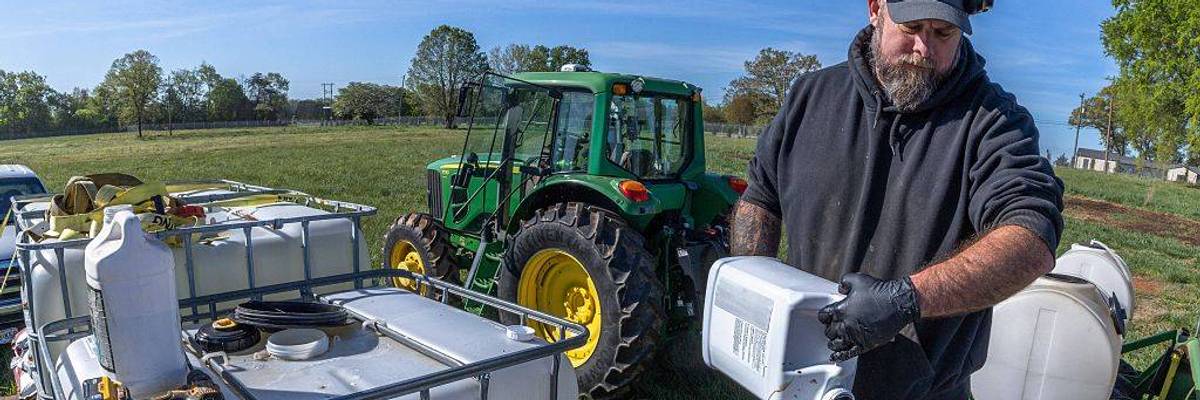
The development of agroecological and regenerative approaches would see a food system that is not only less vulnerable to the supply chain shocks being felt today, but would be better for the environment, human health, and animals.
The global disruptions caused by the war in Iran have brought renewed focus to the vulnerability of global fossil fuel supply chains. But what has received less attention is how the war also highlights the vulnerability of industrial agriculture supply chains reliant on massive amounts of chemical fertilizers and other inputs. Like oil and gas, these frequently travel long distances through turbulent waters.
A big advantage of renewable energy technologies like solar is that sunlight doesn’t have to pass through the Straits of Hormuz. The same can be said for many of the inputs required for agroecological and regenerative farming systems. The development of these approaches would see a food system that is not only less vulnerable to the supply chain shocks being felt today, but would be better for the environment, human health, and animals. It would be healthier, kinder, and more resilient.
A global economic recession and possible food shortages are looming as the war in Iran grinds on. While the devastating impact of the current conflict on people, their families, and communities must be foremost in our minds, the shock waves from the crisis are having system-wide impacts on energy supplies, cost of living, and food prices. As the seasons turn and farmers prepare to plant their crops, they are facing a new pressure: a sudden and critical rise in fertilizer and fuel costs.
As the price of petrol and diesel have skyrocketed since the closure of the Strait of Hormuz, so too have fertilizer costs due to shortages of urea and ammonia. A third of the world's key fertilizer chemicals pass through the Strait, and prices have risen steeply since the outbreak of war, with predictions that prices for nitrogen-based fertilizers like urea could roughly double if the war drags on. Alongside a rise in red diesel prices, agricultural profit margins are highly volatile.
The current war is heinous, but inadvertently it has created an inflexion point, a moment to rethink global distribution of goods, and our broken food system.
Farmers taking the financial hit will likely pass on the costs to the consumer, but this isn’t sustainable and undermines the financial, social, and environmental health of the global food system. What if we flip it? Could the Middle East War not only accelerate a shift to renewable energy but also reduce our dependency on fertilizer-hungry crops? Legumes such as beans and peas, which fix nitrogen in soils, root vegetables, soybeans, and hardy grains such as rye could be viable alternatives.
Since the Second World War, a burgeoning (and hugely profitable for a few) chemical industry has created food systems dependent on inputs such as fossil fuel-based fertilizer, pesticides, herbicides, and fungicides. While delivering greater crop surplus, industrial farming has brought new problems: algal blooms, less wildlife and pollinators, monocultures, local air pollution, global climate change, and the loss of small-scale farming and farmers.
We’ve reached a tipping point; we overproduce food, a third of which is wasted, and too many people are eating too much of the wrong types of food. Noncommunicable diseases such as cardiovascular disease and diabetes are becoming a much bigger health burden than infectious diseases. Meanwhile, entrenched inequalities mean that, despite a global food surplus, millions of people go hungry every day, and 2.6 billion people can’t afford a healthy diet. An insatiable demand for meat now means that there are over 76 billion farmed chicken, pigs, and cattle in production around the planet, driving a largely invisible burden of animal suffering.
The current war is heinous, but inadvertently it has created an inflexion point, a moment to rethink global distribution of goods, and our broken food system. Growing crops that don’t need so many fossil fuel-derived chemicals but still provide enough food to feed our populations, and sustainable farming for current and future generations, is where we should be heading. We need to transition away from industrial agriculture, to food systems built on fairness—to people, animals, and the planet—not one geared toward feeding animals to feed ourselves. It’s a stark reality that over one-third of land used to grow arable crops is used to grow crops for animal feed.
Animal farming industry groups have been calling for public money to weather supply shocks, which begs the question of how resilient are the industrial systems we currently rely on. The US government provided $1 billion in response to avian flu, for example, while the European Union directed €46.7 million to Italian farmers, plus another €15 million for weather and animal-disease-related impacts in parts of Europe, and Canada extended livestock tax relief linked to bovine TB and extreme weather. The Food and Agricultural Organization of the United Nations (FAO) is also calling for urgent action in the form of government funds to protect the countries heavily exposed to import disruptions.
It’s clear that the current industrial animal farming model is not resilient. It depends heavily on unstable supply chains exposed to geopolitical shocks, climate change, extreme weather events, and disease outbreaks, and is a deeply inefficient use of plant resources to feed the world. Yet public money keeps being used to stabilize food systems that are structurally fragile, rather than directed toward sustainable and humane agriculture.
The current crisis in the Middle East has once again spotlighted our dependence on fossil fuels for energy and for food production. The growing success of renewable energy technologies—wind, solar, electric vehicles, and heat pumps—provides a roadmap to achieving energy independence at local and national levels. This has been achieved through several decades of policy and fiscal support, such as feed-in tariffs, technological advances, and growing public support.
Changing how we produce food could advance rapidly on the coat tails of our energy revolution. Calls for a just transition in farming and food production are growing from independent, small-scale farmers to development organizations, from Indigenous people’s groups to animal welfare charities. This transition would pivot away from destructive, insecure industrial agriculture toward more equitable, humane, and sustainable forms of agriculture, such as agroecology.
Rethinking food is not a nice to have, it’s essential if we are to strengthen the resilience of farmers, consumers, and nations, reducing exposure to geopolitical tensions, supply-chain disruptions, and future global shocks.
Dear Common Dreams reader, It’s been nearly 30 years since I co-founded Common Dreams with my late wife, Lina Newhouser. We had the radical notion that journalism should serve the public good, not corporate profits. It was clear to us from the outset what it would take to build such a project. No paid advertisements. No corporate sponsors. No millionaire publisher telling us what to think or do. Many people said we wouldn't last a year, but we proved those doubters wrong. Together with a tremendous team of journalists and dedicated staff, we built an independent media outlet free from the constraints of profits and corporate control. Our mission has always been simple: To inform. To inspire. To ignite change for the common good. Building Common Dreams was not easy. Our survival was never guaranteed. When you take on the most powerful forces—Wall Street greed, fossil fuel industry destruction, Big Tech lobbyists, and uber-rich oligarchs who have spent billions upon billions rigging the economy and democracy in their favor—the only bulwark you have is supporters who believe in your work. But here’s the urgent message from me today. It's never been this bad out there. And it's never been this hard to keep us going. At the very moment Common Dreams is most needed, the threats we face are intensifying. We need your support now more than ever. We don't accept corporate advertising and never will. We don't have a paywall because we don't think people should be blocked from critical news based on their ability to pay. Everything we do is funded by the donations of readers like you. When everyone does the little they can afford, we are strong. But if that support retreats or dries up, so do we. Will you donate now to make sure Common Dreams not only survives but thrives? —Craig Brown, Co-founder |
The global disruptions caused by the war in Iran have brought renewed focus to the vulnerability of global fossil fuel supply chains. But what has received less attention is how the war also highlights the vulnerability of industrial agriculture supply chains reliant on massive amounts of chemical fertilizers and other inputs. Like oil and gas, these frequently travel long distances through turbulent waters.
A big advantage of renewable energy technologies like solar is that sunlight doesn’t have to pass through the Straits of Hormuz. The same can be said for many of the inputs required for agroecological and regenerative farming systems. The development of these approaches would see a food system that is not only less vulnerable to the supply chain shocks being felt today, but would be better for the environment, human health, and animals. It would be healthier, kinder, and more resilient.
A global economic recession and possible food shortages are looming as the war in Iran grinds on. While the devastating impact of the current conflict on people, their families, and communities must be foremost in our minds, the shock waves from the crisis are having system-wide impacts on energy supplies, cost of living, and food prices. As the seasons turn and farmers prepare to plant their crops, they are facing a new pressure: a sudden and critical rise in fertilizer and fuel costs.
As the price of petrol and diesel have skyrocketed since the closure of the Strait of Hormuz, so too have fertilizer costs due to shortages of urea and ammonia. A third of the world's key fertilizer chemicals pass through the Strait, and prices have risen steeply since the outbreak of war, with predictions that prices for nitrogen-based fertilizers like urea could roughly double if the war drags on. Alongside a rise in red diesel prices, agricultural profit margins are highly volatile.
The current war is heinous, but inadvertently it has created an inflexion point, a moment to rethink global distribution of goods, and our broken food system.
Farmers taking the financial hit will likely pass on the costs to the consumer, but this isn’t sustainable and undermines the financial, social, and environmental health of the global food system. What if we flip it? Could the Middle East War not only accelerate a shift to renewable energy but also reduce our dependency on fertilizer-hungry crops? Legumes such as beans and peas, which fix nitrogen in soils, root vegetables, soybeans, and hardy grains such as rye could be viable alternatives.
Since the Second World War, a burgeoning (and hugely profitable for a few) chemical industry has created food systems dependent on inputs such as fossil fuel-based fertilizer, pesticides, herbicides, and fungicides. While delivering greater crop surplus, industrial farming has brought new problems: algal blooms, less wildlife and pollinators, monocultures, local air pollution, global climate change, and the loss of small-scale farming and farmers.
We’ve reached a tipping point; we overproduce food, a third of which is wasted, and too many people are eating too much of the wrong types of food. Noncommunicable diseases such as cardiovascular disease and diabetes are becoming a much bigger health burden than infectious diseases. Meanwhile, entrenched inequalities mean that, despite a global food surplus, millions of people go hungry every day, and 2.6 billion people can’t afford a healthy diet. An insatiable demand for meat now means that there are over 76 billion farmed chicken, pigs, and cattle in production around the planet, driving a largely invisible burden of animal suffering.
The current war is heinous, but inadvertently it has created an inflexion point, a moment to rethink global distribution of goods, and our broken food system. Growing crops that don’t need so many fossil fuel-derived chemicals but still provide enough food to feed our populations, and sustainable farming for current and future generations, is where we should be heading. We need to transition away from industrial agriculture, to food systems built on fairness—to people, animals, and the planet—not one geared toward feeding animals to feed ourselves. It’s a stark reality that over one-third of land used to grow arable crops is used to grow crops for animal feed.
Animal farming industry groups have been calling for public money to weather supply shocks, which begs the question of how resilient are the industrial systems we currently rely on. The US government provided $1 billion in response to avian flu, for example, while the European Union directed €46.7 million to Italian farmers, plus another €15 million for weather and animal-disease-related impacts in parts of Europe, and Canada extended livestock tax relief linked to bovine TB and extreme weather. The Food and Agricultural Organization of the United Nations (FAO) is also calling for urgent action in the form of government funds to protect the countries heavily exposed to import disruptions.
It’s clear that the current industrial animal farming model is not resilient. It depends heavily on unstable supply chains exposed to geopolitical shocks, climate change, extreme weather events, and disease outbreaks, and is a deeply inefficient use of plant resources to feed the world. Yet public money keeps being used to stabilize food systems that are structurally fragile, rather than directed toward sustainable and humane agriculture.
The current crisis in the Middle East has once again spotlighted our dependence on fossil fuels for energy and for food production. The growing success of renewable energy technologies—wind, solar, electric vehicles, and heat pumps—provides a roadmap to achieving energy independence at local and national levels. This has been achieved through several decades of policy and fiscal support, such as feed-in tariffs, technological advances, and growing public support.
Changing how we produce food could advance rapidly on the coat tails of our energy revolution. Calls for a just transition in farming and food production are growing from independent, small-scale farmers to development organizations, from Indigenous people’s groups to animal welfare charities. This transition would pivot away from destructive, insecure industrial agriculture toward more equitable, humane, and sustainable forms of agriculture, such as agroecology.
Rethinking food is not a nice to have, it’s essential if we are to strengthen the resilience of farmers, consumers, and nations, reducing exposure to geopolitical tensions, supply-chain disruptions, and future global shocks.
The global disruptions caused by the war in Iran have brought renewed focus to the vulnerability of global fossil fuel supply chains. But what has received less attention is how the war also highlights the vulnerability of industrial agriculture supply chains reliant on massive amounts of chemical fertilizers and other inputs. Like oil and gas, these frequently travel long distances through turbulent waters.
A big advantage of renewable energy technologies like solar is that sunlight doesn’t have to pass through the Straits of Hormuz. The same can be said for many of the inputs required for agroecological and regenerative farming systems. The development of these approaches would see a food system that is not only less vulnerable to the supply chain shocks being felt today, but would be better for the environment, human health, and animals. It would be healthier, kinder, and more resilient.
A global economic recession and possible food shortages are looming as the war in Iran grinds on. While the devastating impact of the current conflict on people, their families, and communities must be foremost in our minds, the shock waves from the crisis are having system-wide impacts on energy supplies, cost of living, and food prices. As the seasons turn and farmers prepare to plant their crops, they are facing a new pressure: a sudden and critical rise in fertilizer and fuel costs.
As the price of petrol and diesel have skyrocketed since the closure of the Strait of Hormuz, so too have fertilizer costs due to shortages of urea and ammonia. A third of the world's key fertilizer chemicals pass through the Strait, and prices have risen steeply since the outbreak of war, with predictions that prices for nitrogen-based fertilizers like urea could roughly double if the war drags on. Alongside a rise in red diesel prices, agricultural profit margins are highly volatile.
The current war is heinous, but inadvertently it has created an inflexion point, a moment to rethink global distribution of goods, and our broken food system.
Farmers taking the financial hit will likely pass on the costs to the consumer, but this isn’t sustainable and undermines the financial, social, and environmental health of the global food system. What if we flip it? Could the Middle East War not only accelerate a shift to renewable energy but also reduce our dependency on fertilizer-hungry crops? Legumes such as beans and peas, which fix nitrogen in soils, root vegetables, soybeans, and hardy grains such as rye could be viable alternatives.
Since the Second World War, a burgeoning (and hugely profitable for a few) chemical industry has created food systems dependent on inputs such as fossil fuel-based fertilizer, pesticides, herbicides, and fungicides. While delivering greater crop surplus, industrial farming has brought new problems: algal blooms, less wildlife and pollinators, monocultures, local air pollution, global climate change, and the loss of small-scale farming and farmers.
We’ve reached a tipping point; we overproduce food, a third of which is wasted, and too many people are eating too much of the wrong types of food. Noncommunicable diseases such as cardiovascular disease and diabetes are becoming a much bigger health burden than infectious diseases. Meanwhile, entrenched inequalities mean that, despite a global food surplus, millions of people go hungry every day, and 2.6 billion people can’t afford a healthy diet. An insatiable demand for meat now means that there are over 76 billion farmed chicken, pigs, and cattle in production around the planet, driving a largely invisible burden of animal suffering.
The current war is heinous, but inadvertently it has created an inflexion point, a moment to rethink global distribution of goods, and our broken food system. Growing crops that don’t need so many fossil fuel-derived chemicals but still provide enough food to feed our populations, and sustainable farming for current and future generations, is where we should be heading. We need to transition away from industrial agriculture, to food systems built on fairness—to people, animals, and the planet—not one geared toward feeding animals to feed ourselves. It’s a stark reality that over one-third of land used to grow arable crops is used to grow crops for animal feed.
Animal farming industry groups have been calling for public money to weather supply shocks, which begs the question of how resilient are the industrial systems we currently rely on. The US government provided $1 billion in response to avian flu, for example, while the European Union directed €46.7 million to Italian farmers, plus another €15 million for weather and animal-disease-related impacts in parts of Europe, and Canada extended livestock tax relief linked to bovine TB and extreme weather. The Food and Agricultural Organization of the United Nations (FAO) is also calling for urgent action in the form of government funds to protect the countries heavily exposed to import disruptions.
It’s clear that the current industrial animal farming model is not resilient. It depends heavily on unstable supply chains exposed to geopolitical shocks, climate change, extreme weather events, and disease outbreaks, and is a deeply inefficient use of plant resources to feed the world. Yet public money keeps being used to stabilize food systems that are structurally fragile, rather than directed toward sustainable and humane agriculture.
The current crisis in the Middle East has once again spotlighted our dependence on fossil fuels for energy and for food production. The growing success of renewable energy technologies—wind, solar, electric vehicles, and heat pumps—provides a roadmap to achieving energy independence at local and national levels. This has been achieved through several decades of policy and fiscal support, such as feed-in tariffs, technological advances, and growing public support.
Changing how we produce food could advance rapidly on the coat tails of our energy revolution. Calls for a just transition in farming and food production are growing from independent, small-scale farmers to development organizations, from Indigenous people’s groups to animal welfare charities. This transition would pivot away from destructive, insecure industrial agriculture toward more equitable, humane, and sustainable forms of agriculture, such as agroecology.
Rethinking food is not a nice to have, it’s essential if we are to strengthen the resilience of farmers, consumers, and nations, reducing exposure to geopolitical tensions, supply-chain disruptions, and future global shocks.