SUBSCRIBE TO OUR FREE NEWSLETTER
Daily news & progressive opinion—funded by the people, not the corporations—delivered straight to your inbox.
5
#000000
#FFFFFF
To donate by check, phone, or other method, see our More Ways to Give page.
Daily news & progressive opinion—funded by the people, not the corporations—delivered straight to your inbox.
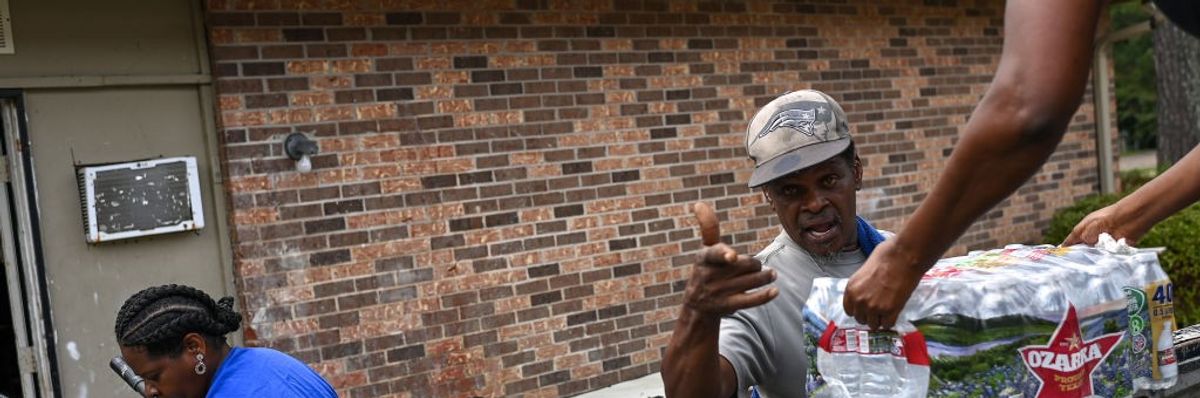
Workers unload cases of bottled water to provide for elderly and disabled residents of a low-income apartment complex on September 3, 2022 in Jackson, Mississippi after a drink water emergency was ordered for the entire city.
Water isn't a commodity to be sold to only those that can pay. It's a basic right our government must provide to all residents.
More than a decade ago, the United Nations declared that access to clean water and sanitation is a human right, underpinning all other goals for equality, health, and economic prosperity. The United States did not sign on. Today, on World Water Day, global leaders are gathering in New York to discuss progress towards this goal. It's the first time the UN Water Conference is being held in the U.S. and time for our nation to embrace the moral imperative: Water is a human right.
People tend to think of clean water and sanitation access as issues for countries with the lowest GDPs. Yet, more than 2 million U.S. residents live without safe running water or a working toilet. Millions more experience water shutoffs because of unaffordable water and sewer bills, and climate change threatens reliable access to clean water for many more communities. The water access gap also costs our national economy more than $8 billion a year.
But the toll is human. From Detroit to California's Central Valley, people are sick and dying when we fail to prioritize access to clean water, public health, and safety. This dire situation led a UN expert investigator to visit these two hot spots for U.S. water challenges: water shutoffs, unaffordable bills, and contaminated water supplies.
From Detroit to California's Central Valley, people are sick and dying when we fail to prioritize access to clean water, public health, and safety.
In Michigan, the rate of water and sewer prices have increased by more than 400% for the poorest households since 1986, rising faster than wages and the cost of all other utility services. This steep rise led to widespread shutoffs, hurting people's ability to care for themselves and their families. After decades of predatory and racist shutoff practices, Detroit was actually one of the first utilities to stop shutting off water during the pandemic. But the moratorium on water shutoffs in the city ended in January, and now the community is pushing for inclusive affordability programs that keep people in their homes with their water running.
In California's Central Valley, groundwater pollution and overuse have left many communities with dry wells or water that is unsafe to drink. This forces low-income families to pay for their water twice: once for tap water they cannot drink and second for expensive trucked-in or bottled water so they can cook and bathe. Ten years ago, California recognized the human right to water, and is working to connect more communities to safe water supplies, but still has work to do on affordability as well as contamination.
Climate change is exacerbating economic inequalities and stressing water systems. Every year, extreme weather causes flooding, burst pipes, sewage spills, and other crises that force people out of their homes and put families on boil notices for months. The cost of building climate-resilient infrastructure or recovering from disaster only makes it harder for families to afford water, a deadly combination for low-income and communities of color in this country.
Fortunately, billions of dollars from the Bipartisan Infrastructure Law and Inflation Reduction Act are flowing to communities right now to fund safe and climate-resilient water systems. This is a great first step, but U.S. leaders must ensure these funds reach the communities that need them most, and then continue investing in our water and wastewater systems while keeping water affordable for all.
Water isn't a commodity to be sold to only those that can pay. It's a basic right our government must provide to all residents.
On World Water Day, policy makers have a job to do. We can make progress right now by getting water infrastructure dollars to places with the most pressing water injustices, like Detroit and the Central Valley, and funding water bill assistance for lower-income families. In the long run, we need to follow the leadership of local communities, sustain investment in our water systems, end water shutoffs, and make a national commitment to water affordability.
Only then can we say water is a human right in the United States.
This country and this world are at a monumental crossroads. US voters have an opportunity to beat back the forces of fascism and confront the billionaires who are rigging the economy, our media system, and our democracy, making it increasingly impossible for ordinary people to get by. We’re not just talking about the election. We’re talking about what must be done once these fascist elements are vanquished from power. We need a bolder set of solutions than what either major party has so far been willing to offer and a working-class movement ready to fight like hell for it. Trump didn't emerge from nowhere. The conditions that fueled MAGA authoritarianism were created by decades of radical neoliberal economic policies and a corrupt political system dominated by corporate interests. They slashed taxes on the super-rich, promising that the benefits would trickle down. They said giveaways to the corporate titans would make life more affordable for the rest of us. It was all bullshit. And when a bitter, betrayed populace searches for someone to blame, right-wing demagogues have little trouble finding scapegoats. People know when they're being lied to, but you won't hear any of this from the corporate media. Only independent journalism—powered and funded by people who believe in building a better world—can deliver truly trustworthy daily news. If you share our vision, please contribute whatever you can to sustain our work. |
More than a decade ago, the United Nations declared that access to clean water and sanitation is a human right, underpinning all other goals for equality, health, and economic prosperity. The United States did not sign on. Today, on World Water Day, global leaders are gathering in New York to discuss progress towards this goal. It's the first time the UN Water Conference is being held in the U.S. and time for our nation to embrace the moral imperative: Water is a human right.
People tend to think of clean water and sanitation access as issues for countries with the lowest GDPs. Yet, more than 2 million U.S. residents live without safe running water or a working toilet. Millions more experience water shutoffs because of unaffordable water and sewer bills, and climate change threatens reliable access to clean water for many more communities. The water access gap also costs our national economy more than $8 billion a year.
But the toll is human. From Detroit to California's Central Valley, people are sick and dying when we fail to prioritize access to clean water, public health, and safety. This dire situation led a UN expert investigator to visit these two hot spots for U.S. water challenges: water shutoffs, unaffordable bills, and contaminated water supplies.
From Detroit to California's Central Valley, people are sick and dying when we fail to prioritize access to clean water, public health, and safety.
In Michigan, the rate of water and sewer prices have increased by more than 400% for the poorest households since 1986, rising faster than wages and the cost of all other utility services. This steep rise led to widespread shutoffs, hurting people's ability to care for themselves and their families. After decades of predatory and racist shutoff practices, Detroit was actually one of the first utilities to stop shutting off water during the pandemic. But the moratorium on water shutoffs in the city ended in January, and now the community is pushing for inclusive affordability programs that keep people in their homes with their water running.
In California's Central Valley, groundwater pollution and overuse have left many communities with dry wells or water that is unsafe to drink. This forces low-income families to pay for their water twice: once for tap water they cannot drink and second for expensive trucked-in or bottled water so they can cook and bathe. Ten years ago, California recognized the human right to water, and is working to connect more communities to safe water supplies, but still has work to do on affordability as well as contamination.
Climate change is exacerbating economic inequalities and stressing water systems. Every year, extreme weather causes flooding, burst pipes, sewage spills, and other crises that force people out of their homes and put families on boil notices for months. The cost of building climate-resilient infrastructure or recovering from disaster only makes it harder for families to afford water, a deadly combination for low-income and communities of color in this country.
Fortunately, billions of dollars from the Bipartisan Infrastructure Law and Inflation Reduction Act are flowing to communities right now to fund safe and climate-resilient water systems. This is a great first step, but U.S. leaders must ensure these funds reach the communities that need them most, and then continue investing in our water and wastewater systems while keeping water affordable for all.
Water isn't a commodity to be sold to only those that can pay. It's a basic right our government must provide to all residents.
On World Water Day, policy makers have a job to do. We can make progress right now by getting water infrastructure dollars to places with the most pressing water injustices, like Detroit and the Central Valley, and funding water bill assistance for lower-income families. In the long run, we need to follow the leadership of local communities, sustain investment in our water systems, end water shutoffs, and make a national commitment to water affordability.
Only then can we say water is a human right in the United States.