SUBSCRIBE TO OUR FREE NEWSLETTER
Daily news & progressive opinion—funded by the people, not the corporations—delivered straight to your inbox.
5
#000000
#FFFFFF
To donate by check, phone, or other method, see our More Ways to Give page.
Daily news & progressive opinion—funded by the people, not the corporations—delivered straight to your inbox.
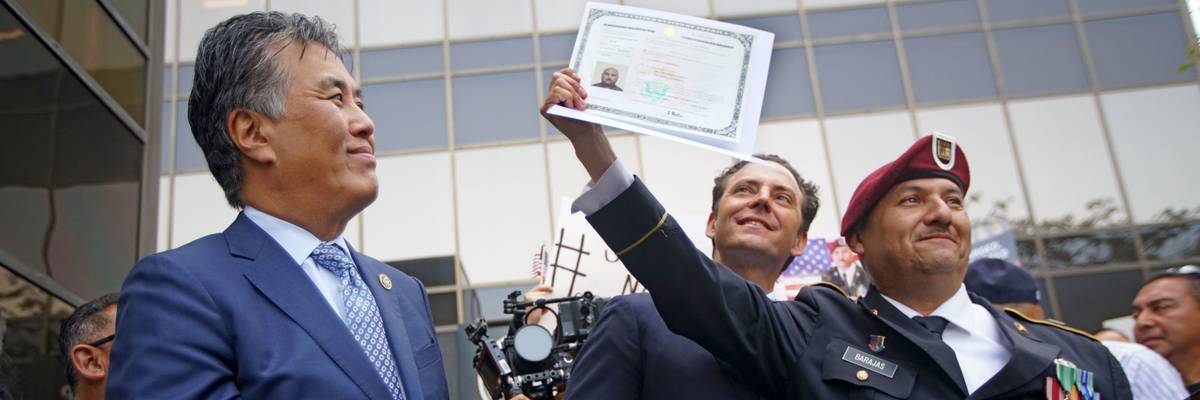
Hector Barajas shows his US citizen document with Nathan Fletcher and Congressman Mark Takano after a swear-in ceremony at the immigration office in Downtown San Diego, California on Friday, April 13, 2018.
Stripping citizens of their citizenship in the name of making the electorate more “American” is arguably one of the most un-American acts imaginable.
You might think that when you are a US citizen, you cannot have that status taken away. You would be wrong, it turns out. And behind that fact is a long and often ugly history.
On Sunday, President Donald Trump said that he would “absolutely” denaturalize American citizens if he could. It comes after a wave of harsh rhetoric directed toward immigrants after the tragic shooting of two National Guard members last week.
Yes, the words that the president says have been discounted. But there’s policy behind the rhetorical provocation.
Denaturalization is the process of stripping citizenship from someone who obtained it illegally, such as by not meeting the requirements or by committing fraud or lying during the application process. At first, government interpreted that standard loosely, leading to years of abuse.
As my colleagues Faiza Patel, Margy O’Herron, and Kendall Verhovek explain:
More than 22,000 Americans lost their citizenship between 1907 and 1967 based on political affiliations, race, and gender, according to denaturalization scholar Patrick Weil. President Woodrow Wilson’s administration began denaturalizing German- and Asian-born citizens during World War I, along with anarchists and people who spoke out against the war. During World War II, a push for denaturalization of naturalized citizens from Germany, Italy, and Japan intensified. A primary target included members of the pro-Nazi German-American Bund for disloyalty and insufficient attachment to the principles of the Constitution.
After the war, the Second Red Scare took hold of a country fearful of domestic communism amid its emergence abroad. Sen. Joseph McCarthy of Wisconsin led witch hunts, with denaturalization often used as a tool against accused communists or sympathizers. Among those targets was Harry Bridges, an Australian-born, nationally known labor leader accused of being a communist, who faced an ultimately unsuccessful campaign to revoke his citizenship. The Supreme Court ruled in his favor, not once, but twice.
As Weil puts it, a process that was intended to redress fraud and illegality in the naturalization process became used to “expel from the body politic ‘un-American’ citizens.” But even during wartime, the Supreme Court responded, limiting its use.
Throughout the 20th century, the court issued several rulings setting a high bar for denaturalization. In 1943, the court struck down a move to denaturalize Russian-born William Schneiderman over ties to the Communist Party, requiring a “heavy burden” for rescinding citizenship. And in 1946, the court warned against the use of denaturalization as a “ready instrument for political persecutions.” It’s why in recent decades, denaturalization attempts have been appropriately rare... until now.
Over the summer, Trump directed Justice Department lawyers to “maximally pursue denaturalization proceedings.” At the time, a spokesperson said that “denaturalization proceedings will only be pursued as permitted by law and supported by evidence against individuals who illegally procured or misrepresented facts in the naturalization process.” Trump’s parameters seem to be much broader. In his Thanksgiving Truth Social post, he said he would “denaturalize migrants who undermine domestic tranquility.”
Among his targets? Trump has repeatedly suggested that he is open to denaturalizing New York City Mayor-elect Zohran Mamdani and Rep. Ilhan Omar (D-Minn.). When asked about Elon Musk, he told the press, “We’ll have to take a look.” It appears that crime isn’t so much a motivation as disloyalty; the law isn’t so much a motivation as impulse.
But we shouldn’t mistake impulse for foolishness.
It’s all part of a broader effort to target the rights of immigrants and redefine who is an American. That started on Inauguration Day with the effort to eliminate birthright citizenship, a right that is explicitly in the Constitution. And it’s part of efforts to reverse what top administration officials have called a conspiracy to alter the makeup of the electorate. In an interview, the director of US Citizenship and Immigration Services, Joseph Edlow, accused previous administrations of admitting immigrants to “make them all citizens and then spread them out to try to change demographics elsewhere in the country.” And on the campaign trail last year, Trump adviser Stephen Miller declared, “America is for Americans and Americans only.”
Stripping citizens of their citizenship in the name of making the electorate more “American” is arguably one of the most un-American acts imaginable. More than a century ago, the Supreme Court held that naturalized citizens are on the same footing as those born in the country, and for decades, the Supreme Court has made clear that stripping citizens of their citizenship due to their views or expressions “would run counter to our traditions.”
We are a nation of immigrants and also a nation of laws. The courts must continue to ensure that those laws protect naturalized citizens from being punished for speaking out.
Dear Common Dreams reader, It’s been nearly 30 years since I co-founded Common Dreams with my late wife, Lina Newhouser. We had the radical notion that journalism should serve the public good, not corporate profits. It was clear to us from the outset what it would take to build such a project. No paid advertisements. No corporate sponsors. No millionaire publisher telling us what to think or do. Many people said we wouldn't last a year, but we proved those doubters wrong. Together with a tremendous team of journalists and dedicated staff, we built an independent media outlet free from the constraints of profits and corporate control. Our mission has always been simple: To inform. To inspire. To ignite change for the common good. Building Common Dreams was not easy. Our survival was never guaranteed. When you take on the most powerful forces—Wall Street greed, fossil fuel industry destruction, Big Tech lobbyists, and uber-rich oligarchs who have spent billions upon billions rigging the economy and democracy in their favor—the only bulwark you have is supporters who believe in your work. But here’s the urgent message from me today. It's never been this bad out there. And it's never been this hard to keep us going. At the very moment Common Dreams is most needed, the threats we face are intensifying. We need your support now more than ever. We don't accept corporate advertising and never will. We don't have a paywall because we don't think people should be blocked from critical news based on their ability to pay. Everything we do is funded by the donations of readers like you. When everyone does the little they can afford, we are strong. But if that support retreats or dries up, so do we. Will you donate now to make sure Common Dreams not only survives but thrives? —Craig Brown, Co-founder |
You might think that when you are a US citizen, you cannot have that status taken away. You would be wrong, it turns out. And behind that fact is a long and often ugly history.
On Sunday, President Donald Trump said that he would “absolutely” denaturalize American citizens if he could. It comes after a wave of harsh rhetoric directed toward immigrants after the tragic shooting of two National Guard members last week.
Yes, the words that the president says have been discounted. But there’s policy behind the rhetorical provocation.
Denaturalization is the process of stripping citizenship from someone who obtained it illegally, such as by not meeting the requirements or by committing fraud or lying during the application process. At first, government interpreted that standard loosely, leading to years of abuse.
As my colleagues Faiza Patel, Margy O’Herron, and Kendall Verhovek explain:
More than 22,000 Americans lost their citizenship between 1907 and 1967 based on political affiliations, race, and gender, according to denaturalization scholar Patrick Weil. President Woodrow Wilson’s administration began denaturalizing German- and Asian-born citizens during World War I, along with anarchists and people who spoke out against the war. During World War II, a push for denaturalization of naturalized citizens from Germany, Italy, and Japan intensified. A primary target included members of the pro-Nazi German-American Bund for disloyalty and insufficient attachment to the principles of the Constitution.
After the war, the Second Red Scare took hold of a country fearful of domestic communism amid its emergence abroad. Sen. Joseph McCarthy of Wisconsin led witch hunts, with denaturalization often used as a tool against accused communists or sympathizers. Among those targets was Harry Bridges, an Australian-born, nationally known labor leader accused of being a communist, who faced an ultimately unsuccessful campaign to revoke his citizenship. The Supreme Court ruled in his favor, not once, but twice.
As Weil puts it, a process that was intended to redress fraud and illegality in the naturalization process became used to “expel from the body politic ‘un-American’ citizens.” But even during wartime, the Supreme Court responded, limiting its use.
Throughout the 20th century, the court issued several rulings setting a high bar for denaturalization. In 1943, the court struck down a move to denaturalize Russian-born William Schneiderman over ties to the Communist Party, requiring a “heavy burden” for rescinding citizenship. And in 1946, the court warned against the use of denaturalization as a “ready instrument for political persecutions.” It’s why in recent decades, denaturalization attempts have been appropriately rare... until now.
Over the summer, Trump directed Justice Department lawyers to “maximally pursue denaturalization proceedings.” At the time, a spokesperson said that “denaturalization proceedings will only be pursued as permitted by law and supported by evidence against individuals who illegally procured or misrepresented facts in the naturalization process.” Trump’s parameters seem to be much broader. In his Thanksgiving Truth Social post, he said he would “denaturalize migrants who undermine domestic tranquility.”
Among his targets? Trump has repeatedly suggested that he is open to denaturalizing New York City Mayor-elect Zohran Mamdani and Rep. Ilhan Omar (D-Minn.). When asked about Elon Musk, he told the press, “We’ll have to take a look.” It appears that crime isn’t so much a motivation as disloyalty; the law isn’t so much a motivation as impulse.
But we shouldn’t mistake impulse for foolishness.
It’s all part of a broader effort to target the rights of immigrants and redefine who is an American. That started on Inauguration Day with the effort to eliminate birthright citizenship, a right that is explicitly in the Constitution. And it’s part of efforts to reverse what top administration officials have called a conspiracy to alter the makeup of the electorate. In an interview, the director of US Citizenship and Immigration Services, Joseph Edlow, accused previous administrations of admitting immigrants to “make them all citizens and then spread them out to try to change demographics elsewhere in the country.” And on the campaign trail last year, Trump adviser Stephen Miller declared, “America is for Americans and Americans only.”
Stripping citizens of their citizenship in the name of making the electorate more “American” is arguably one of the most un-American acts imaginable. More than a century ago, the Supreme Court held that naturalized citizens are on the same footing as those born in the country, and for decades, the Supreme Court has made clear that stripping citizens of their citizenship due to their views or expressions “would run counter to our traditions.”
We are a nation of immigrants and also a nation of laws. The courts must continue to ensure that those laws protect naturalized citizens from being punished for speaking out.
You might think that when you are a US citizen, you cannot have that status taken away. You would be wrong, it turns out. And behind that fact is a long and often ugly history.
On Sunday, President Donald Trump said that he would “absolutely” denaturalize American citizens if he could. It comes after a wave of harsh rhetoric directed toward immigrants after the tragic shooting of two National Guard members last week.
Yes, the words that the president says have been discounted. But there’s policy behind the rhetorical provocation.
Denaturalization is the process of stripping citizenship from someone who obtained it illegally, such as by not meeting the requirements or by committing fraud or lying during the application process. At first, government interpreted that standard loosely, leading to years of abuse.
As my colleagues Faiza Patel, Margy O’Herron, and Kendall Verhovek explain:
More than 22,000 Americans lost their citizenship between 1907 and 1967 based on political affiliations, race, and gender, according to denaturalization scholar Patrick Weil. President Woodrow Wilson’s administration began denaturalizing German- and Asian-born citizens during World War I, along with anarchists and people who spoke out against the war. During World War II, a push for denaturalization of naturalized citizens from Germany, Italy, and Japan intensified. A primary target included members of the pro-Nazi German-American Bund for disloyalty and insufficient attachment to the principles of the Constitution.
After the war, the Second Red Scare took hold of a country fearful of domestic communism amid its emergence abroad. Sen. Joseph McCarthy of Wisconsin led witch hunts, with denaturalization often used as a tool against accused communists or sympathizers. Among those targets was Harry Bridges, an Australian-born, nationally known labor leader accused of being a communist, who faced an ultimately unsuccessful campaign to revoke his citizenship. The Supreme Court ruled in his favor, not once, but twice.
As Weil puts it, a process that was intended to redress fraud and illegality in the naturalization process became used to “expel from the body politic ‘un-American’ citizens.” But even during wartime, the Supreme Court responded, limiting its use.
Throughout the 20th century, the court issued several rulings setting a high bar for denaturalization. In 1943, the court struck down a move to denaturalize Russian-born William Schneiderman over ties to the Communist Party, requiring a “heavy burden” for rescinding citizenship. And in 1946, the court warned against the use of denaturalization as a “ready instrument for political persecutions.” It’s why in recent decades, denaturalization attempts have been appropriately rare... until now.
Over the summer, Trump directed Justice Department lawyers to “maximally pursue denaturalization proceedings.” At the time, a spokesperson said that “denaturalization proceedings will only be pursued as permitted by law and supported by evidence against individuals who illegally procured or misrepresented facts in the naturalization process.” Trump’s parameters seem to be much broader. In his Thanksgiving Truth Social post, he said he would “denaturalize migrants who undermine domestic tranquility.”
Among his targets? Trump has repeatedly suggested that he is open to denaturalizing New York City Mayor-elect Zohran Mamdani and Rep. Ilhan Omar (D-Minn.). When asked about Elon Musk, he told the press, “We’ll have to take a look.” It appears that crime isn’t so much a motivation as disloyalty; the law isn’t so much a motivation as impulse.
But we shouldn’t mistake impulse for foolishness.
It’s all part of a broader effort to target the rights of immigrants and redefine who is an American. That started on Inauguration Day with the effort to eliminate birthright citizenship, a right that is explicitly in the Constitution. And it’s part of efforts to reverse what top administration officials have called a conspiracy to alter the makeup of the electorate. In an interview, the director of US Citizenship and Immigration Services, Joseph Edlow, accused previous administrations of admitting immigrants to “make them all citizens and then spread them out to try to change demographics elsewhere in the country.” And on the campaign trail last year, Trump adviser Stephen Miller declared, “America is for Americans and Americans only.”
Stripping citizens of their citizenship in the name of making the electorate more “American” is arguably one of the most un-American acts imaginable. More than a century ago, the Supreme Court held that naturalized citizens are on the same footing as those born in the country, and for decades, the Supreme Court has made clear that stripping citizens of their citizenship due to their views or expressions “would run counter to our traditions.”
We are a nation of immigrants and also a nation of laws. The courts must continue to ensure that those laws protect naturalized citizens from being punished for speaking out.