SUBSCRIBE TO OUR FREE NEWSLETTER
Daily news & progressive opinion—funded by the people, not the corporations—delivered straight to your inbox.
5
#000000
#FFFFFF
To donate by check, phone, or other method, see our More Ways to Give page.
Daily news & progressive opinion—funded by the people, not the corporations—delivered straight to your inbox.
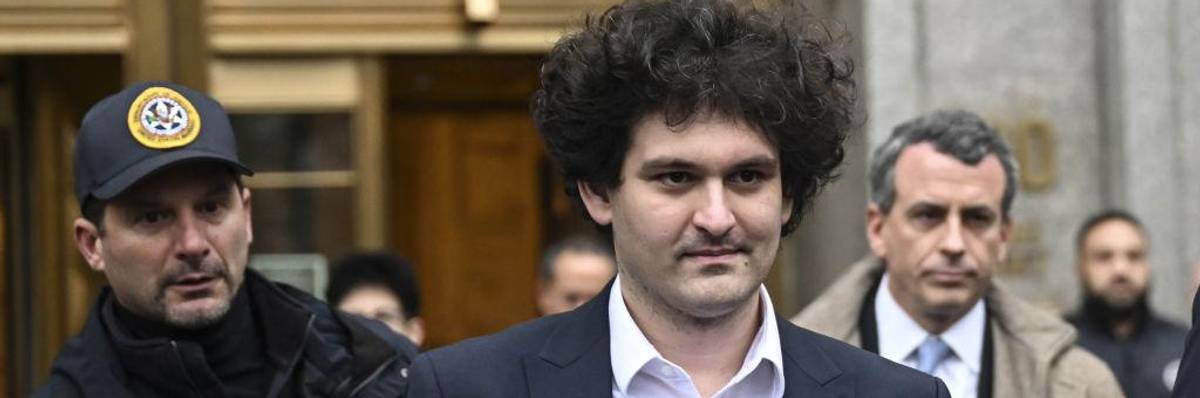
Sam Bankman-Fried leaves the court in New York, on January 03, 2023.
Larceny from our corporate world’s most “respected” chief execs supplies the con artists among us with rationalizations for their own scamming behaviors.
What makes for a thieving culture? An overabundance of pickpockets? Tsunamis of burglary and shoplifting?
Most definitely not. To truly gauge a society’s larcenous leanings, many of us would posit, we need to look beyond the nimble-fingered and focus more on the smooth-talkers, the power-suited flimflammers who thrive in any society where significant numbers of people feel a driving need to get rich quick.
The most recent example? Federal prosecutors last month charged the crypto currency CEO phenom Sam Bankman-Fried with committing “one of the biggest financial frauds in American history.” The 30-year-old billionaire, the Securities and Exchange Commission charges in a separate filing, built an immense financial empire on a “house of cards.”
The executive now trying to pick up those cards — the new CEO of Bankman-Fried’s FTX cryptocurrency exchange — says his predecessor simply engaged in “old-fashioned embezzlement,” not even stopping to bother with the “highly sophisticated” thieving of Enron’s fabled executive crooks a generation ago.
Right before Bankman-Fried’s brief appearance on America’s economic stage, the nation’s face of fraud belonged to Elizabeth Holmes, the founding CEO of the health-tech company Theranos.
Holmes raised some $900 million from a “star-studded” list of investors who ranged from media mogul Rupert Murdock to Henry Kissinger. Early in 2021, a federal jury convicted her of various frauds in what the Washington Post called “the most high-profile test of whether Silicon Valley’s “fake it until you make it” ethos could withstand legal scrutiny.”
The hustles of our Bankman-Frieds and Elizabeth Holmeses can certainly make for entertaining reading. But Freya Berry, a veteran corporate fraud investigator, sees their scams “as not as unusual as you might think” — and not as entertaining either. With “rewards high” and “penalties higher,” she notes, corporate miscreants “go to great pains to conceal” their nefarious ways, even “making death threats to whistleblowers.”
We need these whistleblowers. We also need to understand that our thieving culture rests on more than the outright larceny of our indicted corporate crooks. Our most accomplished corporate thieves, in fact, never fear indictment. They steal in broad daylight. They regularly steal livelihoods — from the thousands upon thousands of men and women who’ve worked ever so diligently, sometimes for many years, to make them fabulously rich.
We’re now living through an intense stretch of this theft. Tech’s top execs are now laying off workers at a fearsome rate. Earlier this month, Microsoft announced plans to pink-slip some 10,000 workers. Amazon is cutting 18,000, Google parent Alphabet 12,000, IBM nearly 4,000. Overall, estimates Forbes, tech firms have so far this month alone given the heave-ho to 56,000 employees.
What makes these layoffs “thefts”? Simple avarice. Investors on Wall Street “expected more growth,” explains Grid economics analyst Matthew Zeitlin, than Big Tech companies “are currently showing.” That has Big Tech share prices sinking, “and any time share prices fall, investors and executives get antsy — and workers often pay the price.”
Meanwhile, the antsy CEOs slashing all these jobs are continuing to stuff dollars into their own personal pockets, at overall pay rates that rarely dare drop below a quarter-million dollars a week.
This past October, Microsoft disclosed that chief exec Satya Nadella’s annual compensation had jumped 10.2 percent to just under $55 million. Nadella now makes more in one year than the typical Microsoft employee can make in 289 years. Back in 2018, the typical Microsoft worker only had to labor 154 years to earn what the company’s CEO made in just one.
This past December brought news that Alphabet’s Sundar Pichai has a new three-year “performance” package that stands to award him $210 million.
Execs like these set a thieving tone for our entire society. Their grand fortunes don’t just make the rest of us feel ever poorer. They leave us ever more vulnerable to the con artists who promise shortcuts to jackpots.
And this larceny from our corporate world’s most “respected” chief execs supplies the con artists among us with rationalizations for their own scamming behaviors. The corporate big boys play their games, they tell themselves, we play ours.
Societies that let enormous wealth concentrate in the pockets of a few make all this inevitable. They nurture greed and grasping. They always have. They always will.
This country and this world are at a monumental crossroads. US voters have an opportunity to beat back the forces of fascism and confront the billionaires who are rigging the economy, our media system, and our democracy, making it increasingly impossible for ordinary people to get by. We’re not just talking about the election. We’re talking about what must be done once these fascist elements are vanquished from power. We need a bolder set of solutions than what either major party has so far been willing to offer and a working-class movement ready to fight like hell for it. Trump didn't emerge from nowhere. The conditions that fueled MAGA authoritarianism were created by decades of radical neoliberal economic policies and a corrupt political system dominated by corporate interests. They slashed taxes on the super-rich, promising that the benefits would trickle down. They said giveaways to the corporate titans would make life more affordable for the rest of us. It was all bullshit. And when a bitter, betrayed populace searches for someone to blame, right-wing demagogues have little trouble finding scapegoats. People know when they're being lied to, but you won't hear any of this from the corporate media. Only independent journalism—powered and funded by people who believe in building a better world—can deliver truly trustworthy daily news. If you share our vision, please contribute whatever you can to sustain our work. |
What makes for a thieving culture? An overabundance of pickpockets? Tsunamis of burglary and shoplifting?
Most definitely not. To truly gauge a society’s larcenous leanings, many of us would posit, we need to look beyond the nimble-fingered and focus more on the smooth-talkers, the power-suited flimflammers who thrive in any society where significant numbers of people feel a driving need to get rich quick.
The most recent example? Federal prosecutors last month charged the crypto currency CEO phenom Sam Bankman-Fried with committing “one of the biggest financial frauds in American history.” The 30-year-old billionaire, the Securities and Exchange Commission charges in a separate filing, built an immense financial empire on a “house of cards.”
The executive now trying to pick up those cards — the new CEO of Bankman-Fried’s FTX cryptocurrency exchange — says his predecessor simply engaged in “old-fashioned embezzlement,” not even stopping to bother with the “highly sophisticated” thieving of Enron’s fabled executive crooks a generation ago.
Right before Bankman-Fried’s brief appearance on America’s economic stage, the nation’s face of fraud belonged to Elizabeth Holmes, the founding CEO of the health-tech company Theranos.
Holmes raised some $900 million from a “star-studded” list of investors who ranged from media mogul Rupert Murdock to Henry Kissinger. Early in 2021, a federal jury convicted her of various frauds in what the Washington Post called “the most high-profile test of whether Silicon Valley’s “fake it until you make it” ethos could withstand legal scrutiny.”
The hustles of our Bankman-Frieds and Elizabeth Holmeses can certainly make for entertaining reading. But Freya Berry, a veteran corporate fraud investigator, sees their scams “as not as unusual as you might think” — and not as entertaining either. With “rewards high” and “penalties higher,” she notes, corporate miscreants “go to great pains to conceal” their nefarious ways, even “making death threats to whistleblowers.”
We need these whistleblowers. We also need to understand that our thieving culture rests on more than the outright larceny of our indicted corporate crooks. Our most accomplished corporate thieves, in fact, never fear indictment. They steal in broad daylight. They regularly steal livelihoods — from the thousands upon thousands of men and women who’ve worked ever so diligently, sometimes for many years, to make them fabulously rich.
We’re now living through an intense stretch of this theft. Tech’s top execs are now laying off workers at a fearsome rate. Earlier this month, Microsoft announced plans to pink-slip some 10,000 workers. Amazon is cutting 18,000, Google parent Alphabet 12,000, IBM nearly 4,000. Overall, estimates Forbes, tech firms have so far this month alone given the heave-ho to 56,000 employees.
What makes these layoffs “thefts”? Simple avarice. Investors on Wall Street “expected more growth,” explains Grid economics analyst Matthew Zeitlin, than Big Tech companies “are currently showing.” That has Big Tech share prices sinking, “and any time share prices fall, investors and executives get antsy — and workers often pay the price.”
Meanwhile, the antsy CEOs slashing all these jobs are continuing to stuff dollars into their own personal pockets, at overall pay rates that rarely dare drop below a quarter-million dollars a week.
This past October, Microsoft disclosed that chief exec Satya Nadella’s annual compensation had jumped 10.2 percent to just under $55 million. Nadella now makes more in one year than the typical Microsoft employee can make in 289 years. Back in 2018, the typical Microsoft worker only had to labor 154 years to earn what the company’s CEO made in just one.
This past December brought news that Alphabet’s Sundar Pichai has a new three-year “performance” package that stands to award him $210 million.
Execs like these set a thieving tone for our entire society. Their grand fortunes don’t just make the rest of us feel ever poorer. They leave us ever more vulnerable to the con artists who promise shortcuts to jackpots.
And this larceny from our corporate world’s most “respected” chief execs supplies the con artists among us with rationalizations for their own scamming behaviors. The corporate big boys play their games, they tell themselves, we play ours.
Societies that let enormous wealth concentrate in the pockets of a few make all this inevitable. They nurture greed and grasping. They always have. They always will.