SUBSCRIBE TO OUR FREE NEWSLETTER
Daily news & progressive opinion—funded by the people, not the corporations—delivered straight to your inbox.
5
#000000
#FFFFFF
To donate by check, phone, or other method, see our More Ways to Give page.
Daily news & progressive opinion—funded by the people, not the corporations—delivered straight to your inbox.
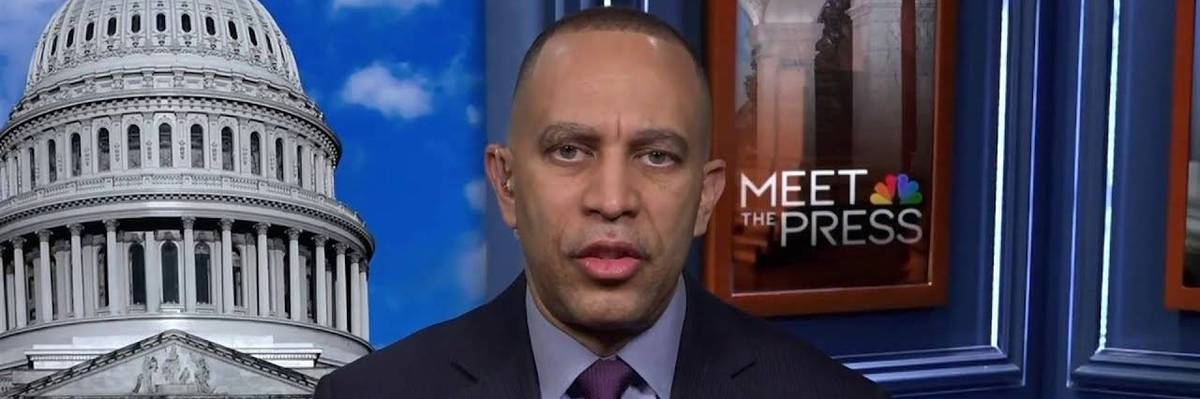
Democratic House Majority Leader Hakeem Jeffries told viewers of NBC’s “Meet the Press” that he no longer supports Medicare for All on Sunday, August 16, 2026.
The so-called "party leader" is failing fantastically when it comes to building a United Front to defeat Donald Trump's fascism.
In the almost-over primary season, Democratic voters chose a mix of progressive nominees like Abdul El Sayed, Peggy Flanagan and Angie Nixon and moderates like David Crowley and Jared Moscowitz, often by slim margins. These candidates often disagreed on issues like Medicare For All and military aide for Israel.
But in the 11 weeks between now and the general election, Democrats progressives and moderates need to form a United Front to take back the Senate and House and have checks and balances on an increasingly unhinged fascistic Donald Trump. As I pointed out in Common Dreams last week, in 1930s Germany moderately left and far left parties fought against each other as hard as they fought against the Nazis and ended up with Hitler in power who outlawed them both and sent them to prisons and eventually concentration camps.
Until Election Day, Democratic leaders need to encourage a United Front against fascism.
But that's the opposite of what House Democratic leader Hakeem Jeffries is doing. He squarely took the side of the so-called moderates and attacked the progressives.
On Meet The Press, host Kristen Welker mentioned that Jeffries co-sponsored Medicare For All legislation for ten years from 2013-2021 but hasn't co-sponsored it since he became Democratic House leader. She asked him if he would even put Medicare For All up for a vote if he became speaker.
Jeffries repeatedly evaded answering the question, but then finally declared: “It's not legislation that I currently am cosponsoring or that I support.” He would not even promise to put it up for a vote. At least 104 current Democratic House members are co-sponsors of Medicare For All legislations and Jeffries won't even promise to give them a chance to vote on it.
This despite the fact that recent polls show that 65% of voters, including 78% of Democrats, 71% of independents and even 49% of Republicans support Medicare For All. And even after respondents were told that Medicare for All would eliminate most private insurance and require higher taxes, support remained above 60 percent.
(It's worth noting that in the current election cycle, Jeffries has received $391,000 of campaign cash from the healthcare sector’s political action committees.)
Jeffries then went on to attack the Democratic Socialists of America telling Meet The Press, "I don't support the DSA agenda as has been articulated by the DSA itself." But his attacks on the DSA focused just on three positions which may have been taken in the past by small factions of the DSA, like defunding the police, open border, and abolishing the Senate. None of these positions are backed by actual DSA candidates who have won Democratic primaries.
Jeffries deciding to put his thumbs on the scale and back one sector of the Democratic Party is directly contrary to the role of a party leader whose job should be to unite the party to win the House and Senate in the General Election.
As Adam Jentleson, former chief of staff to the late Democratic Senate leader Harry Reid wrote in The New York Times, "It is not up to party leaders or the Democratic National Committee to litigate whether a candidate’s views are acceptable; the voters of a state or district decide. The coalition that passed the New Deal included everyone from a Communist sympathizer to self-avowed white supremacists, putting the compromises asked of us today in perspective."
Dear Common Dreams reader, It’s been nearly 30 years since I co-founded Common Dreams with my late wife, Lina Newhouser. We had the radical notion that journalism should serve the public good, not corporate profits. It was clear to us from the outset what it would take to build such a project. No paid advertisements. No corporate sponsors. No millionaire publisher telling us what to think or do. Many people said we wouldn't last a year, but we proved those doubters wrong. Together with a tremendous team of journalists and dedicated staff, we built an independent media outlet free from the constraints of profits and corporate control. Our mission has always been simple: To inform. To inspire. To ignite change for the common good. Building Common Dreams was not easy. Our survival was never guaranteed. When you take on the most powerful forces—Wall Street greed, fossil fuel industry destruction, Big Tech lobbyists, and uber-rich oligarchs who have spent billions upon billions rigging the economy and democracy in their favor—the only bulwark you have is supporters who believe in your work. But here’s the urgent message from me today. It's never been this bad out there. And it's never been this hard to keep us going. At the very moment Common Dreams is most needed, the threats we face are intensifying. We need your support now more than ever. We don't accept corporate advertising and never will. We don't have a paywall because we don't think people should be blocked from critical news based on their ability to pay. Everything we do is funded by the donations of readers like you. When everyone does the little they can afford, we are strong. But if that support retreats or dries up, so do we. Will you donate now to make sure Common Dreams not only survives but thrives? —Craig Brown, Co-founder |
In the almost-over primary season, Democratic voters chose a mix of progressive nominees like Abdul El Sayed, Peggy Flanagan and Angie Nixon and moderates like David Crowley and Jared Moscowitz, often by slim margins. These candidates often disagreed on issues like Medicare For All and military aide for Israel.
But in the 11 weeks between now and the general election, Democrats progressives and moderates need to form a United Front to take back the Senate and House and have checks and balances on an increasingly unhinged fascistic Donald Trump. As I pointed out in Common Dreams last week, in 1930s Germany moderately left and far left parties fought against each other as hard as they fought against the Nazis and ended up with Hitler in power who outlawed them both and sent them to prisons and eventually concentration camps.
Until Election Day, Democratic leaders need to encourage a United Front against fascism.
But that's the opposite of what House Democratic leader Hakeem Jeffries is doing. He squarely took the side of the so-called moderates and attacked the progressives.
On Meet The Press, host Kristen Welker mentioned that Jeffries co-sponsored Medicare For All legislation for ten years from 2013-2021 but hasn't co-sponsored it since he became Democratic House leader. She asked him if he would even put Medicare For All up for a vote if he became speaker.
Jeffries repeatedly evaded answering the question, but then finally declared: “It's not legislation that I currently am cosponsoring or that I support.” He would not even promise to put it up for a vote. At least 104 current Democratic House members are co-sponsors of Medicare For All legislations and Jeffries won't even promise to give them a chance to vote on it.
This despite the fact that recent polls show that 65% of voters, including 78% of Democrats, 71% of independents and even 49% of Republicans support Medicare For All. And even after respondents were told that Medicare for All would eliminate most private insurance and require higher taxes, support remained above 60 percent.
(It's worth noting that in the current election cycle, Jeffries has received $391,000 of campaign cash from the healthcare sector’s political action committees.)
Jeffries then went on to attack the Democratic Socialists of America telling Meet The Press, "I don't support the DSA agenda as has been articulated by the DSA itself." But his attacks on the DSA focused just on three positions which may have been taken in the past by small factions of the DSA, like defunding the police, open border, and abolishing the Senate. None of these positions are backed by actual DSA candidates who have won Democratic primaries.
Jeffries deciding to put his thumbs on the scale and back one sector of the Democratic Party is directly contrary to the role of a party leader whose job should be to unite the party to win the House and Senate in the General Election.
As Adam Jentleson, former chief of staff to the late Democratic Senate leader Harry Reid wrote in The New York Times, "It is not up to party leaders or the Democratic National Committee to litigate whether a candidate’s views are acceptable; the voters of a state or district decide. The coalition that passed the New Deal included everyone from a Communist sympathizer to self-avowed white supremacists, putting the compromises asked of us today in perspective."
In the almost-over primary season, Democratic voters chose a mix of progressive nominees like Abdul El Sayed, Peggy Flanagan and Angie Nixon and moderates like David Crowley and Jared Moscowitz, often by slim margins. These candidates often disagreed on issues like Medicare For All and military aide for Israel.
But in the 11 weeks between now and the general election, Democrats progressives and moderates need to form a United Front to take back the Senate and House and have checks and balances on an increasingly unhinged fascistic Donald Trump. As I pointed out in Common Dreams last week, in 1930s Germany moderately left and far left parties fought against each other as hard as they fought against the Nazis and ended up with Hitler in power who outlawed them both and sent them to prisons and eventually concentration camps.
Until Election Day, Democratic leaders need to encourage a United Front against fascism.
But that's the opposite of what House Democratic leader Hakeem Jeffries is doing. He squarely took the side of the so-called moderates and attacked the progressives.
On Meet The Press, host Kristen Welker mentioned that Jeffries co-sponsored Medicare For All legislation for ten years from 2013-2021 but hasn't co-sponsored it since he became Democratic House leader. She asked him if he would even put Medicare For All up for a vote if he became speaker.
Jeffries repeatedly evaded answering the question, but then finally declared: “It's not legislation that I currently am cosponsoring or that I support.” He would not even promise to put it up for a vote. At least 104 current Democratic House members are co-sponsors of Medicare For All legislations and Jeffries won't even promise to give them a chance to vote on it.
This despite the fact that recent polls show that 65% of voters, including 78% of Democrats, 71% of independents and even 49% of Republicans support Medicare For All. And even after respondents were told that Medicare for All would eliminate most private insurance and require higher taxes, support remained above 60 percent.
(It's worth noting that in the current election cycle, Jeffries has received $391,000 of campaign cash from the healthcare sector’s political action committees.)
Jeffries then went on to attack the Democratic Socialists of America telling Meet The Press, "I don't support the DSA agenda as has been articulated by the DSA itself." But his attacks on the DSA focused just on three positions which may have been taken in the past by small factions of the DSA, like defunding the police, open border, and abolishing the Senate. None of these positions are backed by actual DSA candidates who have won Democratic primaries.
Jeffries deciding to put his thumbs on the scale and back one sector of the Democratic Party is directly contrary to the role of a party leader whose job should be to unite the party to win the House and Senate in the General Election.
As Adam Jentleson, former chief of staff to the late Democratic Senate leader Harry Reid wrote in The New York Times, "It is not up to party leaders or the Democratic National Committee to litigate whether a candidate’s views are acceptable; the voters of a state or district decide. The coalition that passed the New Deal included everyone from a Communist sympathizer to self-avowed white supremacists, putting the compromises asked of us today in perspective."