SUBSCRIBE TO OUR FREE NEWSLETTER
Daily news & progressive opinion—funded by the people, not the corporations—delivered straight to your inbox.
5
#000000
#FFFFFF
To donate by check, phone, or other method, see our More Ways to Give page.
Daily news & progressive opinion—funded by the people, not the corporations—delivered straight to your inbox.
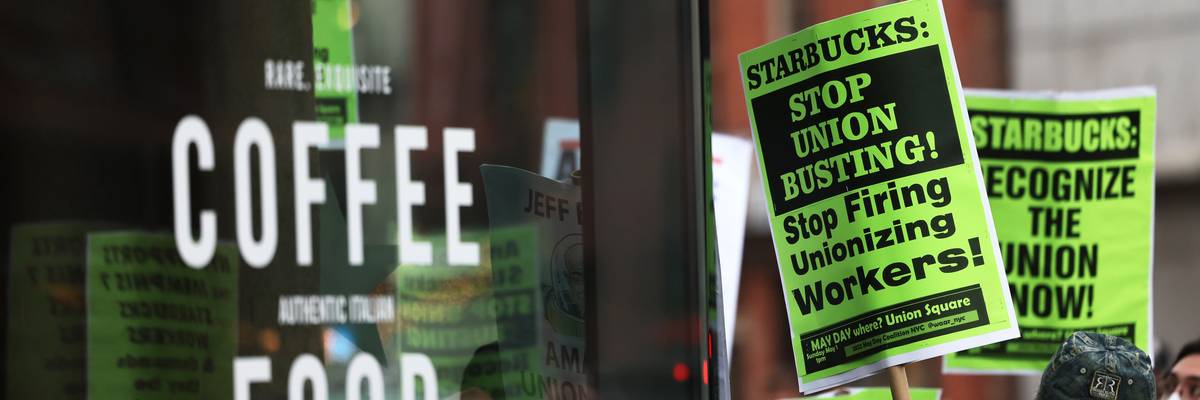
People hold signs while protesting in front of Starbucks on April 14, 2022 in New York City.
Union baristas have shown that our collective power can win meaningful change, and now we’re calling on organizations, political parties, and elected officials to stand with us and boycott Starbucks until our demands are met.
Walking into a Starbucks means being greeted with the sounds of lively lobby conversation, milk being steamed, and baristas chatting with customers. As a customer you might love coming to Starbucks to customize your drink, enjoy a third space, or see your favorite barista.
I thrive in this environment, and I love connecting with my customers as a barista. I love my job, but Starbucks has shown us it has forgotten about baristas like me.
That’s why I’m joining my coworkers in calling on everyone who supports working people over corporations to boycott Starbucks.
It would cost Starbucks less than a single day’s sales to agree to a fair contract that would ensure we’re treated fairly—why wouldn’t the company want that?
Starbucks has lost its way. Workers like myself are trying our hardest to show up for our customers, but Starbucks continues to make our jobs difficult—from creating massive amounts of waste, extra costs, and work for us with the company’s failed AI inventory tool to introducing new beverage components that have put our health and safety at real risk.
The most alluring benefit to many Starbucks applicants—including me—is the promise of health insurance coverage. Now, Starbucks is raising health insurance premiums, forcing some workers to pay up to twice as much as before.
Starbucks wages start at just $15.25 or $16 an hour in 43 states. Many of us already struggle to get enough hours to pay rent or even qualify for health insurance, leaving some of us to rely on the Supplemental Nutrition Assistance Program and Medicaid because Starbucks’ coverage is out of reach.
For years, baristas have shined a light on systemic issues at Starbucks including understaffing, chaotic scheduling, low wages, and too-few hours to qualify for the company’s benefits. Over the past five years, we’ve organized over 12,000 baristas who are fighting for a fair union contract that locks in better pay, better staffing, and enough hours to live on.
Still, Starbucks refuses to finalize a fair union contract after nearly half a decade of negotiations. Starbucks has to do more to earn the moniker “the best job in retail.”
This is exactly why we’re fed up, fired up, and united more than ever in our fight for a fair union contract. It would cost Starbucks less than a single day’s sales to agree to a fair contract that would ensure we’re treated fairly—why wouldn’t the company want that?
Union baristas have shown that our collective power can win meaningful change, and now we’re calling on organizations, political parties, and elected officials to stand with us and boycott Starbucks until our demands are met. Solidarity with baristas brought the company back to the bargaining table before, and we can do it again to take negotiations over the finish line to finalize a contract.
The truth is corporate leadership at Starbucks is out of touch and the poster child of corporate greed.
As the baristas who fuel the company’s struggle to make ends meet, CEO Brian Niccol brags about a $9 coffee as he rakes in tens of millions and commutes to work in a private jet. Our CEO-to-worker pay ratio in 2025 was a staggering 1,794 to 1.
For too long, Starbucks has behaved like it’s above the law, racking up more labor law violations than any company in modern US history.
We want change from Niccol, not platitudes. We want compensation for the value we create, not just a pat on the back, and we want our contract finalized.
This country and this world are at a monumental crossroads. US voters have an opportunity to beat back the forces of fascism and confront the billionaires who are rigging the economy, our media system, and our democracy, making it increasingly impossible for ordinary people to get by. We’re not just talking about the election. We’re talking about what must be done once these fascist elements are vanquished from power. We need a bolder set of solutions than what either major party has so far been willing to offer and a working-class movement ready to fight like hell for it. Trump didn't emerge from nowhere. The conditions that fueled MAGA authoritarianism were created by decades of radical neoliberal economic policies and a corrupt political system dominated by corporate interests. They slashed taxes on the super-rich, promising that the benefits would trickle down. They said giveaways to the corporate titans would make life more affordable for the rest of us. It was all bullshit. And when a bitter, betrayed populace searches for someone to blame, right-wing demagogues have little trouble finding scapegoats. People know when they're being lied to, but you won't hear any of this from the corporate media. Only independent journalism—powered and funded by people who believe in building a better world—can deliver truly trustworthy daily news. If you share our vision, please contribute whatever you can to sustain our work. |
Walking into a Starbucks means being greeted with the sounds of lively lobby conversation, milk being steamed, and baristas chatting with customers. As a customer you might love coming to Starbucks to customize your drink, enjoy a third space, or see your favorite barista.
I thrive in this environment, and I love connecting with my customers as a barista. I love my job, but Starbucks has shown us it has forgotten about baristas like me.
That’s why I’m joining my coworkers in calling on everyone who supports working people over corporations to boycott Starbucks.
It would cost Starbucks less than a single day’s sales to agree to a fair contract that would ensure we’re treated fairly—why wouldn’t the company want that?
Starbucks has lost its way. Workers like myself are trying our hardest to show up for our customers, but Starbucks continues to make our jobs difficult—from creating massive amounts of waste, extra costs, and work for us with the company’s failed AI inventory tool to introducing new beverage components that have put our health and safety at real risk.
The most alluring benefit to many Starbucks applicants—including me—is the promise of health insurance coverage. Now, Starbucks is raising health insurance premiums, forcing some workers to pay up to twice as much as before.
Starbucks wages start at just $15.25 or $16 an hour in 43 states. Many of us already struggle to get enough hours to pay rent or even qualify for health insurance, leaving some of us to rely on the Supplemental Nutrition Assistance Program and Medicaid because Starbucks’ coverage is out of reach.
For years, baristas have shined a light on systemic issues at Starbucks including understaffing, chaotic scheduling, low wages, and too-few hours to qualify for the company’s benefits. Over the past five years, we’ve organized over 12,000 baristas who are fighting for a fair union contract that locks in better pay, better staffing, and enough hours to live on.
Still, Starbucks refuses to finalize a fair union contract after nearly half a decade of negotiations. Starbucks has to do more to earn the moniker “the best job in retail.”
This is exactly why we’re fed up, fired up, and united more than ever in our fight for a fair union contract. It would cost Starbucks less than a single day’s sales to agree to a fair contract that would ensure we’re treated fairly—why wouldn’t the company want that?
Union baristas have shown that our collective power can win meaningful change, and now we’re calling on organizations, political parties, and elected officials to stand with us and boycott Starbucks until our demands are met. Solidarity with baristas brought the company back to the bargaining table before, and we can do it again to take negotiations over the finish line to finalize a contract.
The truth is corporate leadership at Starbucks is out of touch and the poster child of corporate greed.
As the baristas who fuel the company’s struggle to make ends meet, CEO Brian Niccol brags about a $9 coffee as he rakes in tens of millions and commutes to work in a private jet. Our CEO-to-worker pay ratio in 2025 was a staggering 1,794 to 1.
For too long, Starbucks has behaved like it’s above the law, racking up more labor law violations than any company in modern US history.
We want change from Niccol, not platitudes. We want compensation for the value we create, not just a pat on the back, and we want our contract finalized.