SUBSCRIBE TO OUR FREE NEWSLETTER
Daily news & progressive opinion—funded by the people, not the corporations—delivered straight to your inbox.
5
#000000
#FFFFFF
To donate by check, phone, or other method, see our More Ways to Give page.
Daily news & progressive opinion—funded by the people, not the corporations—delivered straight to your inbox.
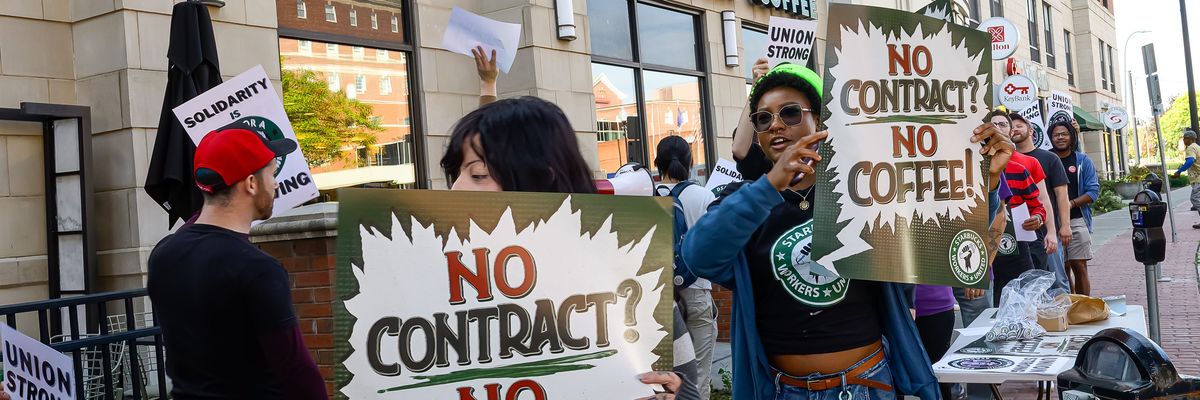
Protesters rally outside the Starbucks at 62 New Scotland Avenue on Saturday, September 27, 2025, in Albany, New York.
As its workers fight for a living wage and for the company to address hundreds of labor violation complaints, Starbucks Workers United says it's prepared for the "biggest and longest" strike in the company's history.
As hundreds of Starbucks workers go on strike across the US to protest the company's unfair labor practices, its union is telling customers to boycott the company in hopes of pressuring it to return to the bargaining table to negotiate its first union contract.
“As of today, Starbucks workers across the country are officially ON STRIKE,” said Starbucks Workers United, the union representing nearly 10,000 baristas, on social media Thursday. “We’re prepared for this to become the biggest and longest [unfair labor practices] strike in Starbucks history.”
The union implored customers: "DON'T BUY STARBUCKS for the duration of our open-ended ULP strike!"
The strike comes after negotiations between the union and the company stalled out in April. Last week, 92% of union baristas voted to authorize a strike as the company's lucrative holiday season began. They are hoping to turn the company’s annual “Red Cup Day,” during which it gives out free reusable cups to customers, into a “Red Cup Rebellion.”
The union says three of its core demands remain unmet. It has called for the company to address "rampant" understaffing, which it says has led to longer wait times for customers and overwhelmed staff, while simultaneously leaving workers without enough hours to afford the cost of living.
It also seeks higher take-home pay for workers. Starting baristas make just over $15 per hour, which data from MIT shows is not enough to afford the cost of living in any US state when working 40 hours a week. According to the union, most Starbucks workers receive fewer than 20 hours of work per week, rendering them ineligible for benefits.
The union has drawn a contrast between its workers' pay, which averages less than $15,000 a year, and that of CEO Brian Niccol, who raked in a total compensation package of $96 million in just four months after taking over last year.
"Too many of us rely on SNAP or Medicaid just to get by, and most baristas still don’t earn a livable wage. In a majority of states, starting pay is just $15.25 an hour—and even then, we’re not getting the 20 hours a week we need to qualify for benefits," said Jasmine Leli, a barista and strike captain from Buffalo, New York, where the first Starbucks store in the nation voted to unionize back in 2021.
The company has gone nearly four years without recognizing it. While it claims to have engaged with the union in "good faith," the National Labor Relations Board (NLRB) has found Starbucks guilty of over 500 labor law violations, making it the worst violator in modern history.
These have included illegal firings and disciplinary actions against union organizers, the illegal withholding of wages and benefits, threats to close stores that unionize, and illegal surveillance of employees. More than 700 unfair labor practice charges made against the company remain unresolved, including 125 of them filed since January.
According to an estimate from the Strategic Organizing Center, Starbucks' union-busting had cost the company more than $240 million through February 2024. That money was lost in the form of legal fees and payments to consultants, as well as productivity lost due to anti-union store closures and captive audience meetings.
“Things have only gone backwards at Starbucks under Niccol’s leadership," Leli said. "But a fair union contract and the resolution of hundreds of unfair labor practice charges are essential to the company’s turnaround."
The union has argued that in order to meet their demands for a fair contract, it would cost less than a single day's sales.
The strike begins just days after 85 US lawmakers—led by Sen. Bernie Sanders (I-Vt.) and Rep. Pramila Jayapal (D-Wash.)—sent letters demanding that the company stop union-busting and negotiate a fair deal with its employees.
"Starbucks is not a poor company," the Senate letter said to Niccol. "Last year, Starbucks made over $3.6 billion in profit and paid out nearly $5 billion in stock buybacks and dividends. In fact, in the first three quarters of the year, Starbucks made $1.7 billion in profit and paid out over $2 billion in dividends. Last year, you made $95 million in compensation for the four months you worked in 2024, roughly 6,666 times more than what your average worker was paid for the entire year."
"Despite that extravagant spending on executives and shareholders, Starbucks refuses to reach an agreement with its own workers even though you are less than one average day’s sales apart from a contract," it continued. "Starbucks must reverse course from its current posture, resolve its existing labor disputes, and bargain a fair contract in good faith with these employees."
The strike will begin at 65 stores across more than 40 US cities, with rallies scheduled in New York, Philadelphia, Chicago, Columbus, and Anaheim, among other locations. The union said the strike is "open-ended," with no set end date, and that baristas across more than 550 unionized stores across the country are prepared to join in.
“If Starbucks keeps stonewalling a fair contract and refusing to end union-busting, they’ll see their business grind to a halt,” said Michelle Eisen, a spokesperson for Starbucks Workers United, who has worked as a barista for 15 years. “'No contract, no coffee' is more than a tagline—it’s a pledge to interrupt Starbucks’ operations and profits until a fair union contract and an end to unfair labor practices are won."
Dear Common Dreams reader, It’s been nearly 30 years since I co-founded Common Dreams with my late wife, Lina Newhouser. We had the radical notion that journalism should serve the public good, not corporate profits. It was clear to us from the outset what it would take to build such a project. No paid advertisements. No corporate sponsors. No millionaire publisher telling us what to think or do. Many people said we wouldn't last a year, but we proved those doubters wrong. Together with a tremendous team of journalists and dedicated staff, we built an independent media outlet free from the constraints of profits and corporate control. Our mission has always been simple: To inform. To inspire. To ignite change for the common good. Building Common Dreams was not easy. Our survival was never guaranteed. When you take on the most powerful forces—Wall Street greed, fossil fuel industry destruction, Big Tech lobbyists, and uber-rich oligarchs who have spent billions upon billions rigging the economy and democracy in their favor—the only bulwark you have is supporters who believe in your work. But here’s the urgent message from me today. It's never been this bad out there. And it's never been this hard to keep us going. At the very moment Common Dreams is most needed, the threats we face are intensifying. We need your support now more than ever. We don't accept corporate advertising and never will. We don't have a paywall because we don't think people should be blocked from critical news based on their ability to pay. Everything we do is funded by the donations of readers like you. When everyone does the little they can afford, we are strong. But if that support retreats or dries up, so do we. Will you donate now to make sure Common Dreams not only survives but thrives? —Craig Brown, Co-founder |
As hundreds of Starbucks workers go on strike across the US to protest the company's unfair labor practices, its union is telling customers to boycott the company in hopes of pressuring it to return to the bargaining table to negotiate its first union contract.
“As of today, Starbucks workers across the country are officially ON STRIKE,” said Starbucks Workers United, the union representing nearly 10,000 baristas, on social media Thursday. “We’re prepared for this to become the biggest and longest [unfair labor practices] strike in Starbucks history.”
The union implored customers: "DON'T BUY STARBUCKS for the duration of our open-ended ULP strike!"
The strike comes after negotiations between the union and the company stalled out in April. Last week, 92% of union baristas voted to authorize a strike as the company's lucrative holiday season began. They are hoping to turn the company’s annual “Red Cup Day,” during which it gives out free reusable cups to customers, into a “Red Cup Rebellion.”
The union says three of its core demands remain unmet. It has called for the company to address "rampant" understaffing, which it says has led to longer wait times for customers and overwhelmed staff, while simultaneously leaving workers without enough hours to afford the cost of living.
It also seeks higher take-home pay for workers. Starting baristas make just over $15 per hour, which data from MIT shows is not enough to afford the cost of living in any US state when working 40 hours a week. According to the union, most Starbucks workers receive fewer than 20 hours of work per week, rendering them ineligible for benefits.
The union has drawn a contrast between its workers' pay, which averages less than $15,000 a year, and that of CEO Brian Niccol, who raked in a total compensation package of $96 million in just four months after taking over last year.
"Too many of us rely on SNAP or Medicaid just to get by, and most baristas still don’t earn a livable wage. In a majority of states, starting pay is just $15.25 an hour—and even then, we’re not getting the 20 hours a week we need to qualify for benefits," said Jasmine Leli, a barista and strike captain from Buffalo, New York, where the first Starbucks store in the nation voted to unionize back in 2021.
The company has gone nearly four years without recognizing it. While it claims to have engaged with the union in "good faith," the National Labor Relations Board (NLRB) has found Starbucks guilty of over 500 labor law violations, making it the worst violator in modern history.
These have included illegal firings and disciplinary actions against union organizers, the illegal withholding of wages and benefits, threats to close stores that unionize, and illegal surveillance of employees. More than 700 unfair labor practice charges made against the company remain unresolved, including 125 of them filed since January.
According to an estimate from the Strategic Organizing Center, Starbucks' union-busting had cost the company more than $240 million through February 2024. That money was lost in the form of legal fees and payments to consultants, as well as productivity lost due to anti-union store closures and captive audience meetings.
“Things have only gone backwards at Starbucks under Niccol’s leadership," Leli said. "But a fair union contract and the resolution of hundreds of unfair labor practice charges are essential to the company’s turnaround."
The union has argued that in order to meet their demands for a fair contract, it would cost less than a single day's sales.
The strike begins just days after 85 US lawmakers—led by Sen. Bernie Sanders (I-Vt.) and Rep. Pramila Jayapal (D-Wash.)—sent letters demanding that the company stop union-busting and negotiate a fair deal with its employees.
"Starbucks is not a poor company," the Senate letter said to Niccol. "Last year, Starbucks made over $3.6 billion in profit and paid out nearly $5 billion in stock buybacks and dividends. In fact, in the first three quarters of the year, Starbucks made $1.7 billion in profit and paid out over $2 billion in dividends. Last year, you made $95 million in compensation for the four months you worked in 2024, roughly 6,666 times more than what your average worker was paid for the entire year."
"Despite that extravagant spending on executives and shareholders, Starbucks refuses to reach an agreement with its own workers even though you are less than one average day’s sales apart from a contract," it continued. "Starbucks must reverse course from its current posture, resolve its existing labor disputes, and bargain a fair contract in good faith with these employees."
The strike will begin at 65 stores across more than 40 US cities, with rallies scheduled in New York, Philadelphia, Chicago, Columbus, and Anaheim, among other locations. The union said the strike is "open-ended," with no set end date, and that baristas across more than 550 unionized stores across the country are prepared to join in.
“If Starbucks keeps stonewalling a fair contract and refusing to end union-busting, they’ll see their business grind to a halt,” said Michelle Eisen, a spokesperson for Starbucks Workers United, who has worked as a barista for 15 years. “'No contract, no coffee' is more than a tagline—it’s a pledge to interrupt Starbucks’ operations and profits until a fair union contract and an end to unfair labor practices are won."
As hundreds of Starbucks workers go on strike across the US to protest the company's unfair labor practices, its union is telling customers to boycott the company in hopes of pressuring it to return to the bargaining table to negotiate its first union contract.
“As of today, Starbucks workers across the country are officially ON STRIKE,” said Starbucks Workers United, the union representing nearly 10,000 baristas, on social media Thursday. “We’re prepared for this to become the biggest and longest [unfair labor practices] strike in Starbucks history.”
The union implored customers: "DON'T BUY STARBUCKS for the duration of our open-ended ULP strike!"
The strike comes after negotiations between the union and the company stalled out in April. Last week, 92% of union baristas voted to authorize a strike as the company's lucrative holiday season began. They are hoping to turn the company’s annual “Red Cup Day,” during which it gives out free reusable cups to customers, into a “Red Cup Rebellion.”
The union says three of its core demands remain unmet. It has called for the company to address "rampant" understaffing, which it says has led to longer wait times for customers and overwhelmed staff, while simultaneously leaving workers without enough hours to afford the cost of living.
It also seeks higher take-home pay for workers. Starting baristas make just over $15 per hour, which data from MIT shows is not enough to afford the cost of living in any US state when working 40 hours a week. According to the union, most Starbucks workers receive fewer than 20 hours of work per week, rendering them ineligible for benefits.
The union has drawn a contrast between its workers' pay, which averages less than $15,000 a year, and that of CEO Brian Niccol, who raked in a total compensation package of $96 million in just four months after taking over last year.
"Too many of us rely on SNAP or Medicaid just to get by, and most baristas still don’t earn a livable wage. In a majority of states, starting pay is just $15.25 an hour—and even then, we’re not getting the 20 hours a week we need to qualify for benefits," said Jasmine Leli, a barista and strike captain from Buffalo, New York, where the first Starbucks store in the nation voted to unionize back in 2021.
The company has gone nearly four years without recognizing it. While it claims to have engaged with the union in "good faith," the National Labor Relations Board (NLRB) has found Starbucks guilty of over 500 labor law violations, making it the worst violator in modern history.
These have included illegal firings and disciplinary actions against union organizers, the illegal withholding of wages and benefits, threats to close stores that unionize, and illegal surveillance of employees. More than 700 unfair labor practice charges made against the company remain unresolved, including 125 of them filed since January.
According to an estimate from the Strategic Organizing Center, Starbucks' union-busting had cost the company more than $240 million through February 2024. That money was lost in the form of legal fees and payments to consultants, as well as productivity lost due to anti-union store closures and captive audience meetings.
“Things have only gone backwards at Starbucks under Niccol’s leadership," Leli said. "But a fair union contract and the resolution of hundreds of unfair labor practice charges are essential to the company’s turnaround."
The union has argued that in order to meet their demands for a fair contract, it would cost less than a single day's sales.
The strike begins just days after 85 US lawmakers—led by Sen. Bernie Sanders (I-Vt.) and Rep. Pramila Jayapal (D-Wash.)—sent letters demanding that the company stop union-busting and negotiate a fair deal with its employees.
"Starbucks is not a poor company," the Senate letter said to Niccol. "Last year, Starbucks made over $3.6 billion in profit and paid out nearly $5 billion in stock buybacks and dividends. In fact, in the first three quarters of the year, Starbucks made $1.7 billion in profit and paid out over $2 billion in dividends. Last year, you made $95 million in compensation for the four months you worked in 2024, roughly 6,666 times more than what your average worker was paid for the entire year."
"Despite that extravagant spending on executives and shareholders, Starbucks refuses to reach an agreement with its own workers even though you are less than one average day’s sales apart from a contract," it continued. "Starbucks must reverse course from its current posture, resolve its existing labor disputes, and bargain a fair contract in good faith with these employees."
The strike will begin at 65 stores across more than 40 US cities, with rallies scheduled in New York, Philadelphia, Chicago, Columbus, and Anaheim, among other locations. The union said the strike is "open-ended," with no set end date, and that baristas across more than 550 unionized stores across the country are prepared to join in.
“If Starbucks keeps stonewalling a fair contract and refusing to end union-busting, they’ll see their business grind to a halt,” said Michelle Eisen, a spokesperson for Starbucks Workers United, who has worked as a barista for 15 years. “'No contract, no coffee' is more than a tagline—it’s a pledge to interrupt Starbucks’ operations and profits until a fair union contract and an end to unfair labor practices are won."