SUBSCRIBE TO OUR FREE NEWSLETTER
Daily news & progressive opinion—funded by the people, not the corporations—delivered straight to your inbox.
5
#000000
#FFFFFF
To donate by check, phone, or other method, see our More Ways to Give page.


Daily news & progressive opinion—funded by the people, not the corporations—delivered straight to your inbox.
Michael Stulman, (202) 546-7961
Today Africa Action released its Africa Policy Outlook for 2009. This
annual publication was released one week after the historic
inauguration of President Barack Obama and as millions across the
African continent celebrate the new opportunities his presidency offers.
The Outlook identifies several large-scale challenges facing the Obama
Administration, including humanitarian disasters in Somalia, the Sudan
and the Democratic Republic of the Congo. It suggests that the
unilateral and militarized U.S. policy towards Africa has made African
people more vulnerable over the last 7 years.
"Instead of dividing Africa up between friends and enemies, Outlook
urges an inclusive and multilateral approach, designed to increase
voluntary cooperation, bolster UN and hybrid UN-African Union
peacekeeping operations, and project long term solutions to the
greatest challenge to security and stability in Africa, poverty." said
Gerald LeMelle, Executive Director of Africa Action.
"We recognize that the expectations for the new Administration are
formidable. However President Obama can take a very first constructive
step by initiating more collaborative models of policy design and
implementation. By engaging a broad spectrum of civil society
organizations, and most importantly, taking into consideration the
concerns of African people, U.S. policy in Africa could be much more
successful and effective, particularly with regard to long term
interest in promoting human rights, democracy and development," added
LeMelle.
The Outlook also cites the recurrent failed policies of international
financial institutions and the need for responsible development finance
and better coordination of foreign aid. It recognizes the dire
importance of investments in health infrastructure and projects climate
change as an urgent and unfair crisis looming over many African nations.
"The new Obama administration must have renewed commitment to effective
foreign assistance that will address global challenges such as food
insecurity, unfair trade and other barriers to Africa's integration
into the world economy," cited Michael Stulman, Africa Action's
Associate Director for Policy and Communications. "Through sustained
engagement, vision and better coordination of foreign assistance
policy, President Obama can promote U.S. policies that support African
struggles for sustainable peace and development."
To view the report online visit https://www.africaaction.org/
Africa Action is a national organization that works for political, economic and social justice in Africa. Through the provision of accessible information and analysis combined with the mobilization of public pressure we work to change the policies and policy-making processes of U.S. and multinational institutions toward Africa. The work of Africa Action is grounded in the history and purpose of its predecessor organizations, the American Committee on Africa (ACOA), The Africa Fund, and the Africa Policy Information Center (APIC), which have fought for freedom and justice in Africa since 1953. Continuing this tradition, Africa Action seeks to re-shape U.S. policy toward African countries.
“Our assessment is that Trump effectively lacks both a coherent plan and the capacity to secure even a temporary agreement,” an Iranian official said.
Iran says it has no plans to negotiate with the US after President Donald Trump said Sunday that "the whole country is going to get blown up" if Iran refuses to make a deal.
Trump claimed that Iranian officials were heading to Islamabad for another round of talks Monday with Vice President JD Vance, his son-in-law Jared Kushner, and Middle East envoy Steve Witkoff.
But Iran’s official IRNA news agency later reported that claims Iran was coming to negotiate were “not true" and described the announcement as “a media game and part of the blame game to pressure Iran.”
The Tasnim News Agency, which is linked to Iran’s Islamic Revolutionary Guard Corps, reiterated the government’s previous position that it would not negotiate unless Trump lifts his blockade of Iranian ports, which Tehran considers a violation of the ceasefire between the US and Iran.
After Trump said the blockade would continue, Iran again shut down travel through the Strait of Hormuz on Saturday, following a brief reopening Friday following the announcement of a ceasefire between Lebanon and Israel.
IRNA added that negotiators decided not to return because of "Washington’s excessive demands, unrealistic expectations, constant shifts in stance, repeated contradictions, and the ongoing naval blockade."
An unnamed Iranian official familiar with Tehran's internal deliberations told Drop Site News on Sunday that Tehran is prepared for a long war.
He said negotiators would prefer to make a deal with the US that would give Iran the right to enrich uranium, provide sanctions relief, and establish a long-term non-aggression framework.
But the official said Trump’s erratic behavior and maximalist demands—including that Iran surrender all its enriched uranium—are causing Iranian officials to sour on the idea that he could ever be a trustworthy negotiating partner.
“Our assessment is that Trump effectively lacks both a coherent plan and the capacity to secure even a temporary agreement,” the official said. “His decision-making appears to be grounded in Israeli political and security assessments, conveyed to him on a daily basis.”
Trump has expressed a desire to find an off-ramp from the war, which has caused economic upheaval and further tanked his already grim approval rating.
But he has also stood by Israel as it has repeatedly undermined negotiations by continuing its attacks on Lebanon, including after a 10-day ceasefire that began Friday. Iran has portrayed ending these attacks as key to a durable ceasefire agreement with the US.
The official said that during the previous round of talks in Islamabad, which resulted in a two-week ceasefire earlier this month, Iran "clearly stated" to Vance that "public threats" like the one Trump issued to wipe out all of "Iranian civilization" would not be tolerated again.
Even before Trump made more such threats Sunday morning, Iran had not yet agreed to another round of talks. The official said that Iranian negotiators are still open to further discussions, but added that they "need to be meaningful, and their framework should be defined in advance."
“The Islamabad negotiations provided President Trump with an appropriate opportunity to exit the war,” the official added. “Should [Trump] nevertheless choose to continue the conflict, Iran will, for a prolonged period, suspend diplomatic channels and will seek, within the context of the conflict, to impose significantly greater costs on United States interests.”
Mohammed Sani, a political analyst based in Tehran, told Drop Site News that Iran appears prepared to inflict more pain on the US should Trump choose violence.
"We see that the Americans have been bringing in more troops and equipment to prepare to attack, but the Iranians have also not been resting during these two weeks of ceasefire,” he said. “They have been preparing, repairing the underground missile cities, bringing in new air defenses, missiles, and drones. Iran is at a high standard of readiness right now. If there is another round of negotiations sometime later in the future, after another round of American attacks against Iran fail, the Iranian conditions for peace will be much tougher.”
Trita Parsi, executive vice president of the Quincy Institute for Responsible Statecraft, said Sunday that Trump’s apparent belief that he can use threats of mass violence to bully Iran into a favorable deal is pushing Tehran further from the negotiating table.
"Due to poor discipline, Trump ends up prioritizing the optics of victory over actually getting a deal," Parsi said. "Instead of using deescalatory signals from Iran to get closer to a deal, he declares victory and seeks Iran's humiliation, and by that, he undermines his own diplomacy."
"Whether he means it or not, his saying it is an indelible moral stain on our country," said one law professor.
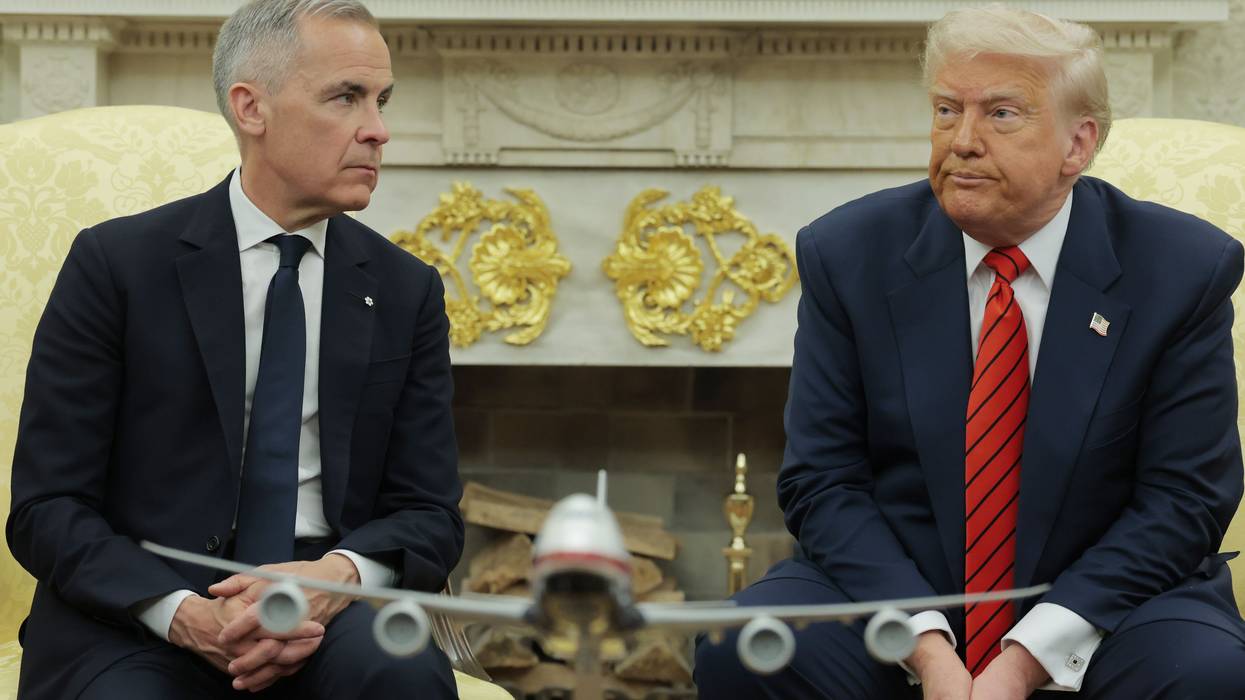
President Donald Trump on Sunday renewed his threat to carry out a genocidal attack on Iran, pledging to "blow up" the "whole country" of over 90 million people and to demolish critical civilian infrastructure if it does not sign a peace deal by Wednesday.
"If they don't sign the deal, then the whole country is going to get blown up," Trump said, according to Fox News correspondent Trey Yingst, who relayed the comments on air Sunday morning.
Trump also reportedly said that the US was "preparing to hit [Iran] harder than any country has ever been hit before because you cannot let them have a nuclear weapon."
The comments came after Iran once again closed the Strait of Hormuz on Saturday in response to the continued US blockade of Iranian ports, which Iranian officials said violated the terms of the agreement reached between the two countries.
After renewing the blockade, Iranian gunboats fired upon a pair of Indian-flagged ships attempting to travel through the strait Saturday.
In response, Trump issued a furious post on Truth Social Sunday morning, saying that he would send a team of negotiators—Vice President JD Vance, his son-in-law Jared Kushner, and special envoy to the Middle East Steve Witkoff—to Islamabad on Monday for another round of negotiations.
"We’re offering a very fair and reasonable DEAL, and I hope they take it because, if they don’t, the United States is going to knock out every single Power Plant, and every single Bridge, in Iran," Trump wrote. "NO MORE MR. NICE GUY!"
"They’ll come down fast, they’ll come down easy and, if they don’t take the DEAL, it will be my Honor to do what has to be done, which should have been done to Iran, by other Presidents, for the last 47 years," he continued.
It echoed the similarly genocidal threat made by Trump earlier in April that "a whole civilization will die... never to be brought back again,” if Iran did not agree to a deal, which drew worldwide condemnation and sparked efforts by some members of Congress to pursue impeachment or push for Trump's cabinet to remove him via the 25th Amendment.
Trump has appeared eager to end the war with Iran after it caused economic upheaval and pushed his already dire approval rating even lower. But he has also backed Israel when it sought to undermine key points of the agreement, prompting retaliation from Iran.
The ceasefire announced earlier this month between the US and Iran initially included a halt to the hostilities between Israel and Lebanon. But within hours, Israel unleashed its most punishing set of attacks against Lebanon since the war began in March. Trump then backed Israeli Prime Minister Benjamin Netanyahu when he claimed that Lebanon was never part of the deal.
Iran only agreed to open the Strait of Hormuz on Friday after Israel and Lebanon appeared to agree to a 10-day ceasefire. But Israel has already violated that agreement several times, continuing to raze Lebanese villages and fire upon people approaching its newly imposed "yellow line."
In addition to calling for the reopening of the Strait of Hormuz, which was open before he launched the war in late February, Trump has demanded that Iran make a deal to hand over all of its enriched uranium, which he refers to as "nuclear dust."
A spokesperson for Iran's Islamic Revolutionary Guard Corps (IRGC) has said such a proposal would violate Iran's sovereignty: "Iran's uranium is Iran's asset. It is our responsibility, our energy, our sovereign right."
An end to the attacks against Lebanon has been described as another central demand from Iran, although officials said the decision to close the strait again on Saturday was in response to Trump's continued blockade of Iranian ports.
International law strictly prohibits indiscriminate attacks on civilian infrastructure with no military objective, including bridges and power plants that are critical to human life.
Trump’s previous threats to bomb Iran "back to the Stone Ages" suggest that the latest threats are less about accomplishing a specific military objective than about inflicting suffering on Iranian society as leverage.
Last time Trump made such a threat, a coalition of more than 200 groups, including Amnesty International, Human Rights Watch, Refugees International, and Oxfam America, wrote in an urgent letter stating that if carried out, such attacks would constitute "a grave atrocity" and that "a threat to wipe out ‘a whole civilization’ may amount to a threat of genocide."
Human Rights Watch said that, if acted upon, "the statement could be indicative of criminal intent if Trump were ever prosecuted by the International Criminal Court.
The last time Trump threatened to unleash an apocalyptic attack on Iran, the threat preceded a deal that, at least in principle, involved the US agreeing to negotiate based on a set of terms laid out by the Iranians. This led many observers to characterize the threats as bluster meant to save face before capitulation rather than a sincere pledge to annihilate Iran.
However, Adil Haque, a law professor at Rutgers and the executive editor at Just Security, said that, "Whether he means it or not, his saying it is an indelible moral stain on our country."
One homeless advocacy group said the bill, which would require homeless people to perform unpaid labor to pay for involuntary treatment, "evokes debtor’s prisons, convict leasing, and the ugliest day of Jim Crow."
The Louisiana House of Representatives voted this week to pass what the National Homelessness Law Center says is "one of the cruelest anti-homeless bills in the country."
Like many other anti-homeless bills being advanced around the country following a 2024 Supreme Court decision allowing states and cities to criminalize homelessness, House Bill 211, which passed by a vote of 70-28, makes unauthorized sleeping in public spaces a crime.
It is punishable by a fine of up to $500, imprisonment for up to six months, or both. Repeat offenders could face one to two years in prison with hard labor and a $1,000 fine.
The bill, which will now advance to the GOP-controlled state Senate, has been nicknamed the "Streets to Success Act" because, according to its sponsor, state Rep. Debbie Villio (R-79), the goal is not to jail homeless people but to "connect them to service providers."
Those who are convicted of sleeping outdoors could be given the option to avoid jail time by instead entering into a mandatory treatment program for at least 12 months. The bill authorizes local governments to set up semi-permanent camps in remote areas, where defendants would be required to stay and receive treatment.
The bill requires homeless defendants to pay “all or part of the cost of the treatment program to which he is assigned," a steep cost for many, as the average cost for residential drug and alcohol rehab treatment in Louisiana is more than $4,400 per week, according to the addiction referral service directory Addicted.org.
According to the bill, those who cannot afford this steep cost would be required to perform unpaid labor for the state or a local community center in lieu of payment.
Bill Quigley, director of the Gillis Long Poverty Law Center at Loyola University New Orleans, called the bill's entire premise "a farce."
"If people had the resources to pay for housing and physical and/or mental health services, they would not be on the street," he told Common Dreams.
He described it as a "cruel theater of the absurd" based on "the lie that people choose to be homeless." The law, he said, "assumes our communities have plenty of affordable apartments and lots of mental and physical health services available."
In reality, he said, these services are chronically underfunded, and the city would need to build about 55,000 more affordable rental units to provide enough housing for its rent-burdened population.
Though it is not uncommon for homeless people to struggle with mental health or substance use issues, increases in the cost of housing have been shown to have a direct relationship with increasing homelessness.
Homelessness in New Orleans dropped considerably in the years following the Covid-19 pandemic, when Congress provided permanent housing subsidies for those in need. But after those funds have dried up, homelessness in the city shot up higher than before the pandemic, a study by the homelessness nonprofit UNITY of Greater New Orleans found in 2024.
New Orleans City Councilmember Lesli Harris (D), who has opposed the bill, pointed to the success of the city's Home for Good program, which took a "Housing First" approach to homelessness, providing rental subsidies and allowing people to move straight from encampments into housing without requirements that they obtain treatment.
According to a May 2025 report, the program had moved 1,133 people off the streets and into supportive housing and allowed eight homeless encampments to close.
"Through our Home for Good program, we house an individual for roughly $21,844 per year. By comparison, jailing that same person costs an average of $51,000—and failing to act at all can cost up to $55,000 in emergency room visits and crisis rehousing," Harris said. "HB 211 would steer Louisiana toward the most expensive option while producing no lasting housing, no services, and no real path forward for the people involved."
Harris has also decried the bill's creation of what she called "internment camps" for treatment. The bill's text requires these facilities to be far away from downtown and other high-value neighborhoods, which she said separates those trying to rebuild their lives from work, public transit, and other critical services, and further isolates them from society.
Since the Supreme Court’s 2024 decision in Grants Pass v. Johnson, which allowed cities to enforce public-camping bans against unhoused people even when shelter is unavailable, around two dozen states and hundreds of municipalities have passed various measures criminalizing poverty.
The homeless advocacy group Housing Not Handcuffs points out that many of the bills were written by the Cicero Institute, a far-right think tank with heavy backing from billionaire tech investors that now has deep influence over the housing policy of President Donald Trump, who has taken a hacksaw to funding for public housing programs under the Department of Housing and Urban Development.
Housing Not Handcuffs said Louisiana's bill, which would almost certainly be signed by Republican Gov. Jeff Landry if passed by the state Senate, "is an extreme take on the already extreme copy-paste legislation" peddled by Cicero.
"This bill forces homeless people charged with a crime to make the false choice between jail or at least one year of forced treatment," the group said. "Louisiana has a long history—and present—of chain gangs, prison labor, and entrenched white supremacy. This bill clearly evokes debtor’s prisons, convict leasing, and the ugliest day of Jim Crow."