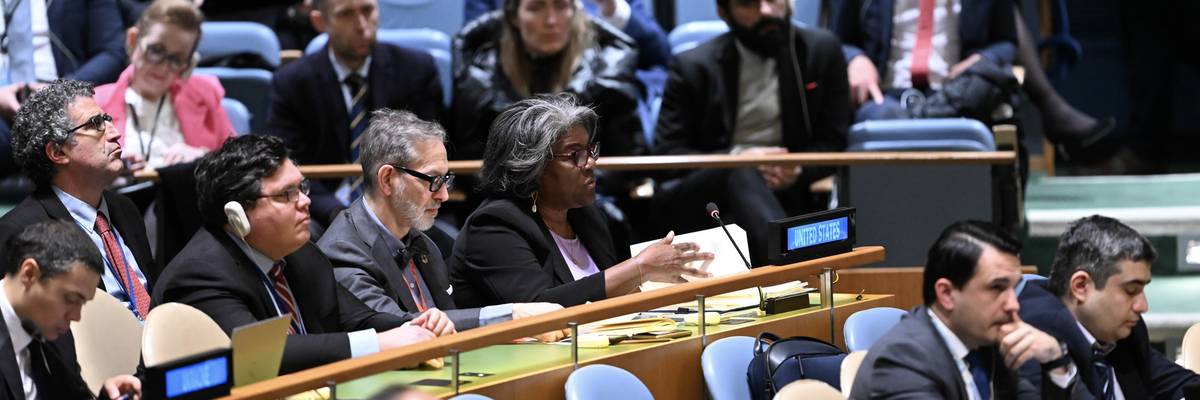
United States Ambassador to the United Nations Linda Thomas-Greenfield makes a speech during a U.N. General Assembly session on December 12, 2023 in New York.
US Trying to Water Down New Cease-Fire Resolution at UN Security Council
"The U.S. cannot afford to be further isolated by vetoing this resolution," said one human rights advocate.
The United Nations Security Council on Monday delayed an expected vote on a new Gaza cease-fire resolution as the U.S. worked to weaken the measure's language, objecting to the proposed call for an "urgent and sustainable cessation of hostilities."
Unnamed diplomats told The Associated Press that the wording will likely be changed to call for a "suspension" of hostilities or some other watered down phrasing amenable to the U.S., which used its veto power to tank a Security Council cease-fire resolution less than two weeks ago.
The veto drew international condemnation, and calls for a cease-fire have grown in the days since. In an overwhelming 153-10 vote on December 12, the U.N. General Assembly approved a resolution demanding an "immediate humanitarian cease-fire," with the U.S. and Israel among the small number of opponents. Unlike those passed by the Security Council, General Assembly resolutions are nonbinding.
The 15-member Security Council is expected to vote on the new, potentially watered down cease-fire resolution as early as Tuesday morning.
Mary Robinson, chair of The Elders and former president of Ireland, said in a statement ahead of the vote that U.S. President Joe Biden's "support for Israel's indiscriminate bombing of Gaza is losing him respect all over the world."
"The U.S. is increasingly isolated, with allies like Australia, Canada, India, Japan, and Poland switching their votes in the UN General Assembly to support an immediate humanitarian cease-fire," said Robinson. "The U.S. cannot afford to be further isolated by vetoing this resolution."
"But even if passed, such resolutions are not enough," she continued. "UNSCR 2712, agreed last month, is not being fully implemented. It calls for the protection of civilians, the release of all hostages, and immediate humanitarian access. Only a cease-fire will allow for these calls to be met."
Louis Charbonneau, U.N. director at Human Rights Watch, wrote late last week that the U.S. "should consistently call for respect for international humanitarian law."
"It says it has urged Israel to protect civilians, so it should support U.N. efforts to do the same," Charbonneau wrote. "It should back the urgent adoption and implementation of a Security Council resolution that demands Israel and Palestinian armed groups end their laws-of-war violations that have cost thousands of civilian lives. And it should back efforts aimed at ensuring accountability for those responsible for war crimes, no matter who commits them."
"Doctors are stepping over bodies of dead children to treat other children who will die anyway."
The latest Security Council vote will come as conditions in the Gaza Strip plunge to new depths by the hour as Israel's U.S.-backed bombing, ground invasion, and suffocating blockade continue.
According to one human rights monitor, Israeli forces have killed more than 10,000 children in Gaza since October 7, when Hamas launched a deadly attack on southern Israel. Martin Griffiths, the U.N.'s emergency relief coordinator, called the humanitarian disaster in Gaza the worst he's ever witnessed.
"People can't leave... No family can plan for their future," Griffiths told the Financial Times in an interview published over the weekend. "I see these things all over the world, but this is beyond my imagination. And it will get worse."
Virtually the entire population of Gaza is at risk of starvation, the territory's water and healthcare systems have collapsed, and infectious diseases are spreading due to contaminated water, overcrowding at makeshift shelters, and lack of medicine.
"The general conditions for most of these people are appalling: They live in temporary structures made of a few pieces of wood banged together and covered in plastic sheeting," said Chris Hook, Doctors Without Borders' medical team leader in Gaza. "They struggle to find enough water to meet their hygiene needs."
At Nasser Hospital in Khan Younis, Hook said, the emergency department is "completely full and new patients are being treated on the floor."
"Doctors are stepping over bodies of dead children to treat other children who will die anyway," he added.
On Sunday, World Health Organization Director-General Tedros Adhanom Ghebreyesus condemned Israeli forces' "effective destruction" of Kamal Adwan Hospital in northern Gaza, noting that attacks on the facility caused the deaths of at least eight patients.
"Gaza's health system was already on its knees, and the loss of another even minimally functioning hospital is a severe blow," Tedros wrote on social media. "Attacks on hospitals, health personnel, and patients must end. Cease-fire NOW."
We are at a crossroads
This country and this world are at a monumental crossroads. In a few short weeks, US voters will have an opportunity to beat back the forces of fascism and confront the billionaires who are rigging the economy, our media system, and our democracy, making it increasingly impossible for ordinary people to get by. We’re not just talking about the election. We’re talking about what must be done once these fascist elements are vanquished from power. We need a bolder set of solutions than what either major party has so far been willing to offer and a working-class movement ready to fight like hell for it. Trump didn't emerge from nowhere. The conditions that fueled MAGA authoritarianism were created by decades of radical neoliberal economic policies and a corrupt political system dominated by corporate interests. They slashed taxes on the super-rich, promising that the benefits would trickle down. They said giveaways to the corporate titans would make life more affordable for the rest of us. It was all bullshit. And when a bitter, betrayed populace searches for someone to blame, right-wing demagogues have little trouble finding scapegoats. People know when they're being lied to, but you won't hear any of this from the corporate media. Only independent journalism—powered and funded by people who believe in building a better world—can deliver truly trustworthy daily news. Our Fall Campaign is underway, and we need your help. To power our newsroom through the rest of the year, we need to raise $125,000 by midnight on October 31. So if you share our vision, please contribute whatever you can to sustain our work. |
The United Nations Security Council on Monday delayed an expected vote on a new Gaza cease-fire resolution as the U.S. worked to weaken the measure's language, objecting to the proposed call for an "urgent and sustainable cessation of hostilities."
Unnamed diplomats told The Associated Press that the wording will likely be changed to call for a "suspension" of hostilities or some other watered down phrasing amenable to the U.S., which used its veto power to tank a Security Council cease-fire resolution less than two weeks ago.
The veto drew international condemnation, and calls for a cease-fire have grown in the days since. In an overwhelming 153-10 vote on December 12, the U.N. General Assembly approved a resolution demanding an "immediate humanitarian cease-fire," with the U.S. and Israel among the small number of opponents. Unlike those passed by the Security Council, General Assembly resolutions are nonbinding.
The 15-member Security Council is expected to vote on the new, potentially watered down cease-fire resolution as early as Tuesday morning.
Mary Robinson, chair of The Elders and former president of Ireland, said in a statement ahead of the vote that U.S. President Joe Biden's "support for Israel's indiscriminate bombing of Gaza is losing him respect all over the world."
"The U.S. is increasingly isolated, with allies like Australia, Canada, India, Japan, and Poland switching their votes in the UN General Assembly to support an immediate humanitarian cease-fire," said Robinson. "The U.S. cannot afford to be further isolated by vetoing this resolution."
"But even if passed, such resolutions are not enough," she continued. "UNSCR 2712, agreed last month, is not being fully implemented. It calls for the protection of civilians, the release of all hostages, and immediate humanitarian access. Only a cease-fire will allow for these calls to be met."
Louis Charbonneau, U.N. director at Human Rights Watch, wrote late last week that the U.S. "should consistently call for respect for international humanitarian law."
"It says it has urged Israel to protect civilians, so it should support U.N. efforts to do the same," Charbonneau wrote. "It should back the urgent adoption and implementation of a Security Council resolution that demands Israel and Palestinian armed groups end their laws-of-war violations that have cost thousands of civilian lives. And it should back efforts aimed at ensuring accountability for those responsible for war crimes, no matter who commits them."
"Doctors are stepping over bodies of dead children to treat other children who will die anyway."
The latest Security Council vote will come as conditions in the Gaza Strip plunge to new depths by the hour as Israel's U.S.-backed bombing, ground invasion, and suffocating blockade continue.
According to one human rights monitor, Israeli forces have killed more than 10,000 children in Gaza since October 7, when Hamas launched a deadly attack on southern Israel. Martin Griffiths, the U.N.'s emergency relief coordinator, called the humanitarian disaster in Gaza the worst he's ever witnessed.
"People can't leave... No family can plan for their future," Griffiths told the Financial Times in an interview published over the weekend. "I see these things all over the world, but this is beyond my imagination. And it will get worse."
Virtually the entire population of Gaza is at risk of starvation, the territory's water and healthcare systems have collapsed, and infectious diseases are spreading due to contaminated water, overcrowding at makeshift shelters, and lack of medicine.
"The general conditions for most of these people are appalling: They live in temporary structures made of a few pieces of wood banged together and covered in plastic sheeting," said Chris Hook, Doctors Without Borders' medical team leader in Gaza. "They struggle to find enough water to meet their hygiene needs."
At Nasser Hospital in Khan Younis, Hook said, the emergency department is "completely full and new patients are being treated on the floor."
"Doctors are stepping over bodies of dead children to treat other children who will die anyway," he added.
On Sunday, World Health Organization Director-General Tedros Adhanom Ghebreyesus condemned Israeli forces' "effective destruction" of Kamal Adwan Hospital in northern Gaza, noting that attacks on the facility caused the deaths of at least eight patients.
"Gaza's health system was already on its knees, and the loss of another even minimally functioning hospital is a severe blow," Tedros wrote on social media. "Attacks on hospitals, health personnel, and patients must end. Cease-fire NOW."
- UN Members Support Gaza Cease-Fire in Overwhelming 153-10 Vote ›
- Rights Advocates Say US Has 'No Justification' to Veto UN Cease-Fire Resolution ›
- 'Disastrous': US Vetoes Cease-Fire Resolution at UN Security Council ›
- Opinion | Support for Israel's Genocidal Attack on Gaza Further Isolates the United States | Common Dreams ›
- Opinion | UN Security Council Caves to US Pressure to Prevent a Gaza Cease-Fire | Common Dreams ›
- Opinion | Cease-Fire Now! What I Said to the UN Security Council | Common Dreams ›
- Minneapolis City Council Overrides Veto of 'Strongest' US Cease-Fire Resolution ›
- US Abstains as UN Security Council Demands 'Immediate Cease-Fire' in Gaza ›
- Opinion | The Cynical Reason Biden Let the UN Pass a Gaza Cease-Fire Resolution | Common Dreams ›
- Opinion | By Voting to Exclude Palestine From Full UN Membership, the US Isolated Itself | Common Dreams ›
- 'Glimmer of Hope' as UN Security Council Approves Gaza Cease-Fire Resolution | Common Dreams ›
- After Another US Security Council Veto, UN General Assembly Votes for Gaza Cease-Fire | Common Dreams ›
The United Nations Security Council on Monday delayed an expected vote on a new Gaza cease-fire resolution as the U.S. worked to weaken the measure's language, objecting to the proposed call for an "urgent and sustainable cessation of hostilities."
Unnamed diplomats told The Associated Press that the wording will likely be changed to call for a "suspension" of hostilities or some other watered down phrasing amenable to the U.S., which used its veto power to tank a Security Council cease-fire resolution less than two weeks ago.
The veto drew international condemnation, and calls for a cease-fire have grown in the days since. In an overwhelming 153-10 vote on December 12, the U.N. General Assembly approved a resolution demanding an "immediate humanitarian cease-fire," with the U.S. and Israel among the small number of opponents. Unlike those passed by the Security Council, General Assembly resolutions are nonbinding.
The 15-member Security Council is expected to vote on the new, potentially watered down cease-fire resolution as early as Tuesday morning.
Mary Robinson, chair of The Elders and former president of Ireland, said in a statement ahead of the vote that U.S. President Joe Biden's "support for Israel's indiscriminate bombing of Gaza is losing him respect all over the world."
"The U.S. is increasingly isolated, with allies like Australia, Canada, India, Japan, and Poland switching their votes in the UN General Assembly to support an immediate humanitarian cease-fire," said Robinson. "The U.S. cannot afford to be further isolated by vetoing this resolution."
"But even if passed, such resolutions are not enough," she continued. "UNSCR 2712, agreed last month, is not being fully implemented. It calls for the protection of civilians, the release of all hostages, and immediate humanitarian access. Only a cease-fire will allow for these calls to be met."
Louis Charbonneau, U.N. director at Human Rights Watch, wrote late last week that the U.S. "should consistently call for respect for international humanitarian law."
"It says it has urged Israel to protect civilians, so it should support U.N. efforts to do the same," Charbonneau wrote. "It should back the urgent adoption and implementation of a Security Council resolution that demands Israel and Palestinian armed groups end their laws-of-war violations that have cost thousands of civilian lives. And it should back efforts aimed at ensuring accountability for those responsible for war crimes, no matter who commits them."
"Doctors are stepping over bodies of dead children to treat other children who will die anyway."
The latest Security Council vote will come as conditions in the Gaza Strip plunge to new depths by the hour as Israel's U.S.-backed bombing, ground invasion, and suffocating blockade continue.
According to one human rights monitor, Israeli forces have killed more than 10,000 children in Gaza since October 7, when Hamas launched a deadly attack on southern Israel. Martin Griffiths, the U.N.'s emergency relief coordinator, called the humanitarian disaster in Gaza the worst he's ever witnessed.
"People can't leave... No family can plan for their future," Griffiths told the Financial Times in an interview published over the weekend. "I see these things all over the world, but this is beyond my imagination. And it will get worse."
Virtually the entire population of Gaza is at risk of starvation, the territory's water and healthcare systems have collapsed, and infectious diseases are spreading due to contaminated water, overcrowding at makeshift shelters, and lack of medicine.
"The general conditions for most of these people are appalling: They live in temporary structures made of a few pieces of wood banged together and covered in plastic sheeting," said Chris Hook, Doctors Without Borders' medical team leader in Gaza. "They struggle to find enough water to meet their hygiene needs."
At Nasser Hospital in Khan Younis, Hook said, the emergency department is "completely full and new patients are being treated on the floor."
"Doctors are stepping over bodies of dead children to treat other children who will die anyway," he added.
On Sunday, World Health Organization Director-General Tedros Adhanom Ghebreyesus condemned Israeli forces' "effective destruction" of Kamal Adwan Hospital in northern Gaza, noting that attacks on the facility caused the deaths of at least eight patients.
"Gaza's health system was already on its knees, and the loss of another even minimally functioning hospital is a severe blow," Tedros wrote on social media. "Attacks on hospitals, health personnel, and patients must end. Cease-fire NOW."
- UN Members Support Gaza Cease-Fire in Overwhelming 153-10 Vote ›
- Rights Advocates Say US Has 'No Justification' to Veto UN Cease-Fire Resolution ›
- 'Disastrous': US Vetoes Cease-Fire Resolution at UN Security Council ›
- Opinion | Support for Israel's Genocidal Attack on Gaza Further Isolates the United States | Common Dreams ›
- Opinion | UN Security Council Caves to US Pressure to Prevent a Gaza Cease-Fire | Common Dreams ›
- Opinion | Cease-Fire Now! What I Said to the UN Security Council | Common Dreams ›
- Minneapolis City Council Overrides Veto of 'Strongest' US Cease-Fire Resolution ›
- US Abstains as UN Security Council Demands 'Immediate Cease-Fire' in Gaza ›
- Opinion | The Cynical Reason Biden Let the UN Pass a Gaza Cease-Fire Resolution | Common Dreams ›
- Opinion | By Voting to Exclude Palestine From Full UN Membership, the US Isolated Itself | Common Dreams ›
- 'Glimmer of Hope' as UN Security Council Approves Gaza Cease-Fire Resolution | Common Dreams ›
- After Another US Security Council Veto, UN General Assembly Votes for Gaza Cease-Fire | Common Dreams ›