SUBSCRIBE TO OUR FREE NEWSLETTER
Daily news & progressive opinion—funded by the people, not the corporations—delivered straight to your inbox.
5
#000000
#FFFFFF
To donate by check, phone, or other method, see our More Ways to Give page.
Daily news & progressive opinion—funded by the people, not the corporations—delivered straight to your inbox.
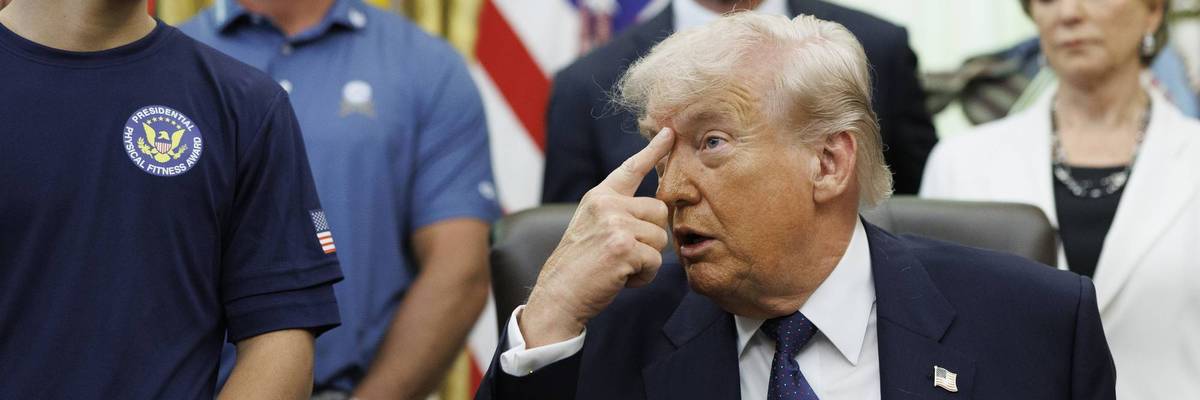
US President Donald Trump speaks before signing a proclamation inside the Oval Office at the White House in Washington, DC on May 5, 2026.
"It's scientific self-sabotage, and the American public will ultimately pay the price in the discoveries never made and lives never changed for the better."
Some scientists and scientific societies sued President Donald Trump's administration in the District of Massachusetts on Monday for shutting down the entity that provides nearly two-thirds of federal funding for basic academic research in the social, behavioral, and economic sciences.
The administration's effort to eliminate the National Science Foundation's Directorate for Social, Behavioral, and Economic Sciences (SBE) "is a disservice to the American public and a crushing blow to the behavioral and brain sciences," declared Juliane Baron, executive director of the Federation of Associations in Behavioral and Brain Sciences (FABBS).
"When I think about the biggest challenges facing people across our country—advancing health and well-being, providing economic and physical security for our loved ones—these are all inherently human questions," Baron stressed. "We can't solve pressing societal challenges without understanding humans."
FABBS partnered with the Society of Experimental Social Psychology (SESP), the Social and Affective Neuroscience Society (SANS), and two researchers—University of Massachusetts Amherst lecturer Jenna Croteau and Boston College assistant professor Gregg Sparkman—in the lawsuit, which Democracy Forward filed on their behalf.
Over the past century, the complaint explains, "SBE research has driven some of the most groundbreaking innovations in nearly every aspect of modern life—from the way doctors match kidney donors with patients, to how governments approach economic policy, national security, and international relations, to the models behind Google's search engine."
"SBE research has helped mitigate the opioid crisis, the spread of diseases like Ebola and Covid-19, and evolving threats posed by cyberhackers and terrorist networks in the United States and abroad," notes the filing. "And it has transformed economics."
As the complaint details:
When the Trump-Vance administration took office, it deemed these fields “woke.” In its 2026 budget proposal, the administration urged Congress to cut funding for the SBE Directorate. Congress refused. The congressional report that accompanied NSF's January 2026 appropriation expressly directed NSF not to reduce SBE’s budget by more than 5%.
Three months later, NSF decided to shutter the directorate anyway. On April 3, 2026—without a director, and without consulting the National Science Board, the body Congress required to make such decisions—NSF leadership announced that it would unilaterally "close-out" the SBE Directorate in fiscal year 2027. Since the April 3 decision, the agency has stopped funding opportunities for basic SBE research, released the scientists who work in the directorate on assignment from universities, and reassigned nearly all the directorate's permanent staff.
"The administration's dismantling of SBE is not only reckless; it is illegal," emphasized Democracy Forward president and CEO Skye Perryman. "NSF provided no public explanation for its decision to close the Social, Behavioral, and Economic Sciences Directorate, and this dangerous dismissal of scientific expertise is a threat to crucial scientific research. We are honored to work with this coalition to challenge the administration's crusade against science and the unlawful closure of the directorate."
Coalition members highlighted the importance of them prevailing in court, particularly in the current era of rapidly developing artificial intelligence with inadequate safeguards. SANS president Jennifer Kubota said that "understanding how the brain shapes trust, cooperation, emotion, and social behavior is essential to addressing some of society's most pressing challenges, from social isolation and polarization to the rapid emergence of AI."
"Eliminating NSF SBE funding for this research threatens decades of scientific progress and the next generation of scientists," Kubota continued. "Research opportunities lost today cannot simply be recovered tomorrow. We risk losing not only critical discoveries, but also the talented researchers who will make them."
A coalition of scientific societies and individual scientists has united to challenge the unlawful closure of the Social, Behavioral, and Economic Sciences Directorate (SBE) of the National Science Foundation (NSF). Happy to support SESP in joining this lawsuit.democracyforward.org/news/press-r...
[image or embed]
— Kate A. Ratliff (@kateratliff.bsky.social) November 9, 2026 at 1:02 PM
Columbia University professor and FABBS board member Jon Freeman delivered a similar warning, arguing that "we cannot allow this administration to shoot America in the foot."
"American behavioral science has transformed everything from the algorithms powering our technology to how we strengthen human connection, overcome social divisions, improve public health, and make better decisions in our everyday lives," he said. "Dismantling SBE would devastate a vital part of our scientific workforce at precisely the moment we need it most, as AI reshapes society. It's scientific self-sabotage, and the American public will ultimately pay the price in the discoveries never made and lives never changed for the better."
SESP executive officer Steven J. Stroessner also not only acknowledged the past but looked toward the future: "For decades, federal support for basic research in social psychology has helped us understand how people think, make decisions, and relate to one another. The resulting discoveries have strengthened our nation by improving education, informing public policy, fostering cooperation, and helping us address some of society’s most persistent challenges. Dismantling that support threatens not only the research being conducted today, but the discoveries we have yet to imagine."
This country and this world are at a monumental crossroads. US voters have an opportunity to beat back the forces of fascism and confront the billionaires who are rigging the economy, our media system, and our democracy, making it increasingly impossible for ordinary people to get by. We’re not just talking about the election. We’re talking about what must be done once these fascist elements are vanquished from power. We need a bolder set of solutions than what either major party has so far been willing to offer and a working-class movement ready to fight like hell for it. Trump didn't emerge from nowhere. The conditions that fueled MAGA authoritarianism were created by decades of radical neoliberal economic policies and a corrupt political system dominated by corporate interests. They slashed taxes on the super-rich, promising that the benefits would trickle down. They said giveaways to the corporate titans would make life more affordable for the rest of us. It was all bullshit. And when a bitter, betrayed populace searches for someone to blame, right-wing demagogues have little trouble finding scapegoats. People know when they're being lied to, but you won't hear any of this from the corporate media. Only independent journalism—powered and funded by people who believe in building a better world—can deliver truly trustworthy daily news. If you share our vision, please contribute whatever you can to sustain our work. |
Some scientists and scientific societies sued President Donald Trump's administration in the District of Massachusetts on Monday for shutting down the entity that provides nearly two-thirds of federal funding for basic academic research in the social, behavioral, and economic sciences.
The administration's effort to eliminate the National Science Foundation's Directorate for Social, Behavioral, and Economic Sciences (SBE) "is a disservice to the American public and a crushing blow to the behavioral and brain sciences," declared Juliane Baron, executive director of the Federation of Associations in Behavioral and Brain Sciences (FABBS).
"When I think about the biggest challenges facing people across our country—advancing health and well-being, providing economic and physical security for our loved ones—these are all inherently human questions," Baron stressed. "We can't solve pressing societal challenges without understanding humans."
FABBS partnered with the Society of Experimental Social Psychology (SESP), the Social and Affective Neuroscience Society (SANS), and two researchers—University of Massachusetts Amherst lecturer Jenna Croteau and Boston College assistant professor Gregg Sparkman—in the lawsuit, which Democracy Forward filed on their behalf.
Over the past century, the complaint explains, "SBE research has driven some of the most groundbreaking innovations in nearly every aspect of modern life—from the way doctors match kidney donors with patients, to how governments approach economic policy, national security, and international relations, to the models behind Google's search engine."
"SBE research has helped mitigate the opioid crisis, the spread of diseases like Ebola and Covid-19, and evolving threats posed by cyberhackers and terrorist networks in the United States and abroad," notes the filing. "And it has transformed economics."
As the complaint details:
When the Trump-Vance administration took office, it deemed these fields “woke.” In its 2026 budget proposal, the administration urged Congress to cut funding for the SBE Directorate. Congress refused. The congressional report that accompanied NSF's January 2026 appropriation expressly directed NSF not to reduce SBE’s budget by more than 5%.
Three months later, NSF decided to shutter the directorate anyway. On April 3, 2026—without a director, and without consulting the National Science Board, the body Congress required to make such decisions—NSF leadership announced that it would unilaterally "close-out" the SBE Directorate in fiscal year 2027. Since the April 3 decision, the agency has stopped funding opportunities for basic SBE research, released the scientists who work in the directorate on assignment from universities, and reassigned nearly all the directorate's permanent staff.
"The administration's dismantling of SBE is not only reckless; it is illegal," emphasized Democracy Forward president and CEO Skye Perryman. "NSF provided no public explanation for its decision to close the Social, Behavioral, and Economic Sciences Directorate, and this dangerous dismissal of scientific expertise is a threat to crucial scientific research. We are honored to work with this coalition to challenge the administration's crusade against science and the unlawful closure of the directorate."
Coalition members highlighted the importance of them prevailing in court, particularly in the current era of rapidly developing artificial intelligence with inadequate safeguards. SANS president Jennifer Kubota said that "understanding how the brain shapes trust, cooperation, emotion, and social behavior is essential to addressing some of society's most pressing challenges, from social isolation and polarization to the rapid emergence of AI."
"Eliminating NSF SBE funding for this research threatens decades of scientific progress and the next generation of scientists," Kubota continued. "Research opportunities lost today cannot simply be recovered tomorrow. We risk losing not only critical discoveries, but also the talented researchers who will make them."
A coalition of scientific societies and individual scientists has united to challenge the unlawful closure of the Social, Behavioral, and Economic Sciences Directorate (SBE) of the National Science Foundation (NSF). Happy to support SESP in joining this lawsuit.democracyforward.org/news/press-r...
[image or embed]
— Kate A. Ratliff (@kateratliff.bsky.social) November 9, 2026 at 1:02 PM
Columbia University professor and FABBS board member Jon Freeman delivered a similar warning, arguing that "we cannot allow this administration to shoot America in the foot."
"American behavioral science has transformed everything from the algorithms powering our technology to how we strengthen human connection, overcome social divisions, improve public health, and make better decisions in our everyday lives," he said. "Dismantling SBE would devastate a vital part of our scientific workforce at precisely the moment we need it most, as AI reshapes society. It's scientific self-sabotage, and the American public will ultimately pay the price in the discoveries never made and lives never changed for the better."
SESP executive officer Steven J. Stroessner also not only acknowledged the past but looked toward the future: "For decades, federal support for basic research in social psychology has helped us understand how people think, make decisions, and relate to one another. The resulting discoveries have strengthened our nation by improving education, informing public policy, fostering cooperation, and helping us address some of society’s most persistent challenges. Dismantling that support threatens not only the research being conducted today, but the discoveries we have yet to imagine."