5
#000000
#FFFFFF
To donate by check, phone, or other method, see our More Ways to Give page.
Daily news & progressive opinion—funded by the people, not the corporations—delivered straight to your inbox.
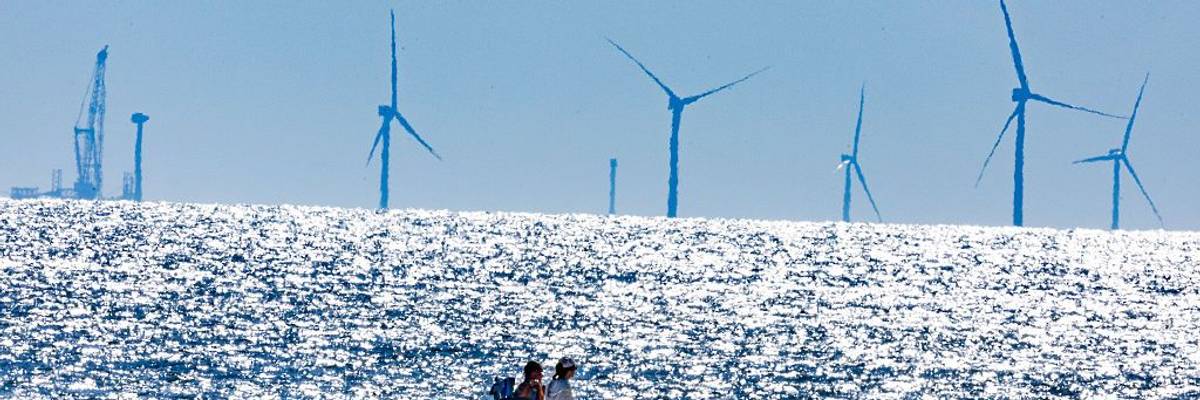
Madaket beachgoers walk along the beach with the Vineyard Wind turbines in the background on September 11, 2025.
"Get out of the way of the expansion of renewable energy," one clean power advocate told the Trump administration.
Clean energy advocates have scored at least a temporary victory after a federal judge on Monday threw out President Donald Trump's executive order that banned new wind power projects in the US.
As reported by CNBC, Judge Patti Saris of the US District Court for the District of Massachusetts tossed Trump's executive order in its entirety after finding it "arbitrary and capricious and contrary to law," and arguing that the federal government did not provide a reasoned explanation for enacting such a policy.
The executive order, which Trump signed in January, halted all permits and leases for both offshore and onshore wind power projects.
A group of 17 states, led by New York Attorney General Letitia James, sued the Trump administration earlier this year to overturn the executive order, which they labeled "an existential threat to the wind industry" in the US.
In a social media post, James hailed the judge's ruling and called the decision "a big victory in our fight to keep tackling the climate crisis and protect one of our best sources of clean, reliable, and affordable energy."
Nancy Pyne, senior adviser for Sierra Club, declared the ruling "a victory for everyone who pays an electricity bill, is part of the clean energy workforce, and breathes air."
"Americans need cheaper and more reliable energy that does not come at the expense of our health and futures," Pyne added. "We are glad to see this illegal order get vacated, and we will continue to advocate for more wind energy projects across the country to lower the cost of energy and create stable, union jobs in our communities."
Kit Kennedy, managing director for power at Natural Resources Defense Council, also emphasized the benefits to US consumers of allowing more wind-power projects to move forward.
"From the beginning of its time in office, the Trump administration put a halt to the wind energy projects that are needed to keep utility bills in check and the grid reliable," Kennedy said. "In the months since, this action has been a devastating blow to workers, electricity customers, and the reliability of the power grid."
Kennedy added that the Trump administration should accept the judge's verdict and "get out of the way of the expansion of renewable energy."
The Trump administration has the option to appeal the judge's order, although it did not respond to questions from the New York Times on Monday about whether it had plans to do so.
Trump's war against wind power comes at a time when rising electric bills, caused in large part by increased demand from energy-devouring artificial intelligence data centers, have become a hot-button political issue.
A recent report from researchers at The Century Foundation and financial abuse watchdog Protect Borrowers found that the average overdue balance on utility bills has surged by 32% over the last three years, going from $597 in 2022 to $789 in 2025. The report also estimated that roughly 1 out of every 20 US households has utility debt that is “so severe it was sent to collections or in arrears."
Dear Common Dreams reader, It’s been nearly 30 years since I co-founded Common Dreams with my late wife, Lina Newhouser. We had the radical notion that journalism should serve the public good, not corporate profits. It was clear to us from the outset what it would take to build such a project. No paid advertisements. No corporate sponsors. No millionaire publisher telling us what to think or do. Many people said we wouldn't last a year, but we proved those doubters wrong. Together with a tremendous team of journalists and dedicated staff, we built an independent media outlet free from the constraints of profits and corporate control. Our mission has always been simple: To inform. To inspire. To ignite change for the common good. Building Common Dreams was not easy. Our survival was never guaranteed. When you take on the most powerful forces—Wall Street greed, fossil fuel industry destruction, Big Tech lobbyists, and uber-rich oligarchs who have spent billions upon billions rigging the economy and democracy in their favor—the only bulwark you have is supporters who believe in your work. But here’s the urgent message from me today. It's never been this bad out there. And it's never been this hard to keep us going. At the very moment Common Dreams is most needed, the threats we face are intensifying. We need your support now more than ever. We don't accept corporate advertising and never will. We don't have a paywall because we don't think people should be blocked from critical news based on their ability to pay. Everything we do is funded by the donations of readers like you. When everyone does the little they can afford, we are strong. But if that support retreats or dries up, so do we. Will you donate now to make sure Common Dreams not only survives but thrives? —Craig Brown, Co-founder |
Clean energy advocates have scored at least a temporary victory after a federal judge on Monday threw out President Donald Trump's executive order that banned new wind power projects in the US.
As reported by CNBC, Judge Patti Saris of the US District Court for the District of Massachusetts tossed Trump's executive order in its entirety after finding it "arbitrary and capricious and contrary to law," and arguing that the federal government did not provide a reasoned explanation for enacting such a policy.
The executive order, which Trump signed in January, halted all permits and leases for both offshore and onshore wind power projects.
A group of 17 states, led by New York Attorney General Letitia James, sued the Trump administration earlier this year to overturn the executive order, which they labeled "an existential threat to the wind industry" in the US.
In a social media post, James hailed the judge's ruling and called the decision "a big victory in our fight to keep tackling the climate crisis and protect one of our best sources of clean, reliable, and affordable energy."
Nancy Pyne, senior adviser for Sierra Club, declared the ruling "a victory for everyone who pays an electricity bill, is part of the clean energy workforce, and breathes air."
"Americans need cheaper and more reliable energy that does not come at the expense of our health and futures," Pyne added. "We are glad to see this illegal order get vacated, and we will continue to advocate for more wind energy projects across the country to lower the cost of energy and create stable, union jobs in our communities."
Kit Kennedy, managing director for power at Natural Resources Defense Council, also emphasized the benefits to US consumers of allowing more wind-power projects to move forward.
"From the beginning of its time in office, the Trump administration put a halt to the wind energy projects that are needed to keep utility bills in check and the grid reliable," Kennedy said. "In the months since, this action has been a devastating blow to workers, electricity customers, and the reliability of the power grid."
Kennedy added that the Trump administration should accept the judge's verdict and "get out of the way of the expansion of renewable energy."
The Trump administration has the option to appeal the judge's order, although it did not respond to questions from the New York Times on Monday about whether it had plans to do so.
Trump's war against wind power comes at a time when rising electric bills, caused in large part by increased demand from energy-devouring artificial intelligence data centers, have become a hot-button political issue.
A recent report from researchers at The Century Foundation and financial abuse watchdog Protect Borrowers found that the average overdue balance on utility bills has surged by 32% over the last three years, going from $597 in 2022 to $789 in 2025. The report also estimated that roughly 1 out of every 20 US households has utility debt that is “so severe it was sent to collections or in arrears."
Clean energy advocates have scored at least a temporary victory after a federal judge on Monday threw out President Donald Trump's executive order that banned new wind power projects in the US.
As reported by CNBC, Judge Patti Saris of the US District Court for the District of Massachusetts tossed Trump's executive order in its entirety after finding it "arbitrary and capricious and contrary to law," and arguing that the federal government did not provide a reasoned explanation for enacting such a policy.
The executive order, which Trump signed in January, halted all permits and leases for both offshore and onshore wind power projects.
A group of 17 states, led by New York Attorney General Letitia James, sued the Trump administration earlier this year to overturn the executive order, which they labeled "an existential threat to the wind industry" in the US.
In a social media post, James hailed the judge's ruling and called the decision "a big victory in our fight to keep tackling the climate crisis and protect one of our best sources of clean, reliable, and affordable energy."
Nancy Pyne, senior adviser for Sierra Club, declared the ruling "a victory for everyone who pays an electricity bill, is part of the clean energy workforce, and breathes air."
"Americans need cheaper and more reliable energy that does not come at the expense of our health and futures," Pyne added. "We are glad to see this illegal order get vacated, and we will continue to advocate for more wind energy projects across the country to lower the cost of energy and create stable, union jobs in our communities."
Kit Kennedy, managing director for power at Natural Resources Defense Council, also emphasized the benefits to US consumers of allowing more wind-power projects to move forward.
"From the beginning of its time in office, the Trump administration put a halt to the wind energy projects that are needed to keep utility bills in check and the grid reliable," Kennedy said. "In the months since, this action has been a devastating blow to workers, electricity customers, and the reliability of the power grid."
Kennedy added that the Trump administration should accept the judge's verdict and "get out of the way of the expansion of renewable energy."
The Trump administration has the option to appeal the judge's order, although it did not respond to questions from the New York Times on Monday about whether it had plans to do so.
Trump's war against wind power comes at a time when rising electric bills, caused in large part by increased demand from energy-devouring artificial intelligence data centers, have become a hot-button political issue.
A recent report from researchers at The Century Foundation and financial abuse watchdog Protect Borrowers found that the average overdue balance on utility bills has surged by 32% over the last three years, going from $597 in 2022 to $789 in 2025. The report also estimated that roughly 1 out of every 20 US households has utility debt that is “so severe it was sent to collections or in arrears."