5
#000000
#FFFFFF
To donate by check, phone, or other method, see our More Ways to Give page.
Daily news & progressive opinion—funded by the people, not the corporations—delivered straight to your inbox.
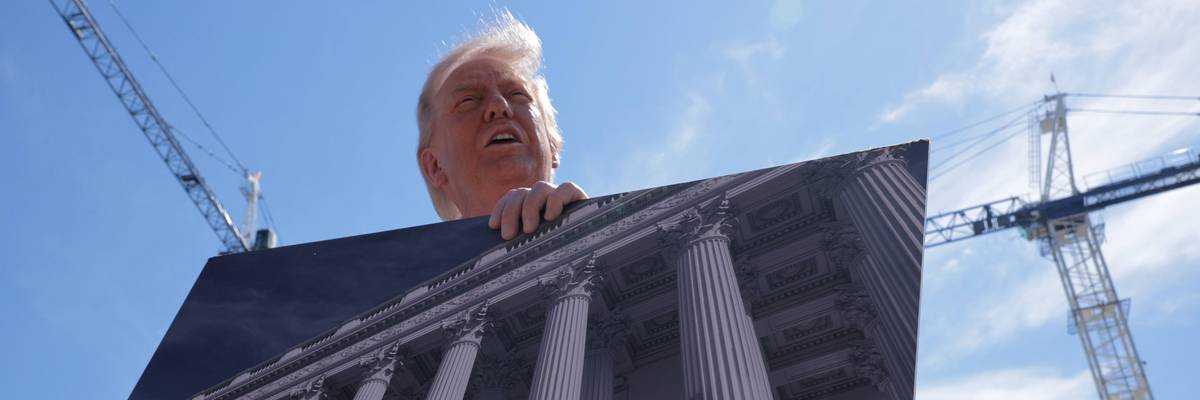
US President Donald Trump holds a artist's renderings as he talks to reporters about his proposed White House ballroom next to the worksite on May 19, 2026 in Washington, DC.
"The Constitution's system of checks and balances ensures that no individual or branch of government holds absolute power," said one legal expert. "The president is ignoring this design."
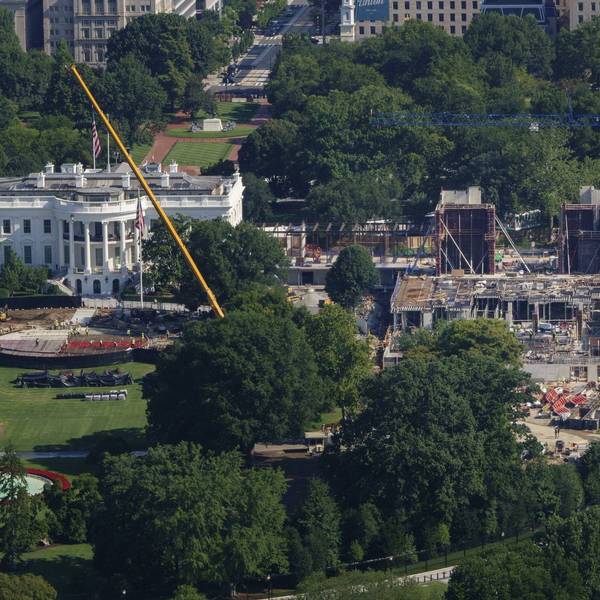
Just days after President Donald Trump's administration asked the right-wing US Supreme Court to allow construction of a new White House ballroom to continue while a legal challenge plays out, federal lawmakers and advocacy groups on Tuesday urged the justices to block any more work on the project absent congressional approval.
"The Constitution's system of checks and balances ensures that no individual or branch of government holds absolute power," said Trevor Potter, president of the nonpartisan Campaign Legal Center, which filed an amicus brief with Citizens for Responsibility and Ethics in Washington (CREW).
"The president is ignoring this design by unilaterally demolishing the East Wing of the White House and trying to construct a massive ballroom with private funds, raising the risk of corruption that constitutional checks are supposed to prevent," he continued.
Potter stressed that "Congress, not the president, is empowered to raise and spend taxpayer dollars—and it has not authorized the ballroom. The administration's reliance on private donor funding for the ballroom project violates a core principle of separation of powers embedded in our Constitution."
CREW president Donald Sherman highlighted that "President Trump has spent his second term creating pay-to-play opportunities for corporations to curry favor and advance his personal priorities, without regard for the Constitution or the American people's best interests."
Trump kicked off his second term with an inauguration dubbed "a coronation of our country’s descent into oligarchy" because of the billionaires who got prime seating at the event. Since then, according to recent disclosures, he's pocketed at least $2.2 billion, over half of it from his family’s crypto scheming.
Amid alarm over Trump's enrichment of himself and his allies—and his plummeting approval rating—Sherman said that "the Supreme Court should deny the request for a stay and ensure that this administration isn't allowed to run roughshod over the separation of powers and dodge congressional approval for spending taxpayer dollars."
Sherman and Potter's groups were far from alone in filing a brief with that demand; dozens of Democrats who serve as ranking members of various committees across both chambers of Congress as well as the minority leader, whip, and caucus chair in the House of Representatives submitted a similar filing to the nation's top court.
The Democrats "understand that the Constitution empowers Congress—not the President—to control federal property, including
determining whether (and how) parts of the White House should be demolished or constructed," their lawyers wrote, noting that they previously sent a brief to US Court of Appeals for the District of Columbia, which earlier this month upheld a district judge's ruling that halted most construction.
The filing argues that the injunction should remain in place, and "the construction the president seeks should not proceed until Congress authorizes that construction and appropriates the funds for it," an event that is unlikely during this session, even with the GOP's narrow control of both chambers.
Welcoming the lawmakers' brief, Jon Golinger, democracy advocate at the watchdog group Public Citizen, asked, "If President Trump is so proud of his Golden Ballroom, why is he so afraid to ask Congress to approve it?"
"A key reason the Constitution requires Congress to authorize the White House ballroom project is to ensure transparency and oversight of the '$335 million of an expected $400 million' that the White House says it's raised from donors, including corporations who have been awarded billions in government contracts and anonymous donors with secret agendas," Golinger said.
"We agree that by law Congress needs to authorize it and urge the court to reject the White House's desperate 'Hail Mary' pass," he added. "The Supreme Court is expected to decide by this Friday whether to intervene in the ballroom case or to allow the Court of Appeals injunction to take effect, which would block further ballroom construction unless and until Congress authorizes it."
The National Trust for Historic Preservation, which is behind the legal challenge to the project, also sent its arguments against Trump's ballroom on Tuesday. The group's president and CEO, Brent Leggs, noted that "last week, the administration made two audacious claims in asking the US Supreme Court to greenlight continued aboveground construction of the White House ballroom."
"First, that no court in the land has the authority to stop them," he explained. "And second, that because they are using the same indestructible concrete used in nuclear power plants, it would be impossible to remove the ballroom even if ordered to do so. They are working around the clock in an attempt to outrace judicial review."
Leggs said that in its filing, his group "reiterated that the administration has no unilateral legal authority—constitutional, statutory, or otherwise—to build a ballroom on the site of the now-demolished East Wing, unless and until Congress expressly approves. Each court that has reviewed this case has agreed with the National Trust. We hope the Supreme Court will uphold the rule of law by stopping this illegal project."
"Our position was supported by several amicus briefs, including one from the Society for the Rule of Law and former Republican White House lawyers," he added. "These briefs highlight the point the National Trust has made for months: The executive branch lacks unilateral authority to destroy or transform the White House, and cannot use national security as a justification for ignoring the Constitution."
Dear Common Dreams reader, It’s been nearly 30 years since I co-founded Common Dreams with my late wife, Lina Newhouser. We had the radical notion that journalism should serve the public good, not corporate profits. It was clear to us from the outset what it would take to build such a project. No paid advertisements. No corporate sponsors. No millionaire publisher telling us what to think or do. Many people said we wouldn't last a year, but we proved those doubters wrong. Together with a tremendous team of journalists and dedicated staff, we built an independent media outlet free from the constraints of profits and corporate control. Our mission has always been simple: To inform. To inspire. To ignite change for the common good. Building Common Dreams was not easy. Our survival was never guaranteed. When you take on the most powerful forces—Wall Street greed, fossil fuel industry destruction, Big Tech lobbyists, and uber-rich oligarchs who have spent billions upon billions rigging the economy and democracy in their favor—the only bulwark you have is supporters who believe in your work. But here’s the urgent message from me today. It's never been this bad out there. And it's never been this hard to keep us going. At the very moment Common Dreams is most needed, the threats we face are intensifying. We need your support now more than ever. We don't accept corporate advertising and never will. We don't have a paywall because we don't think people should be blocked from critical news based on their ability to pay. Everything we do is funded by the donations of readers like you. When everyone does the little they can afford, we are strong. But if that support retreats or dries up, so do we. Will you donate now to make sure Common Dreams not only survives but thrives? —Craig Brown, Co-founder |
Just days after President Donald Trump's administration asked the right-wing US Supreme Court to allow construction of a new White House ballroom to continue while a legal challenge plays out, federal lawmakers and advocacy groups on Tuesday urged the justices to block any more work on the project absent congressional approval.
"The Constitution's system of checks and balances ensures that no individual or branch of government holds absolute power," said Trevor Potter, president of the nonpartisan Campaign Legal Center, which filed an amicus brief with Citizens for Responsibility and Ethics in Washington (CREW).
"The president is ignoring this design by unilaterally demolishing the East Wing of the White House and trying to construct a massive ballroom with private funds, raising the risk of corruption that constitutional checks are supposed to prevent," he continued.
Potter stressed that "Congress, not the president, is empowered to raise and spend taxpayer dollars—and it has not authorized the ballroom. The administration's reliance on private donor funding for the ballroom project violates a core principle of separation of powers embedded in our Constitution."
CREW president Donald Sherman highlighted that "President Trump has spent his second term creating pay-to-play opportunities for corporations to curry favor and advance his personal priorities, without regard for the Constitution or the American people's best interests."
Trump kicked off his second term with an inauguration dubbed "a coronation of our country’s descent into oligarchy" because of the billionaires who got prime seating at the event. Since then, according to recent disclosures, he's pocketed at least $2.2 billion, over half of it from his family’s crypto scheming.
Amid alarm over Trump's enrichment of himself and his allies—and his plummeting approval rating—Sherman said that "the Supreme Court should deny the request for a stay and ensure that this administration isn't allowed to run roughshod over the separation of powers and dodge congressional approval for spending taxpayer dollars."
Sherman and Potter's groups were far from alone in filing a brief with that demand; dozens of Democrats who serve as ranking members of various committees across both chambers of Congress as well as the minority leader, whip, and caucus chair in the House of Representatives submitted a similar filing to the nation's top court.
The Democrats "understand that the Constitution empowers Congress—not the President—to control federal property, including
determining whether (and how) parts of the White House should be demolished or constructed," their lawyers wrote, noting that they previously sent a brief to US Court of Appeals for the District of Columbia, which earlier this month upheld a district judge's ruling that halted most construction.
The filing argues that the injunction should remain in place, and "the construction the president seeks should not proceed until Congress authorizes that construction and appropriates the funds for it," an event that is unlikely during this session, even with the GOP's narrow control of both chambers.
Welcoming the lawmakers' brief, Jon Golinger, democracy advocate at the watchdog group Public Citizen, asked, "If President Trump is so proud of his Golden Ballroom, why is he so afraid to ask Congress to approve it?"
"A key reason the Constitution requires Congress to authorize the White House ballroom project is to ensure transparency and oversight of the '$335 million of an expected $400 million' that the White House says it's raised from donors, including corporations who have been awarded billions in government contracts and anonymous donors with secret agendas," Golinger said.
"We agree that by law Congress needs to authorize it and urge the court to reject the White House's desperate 'Hail Mary' pass," he added. "The Supreme Court is expected to decide by this Friday whether to intervene in the ballroom case or to allow the Court of Appeals injunction to take effect, which would block further ballroom construction unless and until Congress authorizes it."
The National Trust for Historic Preservation, which is behind the legal challenge to the project, also sent its arguments against Trump's ballroom on Tuesday. The group's president and CEO, Brent Leggs, noted that "last week, the administration made two audacious claims in asking the US Supreme Court to greenlight continued aboveground construction of the White House ballroom."
"First, that no court in the land has the authority to stop them," he explained. "And second, that because they are using the same indestructible concrete used in nuclear power plants, it would be impossible to remove the ballroom even if ordered to do so. They are working around the clock in an attempt to outrace judicial review."
Leggs said that in its filing, his group "reiterated that the administration has no unilateral legal authority—constitutional, statutory, or otherwise—to build a ballroom on the site of the now-demolished East Wing, unless and until Congress expressly approves. Each court that has reviewed this case has agreed with the National Trust. We hope the Supreme Court will uphold the rule of law by stopping this illegal project."
"Our position was supported by several amicus briefs, including one from the Society for the Rule of Law and former Republican White House lawyers," he added. "These briefs highlight the point the National Trust has made for months: The executive branch lacks unilateral authority to destroy or transform the White House, and cannot use national security as a justification for ignoring the Constitution."
Just days after President Donald Trump's administration asked the right-wing US Supreme Court to allow construction of a new White House ballroom to continue while a legal challenge plays out, federal lawmakers and advocacy groups on Tuesday urged the justices to block any more work on the project absent congressional approval.
"The Constitution's system of checks and balances ensures that no individual or branch of government holds absolute power," said Trevor Potter, president of the nonpartisan Campaign Legal Center, which filed an amicus brief with Citizens for Responsibility and Ethics in Washington (CREW).
"The president is ignoring this design by unilaterally demolishing the East Wing of the White House and trying to construct a massive ballroom with private funds, raising the risk of corruption that constitutional checks are supposed to prevent," he continued.
Potter stressed that "Congress, not the president, is empowered to raise and spend taxpayer dollars—and it has not authorized the ballroom. The administration's reliance on private donor funding for the ballroom project violates a core principle of separation of powers embedded in our Constitution."
CREW president Donald Sherman highlighted that "President Trump has spent his second term creating pay-to-play opportunities for corporations to curry favor and advance his personal priorities, without regard for the Constitution or the American people's best interests."
Trump kicked off his second term with an inauguration dubbed "a coronation of our country’s descent into oligarchy" because of the billionaires who got prime seating at the event. Since then, according to recent disclosures, he's pocketed at least $2.2 billion, over half of it from his family’s crypto scheming.
Amid alarm over Trump's enrichment of himself and his allies—and his plummeting approval rating—Sherman said that "the Supreme Court should deny the request for a stay and ensure that this administration isn't allowed to run roughshod over the separation of powers and dodge congressional approval for spending taxpayer dollars."
Sherman and Potter's groups were far from alone in filing a brief with that demand; dozens of Democrats who serve as ranking members of various committees across both chambers of Congress as well as the minority leader, whip, and caucus chair in the House of Representatives submitted a similar filing to the nation's top court.
The Democrats "understand that the Constitution empowers Congress—not the President—to control federal property, including
determining whether (and how) parts of the White House should be demolished or constructed," their lawyers wrote, noting that they previously sent a brief to US Court of Appeals for the District of Columbia, which earlier this month upheld a district judge's ruling that halted most construction.
The filing argues that the injunction should remain in place, and "the construction the president seeks should not proceed until Congress authorizes that construction and appropriates the funds for it," an event that is unlikely during this session, even with the GOP's narrow control of both chambers.
Welcoming the lawmakers' brief, Jon Golinger, democracy advocate at the watchdog group Public Citizen, asked, "If President Trump is so proud of his Golden Ballroom, why is he so afraid to ask Congress to approve it?"
"A key reason the Constitution requires Congress to authorize the White House ballroom project is to ensure transparency and oversight of the '$335 million of an expected $400 million' that the White House says it's raised from donors, including corporations who have been awarded billions in government contracts and anonymous donors with secret agendas," Golinger said.
"We agree that by law Congress needs to authorize it and urge the court to reject the White House's desperate 'Hail Mary' pass," he added. "The Supreme Court is expected to decide by this Friday whether to intervene in the ballroom case or to allow the Court of Appeals injunction to take effect, which would block further ballroom construction unless and until Congress authorizes it."
The National Trust for Historic Preservation, which is behind the legal challenge to the project, also sent its arguments against Trump's ballroom on Tuesday. The group's president and CEO, Brent Leggs, noted that "last week, the administration made two audacious claims in asking the US Supreme Court to greenlight continued aboveground construction of the White House ballroom."
"First, that no court in the land has the authority to stop them," he explained. "And second, that because they are using the same indestructible concrete used in nuclear power plants, it would be impossible to remove the ballroom even if ordered to do so. They are working around the clock in an attempt to outrace judicial review."
Leggs said that in its filing, his group "reiterated that the administration has no unilateral legal authority—constitutional, statutory, or otherwise—to build a ballroom on the site of the now-demolished East Wing, unless and until Congress expressly approves. Each court that has reviewed this case has agreed with the National Trust. We hope the Supreme Court will uphold the rule of law by stopping this illegal project."
"Our position was supported by several amicus briefs, including one from the Society for the Rule of Law and former Republican White House lawyers," he added. "These briefs highlight the point the National Trust has made for months: The executive branch lacks unilateral authority to destroy or transform the White House, and cannot use national security as a justification for ignoring the Constitution."