SUBSCRIBE TO OUR FREE NEWSLETTER
Daily news & progressive opinion—funded by the people, not the corporations—delivered straight to your inbox.
5
#000000
#FFFFFF
To donate by check, phone, or other method, see our More Ways to Give page.
Daily news & progressive opinion—funded by the people, not the corporations—delivered straight to your inbox.
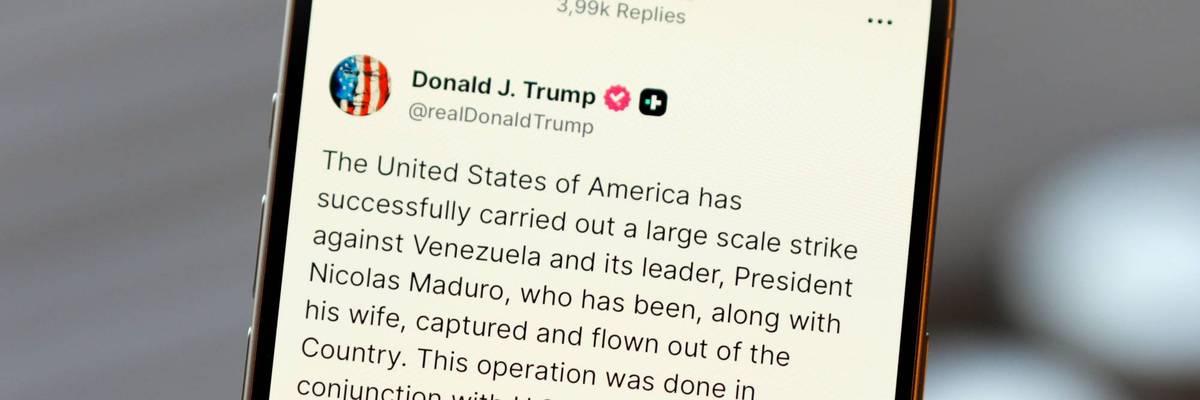
US President Donald Trump's post is seen on the Truth Social media app in this photo illustraiton taken in Warsaw, Poland on January 3, 2026.
"Nothing could be more antithetical to the free, independent press than the president charging for early access to his public announcements."
A lawsuit filed on Wednesday is challenging the legality of Truth API, a recently unveiled initiative to allow Wall Street firms to pay up to $100,000 per month in exchange for early access to potentially market-moving social media posts from President Donald Trump.
The complaint, filed by the Freedom of the Press Foundation (FPF) and The Intercept, alleges Truth API violates the US Constitution's First Amendment by granting insiders special access to the president's announcements.
The scheme also violates the Constitution's Fifth Amendment by "charging unreasonable sums that cannot be justified to offset the cost" of receiving the benefit of information from the president, the complaint states.
The lawsuit describes Truth API as "profoundly corrupt," given that "the president stands to gain financially by giving 'market-moving' government information to those who are willing and able to pay his personal company."
In establishing the plaintiffs' standing, the complaint argues that The Intercept is being put at a competitive disadvantage by the scheme, given that the news outlet is "both unable and unwilling to subscribe" to it, even though it risks "losing out on timely news to competing organizations."
Ben Muessig, editor-in-chief of The Intercept, accused the president of "trying to enrich himself by privatizing government information that he has no right to sell," while vowing that "we won't let that stand."
David Bralow, chief legal officer for The Intercept, said that "nothing could be more antithetical to the free, independent press than the president charging for early access to his public announcements," emphasizing that "public information belongs to the public."
Seth Stern, chief of advocacy at FPF, said Truth API "is so blatantly corrupt and unconstitutional that it would have been hard to even fathom just a few years ago."
"Trump’s crooked scheme is particularly outrageous," Stern added, "because, as documented by our Trump Anti-Press Social Media Tracker, he frequently uses his Truth Social account to berate journalists and even to announce his plans to sue them and criminally investigate them. Then, he makes them wait in line behind paying customers to find out about it unless they’re willing to subsidize the platform he uses to attack them."
The Intercept and the FPF are being represented in the case by attorneys from Citizens for Responsibility and Ethics in Washington (CREW), the Yale Law School Media Freedom and Information Access Clinic, the Public Integrity Project, and Altshuler Berzon LLP.
Nikhel Sus, chief counsel at CREW, said his organization was "proud to represent our clients in their effort to end this corrupt and unconstitutional scheme" because "all Americans are entitled to timely access to their president’s public statements, not just those willing to pay the president’s company $100,000 a month."
Truth API has also drawn the attention of Rep. Jamie Raskin (D-Md.), ranking member of the US House Judiciary Committee, who announced a probe into the initiative last month, describing it as an "insider-information scheme" that "will enable Wall Street to profit from the president’s frequent market-moving posts on major businesses."
Dear Common Dreams reader, It’s been nearly 30 years since I co-founded Common Dreams with my late wife, Lina Newhouser. We had the radical notion that journalism should serve the public good, not corporate profits. It was clear to us from the outset what it would take to build such a project. No paid advertisements. No corporate sponsors. No millionaire publisher telling us what to think or do. Many people said we wouldn't last a year, but we proved those doubters wrong. Together with a tremendous team of journalists and dedicated staff, we built an independent media outlet free from the constraints of profits and corporate control. Our mission has always been simple: To inform. To inspire. To ignite change for the common good. Building Common Dreams was not easy. Our survival was never guaranteed. When you take on the most powerful forces—Wall Street greed, fossil fuel industry destruction, Big Tech lobbyists, and uber-rich oligarchs who have spent billions upon billions rigging the economy and democracy in their favor—the only bulwark you have is supporters who believe in your work. But here’s the urgent message from me today. It's never been this bad out there. And it's never been this hard to keep us going. At the very moment Common Dreams is most needed, the threats we face are intensifying. We need your support now more than ever. We don't accept corporate advertising and never will. We don't have a paywall because we don't think people should be blocked from critical news based on their ability to pay. Everything we do is funded by the donations of readers like you. When everyone does the little they can afford, we are strong. But if that support retreats or dries up, so do we. Will you donate now to make sure Common Dreams not only survives but thrives? —Craig Brown, Co-founder |
A lawsuit filed on Wednesday is challenging the legality of Truth API, a recently unveiled initiative to allow Wall Street firms to pay up to $100,000 per month in exchange for early access to potentially market-moving social media posts from President Donald Trump.
The complaint, filed by the Freedom of the Press Foundation (FPF) and The Intercept, alleges Truth API violates the US Constitution's First Amendment by granting insiders special access to the president's announcements.
The scheme also violates the Constitution's Fifth Amendment by "charging unreasonable sums that cannot be justified to offset the cost" of receiving the benefit of information from the president, the complaint states.
The lawsuit describes Truth API as "profoundly corrupt," given that "the president stands to gain financially by giving 'market-moving' government information to those who are willing and able to pay his personal company."
In establishing the plaintiffs' standing, the complaint argues that The Intercept is being put at a competitive disadvantage by the scheme, given that the news outlet is "both unable and unwilling to subscribe" to it, even though it risks "losing out on timely news to competing organizations."
Ben Muessig, editor-in-chief of The Intercept, accused the president of "trying to enrich himself by privatizing government information that he has no right to sell," while vowing that "we won't let that stand."
David Bralow, chief legal officer for The Intercept, said that "nothing could be more antithetical to the free, independent press than the president charging for early access to his public announcements," emphasizing that "public information belongs to the public."
Seth Stern, chief of advocacy at FPF, said Truth API "is so blatantly corrupt and unconstitutional that it would have been hard to even fathom just a few years ago."
"Trump’s crooked scheme is particularly outrageous," Stern added, "because, as documented by our Trump Anti-Press Social Media Tracker, he frequently uses his Truth Social account to berate journalists and even to announce his plans to sue them and criminally investigate them. Then, he makes them wait in line behind paying customers to find out about it unless they’re willing to subsidize the platform he uses to attack them."
The Intercept and the FPF are being represented in the case by attorneys from Citizens for Responsibility and Ethics in Washington (CREW), the Yale Law School Media Freedom and Information Access Clinic, the Public Integrity Project, and Altshuler Berzon LLP.
Nikhel Sus, chief counsel at CREW, said his organization was "proud to represent our clients in their effort to end this corrupt and unconstitutional scheme" because "all Americans are entitled to timely access to their president’s public statements, not just those willing to pay the president’s company $100,000 a month."
Truth API has also drawn the attention of Rep. Jamie Raskin (D-Md.), ranking member of the US House Judiciary Committee, who announced a probe into the initiative last month, describing it as an "insider-information scheme" that "will enable Wall Street to profit from the president’s frequent market-moving posts on major businesses."
A lawsuit filed on Wednesday is challenging the legality of Truth API, a recently unveiled initiative to allow Wall Street firms to pay up to $100,000 per month in exchange for early access to potentially market-moving social media posts from President Donald Trump.
The complaint, filed by the Freedom of the Press Foundation (FPF) and The Intercept, alleges Truth API violates the US Constitution's First Amendment by granting insiders special access to the president's announcements.
The scheme also violates the Constitution's Fifth Amendment by "charging unreasonable sums that cannot be justified to offset the cost" of receiving the benefit of information from the president, the complaint states.
The lawsuit describes Truth API as "profoundly corrupt," given that "the president stands to gain financially by giving 'market-moving' government information to those who are willing and able to pay his personal company."
In establishing the plaintiffs' standing, the complaint argues that The Intercept is being put at a competitive disadvantage by the scheme, given that the news outlet is "both unable and unwilling to subscribe" to it, even though it risks "losing out on timely news to competing organizations."
Ben Muessig, editor-in-chief of The Intercept, accused the president of "trying to enrich himself by privatizing government information that he has no right to sell," while vowing that "we won't let that stand."
David Bralow, chief legal officer for The Intercept, said that "nothing could be more antithetical to the free, independent press than the president charging for early access to his public announcements," emphasizing that "public information belongs to the public."
Seth Stern, chief of advocacy at FPF, said Truth API "is so blatantly corrupt and unconstitutional that it would have been hard to even fathom just a few years ago."
"Trump’s crooked scheme is particularly outrageous," Stern added, "because, as documented by our Trump Anti-Press Social Media Tracker, he frequently uses his Truth Social account to berate journalists and even to announce his plans to sue them and criminally investigate them. Then, he makes them wait in line behind paying customers to find out about it unless they’re willing to subsidize the platform he uses to attack them."
The Intercept and the FPF are being represented in the case by attorneys from Citizens for Responsibility and Ethics in Washington (CREW), the Yale Law School Media Freedom and Information Access Clinic, the Public Integrity Project, and Altshuler Berzon LLP.
Nikhel Sus, chief counsel at CREW, said his organization was "proud to represent our clients in their effort to end this corrupt and unconstitutional scheme" because "all Americans are entitled to timely access to their president’s public statements, not just those willing to pay the president’s company $100,000 a month."
Truth API has also drawn the attention of Rep. Jamie Raskin (D-Md.), ranking member of the US House Judiciary Committee, who announced a probe into the initiative last month, describing it as an "insider-information scheme" that "will enable Wall Street to profit from the president’s frequent market-moving posts on major businesses."