

SUBSCRIBE TO OUR FREE NEWSLETTER
Daily news & progressive opinion—funded by the people, not the corporations—delivered straight to your inbox.
5
#000000
#FFFFFF
To donate by check, phone, or other method, see our More Ways to Give page.
Daily news & progressive opinion—funded by the people, not the corporations—delivered straight to your inbox.
"Nothing could be more antithetical to the free, independent press than the president charging for early access to his public announcements."
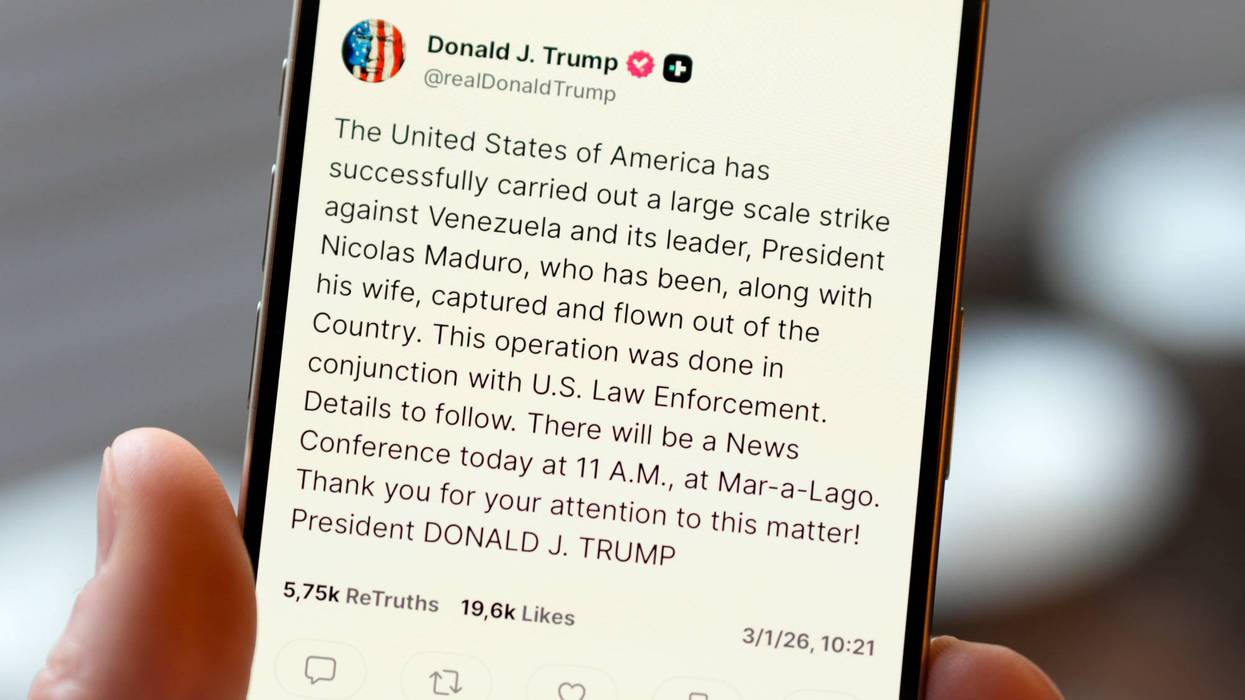
A lawsuit filed on Wednesday is challenging the legality of Truth API, a recently unveiled initiative to allow Wall Street firms to pay up to $100,000 per month in exchange for early access to potentially market-moving social media posts from President Donald Trump.
The complaint, filed by the Freedom of the Press Foundation (FPF) and The Intercept, alleges Truth API violates the US Constitution's First Amendment by granting insiders special access to the president's announcements.
The scheme also violates the Constitution's Fifth Amendment by "charging unreasonable sums that cannot be justified to offset the cost" of receiving the benefit of information from the president, the complaint states.
The lawsuit describes Truth API as "profoundly corrupt," given that "the president stands to gain financially by giving 'market-moving' government information to those who are willing and able to pay his personal company."
In establishing the plaintiffs' standing, the complaint argues that The Intercept is being put at a competitive disadvantage by the scheme, given that the news outlet is "both unable and unwilling to subscribe" to it, even though it risks "losing out on timely news to competing organizations."
Ben Muessig, editor-in-chief of The Intercept, accused the president of "trying to enrich himself by privatizing government information that he has no right to sell," while vowing that "we won't let that stand."
David Bralow, chief legal officer for The Intercept, said that "nothing could be more antithetical to the free, independent press than the president charging for early access to his public announcements," emphasizing that "public information belongs to the public."
Seth Stern, chief of advocacy at FPF, said Truth API "is so blatantly corrupt and unconstitutional that it would have been hard to even fathom just a few years ago."
"Trump’s crooked scheme is particularly outrageous," Stern added, "because, as documented by our Trump Anti-Press Social Media Tracker, he frequently uses his Truth Social account to berate journalists and even to announce his plans to sue them and criminally investigate them. Then, he makes them wait in line behind paying customers to find out about it unless they’re willing to subsidize the platform he uses to attack them."
The Intercept and the FPF are being represented in the case by attorneys from Citizens for Responsibility and Ethics in Washington (CREW), the Yale Law School Media Freedom and Information Access Clinic, the Public Integrity Project, and Altshuler Berzon LLP.
Nikhel Sus, chief counsel at CREW, said his organization was "proud to represent our clients in their effort to end this corrupt and unconstitutional scheme" because "all Americans are entitled to timely access to their president’s public statements, not just those willing to pay the president’s company $100,000 a month."
Truth API has also drawn the attention of Rep. Jamie Raskin (D-Md.), ranking member of the US House Judiciary Committee, who announced a probe into the initiative last month, describing it as an "insider-information scheme" that "will enable Wall Street to profit from the president’s frequent market-moving posts on major businesses."
“The government is not allowed to selectively hide information about its actions that impact protected First Amendment activity,” said a member of the legal team representing The Intercept in its legal challenge.
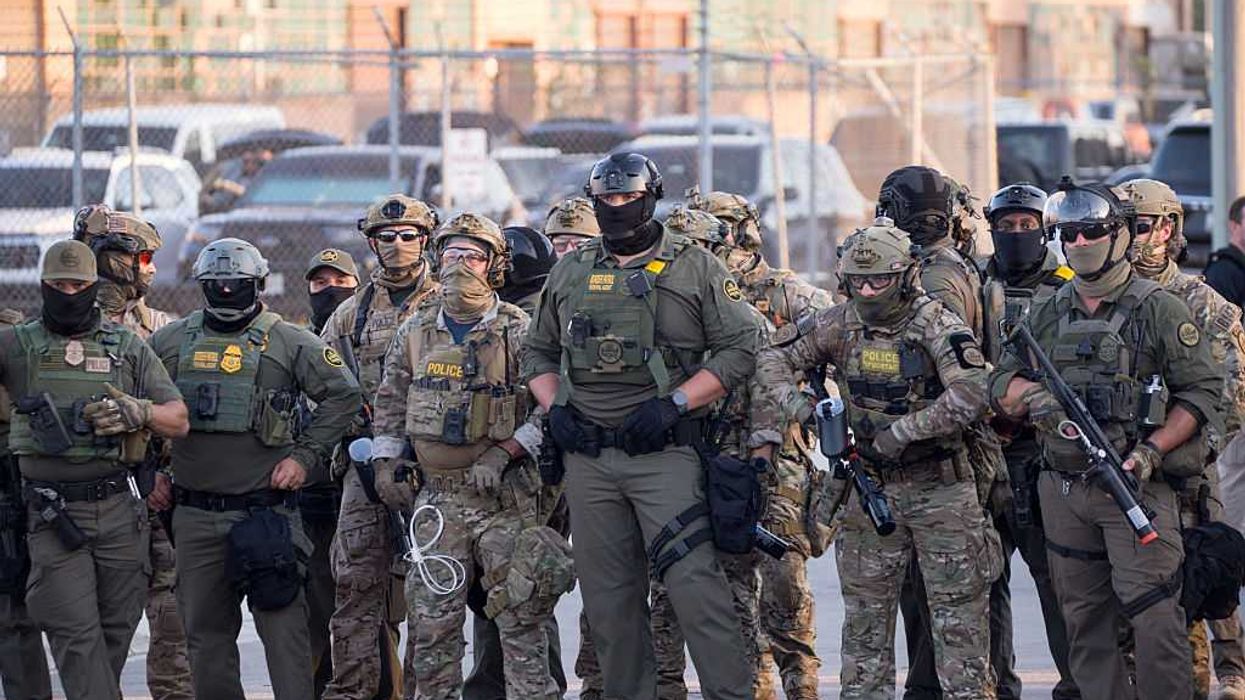
The progressive US media outlet The Intercept filed a lawsuit on Wednesday seeking to compel the Trump administration to hand over documents related to claims by federal officials of a secret database used to track protesters and others dubiously deemed "domestic terrorists."
The Intercept is asking the US District Court for the Southern District of New York to force the Department of Homeland Security (DHS) to release material sought via a Freedom of Information Act (FOIA) request it filed on February 23.
“It’s not illegal to monitor the activity of immigration agents inside your community,” Intercept editor-in-chief Ben Muessig said on Wednesday. “What is illegal is the US government’s secret list of activists—and its refusal to turn over information about that database to the American public.”
The Intercept's FOIA request came amid mounting evidence that, "by using photos, video, license plates, hotel check-in information, and more to create a database of lawful protestors, the government may be taking concerning action affecting the rights of those exercising their First Amendment rights," as plaintiff's counsel Democracy Forward noted in a statement announcing the lawsuit.
The Intercept's complaint cites a video posted on social media on January 23 that shows a federal immigration agent telling a legal observer in Maine during a protest against the deadly US Immigration and Customs Enforcement (ICE) anti-immigrant crackdown that "we have a nice little database, and now you’re considered a domestic terrorist."
According to the lawsuit:
In a court hearing regarding immigration enforcement actions in Minnesota, attorneys for the state of Minnesota reportedly included an exhibit of a recording of a federal agent saying, “Well, this person is gonna have a hard time traveling from now on" after taking a photo of an ICE observer's license plate. The press has reported that “a memo sent earlier this month to agents temporarily assigned to the city asked them to ‘capture all images, license plates, identifications, and general information on hotels, agitators, protestors, etc., so we can capture it all in one consolidated form.'"
Democracy Forward noted that "in a separate court case, a civilian observing ICE submitted a declaration stating that her [Transportation Security Administration] PreCheck and Global Entry were revoked three days after an encounter with immigration enforcement officials."
"Additionally, at least one prominent supporter of transgender rights has reportedly had her Global Entry and US passport canceled in the past few months," the group added.
Not included in the lawsuit are remarks made by White House "border czar" Tom Homan during a January interview with Fox News, during which he said that he aimed to “create a database where those people that are arrested for interference, impeding, and assault" and "make them famous.”
Democracy Forward president and CEO Skye Perryman said Wednesday, "The government is not allowed to selectively hide information about its actions that impact protected First Amendment activity."
"The surveillance and retaliation being reported would be egregious violations of core constitutional principles," she added, "and we are honored to represent a storied news organization as it fights to demand the public have access to the information we need to protect our democracy.”
"This is the evidence that President Biden's talk about a two-state solution is nothing but idle talk," said one former Lebanese diplomat.
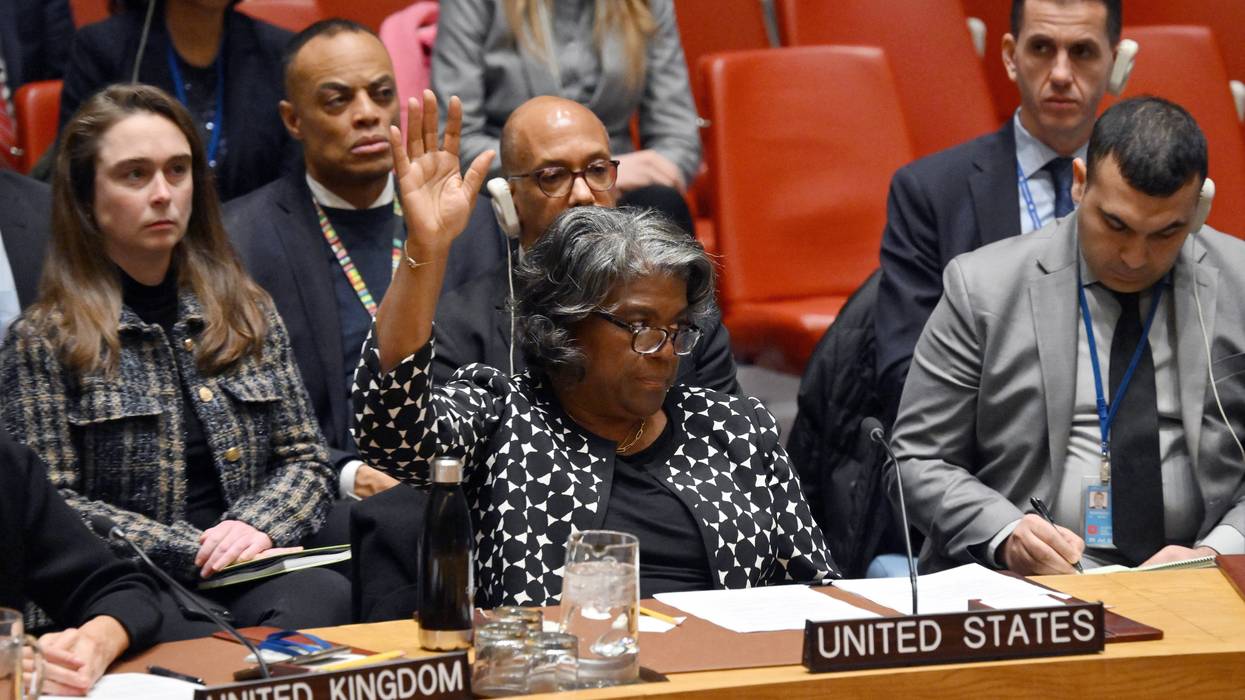
As the United Nations Security Council prepares to vote Thursday on Palestine's bid to become a full U.N. member, the Biden administration—which claims to support Palestinian statehood—is lobbying UNSC nations in an effort to wrangle enough "no" votes so that the United States can avoid resorting to a veto.
Leaked cables obtained by The Intercept show U.S. pressure on Security Council members including Malta—which currently presides over the body—and Ecuador.
While claiming that President Joe Biden backs "Palestinian aspirations for statehood," one of the cables asserts that "it remains the U.S. view that the most expeditious path toward a political horizon for the Palestinian people is in the context of a normalization agreement between Israel and its neighbors."
"We therefore urge you not to support any potential Security Council resolution recommending the admission of 'Palestine' as a U.N. member state, should such a resolution be presented to the Security Council for a decision in the coming days and weeks," the document advises.
The U.S. argument essentially is that the U.N. should not create an independent Palestinian state by fiat—even though that's precisely how the world body voted in 1947 to establish the modern state of Israel.
The renewed push for Palestine's U.N. membership comes as Israel wages a genocidal war on the Gaza Strip. The Palestinian Authority, which hasn't controlled Gaza for nearly two decades, rejected the Biden administration's requests to hold off on seeking full membership.
"We wanted the U.S. to provide a substantive alternative to U.N. recognition. They didn't," one unnamed Palestinian official told Axios on Wednesday. "We believe full membership in the U.N. for Palestine is way overdue. We have waited more than 12 years since our initial request."
As The Intercept's Ken Klippenstein and Daniel Boguslaw noted:
Since 2011, the U.N. Security Council has rejected the Palestinian Authority's request for full member status. On April 2, the Palestinian Observer Mission to the U.N. requested that the council once again take up consideration of its membership application. According to the first State Department cable, U.N. meetings since the beginning of April suggest that Algeria, China, Guyana, Mozambique, Russia, Slovenia, Sierra Leone, and Malta support granting Palestine full membership to the U.N. It also says that France, Japan, and Korea are undecided, while the United Kingdom will likely abstain from a vote.
Along with the United States, China, France, Russia, and the United Kingdom are permanent members of the UNSC, so they also have veto power.
Ahead of Thursday's planned vote, Spain has been doing its own lobbying in Europe to build greater support for Palestinian statehood. At a joint Tuesday press conference with Spanish Prime Minister Pedro Sánchez, Slovenian Prime Minister Robert Golob said the question is "when, not if, but when is the best moment to recognize Palestine."
Belgium—which is seeking economic sanctions against Israel in response to its genocidal war on Gaza—is expected to join Spain's push for Palestinian statehood after the country's European Union presidency expires in June.
Currently, 139 of the U.N.'s 193 member states recognize Palestine as an independent state.
Israeli Prime Minister Benjamin Netanyahu—who has also claimed to support a so-called "two-state solution"—has alternately boasted about thwarting Palestinian statehood.
Critics pointed to the leaked cables as more proof of U.S. duplicity and double standards on the Israel-Palestine issue.
"This is the evidence that President Biden's talk about a two-state solution is nothing but idle talk," Massoud Maalouf, a former Lebanese ambassador to Canada, Chile, and Poland, said on social media.
The media outlets claim the company violated copyright laws.
The Intercept, Raw Story, and Alternet joined forces on Wednesday to sue OpenAI for using copyrighted content to train its generative artificial intelligence tool ChatGPT.
The law firm Loevy + Loevy is representing the publications, and it has filed the lawsuit in the Southern District of New York. The firm claims OpenAI violated the Digital Millennium Copyright Act (DMCA) by using copyrighted content from news organizations to train ChatGPT.
"Had OpenAI trained ChatGPT using these works as they were published, including author, title, and copyright information, ChatGPT may have learned to respect third-party copyrights, or at least inform ChatGPT users that it was providing responses that were based on the copyrighted works of others. Instead, OpenAI removed that information from its ChatGPT training sets, in violation of the DMCA," the firm said in a statement.
NEWS: @RawStory is suing @OpenAI, creator of #ChatGPT.
“I think it's time for tech companies to be proactive in compensating publishers for their work,” Raw Story CEO @JohnByrnester told @corbinbolies of @TheDailyBeasthttps://t.co/dVX1q1qsvA
— Raw Story (@RawStory) February 28, 2024
OpenAI is facing multiple lawsuits over its use of copyrighted material, including from comedian Sarah Silverman and The New York Times. The Times lawsuit also references violations of the DMCA. OpenAI recently claimed the Times "hacked" ChatGPT to get it to reproduce its copyrighted content.
Publications like the The Associated Press have formed partnerships with OpenAI where they license their work to the company, rather than suing them over the use of copyrighted content. According to the AI-based text analysis company Copyleaks, approximately 60% of the content generated by ChatGPT-3.5 is plagiarized.
OpenAI argues its actions fall under "fair use." In 2016, the U.S. Supreme Court let a lower court ruling stand that said Google had not violated copyright laws by digitizing millions of books, so OpenAI may have a shot at winning with that kind of argument. It remains to be seen if any of the lawsuits against the company will make their way to the Supreme Court.
"Developers like OpenAI have garnered billions in investment and revenue because of AI products fundamentally created with and trained on copyright-protected material," said Loevy + Loevy partner Matt Topic, who represents the news organizations in the suits."The Digital Millennium Copyright Act prohibits the removal of author, title, and copyright notice when there is reason to know it would conceal or facilitate copyright infringement, and unlike traditional copyright infringement claims, it does not require creators to incur the copyright registration fees that often make traditional copyright infringement suits cost prohibitive given the massive scale of OpenAI's infringement."
"Given the use of AI systems in the targeting of civilians in Gaza, it's a notable moment to make the decision to remove the words," warned one policy analyst.
ChatGPT maker OpenAI this week quietly removed language from its usage policy that prohibited military use of its technology, a move with serious implications given the increase use of artificial intelligence on battlefields including Gaza.
ChatGPT is a free tool that lets users enter prompts to receive text or images generated by AI.The Intercept's Sam Biddle reported Friday that prior to Wednesday, OpenAI's permissible uses page banned "activity that has high risk of physical harm, including," specifically, "weapons development" and "military and warfare."
Although the company's
new policy stipulates that users should not harm human beings or "develop or use weapons," experts said the removal of the "military and warfare" language leaves open the door for lucrative contracts with U.S. and other militaries.
"Given the use of AI systems in the
targeting of civilians in Gaza, it's a notable moment to make the decision to remove the words 'military and warfare' from OpenAI's permissible use policy," Sarah Myers West, managing director of the AI Now Institute and a former AI policy analyst at the Federal Trade Commission, told The Intercept.
"The language that is in the policy remains vague and raises questions about how OpenAI intends to approach enforcement," she added.
An OpenAI spokesperson told Common Dreams in an email that:
Our policy does not allow our tools to be used to harm people, develop weapons, for communications surveillance, or to injure others or destroy property. There are, however, national security use cases that align with our mission. For example, we are already working with [the Defense Advanced Research Projects Agency] to spur the creation of new cybersecurity tools to secure open source software that critical infrastructure and industry depend on. It was not clear whether these beneficial use cases would have been allowed under "military" in our previous policies. So the goal with our policy update is to provide clarity and the ability to have these discussions.
As AI advances, so does its weaponization. Experts warn that AI applications including lethal autonomous weapons systems, commonly called "killer robots," could pose a potentially existential threat to humanity that underscores the imperative of arms control measures to slow the pace of weaponization.
That's the goal of nuclear weapons legislation introduced last year in the U.S. Congress. The bipartisan Block Nuclear Launch by Autonomous Artificial Intelligence Act—introduced by Sen. Ed Markey (D-Mass.) and Reps. Ted Lieu (D-Calif.), Don Beyer (D-Va.), and Ken Buck (R-Colo.)—asserts that "any decision to launch a nuclear weapon should not be made" by AI.
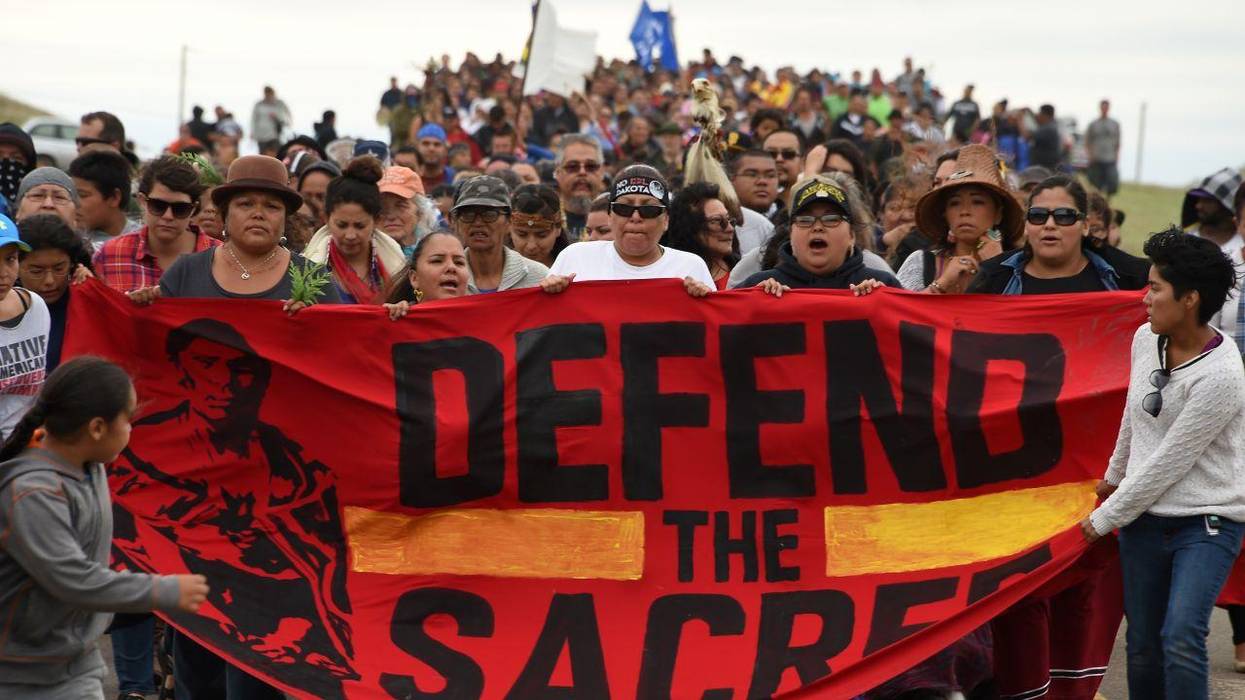
May Boeve, who heads 350.org, decried private security firm TigerSwan's "astonishing abuse of power and significant interference with the right to political freedom of thought and the right to protest."
A private security firm that worked with law enforcement to suppress the Indigenous-led movement against the Dakota Access Pipeline targeted peaceful activist groups including the 350.org climate campaign as part of a sweeping surveillance effort, according to a report published Thursday by The Intercept.
Previous reporting by The Intercept's Alleen Brown showed how TigerSwan—which was founded by U.S. special forces veteran James Reese—infiltrated and spied on water protectors during the 2016-2017 #NoDAPL protests at the Standing Rock Indian Reservation in North and South Dakota.
The new reporting from Brown and Naveena Sadasivam—who received more than 50,000 pages of documents via a public records request—details how "TigerSwan used social media monitoring, aerial surveillance, radio eavesdropping, undercover personnel, and subscription-based records databases to build watchlists and dossiers on Indigenous activists and environmental organizations."
TigerSwan—which did not even have the requisite security license to operate in North Dakota—then tried to sell the intelligence it illegally gleaned to other oil companies.
One of those groups was the nonviolent climate organization 350.org. According to a TigerSwan client document titled Background Investigation: 350.org:
350.org's ability to bring global attention to the DAPL protest via their network of supporters and their media concerns represents a significant concern for TigerSwan and their client. 350.org's ability to mobilize large groups of people is also of significant concern. They are unlikely to remove themselves from the protesters' groups because their goals align perfectly with the Standing Rock Sioux tribe. They have a track record of success and should only be engaged after significant preparation.
Brown and Sadasivam also found that:
TigerSwan also attempted to dig up dirt on legal workers with the Water Protector Legal Collective, which represented pipeline opponents. The security company used the CLEAR database, which is only available to select entities like law enforcement and licensed private security companies, to dig up information on attorney Chad Nodland...
At the same time, the National Sheriffs'Association was building its own profiles and sharing them with TigerSwan. In one instance, a contractor for the sheriffs' group passed along a six-page backgrounder on LaDonna Brave Bull Allard, a prominent Dakota Access pipeline opponent and historian, to TigerSwan. The document included statements Allard made to the press, her public appearances, social media posts, and details about tax liens filed against her and her husband.
"Across the globe we know that thousands of groups have been spied on by government and private security firms that are serving the interests of the fossil fuel industry," 350.org chief executive May Boeve said in a Thursday statement in response to the latest reporting. "This represents an astonishing abuse of power and significant interference with the right to political freedom of thought and the right to protest."
Wasté Win Young, a citizen of the Standing Rock Sioux Tribe and a plaintiff in a class-action civil rights lawsuit against TigerSwan and local law enforcement, told The Intercept that for pipeline supporters, the surveillance "was an opportunity to help create a narrative against our tribe and our supporters."
Boeve contended that "ultimately, it is a means for those who hold power to preserve the status quo and prevent action on the climate crisis and necessary social change."
"We need to always be very clear that the industry knows what a risk the climate movement is," she told The Intercept. "They're going to keep using these kinds of strategies, but they'll think of other things as well."

The Pentagon's stated commitment to transparency on civilian casualties was questioned Tuesday in an Intercept report noting that the Department of Defense has failed to respond to a group of House Democrats who set a three-month deadline to explain the U.S. military's role in a 2017 Nigerian airstrike that killed more than 160 noncombatants.
"It sends a worrisome message that, at minimum, the Defense Department is unwilling to engage on an issue affecting countless lives."
On September 8, Reps. Sara Jacobs (D-Calif.), Jason Crow (D-Colo.), Ro Khanna (D-Calif.), Tom Malinowski (D-N.J.), and Andy Kim (D-N.J.)--the Protection of Civilians in Combat Caucus--sent a letter to Defense Secretary Lloyd Austin citing reporting that the U.S. military provided Nigerian forces with intelligence support ahead of a January 17, 2017 airstrike on a refugee camp in Rann, Borno state, in the country's northeastern corner.
Nigeria bombed the camp believing it was a base for Boko Haram fighters. More than 160 civilians died in the attack, including six Red Cross aid workers. A formerly classified U.S. military document obtained by The Intercept referred to the strike as a "U.S.-Nigerian" operation. Days after the attack, U.S. Africa Command (AFRICOM) secretly ordered a probe of the airstrike.
The lawmakers asked what was the nature of U.S. involvement in the strike, whether the military provided intelligence or other support to its Nigerian partner, and other questions, asking Pentagon officials to reply "no later than 90 days" after they received the letter. That deadline was nearly two weeks ago.
"The Pentagon's failure to provide information and documents... to determine possible U.S. involvement in an airstrike that took many civilian lives in northeast Nigeria does not bode well for the U.S. government's expressed commitment to transparency and accountability," Human Rights Watch Nigeria researcher Anietie Ewang told The Intercept.
"It sends a worrisome message that, at minimum, the Defense Department is unwilling to engage on an issue affecting countless lives and may even reflect an attempt to evade responsibility," she added.
The Intercept's Nick Turse writes:
In August, the Pentagon unveiled a Civilian Harm Mitigation and Response Action Plan, which provides a blueprint for improving how the U.S. military addresses civilian harm. The plan calls for a new emphasis on the "proactive release of information" and "transparency regarding [Defense Department] policies and processes for mitigating and responding to civilian harm"--but not until next year.
The formerly secret AFRICOM document obtained by The Intercept, along with reporting by Nigerian journalists and interviews with experts, suggests that the U.S. may have launched this rare internal investigation because it secretly provided intelligence or other support to the Nigerian armed forces who carried out the deadly strike.
Asked to comment on the missed deadline, Pentagon spokesperson Col. Phillip Ventura told The Intercept that "I don't think we're going to get a lot of joy on this one."
"The Department of Defense is aware of the matter and addressing the concerns of Congress directly with them," Ventura told the outlet after the article's publication.
"As a department, we have long recognized the strategic and moral importance of mitigating harm to civilians--whether resulting from a U.S. military operation or an operation conducted by our allies and partners," he added, "and we will continue to improve by implementing the steps outlined in the Civilian Harm Mitigation and Response Action Plan (CHMR-AP), which Secretary Austin approved in August of this year."
Earlier this week, Jacobs and Sen. Elizabeth Warren (D-Mass.) sent a letter to Austin expressing alarm over the "vast difference" in the number of civilians the Pentagon claims responsibility for killing during U.S. attacks and casualty figures compiled by independent investigators.

While claiming to have bought the social media giant in order to make it "an inclusive arena for free speech," multibillionaire Twitter owner Elon Musk is apparently overseeing what critics claim is a purge of anti-fascist voices, The Intercept reported Tuesday.
"No one should've honestly believed Elon Musk would use his ownership of Twitter to champion free speech."
"Several prominent anti-fascist organizers and journalists have had their accounts suspended in the past week, after right-wing operatives appealed directly to Musk to ban them and far-right internet trolls flooded Twitter's complaints system with false reports about terms of service violations," The Intercept's Robert Mackey and Micah Lee wrote.
Among the suspended Twitter accounts are those of journalist Vishal Pratap Singh, who covers far-right protests in California; the Elm Fork John Brown Gun Club, which provides security for LGBTQ+ events in Texas; the anarchist collective CrimethInc; and anti-fascist researcher Chad Loder.
"What I believe happened is that I and other accounts have been mass reported for the last few weeks by a dedicated group of far-right extremists who want to erase archived evidence of their past misdeeds and to neutralize our ability to expose them in the future," Loder told The Intercept.
"What I suspect happened is that Twitter's automatic systems flagged my account for some reason and no human being is reviewing these," Loder added.
A common thread connects the aforementioned suspensions: All were flagged by far-right conspiracy theorist and social media influencer Andy Ngo, who, in a Twitter exchange was invited by Musk to identify accounts for possible suspension.
"Andy Ngo's bizarre vision of 'Antifa' seems to be the metric used to delete the accounts of journalists and publications, most of which engaged in verifiably good journalism and [have] done so completely above board and [terms of service] observant ways," tweeted Shane Burley, editor of the anthology !No Pasaran!: Anti-fascist Dispatches From a World in Crisis. "Paranoid delusions about Antifa are driving it."
In recent days, a list of thousands of purported "Antifa" Twitter accounts--including those of CNN, actor Danny DeVito, the World Health Organization, and a "professional dog rater"--has been circulating online.
While calling the list "absurd," listee Nick Martin, publisher of the extremism monitoring site The Informant, warned: "Don't dismiss it. A mass flagging campaign has begun based on the list and is already claiming victory for a number of bans. It's a sign far-right extremists see Elon Musk as a ally who will empower them and destroy their enemies."
The suspensions of left-wing accounts came as Musk restores the accounts of far-right figures, some of whom--like former U.S. President Donald Trump--have called for or incited violence on the platform.
"The irony isn't lost on us that our suspension coincides with a coordinated effort to reinstate the most vile antisemitic, transphobic hate accounts," Elm Fork John Brown Gun Club told The Intercept. "Whether this is an indication of the future of leadership of Elon Musk's running of Twitter, we cannot say but we can say that the timing and reasoning is deliberate and targeted."
CrimethInc, which before the current suspension had never run afoul of Twitter's terms of service in its 14-year existence, said that "Musk's goal in acquiring Twitter had nothing to do with free speech. It was a partisan move to silence opposition, paving the way for fascist violence."
Jacobin's Branko Marcetic wrote Tuesday that "no one should've honestly believed Elon Musk would use his ownership of Twitter to champion free speech."
"Besides the fact that the man is a professional bullshitter," he added, "it was always dubious that a guy who slaps employees with gag orders and bars them from wearing pro-union messages had a genuine commitment to the proverbial marketplace of ideas."

As a report published Wednesday revealed the loss of over 500,000 jobs since the Taliban retook control of Afghanistan last August, critics of the Biden administration's policy of economic sanctions and freezing billions of dollars in Afghan government funds renewed warnings of a "U.S.-fueled genocide" in the starving, suffering, war-torn nation.
"The Taliban barely fired a shot in taking over the country last summer, but the U.S., with the press of a button, has flattened it."
The United Nations International Labor Organization (ILO) reported that Afghanistan's economy has been "paralyzed" since the Taliban takeover, with more than half a million jobs lost in the third quarter of 2021, much of the decline attributable to a precipitous drop in "women's participation in the workplace."
The agency projects further employment losses of 700,000 to over 900,000 by mid-2022.
However, a direr--yet connected--crisis is being largely blamed on the Biden administration's punitive policies that, while meant to target the Taliban, are causing grievous harm to ordinary Afghans.
The Intercept's Ryan Grim and Sara Sirota noted Wednesday that after the Taliban seized power, the United States--which as an occupying power controlled Afghanistan's foreign currency reserves--froze more than $9 billion in funds belonging to the country.
On August 14, $300 million was scheduled for transfer to the U.S.-backed Afghan government. However, the Taliban entered Kabul the following day, and U.S. Secretary of State Antony Blinken stopped the transfer.
Back in November, Amnesty International warned that the freeze contributed to plunging the country into "a full-blown economic crisis."
Yamini Mishra, the group's South Asia regional director, said at the time that "without an urgent program of targeted international support and without permitting the use of Afghanistan government reserves to support the country's population, the scene is set for a human catastrophe over the coming months."
"The Taliban barely fired a shot in taking over the country last summer," wrote Grim and Sirota, "but the U.S., with the press of a button, has flattened it."
Grim and Sirota continued:
The economic fallout has been extreme, much as it would be if the U.S. Federal Reserve suddenly lost access to its own capital. The result has been bank closures, mass business failures, soaring unemployment, collapse of the currency against the dollar, soaring inflation, and death by starvation. Desperate Afghans have resorted to selling off their belongings for food or burning them to stay warm. A migration crisis is brewing. The Biden administration's sanctions have deepened the economic collapse, while the White House has also urged European partners and multilateral institutions like the World Bank and International Monetary Fund to similarly starve the nation of capital.
Vicki Aken, Afghanistan director at the humanitarian aid group International Rescue Committee, said last week that "the grim reality is that disease and child malnutrition are rising as health workers go without pay and hospitals go without medicine, while nine million Afghans are on the brink of famine conditions against the backdrop of massive economic collapse."
The World Food Program warned last month that, without urgent funding needs being met, 3.2 million Afghan children faced life-threatening malnutrition.
Common Dreams reported last week that the Biden administration has promised just over $300 million for humanitarian assistance in Afghanistan, far short of the $5 billion urgently sought by the U.N. in its largest-ever single-country aid appeal.
Related Content

Grim and Sirota noted that "congressional Democrats are divided over how to respond the Biden administration's continuing insistence on driving millions of people in Afghanistan to the brink of starvation and beyond, a policy that has produced a humanitarian catastrophe that threatens to morph into a U.S.-fueled genocide."
While moderate and right-wing Democrats are demanding that the Taliban meet certain conditions--including the administration's insistence upon a more inclusive government--before offering the Afghans sanctions and funding relief, congressional progressives are calling upon the Biden administration to immediately lift sanctions and release Afghan funds without preconditions.
"Afghanistan is facing a humanitarian catastrophe," Sen. Bernie Sanders (I-Vt.) tweeted Tuesday. "I urge the Biden administration to immediately release billions in frozen Afghan government funds to help avert this crisis, and prevent the death of millions of people."
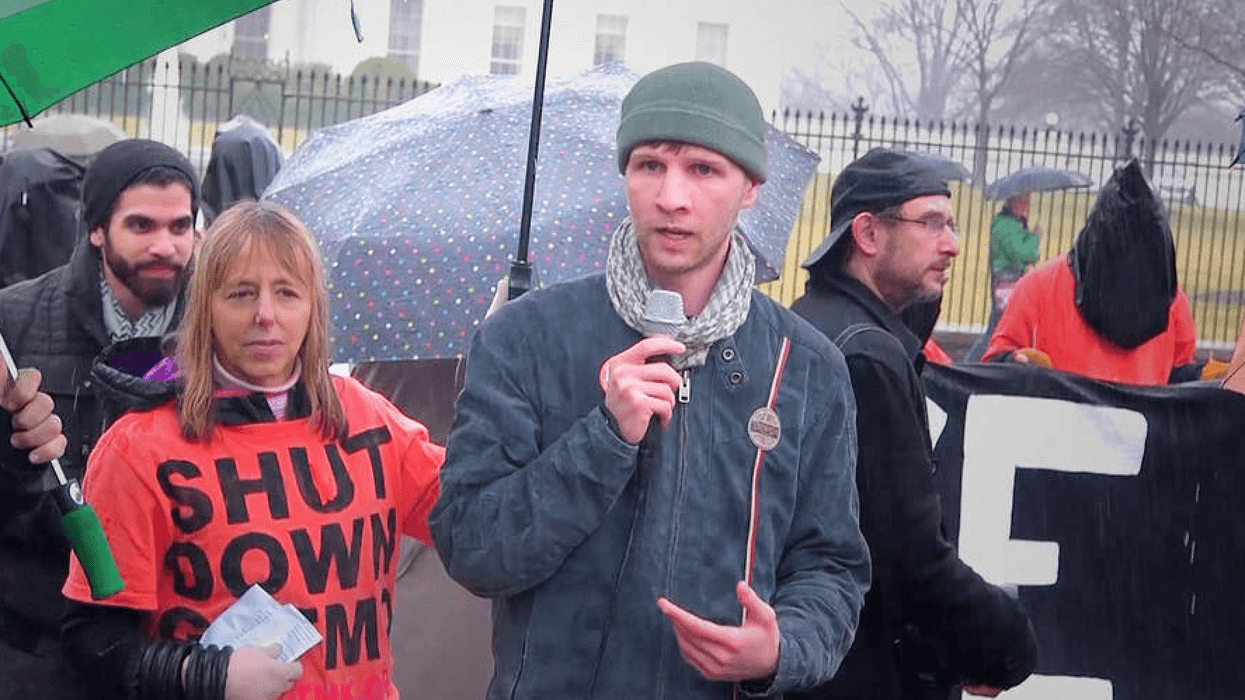
Press freedom, peace, and human rights advocates are rallying behind Daniel Hale, the former intelligence analyst who blew the whistle on the U.S. government's drone assassination program, and who pleaded guilty Wednesday in federal court to violating the Espionage Act.
"The U.S. government's policy of punishing people who provide journalists with information in the public interest is a profound threat to free speech, free press, and a healthy democracy."
--Jesselyn Radack,
Hale's attorney
The Washington Post reports Hale, who was set to go on trial next week, pleaded guilty to a single count of violating the 1917 law that has been used to target whistleblowers including Julian Assange, John Kiriakou, Chelsea Manning, Edward Snowden, Jeffrey Sterling, Reality Winner, and others.
Hale was charged in 2019 during the Trump administration after he leaked classified information on the U.S. government's targeted assassination program to a reporter, who according to court documents, matches the description of The Intercept founding editor Jeremy Scahill. He is the first person to face sentencing for an Espionage Act offense during the administration of President Joe Biden.
As vice president under President Barack Obama, Biden contributed to the creation of whistleblower protections in the Dodd-Frank Wall Street Reform and Consumer Protection Act, while simultaneously serving in an administration that, while promising "a new era of open government," relentlessly targeted individuals who revealed U.S. war crimes and other classified information.
Kiriakou--a former CIA agent who under Obama was sentenced to 30 months' imprisonment for exposing U.S. torture--told Kevin Gosztola that he is "dissapointed that Daniel Hale's case was continued in the Biden Justice Department."
"I had hopes that Biden's Justice Department appointee would recognize the public service that Daniel Hale provided when he revealed illegality and abuse in the drone program," said Kiriakou.
Hale, who was an intelligence analyst for the U.S. Air Force before moving on to the National Security Agency and then the National Geospatial-Intelligence Agency, "knowingly took highly classified documents and disclosed them without authorization, thereby violating his solemn obligations to our country," according to a statement from Raj Parekh, the acting U.S. attorney for the Eastern District of Virginia.
According to Gosztola, Hale's whistleblowing led to the revelation by The Intercept that "nearly half of the people on the U.S. government's widely shared database of terrorist suspects are not connected to any known terrorist group," details on how the Obama administration approved targeted assassinations, and information about Bilal el-Berjawi, a Briton "who was stripped of his citizenship before being killed in a U.S. drone strike in 2012."
The Post reports that Hale admitted in court to writing an anonymous chapter in Scahill's 2016 book, The Assassination Complex: Inside the Government's Secret Drone Warfare Program, which divulged information taken from top-secret documents about drone strike protocols, civilian casualties, and Pentagon officials' debate about the accuracy of intelligence.
"These documents detailed a secret, unaccountable process for targeting and killing people around the world, including U.S. citizens, through drone strikes," Betsy Reed, editor-in-chief of The Intercept, said after Hale's indictment. "They are of vital public importance, and activity related to their disclosure is protected by the First Amendment."
Hale had initially centered his defense on First Amendment grounds, and his numerous defenders condemned his prosecution as a violation of press freedom and freedom of speech. His lawyer, Jesselyn Radack, issued a statement saying "the U.S. government's policy of punishing people who provide journalists with information in the public interest is a profound threat to free speech, free press, and a healthy democracy."
"Classified information is published in the press every day; in fact, the biggest leaker of classified information is the U.S. government," wrote Radack. "However, the Espionage Act is used uniquely to punish those sources who give journalists information that embarrasses the government or exposes its lies."
"Every whistleblower jailed under the Espionage Act is a threat to the work of national security journalists and the sources they rely upon to hold the government accountable," she added.
Medea Benjamin, co-founder of the women-led peace group CodePink, tweeted that it's "outrageous that drone whistleblower Daniel Hale will be going to prison for exposing the drone murders by the U.S. military. Why don't the murderers go to jail? Or the ones who ok the murders? Or the ones who make the killer drones and profit from murder?"
Hale's sentencing is scheduled for July 13. He faces up to 10 years behind bars. Kiriakou told Gosztola that he hopes the judge "recognizes the good in what Daniel Hale has done and gives him the lightest possible sentence."