SUBSCRIBE TO OUR FREE NEWSLETTER
Daily news & progressive opinion—funded by the people, not the corporations—delivered straight to your inbox.
5
#000000
#FFFFFF
To donate by check, phone, or other method, see our More Ways to Give page.
Daily news & progressive opinion—funded by the people, not the corporations—delivered straight to your inbox.
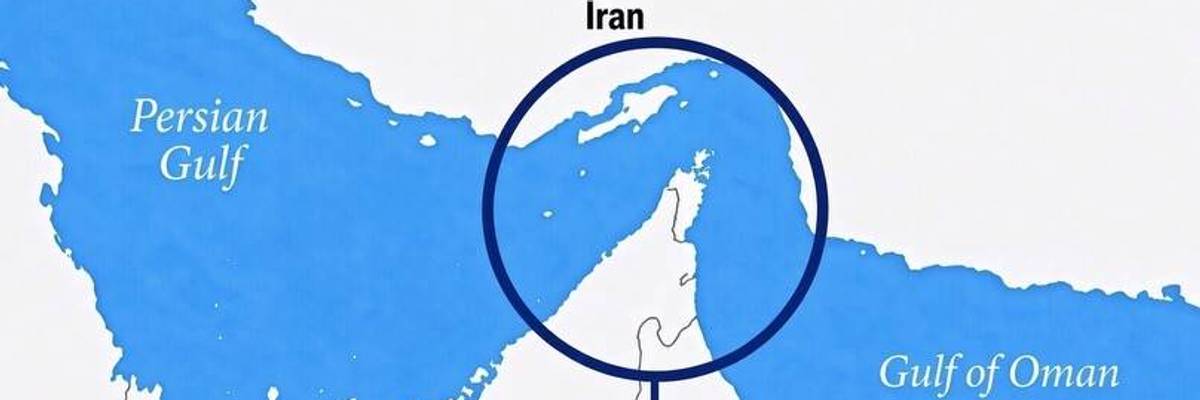
President Donald Trump shared this map labeling the Strait of Hormuz a "new US territory" on his Truth Social platform on August 18, 2026.
The Iranian Parliament speaker said the strait will stay closed until the US blockade and oil embargo are lifted, and any party continuing its "aggression or threats" would face a "more severe defeat."
Just days after threatening to declare the Strait of Hormuz a US territory, President Donald Trump on Tuesday posted a map on his Truth Social platform with that label over the crucial waterway—and was swiftly called out by a top Iranian diplomat.
"Just as Trump correctly wrote the name of the Persian Gulf, his illusion about the Strait of Hormuz will soon be corrected—or we will correct the delusions of this delusional individual," Iran's deputy foreign minister, Kazem Gharibabadi, responded in Arabic on X.
Gharibabadi included a screengrab of Trump's post featuring a map that shows the strait, which is south of Iran and runs between the Persian Gulf and Gulf of Oman.
Since Trump and Israel began illegally bombing Iran on February 28, the Middle East country has restricted traffic through the strait, a key shipping route, particularly for fossil fuels. That has driven up fuel prices worldwide, including in the United States, where the cost for a gallon of gasoline just hit a record high for mid-August.
Despite the economic toll at home, the range of impacts across the Middle East—where nearly six months of war have killed thousands of people—and a plummeting approval rating, Trump said last week that "I'll never apologize, I did the right thing."
That declaration and Trump's threat over the strait came in a Friday speech on Long Island, after which critics across the United States and beyond condemned the president as a "completely unhinged lunatic" and "sadistic violent menace to the world" who ought to be impeached again.
By Monday, a 60-day ceasefire deal expired, and neither side has signaled any progress on talks to end the war—which Trump claims is aimed at stopping Iran from building nuclear weapons, even though his own intelligence agencies have said it wasn't trying to do so. Trump notably ditched the Obama administration's Iran nuclear deal during his first term.
According to Palestine Chronicle, Iranian Maj. Gen. Mostafa Izadi, deputy commander-in-chief of the Islamic Revolutionary Guard Corps, said Tuesday that "the enemy failed to destroy Iran's defensive capabilities and nuclear industries."
As for the strait, Iranian Parliament Speaker Mohammad Bagher Ghalibaf said that it will stay closed until the US blockade and oil embargo are lifted, and warned that any party continuing its "aggression or threats" would face a "more severe defeat."
Dear Common Dreams reader, It’s been nearly 30 years since I co-founded Common Dreams with my late wife, Lina Newhouser. We had the radical notion that journalism should serve the public good, not corporate profits. It was clear to us from the outset what it would take to build such a project. No paid advertisements. No corporate sponsors. No millionaire publisher telling us what to think or do. Many people said we wouldn't last a year, but we proved those doubters wrong. Together with a tremendous team of journalists and dedicated staff, we built an independent media outlet free from the constraints of profits and corporate control. Our mission has always been simple: To inform. To inspire. To ignite change for the common good. Building Common Dreams was not easy. Our survival was never guaranteed. When you take on the most powerful forces—Wall Street greed, fossil fuel industry destruction, Big Tech lobbyists, and uber-rich oligarchs who have spent billions upon billions rigging the economy and democracy in their favor—the only bulwark you have is supporters who believe in your work. But here’s the urgent message from me today. It's never been this bad out there. And it's never been this hard to keep us going. At the very moment Common Dreams is most needed, the threats we face are intensifying. We need your support now more than ever. We don't accept corporate advertising and never will. We don't have a paywall because we don't think people should be blocked from critical news based on their ability to pay. Everything we do is funded by the donations of readers like you. When everyone does the little they can afford, we are strong. But if that support retreats or dries up, so do we. Will you donate now to make sure Common Dreams not only survives but thrives? —Craig Brown, Co-founder |
Just days after threatening to declare the Strait of Hormuz a US territory, President Donald Trump on Tuesday posted a map on his Truth Social platform with that label over the crucial waterway—and was swiftly called out by a top Iranian diplomat.
"Just as Trump correctly wrote the name of the Persian Gulf, his illusion about the Strait of Hormuz will soon be corrected—or we will correct the delusions of this delusional individual," Iran's deputy foreign minister, Kazem Gharibabadi, responded in Arabic on X.
Gharibabadi included a screengrab of Trump's post featuring a map that shows the strait, which is south of Iran and runs between the Persian Gulf and Gulf of Oman.
Since Trump and Israel began illegally bombing Iran on February 28, the Middle East country has restricted traffic through the strait, a key shipping route, particularly for fossil fuels. That has driven up fuel prices worldwide, including in the United States, where the cost for a gallon of gasoline just hit a record high for mid-August.
Despite the economic toll at home, the range of impacts across the Middle East—where nearly six months of war have killed thousands of people—and a plummeting approval rating, Trump said last week that "I'll never apologize, I did the right thing."
That declaration and Trump's threat over the strait came in a Friday speech on Long Island, after which critics across the United States and beyond condemned the president as a "completely unhinged lunatic" and "sadistic violent menace to the world" who ought to be impeached again.
By Monday, a 60-day ceasefire deal expired, and neither side has signaled any progress on talks to end the war—which Trump claims is aimed at stopping Iran from building nuclear weapons, even though his own intelligence agencies have said it wasn't trying to do so. Trump notably ditched the Obama administration's Iran nuclear deal during his first term.
According to Palestine Chronicle, Iranian Maj. Gen. Mostafa Izadi, deputy commander-in-chief of the Islamic Revolutionary Guard Corps, said Tuesday that "the enemy failed to destroy Iran's defensive capabilities and nuclear industries."
As for the strait, Iranian Parliament Speaker Mohammad Bagher Ghalibaf said that it will stay closed until the US blockade and oil embargo are lifted, and warned that any party continuing its "aggression or threats" would face a "more severe defeat."
Just days after threatening to declare the Strait of Hormuz a US territory, President Donald Trump on Tuesday posted a map on his Truth Social platform with that label over the crucial waterway—and was swiftly called out by a top Iranian diplomat.
"Just as Trump correctly wrote the name of the Persian Gulf, his illusion about the Strait of Hormuz will soon be corrected—or we will correct the delusions of this delusional individual," Iran's deputy foreign minister, Kazem Gharibabadi, responded in Arabic on X.
Gharibabadi included a screengrab of Trump's post featuring a map that shows the strait, which is south of Iran and runs between the Persian Gulf and Gulf of Oman.
Since Trump and Israel began illegally bombing Iran on February 28, the Middle East country has restricted traffic through the strait, a key shipping route, particularly for fossil fuels. That has driven up fuel prices worldwide, including in the United States, where the cost for a gallon of gasoline just hit a record high for mid-August.
Despite the economic toll at home, the range of impacts across the Middle East—where nearly six months of war have killed thousands of people—and a plummeting approval rating, Trump said last week that "I'll never apologize, I did the right thing."
That declaration and Trump's threat over the strait came in a Friday speech on Long Island, after which critics across the United States and beyond condemned the president as a "completely unhinged lunatic" and "sadistic violent menace to the world" who ought to be impeached again.
By Monday, a 60-day ceasefire deal expired, and neither side has signaled any progress on talks to end the war—which Trump claims is aimed at stopping Iran from building nuclear weapons, even though his own intelligence agencies have said it wasn't trying to do so. Trump notably ditched the Obama administration's Iran nuclear deal during his first term.
According to Palestine Chronicle, Iranian Maj. Gen. Mostafa Izadi, deputy commander-in-chief of the Islamic Revolutionary Guard Corps, said Tuesday that "the enemy failed to destroy Iran's defensive capabilities and nuclear industries."
As for the strait, Iranian Parliament Speaker Mohammad Bagher Ghalibaf said that it will stay closed until the US blockade and oil embargo are lifted, and warned that any party continuing its "aggression or threats" would face a "more severe defeat."