5
#000000
#FFFFFF
To donate by check, phone, or other method, see our More Ways to Give page.
Daily news & progressive opinion—funded by the people, not the corporations—delivered straight to your inbox.
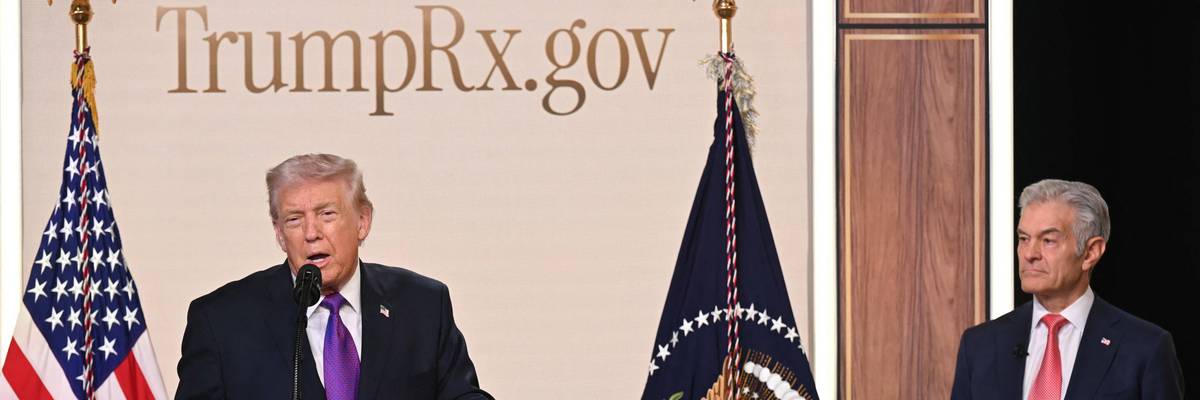
US President Donald Trump speaks in the South Court Auditorium of the White House in Washington, DC on February 5, 2026.
"Trump and congressional Republicans intentionally force seniors to pay more for cancer treatment so that Big Pharma can rake in more money that Trump can personally profit from."
An analysis released Friday by Democrats on the congressional Joint Economic Committee details how US President Donald Trump loaded up on shares of major pharmaceutical companies last year as his administration and Republican allies enacted policies that benefited the industry—at the expense seniors and other patients.
The JEC analysis estimates that Trump increased his stock holdings in the pharmaceutical sector from $1.7 million in 2024 to as much as $56.2 million last year. The committee notes that Trump, who has repeatedly promised to cut drug prices while implementing policies that raised them, "held as much as $39.1 million in stock in the same Big Pharma companies that directly benefited" from a budget package that the president signed into law last summer.
“Trump and congressional Republicans intentionally force seniors to pay more for cancer treatment so that Big Pharma can rake in more money that Trump can personally profit from," said Sen. Maggie Hassan (D-NH), the JEC's ranking member. "It’s outrageous and yet typical from this president, who makes the American people foot the bill again and again for his own gains."
Tucked in the Trump-GOP budget law was a provision exempting some widely used, high-priced prescription drugs from Medicare price negotiations. Merck's cancer medication Keytruda was one of the drugs temporarily shielded by the provision; Merck appears more than 60 times in the president's 2025 financial disclosure.
The JEC analysis notes that "in 2025, Merck reported $18.8 billion in US revenues for Keytruda, which helped the company net $22.5 billion in profits that year, a 16% increase compared to 2024."
The president also made big purchases of stock in Johnson & Johnson, AbbVie, Pfizer, and Amgen last year. The JEC found that each of those companies "had at least one drug that benefited from the carveouts" in the Trump-GOP budget law.
Additionally, the Trump administration has entered friendly agreements with pharmaceutical companies in which the president is invested, including Pfizer and Eli Lilly.
“Trump’s drug pricing deals are a mirage, designed to convince Americans that he’s taken significant action on drug pricing while creating minimal if any downside for Big Pharma,” Peter Maybarduk, access to medicines director for the consumer advocacy group Public Citizen, said last month after his organization obtained heavily redacted texts of the agreements.
"The texts show Trump handing out favors to Big Pharma, undercutting his own models to lower prices, and throwing the support of the US government behind corporate decisions to deny medicines entirely to other countries," said Maybarduk.
This country and this world are at a monumental crossroads. US voters have an opportunity to beat back the forces of fascism and confront the billionaires who are rigging the economy, our media system, and our democracy, making it increasingly impossible for ordinary people to get by. We’re not just talking about the election. We’re talking about what must be done once these fascist elements are vanquished from power. We need a bolder set of solutions than what either major party has so far been willing to offer and a working-class movement ready to fight like hell for it. Trump didn't emerge from nowhere. The conditions that fueled MAGA authoritarianism were created by decades of radical neoliberal economic policies and a corrupt political system dominated by corporate interests. They slashed taxes on the super-rich, promising that the benefits would trickle down. They said giveaways to the corporate titans would make life more affordable for the rest of us. It was all bullshit. And when a bitter, betrayed populace searches for someone to blame, right-wing demagogues have little trouble finding scapegoats. People know when they're being lied to, but you won't hear any of this from the corporate media. Only independent journalism—powered and funded by people who believe in building a better world—can deliver truly trustworthy daily news. If you share our vision, please contribute whatever you can to sustain our work. |
An analysis released Friday by Democrats on the congressional Joint Economic Committee details how US President Donald Trump loaded up on shares of major pharmaceutical companies last year as his administration and Republican allies enacted policies that benefited the industry—at the expense seniors and other patients.
The JEC analysis estimates that Trump increased his stock holdings in the pharmaceutical sector from $1.7 million in 2024 to as much as $56.2 million last year. The committee notes that Trump, who has repeatedly promised to cut drug prices while implementing policies that raised them, "held as much as $39.1 million in stock in the same Big Pharma companies that directly benefited" from a budget package that the president signed into law last summer.
“Trump and congressional Republicans intentionally force seniors to pay more for cancer treatment so that Big Pharma can rake in more money that Trump can personally profit from," said Sen. Maggie Hassan (D-NH), the JEC's ranking member. "It’s outrageous and yet typical from this president, who makes the American people foot the bill again and again for his own gains."
Tucked in the Trump-GOP budget law was a provision exempting some widely used, high-priced prescription drugs from Medicare price negotiations. Merck's cancer medication Keytruda was one of the drugs temporarily shielded by the provision; Merck appears more than 60 times in the president's 2025 financial disclosure.
The JEC analysis notes that "in 2025, Merck reported $18.8 billion in US revenues for Keytruda, which helped the company net $22.5 billion in profits that year, a 16% increase compared to 2024."
The president also made big purchases of stock in Johnson & Johnson, AbbVie, Pfizer, and Amgen last year. The JEC found that each of those companies "had at least one drug that benefited from the carveouts" in the Trump-GOP budget law.
Additionally, the Trump administration has entered friendly agreements with pharmaceutical companies in which the president is invested, including Pfizer and Eli Lilly.
“Trump’s drug pricing deals are a mirage, designed to convince Americans that he’s taken significant action on drug pricing while creating minimal if any downside for Big Pharma,” Peter Maybarduk, access to medicines director for the consumer advocacy group Public Citizen, said last month after his organization obtained heavily redacted texts of the agreements.
"The texts show Trump handing out favors to Big Pharma, undercutting his own models to lower prices, and throwing the support of the US government behind corporate decisions to deny medicines entirely to other countries," said Maybarduk.