5
#000000
#FFFFFF
To donate by check, phone, or other method, see our More Ways to Give page.
Daily news & progressive opinion—funded by the people, not the corporations—delivered straight to your inbox.
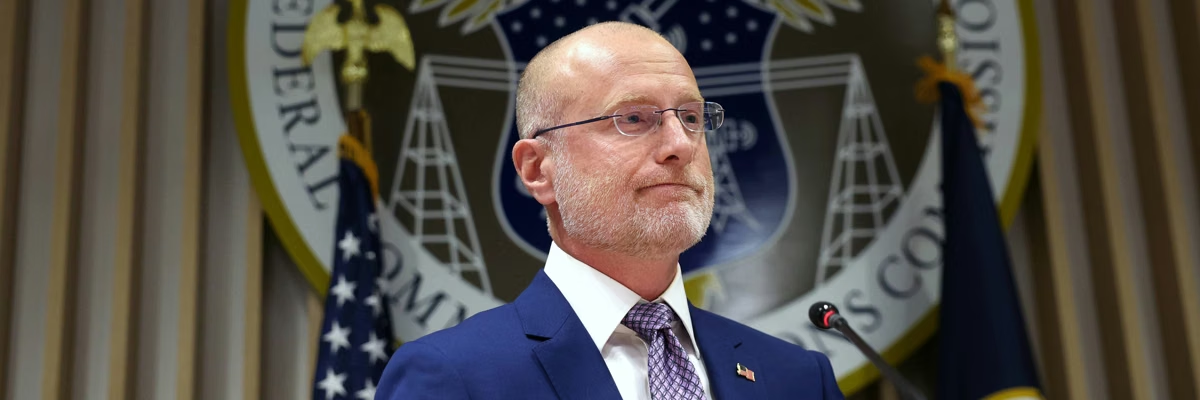
Federal Communications Commission Chair Brendan Carr speaks at a news conference on February 18, 2026 in Washington, DC.
"The FCC simply cannot ignore the laws Congress makes just because the current agency head wants to."
A coalition of nonprofit groups and labor unions filed an emergency petition on Friday aimed at blocking the Federal Communications Commission's recent repeal of a decades-old rule that limited consolidation among television broadcasters, a move that would allow media conglomerates to seize even more control over local news stations.
The petition states that the Republican-controlled FCC's decision—pushed by Chair Brendan Carr and approved in August in a 2-1 vote along party lines—was "plainly contrary to law and violates core administrative law principles." The filing notes that Congress enacted the rule barring any single TV broadcaster from reaching more than 39% of US households—and only Congress can roll it back.
"The FCC simply cannot ignore the laws Congress makes just because the current agency head wants to," said Matt Wood, vice president of policy at Free Press, one of the groups that joined the new motion. "Chairman Carr serves only [President] Donald Trump, not the people of this country. Carr threatens broadcasters when their coverage angers the administration, but tosses them bones like this repeal when the biggest broadcast conglomerates toe the line."
The petition was submitted days after the FCC published the final text of its order repealing the National Television Multiple Ownership Rule, which Carr's FCC effectively ignored earlier this year when it approved Nexstar’s $6.2 billion acquisition of rival TV company Tegna—a deal that Trump vocally supported. Free Press noted that the merger would "give Nexstar access to 80% of US households over the nation’s broadcast airwaves."
Clayton Weimers, executive director of Reporters Without Borders North America, said Friday that repealing the 39% cap "eliminates the only meaningful limit on TV ownership consolidation in the US, reducing media pluralism, eliminating choices for news consumers, and threatening jobs in an industry already reeling from widespread layoffs and closures."
"If allowed to move forward, this policy will benefit a small handful of powerful owners of media conglomerates, while harming journalists, local and independent TV stations, and, not least of all, the American people," said Weimers.
Cable industry groups are also taking action against the FCC over its move to repeal TV ownership constraints. Ars Technica reported earlier this month that "cable lobby groups notified the Federal Communications Commission that they will sue the agency to block its controversial repeal of the National Television Ownership Rule."
The industry's filing states that the FCC's repeal "arbitrarily and capriciously ignores the harms that will surely follow from allowing broadcast station groups to exceed the National Cap, in the form of increased retransmission consent fees for multichannel video programming distributors... and higher monthly TV bills for consumers."
This country and this world are at a monumental crossroads. US voters have an opportunity to beat back the forces of fascism and confront the billionaires who are rigging the economy, our media system, and our democracy, making it increasingly impossible for ordinary people to get by. We’re not just talking about the election. We’re talking about what must be done once these fascist elements are vanquished from power. We need a bolder set of solutions than what either major party has so far been willing to offer and a working-class movement ready to fight like hell for it. Trump didn't emerge from nowhere. The conditions that fueled MAGA authoritarianism were created by decades of radical neoliberal economic policies and a corrupt political system dominated by corporate interests. They slashed taxes on the super-rich, promising that the benefits would trickle down. They said giveaways to the corporate titans would make life more affordable for the rest of us. It was all bullshit. And when a bitter, betrayed populace searches for someone to blame, right-wing demagogues have little trouble finding scapegoats. People know when they're being lied to, but you won't hear any of this from the corporate media. Only independent journalism—powered and funded by people who believe in building a better world—can deliver truly trustworthy daily news. If you share our vision, please contribute whatever you can to sustain our work. |
A coalition of nonprofit groups and labor unions filed an emergency petition on Friday aimed at blocking the Federal Communications Commission's recent repeal of a decades-old rule that limited consolidation among television broadcasters, a move that would allow media conglomerates to seize even more control over local news stations.
The petition states that the Republican-controlled FCC's decision—pushed by Chair Brendan Carr and approved in August in a 2-1 vote along party lines—was "plainly contrary to law and violates core administrative law principles." The filing notes that Congress enacted the rule barring any single TV broadcaster from reaching more than 39% of US households—and only Congress can roll it back.
"The FCC simply cannot ignore the laws Congress makes just because the current agency head wants to," said Matt Wood, vice president of policy at Free Press, one of the groups that joined the new motion. "Chairman Carr serves only [President] Donald Trump, not the people of this country. Carr threatens broadcasters when their coverage angers the administration, but tosses them bones like this repeal when the biggest broadcast conglomerates toe the line."
The petition was submitted days after the FCC published the final text of its order repealing the National Television Multiple Ownership Rule, which Carr's FCC effectively ignored earlier this year when it approved Nexstar’s $6.2 billion acquisition of rival TV company Tegna—a deal that Trump vocally supported. Free Press noted that the merger would "give Nexstar access to 80% of US households over the nation’s broadcast airwaves."
Clayton Weimers, executive director of Reporters Without Borders North America, said Friday that repealing the 39% cap "eliminates the only meaningful limit on TV ownership consolidation in the US, reducing media pluralism, eliminating choices for news consumers, and threatening jobs in an industry already reeling from widespread layoffs and closures."
"If allowed to move forward, this policy will benefit a small handful of powerful owners of media conglomerates, while harming journalists, local and independent TV stations, and, not least of all, the American people," said Weimers.
Cable industry groups are also taking action against the FCC over its move to repeal TV ownership constraints. Ars Technica reported earlier this month that "cable lobby groups notified the Federal Communications Commission that they will sue the agency to block its controversial repeal of the National Television Ownership Rule."
The industry's filing states that the FCC's repeal "arbitrarily and capriciously ignores the harms that will surely follow from allowing broadcast station groups to exceed the National Cap, in the form of increased retransmission consent fees for multichannel video programming distributors... and higher monthly TV bills for consumers."