

SUBSCRIBE TO OUR FREE NEWSLETTER
Daily news & progressive opinion—funded by the people, not the corporations—delivered straight to your inbox.
5
#000000
#FFFFFF
To donate by check, phone, or other method, see our More Ways to Give page.
Daily news & progressive opinion—funded by the people, not the corporations—delivered straight to your inbox.
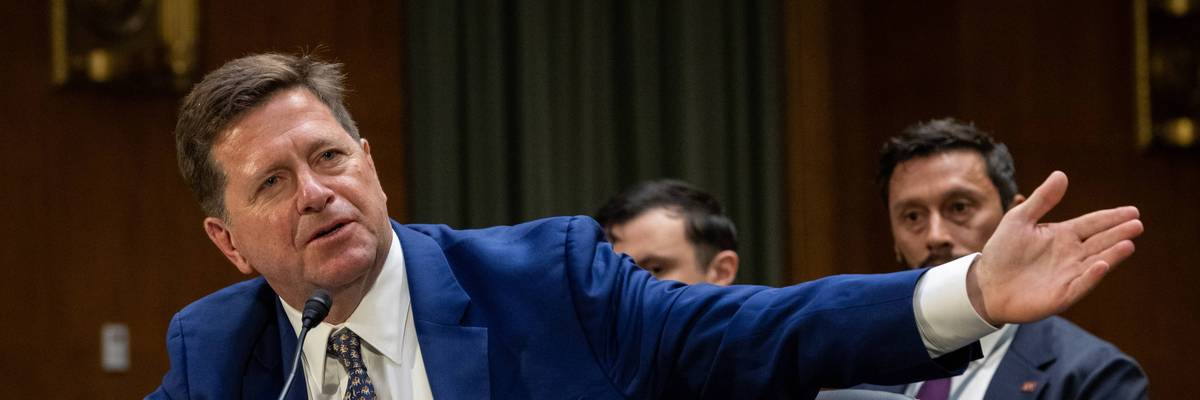
Jay Clayton, nominee to be director of national intelligence, testifies during his Senate confirmation hearing on July 15, 2026.
Hundreds of former officials warned that Clayton "has consistently shown an unwillingness to draw clear lines between the interests of the intelligence community and the political interests of the president."
Sen. Susan Collins, widely seen as the most vulnerable Republican senator up for reelection in November, voted on Monday to advance President Donald Trump's pick to lead the US intelligence community as he faced opposition from former national security officials and press freedom organizations.
Monday's 51-43 vote along party lines all but guarantees that Jay Clayton, currently the US attorney for the Southern District of New York, will be confirmed as director of national intelligence on Tuesday.
Collins (R-Maine), who is commonly portrayed as a moderate despite almost always voting with Trump, waved away Clayton's election denial during his Senate confirmation hearing earlier this month, when he refused to say Trump lost in 2020.
"The Office of the Director of National Intelligence does not certify elections, and he made very clear over and over again that Joe Biden had been certified as the winner of the election," Collins told reporters after the hearing. (When facing questions under oath, Trump nominees and officials often say Biden was "certified" as the 2020 winner to avoid directly contradicting the president's false claim that the election was stolen.)
Collins, who is running for a sixth Senate term, went on to say she believes Clayton "brings the experience" to the role and "did a good job" during his confirmation hearing.
Asked Susan Collins about Jay Clayton’s refusal to say Biden won in 2020.
The DNI “does not certify elections, and he made very clear over and over again that Joe Biden had been certified as the winner of the election. I'm not sure what my colleagues were seeking further.” pic.twitter.com/dlZxVS8LwY
— Manu Raju (@mkraju) July 16, 2026
Monday's procedural vote came as hundreds of former US national security and intelligence officials issued an open letter opposing Clayton's nomination, warning that he "has consistently shown an unwillingness to draw clear lines between the interests of the intelligence community and the political interests of the president who nominated him."
"Equally troubling is Mr. Clayton’s defense, during his hearing, of subpoenas issued to four journalists at The New York Times while he served as United States attorney for the Southern District of New York," the letter states. "The director of national intelligence sits at the intersection of secrecy and accountability, deciding what the public may know about the government’s most sensitive activities. A nominee who justifies forcing journalists to testify, instead of recognizing the First Amendment’s protections for a free press, does not demonstrate the sound judgment required for the office."
The Freedom of the Press Foundation (FPF), which also opposes Clayton's nomination, argued Monday that Clayton appears to have lied to lawmakers during his testimony about the subpoenas for Times journalists. The subpoenas targeted journalists who reported on the new Air Force One, a $400 million luxury jet donated by Qatar.
During his Senate testimony, Clayton insisted that he followed "the procedures we have in place to protect the First Amendment and protect the freedom of the press" prior to signing the subpoenas. But Trevor Timm, FPF's executive director, wrote Monday that "this was likely impossible."
"Given the Times’ story came out on a Wednesday and the subpoenas were issued on a Friday (after an hourslong White House meeting discussing the case with FBI Director Kash Patel), there was almost no way 'all reasonable attempts' were made before the subpoenas were issued. These investigations usually take months," Timm wrote. "It sure seemed like false testimony to us."
"But on Friday, the Department of Justice itself seems to have confirmed that Clayton lied to Congress," Timm noted. "In a court hearing in the Times subpoena case, a federal judge castigated government lawyers for an hour for making a multitude of errors when issuing the subpoenas, misleading the court, and not following the law... The DOJ didn’t even attempt to argue they took any investigative steps before issuing the subpoenas. Instead, they claimed there was an “exception” to that rule that allowed them to bypass it entirely, which left the judge flabbergasted."
"Clayton should be immediately called back to the Senate to answer for his seemingly false statement," he added.
Dear Common Dreams reader, It’s been nearly 30 years since I co-founded Common Dreams with my late wife, Lina Newhouser. We had the radical notion that journalism should serve the public good, not corporate profits. It was clear to us from the outset what it would take to build such a project. No paid advertisements. No corporate sponsors. No millionaire publisher telling us what to think or do. Many people said we wouldn't last a year, but we proved those doubters wrong. Together with a tremendous team of journalists and dedicated staff, we built an independent media outlet free from the constraints of profits and corporate control. Our mission has always been simple: To inform. To inspire. To ignite change for the common good. Building Common Dreams was not easy. Our survival was never guaranteed. When you take on the most powerful forces—Wall Street greed, fossil fuel industry destruction, Big Tech lobbyists, and uber-rich oligarchs who have spent billions upon billions rigging the economy and democracy in their favor—the only bulwark you have is supporters who believe in your work. But here’s the urgent message from me today. It's never been this bad out there. And it's never been this hard to keep us going. At the very moment Common Dreams is most needed, the threats we face are intensifying. We need your support now more than ever. We don't accept corporate advertising and never will. We don't have a paywall because we don't think people should be blocked from critical news based on their ability to pay. Everything we do is funded by the donations of readers like you. When everyone does the little they can afford, we are strong. But if that support retreats or dries up, so do we. Will you donate now to make sure Common Dreams not only survives but thrives? —Craig Brown, Co-founder |
Sen. Susan Collins, widely seen as the most vulnerable Republican senator up for reelection in November, voted on Monday to advance President Donald Trump's pick to lead the US intelligence community as he faced opposition from former national security officials and press freedom organizations.
Monday's 51-43 vote along party lines all but guarantees that Jay Clayton, currently the US attorney for the Southern District of New York, will be confirmed as director of national intelligence on Tuesday.
Collins (R-Maine), who is commonly portrayed as a moderate despite almost always voting with Trump, waved away Clayton's election denial during his Senate confirmation hearing earlier this month, when he refused to say Trump lost in 2020.
"The Office of the Director of National Intelligence does not certify elections, and he made very clear over and over again that Joe Biden had been certified as the winner of the election," Collins told reporters after the hearing. (When facing questions under oath, Trump nominees and officials often say Biden was "certified" as the 2020 winner to avoid directly contradicting the president's false claim that the election was stolen.)
Collins, who is running for a sixth Senate term, went on to say she believes Clayton "brings the experience" to the role and "did a good job" during his confirmation hearing.
Asked Susan Collins about Jay Clayton’s refusal to say Biden won in 2020.
The DNI “does not certify elections, and he made very clear over and over again that Joe Biden had been certified as the winner of the election. I'm not sure what my colleagues were seeking further.” pic.twitter.com/dlZxVS8LwY
— Manu Raju (@mkraju) July 16, 2026
Monday's procedural vote came as hundreds of former US national security and intelligence officials issued an open letter opposing Clayton's nomination, warning that he "has consistently shown an unwillingness to draw clear lines between the interests of the intelligence community and the political interests of the president who nominated him."
"Equally troubling is Mr. Clayton’s defense, during his hearing, of subpoenas issued to four journalists at The New York Times while he served as United States attorney for the Southern District of New York," the letter states. "The director of national intelligence sits at the intersection of secrecy and accountability, deciding what the public may know about the government’s most sensitive activities. A nominee who justifies forcing journalists to testify, instead of recognizing the First Amendment’s protections for a free press, does not demonstrate the sound judgment required for the office."
The Freedom of the Press Foundation (FPF), which also opposes Clayton's nomination, argued Monday that Clayton appears to have lied to lawmakers during his testimony about the subpoenas for Times journalists. The subpoenas targeted journalists who reported on the new Air Force One, a $400 million luxury jet donated by Qatar.
During his Senate testimony, Clayton insisted that he followed "the procedures we have in place to protect the First Amendment and protect the freedom of the press" prior to signing the subpoenas. But Trevor Timm, FPF's executive director, wrote Monday that "this was likely impossible."
"Given the Times’ story came out on a Wednesday and the subpoenas were issued on a Friday (after an hourslong White House meeting discussing the case with FBI Director Kash Patel), there was almost no way 'all reasonable attempts' were made before the subpoenas were issued. These investigations usually take months," Timm wrote. "It sure seemed like false testimony to us."
"But on Friday, the Department of Justice itself seems to have confirmed that Clayton lied to Congress," Timm noted. "In a court hearing in the Times subpoena case, a federal judge castigated government lawyers for an hour for making a multitude of errors when issuing the subpoenas, misleading the court, and not following the law... The DOJ didn’t even attempt to argue they took any investigative steps before issuing the subpoenas. Instead, they claimed there was an “exception” to that rule that allowed them to bypass it entirely, which left the judge flabbergasted."
"Clayton should be immediately called back to the Senate to answer for his seemingly false statement," he added.
Sen. Susan Collins, widely seen as the most vulnerable Republican senator up for reelection in November, voted on Monday to advance President Donald Trump's pick to lead the US intelligence community as he faced opposition from former national security officials and press freedom organizations.
Monday's 51-43 vote along party lines all but guarantees that Jay Clayton, currently the US attorney for the Southern District of New York, will be confirmed as director of national intelligence on Tuesday.
Collins (R-Maine), who is commonly portrayed as a moderate despite almost always voting with Trump, waved away Clayton's election denial during his Senate confirmation hearing earlier this month, when he refused to say Trump lost in 2020.
"The Office of the Director of National Intelligence does not certify elections, and he made very clear over and over again that Joe Biden had been certified as the winner of the election," Collins told reporters after the hearing. (When facing questions under oath, Trump nominees and officials often say Biden was "certified" as the 2020 winner to avoid directly contradicting the president's false claim that the election was stolen.)
Collins, who is running for a sixth Senate term, went on to say she believes Clayton "brings the experience" to the role and "did a good job" during his confirmation hearing.
Asked Susan Collins about Jay Clayton’s refusal to say Biden won in 2020.
The DNI “does not certify elections, and he made very clear over and over again that Joe Biden had been certified as the winner of the election. I'm not sure what my colleagues were seeking further.” pic.twitter.com/dlZxVS8LwY
— Manu Raju (@mkraju) July 16, 2026
Monday's procedural vote came as hundreds of former US national security and intelligence officials issued an open letter opposing Clayton's nomination, warning that he "has consistently shown an unwillingness to draw clear lines between the interests of the intelligence community and the political interests of the president who nominated him."
"Equally troubling is Mr. Clayton’s defense, during his hearing, of subpoenas issued to four journalists at The New York Times while he served as United States attorney for the Southern District of New York," the letter states. "The director of national intelligence sits at the intersection of secrecy and accountability, deciding what the public may know about the government’s most sensitive activities. A nominee who justifies forcing journalists to testify, instead of recognizing the First Amendment’s protections for a free press, does not demonstrate the sound judgment required for the office."
The Freedom of the Press Foundation (FPF), which also opposes Clayton's nomination, argued Monday that Clayton appears to have lied to lawmakers during his testimony about the subpoenas for Times journalists. The subpoenas targeted journalists who reported on the new Air Force One, a $400 million luxury jet donated by Qatar.
During his Senate testimony, Clayton insisted that he followed "the procedures we have in place to protect the First Amendment and protect the freedom of the press" prior to signing the subpoenas. But Trevor Timm, FPF's executive director, wrote Monday that "this was likely impossible."
"Given the Times’ story came out on a Wednesday and the subpoenas were issued on a Friday (after an hourslong White House meeting discussing the case with FBI Director Kash Patel), there was almost no way 'all reasonable attempts' were made before the subpoenas were issued. These investigations usually take months," Timm wrote. "It sure seemed like false testimony to us."
"But on Friday, the Department of Justice itself seems to have confirmed that Clayton lied to Congress," Timm noted. "In a court hearing in the Times subpoena case, a federal judge castigated government lawyers for an hour for making a multitude of errors when issuing the subpoenas, misleading the court, and not following the law... The DOJ didn’t even attempt to argue they took any investigative steps before issuing the subpoenas. Instead, they claimed there was an “exception” to that rule that allowed them to bypass it entirely, which left the judge flabbergasted."
"Clayton should be immediately called back to the Senate to answer for his seemingly false statement," he added.

