SUBSCRIBE TO OUR FREE NEWSLETTER
Daily news & progressive opinion—funded by the people, not the corporations—delivered straight to your inbox.
5
#000000
#FFFFFF
To donate by check, phone, or other method, see our More Ways to Give page.
Daily news & progressive opinion—funded by the people, not the corporations—delivered straight to your inbox.
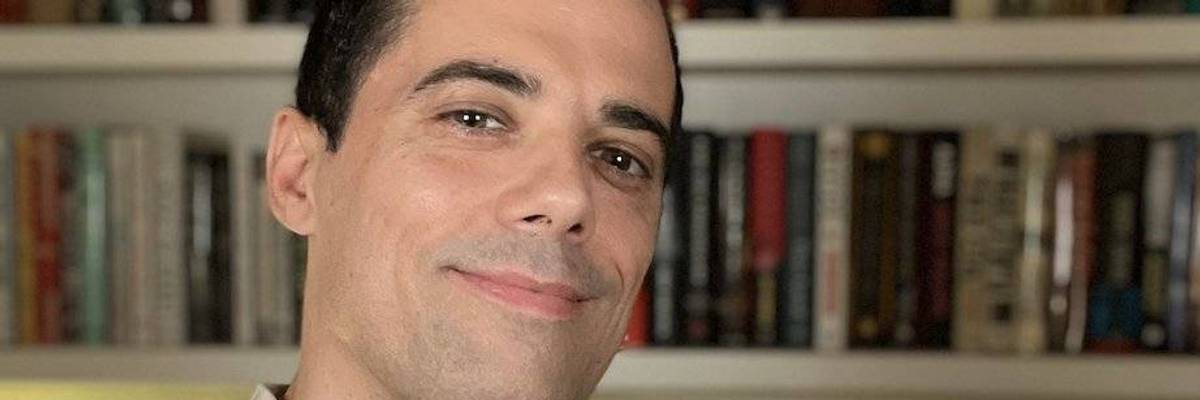
Investigative journalist Seth Harp holds a copy of his New York Times bestselling book The Fort Bragg Cartel in a photo posted to his social media on October 25, 2025.
"I think the US is only the latest in a very long history of military empires," he told Common Dreams. "This is a perspective to which New York Times readers are rarely exposed."
Investigative journalist Seth Harp has accused the New York Times of burying his interview with a prominent opinion columnist. He told Common Dreams that the paper is trying to silence his forceful critiques of US foreign policy.
In a post on social media Thursday, Harp blasted Ross Douthat, a conservative opinion columnist for the paper, after learning that a conversation the two had recorded last month had been cut.
“Ross Douthat challenged me to a debate on foreign policy,” Harp wrote. “We recorded a 90-minute segment for his show, Interesting Times, on January 15, 2026. But I defeated him so decisively that he refuses to air the footage. What an absolute coward.”
According to Douthat, the conversation between the two was “pegged to the Delta Force raid in Venezuela,” referring to President Donald Trump’s operation last month, which overthrew the South American nation’s president, Nicolás Maduro.
Though Trump himself has plainly stated that his goal was to forcibly open the nation’s vast oil reserves to be taken over by US corporations, the administration has papered over this nakedly imperialist justification with dubious claims that Maduro was at the helm of a multinational narcotics trafficking ring. Maduro has pleaded not guilty to related charges in US court.
This was where, Douthat said, Harp’s perspective was relevant. His recent Times bestselling book, The Fort Bragg Cartel, examines the long history of the US Army Special Forces’ own history of international drug trafficking, which culminated in a series of unsolved murders at the titular Army installation in North Carolina.
The day after US forces bombed Caracas in the January operation, which is estimated to have killed as many as 83 people—including dozens of civilians—Harp posted a photo of one of the Delta Force commanders who played a key role in the attack. For this, he was subpoenaed by the Republican-led House Oversight Committee, which accused him of “leaking classified intel” and “doxing” the official, even though the information was already publicly available.
According to Harp, the conversation was cordial at first but became prickly when the two began to discuss the recent attack on Venezuela.
"Again and again he tried to box me in with some kind of gotcha," Harp said. "For example, he sprung on me that I'd called Nicolás Maduro the 'rightful' president of Venezuela, and tried to make the discussion about the last election in Venezuela and abuses by the government security forces there."
"I replied that Maduro was the rightful president of Venezuela simply because he became president through Venezuela's own internal political processes, and that the US has no right to dictate to other countries who their leaders should be," he said. "Douthat had no response to that and appeared visibly thrown off balance. It was as if he had never encountered a real anti-imperialist critique of US foreign policy and was only prepared to deal with some weak sauce humanitarian liberal critique, which I'm not about."
Harp said the discussion also encompassed many other foreign policy topics, including “Israel’s genocide in Gaza, the war in Ukraine, the post-9/11 wars, and American military interventions since 1945 more broadly.”
He added that the pair “also discussed the methods by which these interventions were accomplished, specifically the use of large conventional armies versus special forces and proxies,” and that they “talked a lot about China and Russia, too.”
“I served in the military and have spent my entire adult life thinking and writing about these issues,” said Harp, an Army veteran. “My basic argument was that the United States has been so violent and aggressive since World War II that it has not only destabilized the entire world but also destroyed our own country from the inside, materially and politically.”
“Ross’ basic point of view was that while the US has done terrible things and killed millions of people in recent years, the world is a better place as a result of American hegemony,” Harp continued. “But his grasp on historical facts was so weak that he was unable to make a strong argument.”
“He frequently became confused and contradicted or reversed himself,” Harp explained. “Frustrated at his own befuddlement, he blew up and said: ‘We get it. You think the United States is uniquely evil.’”
Within days of the interview, Harp expressed fears that the Times might decide not to release it. On January 20, five days after his sit-down with Douthat, he wrote to one of his editors.
“I was somewhat surprised that Ross wasn’t better prepared to defend his point of view,” he said, according to a message he made available on social media. “They may decide to spike it; we’ll see.”
About three weeks after the conversation and after weeks of silence from the Times, Harp received a text message from one of the show’s producers, who told him, “We aren’t going to be able to make it work.”
“We were kind of pummeled by the news cycle in the last six weeks and are going to pivot away from this story,” the producer explained in the text message exchange.
“I had canceled a vacation to do the show in studio,” Harp told Common Dreams. “Twice they changed the date on me, so I was kept waiting for two weeks. Then, after they spiked the episode, they didn’t even bother to inform me. I didn’t learn about it until three weeks later, when I reached out to the producer. At that point, I asked for Ross’ email address so that I could speak to him about it directly and in private. The producer refused to put me in touch.”
Harp responded to the message, calling it “unbelievable cowardice on Ross’ part and a giant waste of my time.” He said he was going to “make it known what actually happened: Ross challenged me to a debate on foreign policy, got crushed, and doesn’t have the intellectual or journalistic integrity to air the footage.”
He later posted the text exchange to social media. He told Common Dreams he chose to go public because he “felt deeply offended by [The Times'] complete disrespect for my time and lack of professional courtesy.”
hey @DouthatNYT, release the debate ya coward https://t.co/2eMysOn4nn
— Nathan J Robinson (@NathanJRobinson) February 6, 2026
ross douthat has no time for a foreign policy discussion with seth harp but loads of time for this misogynistic culture war slop… https://t.co/ZIZDqTy8Kc pic.twitter.com/SaCkE3OMkV
— Erin Overbey (@erinoverbey) February 7, 2026
Harp's publication of the messages on social media resulted in a wave of backlash from others in the media, who accused Douthat of cowardice and the Times of burying the interview to protect him from embarrassment.
On Thursday, Douthat issued a response on social media.
Though the debate was recorded less than two weeks after Trump’s raid, he said the interview “had missed the ideal spot in the news cycle” for a conversation about Venezuela. He also said the interview, which he wanted to keep narrowly focused on Harp’s reporting about drug-dealing in the Special Forces, “became unmoored from Mr. Harp’s specific reporting in a way that undermined the first half of our conversation.”
“Interesting Times is a show where I try to give a lot of space to the guest’s perspective while posing challenging questions, creating episodes where the audience gets the best version of an idea or worldview that they might not have understood before,” Douthat continued.
Harp called this justification “hogwash,” pointing out that three of the most recent episodes of his show address such timely issues as the end of Roe v. Wade, questions about public trust after the Covid-19 pandemic, and church attendance statistics among young men.
“Anyone can look at your recent episodes and see that a debate between us on the US military and foreign policy would have been far more timely and relevant to the news cycle than any of them,” Harp wrote.
Douthat, one of the many Times columnists who enthusiastically supported the Bush administration’s War in Iraq more than two decades ago, has often given his platform to unapologetic supporters of US foreign military interventions.
The first interview he published after Trump’s Venezuela operation was a conversation titled “A Defense of US Intervention in Venezuela,” in which he hosted the notorious war hawk Elliott Abrams, who served as special envoy to Venezuela during Trump’s first term.
The neoconservative policy adviser, who’d previously worked for Presidents George W. Bush and Ronald Reagan. During that time, he championed US support for anti-communist death squads and dictators across Latin America and was later convicted for his participation in the Iran-Contra affair.
Douthat largely agreed with Abrams on the moral justifications for regime change in Venezuela, though he questioned the operation’s effectiveness in bringing about democracy.
Harp said that during their conversation weeks later, he disputed Douthat’s “sarcastic outburst,” accusing him of portraying America as a unique evil.
“I don’t think the US is unique or evil,” he told Common Dreams. “I don’t think in those sorts of religious terms. Rather, I think the US is only the latest in a very long history of military empires, but that its marriage to extractive capitalism makes it exceptionally violent, unstable, and short-lived.”
“This is a perspective to which New York Times readers are rarely exposed,” he went on. “It was an interesting and entertaining discussion all around, and no doubt would have garnered far more views than anything else that Ross has published recently. Sadly, Ross’ ego was a little battered.”
“I had tried to go easy on him as an interlocutor, not pointing out, for example, that I personally fought in the Iraq War while he merely promoted it in the pages of the National Review, even though both of us were of military age in the early 2000s,” he said. “I had kept it all above the belt and never attacked him personally. But I had laid bare the shallowness and inconsistency of his views on foreign policy.”
“Another pundit or host would have had the intellectual and journalistic integrity to publish the interview anyway,” he said. “Not Ross.”
Dear Common Dreams reader, It’s been nearly 30 years since I co-founded Common Dreams with my late wife, Lina Newhouser. We had the radical notion that journalism should serve the public good, not corporate profits. It was clear to us from the outset what it would take to build such a project. No paid advertisements. No corporate sponsors. No millionaire publisher telling us what to think or do. Many people said we wouldn't last a year, but we proved those doubters wrong. Together with a tremendous team of journalists and dedicated staff, we built an independent media outlet free from the constraints of profits and corporate control. Our mission has always been simple: To inform. To inspire. To ignite change for the common good. Building Common Dreams was not easy. Our survival was never guaranteed. When you take on the most powerful forces—Wall Street greed, fossil fuel industry destruction, Big Tech lobbyists, and uber-rich oligarchs who have spent billions upon billions rigging the economy and democracy in their favor—the only bulwark you have is supporters who believe in your work. But here’s the urgent message from me today. It's never been this bad out there. And it's never been this hard to keep us going. At the very moment Common Dreams is most needed, the threats we face are intensifying. We need your support now more than ever. We don't accept corporate advertising and never will. We don't have a paywall because we don't think people should be blocked from critical news based on their ability to pay. Everything we do is funded by the donations of readers like you. When everyone does the little they can afford, we are strong. But if that support retreats or dries up, so do we. Will you donate now to make sure Common Dreams not only survives but thrives? —Craig Brown, Co-founder |
Investigative journalist Seth Harp has accused the New York Times of burying his interview with a prominent opinion columnist. He told Common Dreams that the paper is trying to silence his forceful critiques of US foreign policy.
In a post on social media Thursday, Harp blasted Ross Douthat, a conservative opinion columnist for the paper, after learning that a conversation the two had recorded last month had been cut.
“Ross Douthat challenged me to a debate on foreign policy,” Harp wrote. “We recorded a 90-minute segment for his show, Interesting Times, on January 15, 2026. But I defeated him so decisively that he refuses to air the footage. What an absolute coward.”
According to Douthat, the conversation between the two was “pegged to the Delta Force raid in Venezuela,” referring to President Donald Trump’s operation last month, which overthrew the South American nation’s president, Nicolás Maduro.
Though Trump himself has plainly stated that his goal was to forcibly open the nation’s vast oil reserves to be taken over by US corporations, the administration has papered over this nakedly imperialist justification with dubious claims that Maduro was at the helm of a multinational narcotics trafficking ring. Maduro has pleaded not guilty to related charges in US court.
This was where, Douthat said, Harp’s perspective was relevant. His recent Times bestselling book, The Fort Bragg Cartel, examines the long history of the US Army Special Forces’ own history of international drug trafficking, which culminated in a series of unsolved murders at the titular Army installation in North Carolina.
The day after US forces bombed Caracas in the January operation, which is estimated to have killed as many as 83 people—including dozens of civilians—Harp posted a photo of one of the Delta Force commanders who played a key role in the attack. For this, he was subpoenaed by the Republican-led House Oversight Committee, which accused him of “leaking classified intel” and “doxing” the official, even though the information was already publicly available.
According to Harp, the conversation was cordial at first but became prickly when the two began to discuss the recent attack on Venezuela.
"Again and again he tried to box me in with some kind of gotcha," Harp said. "For example, he sprung on me that I'd called Nicolás Maduro the 'rightful' president of Venezuela, and tried to make the discussion about the last election in Venezuela and abuses by the government security forces there."
"I replied that Maduro was the rightful president of Venezuela simply because he became president through Venezuela's own internal political processes, and that the US has no right to dictate to other countries who their leaders should be," he said. "Douthat had no response to that and appeared visibly thrown off balance. It was as if he had never encountered a real anti-imperialist critique of US foreign policy and was only prepared to deal with some weak sauce humanitarian liberal critique, which I'm not about."
Harp said the discussion also encompassed many other foreign policy topics, including “Israel’s genocide in Gaza, the war in Ukraine, the post-9/11 wars, and American military interventions since 1945 more broadly.”
He added that the pair “also discussed the methods by which these interventions were accomplished, specifically the use of large conventional armies versus special forces and proxies,” and that they “talked a lot about China and Russia, too.”
“I served in the military and have spent my entire adult life thinking and writing about these issues,” said Harp, an Army veteran. “My basic argument was that the United States has been so violent and aggressive since World War II that it has not only destabilized the entire world but also destroyed our own country from the inside, materially and politically.”
“Ross’ basic point of view was that while the US has done terrible things and killed millions of people in recent years, the world is a better place as a result of American hegemony,” Harp continued. “But his grasp on historical facts was so weak that he was unable to make a strong argument.”
“He frequently became confused and contradicted or reversed himself,” Harp explained. “Frustrated at his own befuddlement, he blew up and said: ‘We get it. You think the United States is uniquely evil.’”
Within days of the interview, Harp expressed fears that the Times might decide not to release it. On January 20, five days after his sit-down with Douthat, he wrote to one of his editors.
“I was somewhat surprised that Ross wasn’t better prepared to defend his point of view,” he said, according to a message he made available on social media. “They may decide to spike it; we’ll see.”
About three weeks after the conversation and after weeks of silence from the Times, Harp received a text message from one of the show’s producers, who told him, “We aren’t going to be able to make it work.”
“We were kind of pummeled by the news cycle in the last six weeks and are going to pivot away from this story,” the producer explained in the text message exchange.
“I had canceled a vacation to do the show in studio,” Harp told Common Dreams. “Twice they changed the date on me, so I was kept waiting for two weeks. Then, after they spiked the episode, they didn’t even bother to inform me. I didn’t learn about it until three weeks later, when I reached out to the producer. At that point, I asked for Ross’ email address so that I could speak to him about it directly and in private. The producer refused to put me in touch.”
Harp responded to the message, calling it “unbelievable cowardice on Ross’ part and a giant waste of my time.” He said he was going to “make it known what actually happened: Ross challenged me to a debate on foreign policy, got crushed, and doesn’t have the intellectual or journalistic integrity to air the footage.”
He later posted the text exchange to social media. He told Common Dreams he chose to go public because he “felt deeply offended by [The Times'] complete disrespect for my time and lack of professional courtesy.”
hey @DouthatNYT, release the debate ya coward https://t.co/2eMysOn4nn
— Nathan J Robinson (@NathanJRobinson) February 6, 2026
ross douthat has no time for a foreign policy discussion with seth harp but loads of time for this misogynistic culture war slop… https://t.co/ZIZDqTy8Kc pic.twitter.com/SaCkE3OMkV
— Erin Overbey (@erinoverbey) February 7, 2026
Harp's publication of the messages on social media resulted in a wave of backlash from others in the media, who accused Douthat of cowardice and the Times of burying the interview to protect him from embarrassment.
On Thursday, Douthat issued a response on social media.
Though the debate was recorded less than two weeks after Trump’s raid, he said the interview “had missed the ideal spot in the news cycle” for a conversation about Venezuela. He also said the interview, which he wanted to keep narrowly focused on Harp’s reporting about drug-dealing in the Special Forces, “became unmoored from Mr. Harp’s specific reporting in a way that undermined the first half of our conversation.”
“Interesting Times is a show where I try to give a lot of space to the guest’s perspective while posing challenging questions, creating episodes where the audience gets the best version of an idea or worldview that they might not have understood before,” Douthat continued.
Harp called this justification “hogwash,” pointing out that three of the most recent episodes of his show address such timely issues as the end of Roe v. Wade, questions about public trust after the Covid-19 pandemic, and church attendance statistics among young men.
“Anyone can look at your recent episodes and see that a debate between us on the US military and foreign policy would have been far more timely and relevant to the news cycle than any of them,” Harp wrote.
Douthat, one of the many Times columnists who enthusiastically supported the Bush administration’s War in Iraq more than two decades ago, has often given his platform to unapologetic supporters of US foreign military interventions.
The first interview he published after Trump’s Venezuela operation was a conversation titled “A Defense of US Intervention in Venezuela,” in which he hosted the notorious war hawk Elliott Abrams, who served as special envoy to Venezuela during Trump’s first term.
The neoconservative policy adviser, who’d previously worked for Presidents George W. Bush and Ronald Reagan. During that time, he championed US support for anti-communist death squads and dictators across Latin America and was later convicted for his participation in the Iran-Contra affair.
Douthat largely agreed with Abrams on the moral justifications for regime change in Venezuela, though he questioned the operation’s effectiveness in bringing about democracy.
Harp said that during their conversation weeks later, he disputed Douthat’s “sarcastic outburst,” accusing him of portraying America as a unique evil.
“I don’t think the US is unique or evil,” he told Common Dreams. “I don’t think in those sorts of religious terms. Rather, I think the US is only the latest in a very long history of military empires, but that its marriage to extractive capitalism makes it exceptionally violent, unstable, and short-lived.”
“This is a perspective to which New York Times readers are rarely exposed,” he went on. “It was an interesting and entertaining discussion all around, and no doubt would have garnered far more views than anything else that Ross has published recently. Sadly, Ross’ ego was a little battered.”
“I had tried to go easy on him as an interlocutor, not pointing out, for example, that I personally fought in the Iraq War while he merely promoted it in the pages of the National Review, even though both of us were of military age in the early 2000s,” he said. “I had kept it all above the belt and never attacked him personally. But I had laid bare the shallowness and inconsistency of his views on foreign policy.”
“Another pundit or host would have had the intellectual and journalistic integrity to publish the interview anyway,” he said. “Not Ross.”
Investigative journalist Seth Harp has accused the New York Times of burying his interview with a prominent opinion columnist. He told Common Dreams that the paper is trying to silence his forceful critiques of US foreign policy.
In a post on social media Thursday, Harp blasted Ross Douthat, a conservative opinion columnist for the paper, after learning that a conversation the two had recorded last month had been cut.
“Ross Douthat challenged me to a debate on foreign policy,” Harp wrote. “We recorded a 90-minute segment for his show, Interesting Times, on January 15, 2026. But I defeated him so decisively that he refuses to air the footage. What an absolute coward.”
According to Douthat, the conversation between the two was “pegged to the Delta Force raid in Venezuela,” referring to President Donald Trump’s operation last month, which overthrew the South American nation’s president, Nicolás Maduro.
Though Trump himself has plainly stated that his goal was to forcibly open the nation’s vast oil reserves to be taken over by US corporations, the administration has papered over this nakedly imperialist justification with dubious claims that Maduro was at the helm of a multinational narcotics trafficking ring. Maduro has pleaded not guilty to related charges in US court.
This was where, Douthat said, Harp’s perspective was relevant. His recent Times bestselling book, The Fort Bragg Cartel, examines the long history of the US Army Special Forces’ own history of international drug trafficking, which culminated in a series of unsolved murders at the titular Army installation in North Carolina.
The day after US forces bombed Caracas in the January operation, which is estimated to have killed as many as 83 people—including dozens of civilians—Harp posted a photo of one of the Delta Force commanders who played a key role in the attack. For this, he was subpoenaed by the Republican-led House Oversight Committee, which accused him of “leaking classified intel” and “doxing” the official, even though the information was already publicly available.
According to Harp, the conversation was cordial at first but became prickly when the two began to discuss the recent attack on Venezuela.
"Again and again he tried to box me in with some kind of gotcha," Harp said. "For example, he sprung on me that I'd called Nicolás Maduro the 'rightful' president of Venezuela, and tried to make the discussion about the last election in Venezuela and abuses by the government security forces there."
"I replied that Maduro was the rightful president of Venezuela simply because he became president through Venezuela's own internal political processes, and that the US has no right to dictate to other countries who their leaders should be," he said. "Douthat had no response to that and appeared visibly thrown off balance. It was as if he had never encountered a real anti-imperialist critique of US foreign policy and was only prepared to deal with some weak sauce humanitarian liberal critique, which I'm not about."
Harp said the discussion also encompassed many other foreign policy topics, including “Israel’s genocide in Gaza, the war in Ukraine, the post-9/11 wars, and American military interventions since 1945 more broadly.”
He added that the pair “also discussed the methods by which these interventions were accomplished, specifically the use of large conventional armies versus special forces and proxies,” and that they “talked a lot about China and Russia, too.”
“I served in the military and have spent my entire adult life thinking and writing about these issues,” said Harp, an Army veteran. “My basic argument was that the United States has been so violent and aggressive since World War II that it has not only destabilized the entire world but also destroyed our own country from the inside, materially and politically.”
“Ross’ basic point of view was that while the US has done terrible things and killed millions of people in recent years, the world is a better place as a result of American hegemony,” Harp continued. “But his grasp on historical facts was so weak that he was unable to make a strong argument.”
“He frequently became confused and contradicted or reversed himself,” Harp explained. “Frustrated at his own befuddlement, he blew up and said: ‘We get it. You think the United States is uniquely evil.’”
Within days of the interview, Harp expressed fears that the Times might decide not to release it. On January 20, five days after his sit-down with Douthat, he wrote to one of his editors.
“I was somewhat surprised that Ross wasn’t better prepared to defend his point of view,” he said, according to a message he made available on social media. “They may decide to spike it; we’ll see.”
About three weeks after the conversation and after weeks of silence from the Times, Harp received a text message from one of the show’s producers, who told him, “We aren’t going to be able to make it work.”
“We were kind of pummeled by the news cycle in the last six weeks and are going to pivot away from this story,” the producer explained in the text message exchange.
“I had canceled a vacation to do the show in studio,” Harp told Common Dreams. “Twice they changed the date on me, so I was kept waiting for two weeks. Then, after they spiked the episode, they didn’t even bother to inform me. I didn’t learn about it until three weeks later, when I reached out to the producer. At that point, I asked for Ross’ email address so that I could speak to him about it directly and in private. The producer refused to put me in touch.”
Harp responded to the message, calling it “unbelievable cowardice on Ross’ part and a giant waste of my time.” He said he was going to “make it known what actually happened: Ross challenged me to a debate on foreign policy, got crushed, and doesn’t have the intellectual or journalistic integrity to air the footage.”
He later posted the text exchange to social media. He told Common Dreams he chose to go public because he “felt deeply offended by [The Times'] complete disrespect for my time and lack of professional courtesy.”
hey @DouthatNYT, release the debate ya coward https://t.co/2eMysOn4nn
— Nathan J Robinson (@NathanJRobinson) February 6, 2026
ross douthat has no time for a foreign policy discussion with seth harp but loads of time for this misogynistic culture war slop… https://t.co/ZIZDqTy8Kc pic.twitter.com/SaCkE3OMkV
— Erin Overbey (@erinoverbey) February 7, 2026
Harp's publication of the messages on social media resulted in a wave of backlash from others in the media, who accused Douthat of cowardice and the Times of burying the interview to protect him from embarrassment.
On Thursday, Douthat issued a response on social media.
Though the debate was recorded less than two weeks after Trump’s raid, he said the interview “had missed the ideal spot in the news cycle” for a conversation about Venezuela. He also said the interview, which he wanted to keep narrowly focused on Harp’s reporting about drug-dealing in the Special Forces, “became unmoored from Mr. Harp’s specific reporting in a way that undermined the first half of our conversation.”
“Interesting Times is a show where I try to give a lot of space to the guest’s perspective while posing challenging questions, creating episodes where the audience gets the best version of an idea or worldview that they might not have understood before,” Douthat continued.
Harp called this justification “hogwash,” pointing out that three of the most recent episodes of his show address such timely issues as the end of Roe v. Wade, questions about public trust after the Covid-19 pandemic, and church attendance statistics among young men.
“Anyone can look at your recent episodes and see that a debate between us on the US military and foreign policy would have been far more timely and relevant to the news cycle than any of them,” Harp wrote.
Douthat, one of the many Times columnists who enthusiastically supported the Bush administration’s War in Iraq more than two decades ago, has often given his platform to unapologetic supporters of US foreign military interventions.
The first interview he published after Trump’s Venezuela operation was a conversation titled “A Defense of US Intervention in Venezuela,” in which he hosted the notorious war hawk Elliott Abrams, who served as special envoy to Venezuela during Trump’s first term.
The neoconservative policy adviser, who’d previously worked for Presidents George W. Bush and Ronald Reagan. During that time, he championed US support for anti-communist death squads and dictators across Latin America and was later convicted for his participation in the Iran-Contra affair.
Douthat largely agreed with Abrams on the moral justifications for regime change in Venezuela, though he questioned the operation’s effectiveness in bringing about democracy.
Harp said that during their conversation weeks later, he disputed Douthat’s “sarcastic outburst,” accusing him of portraying America as a unique evil.
“I don’t think the US is unique or evil,” he told Common Dreams. “I don’t think in those sorts of religious terms. Rather, I think the US is only the latest in a very long history of military empires, but that its marriage to extractive capitalism makes it exceptionally violent, unstable, and short-lived.”
“This is a perspective to which New York Times readers are rarely exposed,” he went on. “It was an interesting and entertaining discussion all around, and no doubt would have garnered far more views than anything else that Ross has published recently. Sadly, Ross’ ego was a little battered.”
“I had tried to go easy on him as an interlocutor, not pointing out, for example, that I personally fought in the Iraq War while he merely promoted it in the pages of the National Review, even though both of us were of military age in the early 2000s,” he said. “I had kept it all above the belt and never attacked him personally. But I had laid bare the shallowness and inconsistency of his views on foreign policy.”
“Another pundit or host would have had the intellectual and journalistic integrity to publish the interview anyway,” he said. “Not Ross.”