SUBSCRIBE TO OUR FREE NEWSLETTER
Daily news & progressive opinion—funded by the people, not the corporations—delivered straight to your inbox.
5
#000000
#FFFFFF
To donate by check, phone, or other method, see our More Ways to Give page.
Daily news & progressive opinion—funded by the people, not the corporations—delivered straight to your inbox.
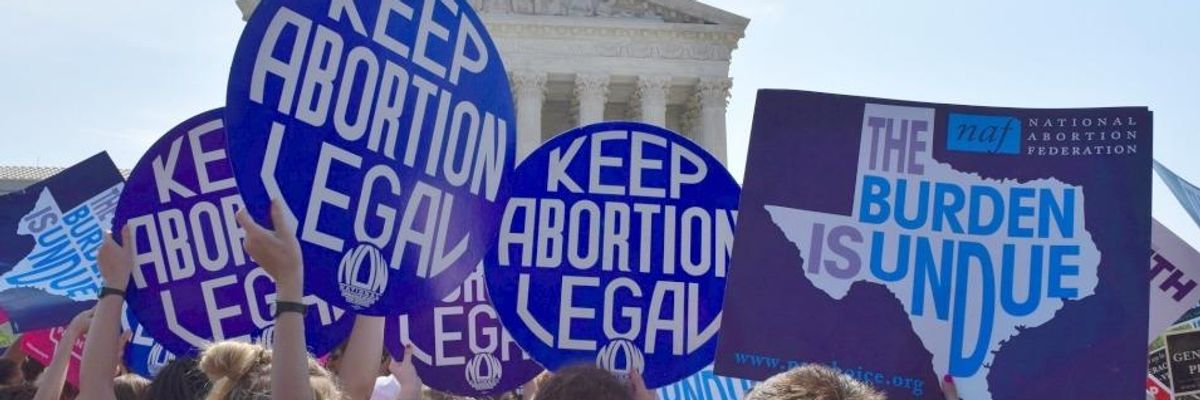
A contested Louisiana law that requires abortion providers to have admitting privileges at local hospitals resembles a Texas law the U.S. Supreme Court struck down in 2016. (Photo: Jordan Uhl/Flickr/cc)
Reproductive rights groups on Friday emphasized the importance of legal precedent after the U.S. Supreme Court agreed to hear a case challenging an anti-choice Louisiana law--the court's first abortion rights case since President Donald Trump's appointees, Justices Neil Gorsuch and Brett Kavanaugh, joined the bench and shifted the court to the right.
"If the Supreme Court fails to follow precedent and upholds Louisiana's anti-abortion law, it could make getting an abortion virtually impossible in the state."
--Alexis McGill Johnson, Planned Parenthood
Act 620, a 2014 Louisiana law that requires abortion providers to have admitting privileges at local hospitals, is similar to a Texas law the Supreme Court struck down in 2016. Such measures--which critics call "TRAP" (Targeted Regulation of Abortion Providers) laws--have become popular among right-wing legislatures trying to circumvent Roe v. Wade and restrict access to abortion care.
"These excessive and unnecessary government regulations--an ever-growing trend among state legislatures--increase the cost and scarcity of abortion services, harming women's health and inhibiting their reproductive choices," according to the Center for Reproductive Rights, which is challenging Act 620. "These laws jeopardize women's access to safe, legal, high-quality reproductive healthcare and represent a backdoor attempt by politicians to end legal abortion access."
In a statement Friday responding to the high court's decision to hear the Louisiana case, June Medical Services v. Gee, Center for Reproductive Rights president and CEO Nancy Northup pointed to the court's ruling in the Texas case, Whole Woman's Health v. Hellerstedt, which was also brought by the center.
"Louisiana is openly defying the Supreme Court's decision from just three years ago, in which they found an identical Texas law unconstitutional," declared Northup. "We are counting on the court to follow its precedent; otherwise, clinics will needlessly close and there will be just one doctor left in the entire state to provide abortion care."
"Louisiana has tried everything under the sun to decimate access to abortion care," said Kathaleen Pittman, clinic administrator at Hope Medical Group, a plaintiff in the case. "The situation here is already dire and this law would be the last straw for most of the remaining clinics. We're hopeful that the court will recognize how devastating this law would be for women in our state."
Alexis McGill Johnson, acting president and CEO of Planned Parenthood Federation of America, warned in a tweet that if the court fails to follow its precedent, "it could make getting an abortion virtually impossible in the state."
In September of 2018, a three-judge panel of the New Orleans-based 5th U.S. Circuit Court of Appeals defied the Texas ruling and upheld the Louisiana law in a 2-1 decision. In February, Chief Justice John Roberts--who dissented in the Texas case--joined the Supreme Court's four liberals justices for an interim ruling that extended a stay temporarily blocking Act 620 while abortion providers pursued an appeal.
"The meaning of Chief Justice Roberts's vote to block the Louisiana law is contested, and it is hardly certain he will vote to uphold the law on the merits," The New York Times reported Friday. "Instead, he might have meant only to ensure an orderly process in which the Supreme Court, rather than an appellate panel, makes the momentous decision of whether to limit or overrule a recent Supreme Court precedent."
Now, the Supreme Court will review the 5th Circuit's ruling on the Louisiana measure.
"If the rule of law means anything, it means that the court cannot sit by and watch as the lower court thumbs its nose at Supreme Court precedent and at people's constitutional rights," Jennifer Dalven of the ACLU's Reproductive Freedom Project said Friday. "We hope and expect that the court will strike down this unconstitutional law, which would decimate access to abortion for people in Louisiana."
"President Trump vowed to remake the judiciary by nominating judges who would overturn Roe v. Wade. No doubt, states like Louisiana are seeking to exploit this moment."
--Dariely Rodriguez, Lawyers' Committee for Civil Rights Under Law
The Supreme Court's decision to hear the Louisiana case follows a wave of recently enacted state laws restricting abortion, all of which have the ultimate aim of giving the right-wing high court an opportunity to overturn its 1973 Roe v. Wade ruling that affirmed the constitutional right to abortion.
"President Trump vowed to remake the judiciary by nominating judges who would overturn Roe v. Wade," noted Dariely Rodriguez, director of the Economic Justice Project at the Lawyers' Committee for Civil Rights Under Law. "No doubt, states like Louisiana are seeking to exploit this moment by proposing laws intended to collide with decades of settled Supreme Court precedents."
Considering that Louisiana has "one of the largest black populations and with some of the highest racial healthcare disparities," she added that "Louisiana's law would have an especially stark impact on low-income black women and women of color."
Rodriguez, who denounced Act 620's restrictions as "draconian and burdensome," concluded that "the Supreme Court should adhere to its precedents and reject this law as plainly unconstitutional."
However, pro-choice advocates expressed worries Friday that June Medical Services will be "a golden opportunity" for the high court's new right-wing additions to begin overturning legal precedent on abortion rights and cutting off access to the procedure.
The National Institute for Reproductive Health pointed out in a pair of tweets Friday that many people across the United States already struggle to access abortion care due to legally dubious local restrictions. Regarding the court's decicion, the group added that "today's news is a reminder that this fight is a marathon, not a sprint."
Dear Common Dreams reader, It’s been nearly 30 years since I co-founded Common Dreams with my late wife, Lina Newhouser. We had the radical notion that journalism should serve the public good, not corporate profits. It was clear to us from the outset what it would take to build such a project. No paid advertisements. No corporate sponsors. No millionaire publisher telling us what to think or do. Many people said we wouldn't last a year, but we proved those doubters wrong. Together with a tremendous team of journalists and dedicated staff, we built an independent media outlet free from the constraints of profits and corporate control. Our mission has always been simple: To inform. To inspire. To ignite change for the common good. Building Common Dreams was not easy. Our survival was never guaranteed. When you take on the most powerful forces—Wall Street greed, fossil fuel industry destruction, Big Tech lobbyists, and uber-rich oligarchs who have spent billions upon billions rigging the economy and democracy in their favor—the only bulwark you have is supporters who believe in your work. But here’s the urgent message from me today. It's never been this bad out there. And it's never been this hard to keep us going. At the very moment Common Dreams is most needed, the threats we face are intensifying. We need your support now more than ever. We don't accept corporate advertising and never will. We don't have a paywall because we don't think people should be blocked from critical news based on their ability to pay. Everything we do is funded by the donations of readers like you. When everyone does the little they can afford, we are strong. But if that support retreats or dries up, so do we. Will you donate now to make sure Common Dreams not only survives but thrives? —Craig Brown, Co-founder |
Reproductive rights groups on Friday emphasized the importance of legal precedent after the U.S. Supreme Court agreed to hear a case challenging an anti-choice Louisiana law--the court's first abortion rights case since President Donald Trump's appointees, Justices Neil Gorsuch and Brett Kavanaugh, joined the bench and shifted the court to the right.
"If the Supreme Court fails to follow precedent and upholds Louisiana's anti-abortion law, it could make getting an abortion virtually impossible in the state."
--Alexis McGill Johnson, Planned Parenthood
Act 620, a 2014 Louisiana law that requires abortion providers to have admitting privileges at local hospitals, is similar to a Texas law the Supreme Court struck down in 2016. Such measures--which critics call "TRAP" (Targeted Regulation of Abortion Providers) laws--have become popular among right-wing legislatures trying to circumvent Roe v. Wade and restrict access to abortion care.
"These excessive and unnecessary government regulations--an ever-growing trend among state legislatures--increase the cost and scarcity of abortion services, harming women's health and inhibiting their reproductive choices," according to the Center for Reproductive Rights, which is challenging Act 620. "These laws jeopardize women's access to safe, legal, high-quality reproductive healthcare and represent a backdoor attempt by politicians to end legal abortion access."
In a statement Friday responding to the high court's decision to hear the Louisiana case, June Medical Services v. Gee, Center for Reproductive Rights president and CEO Nancy Northup pointed to the court's ruling in the Texas case, Whole Woman's Health v. Hellerstedt, which was also brought by the center.
"Louisiana is openly defying the Supreme Court's decision from just three years ago, in which they found an identical Texas law unconstitutional," declared Northup. "We are counting on the court to follow its precedent; otherwise, clinics will needlessly close and there will be just one doctor left in the entire state to provide abortion care."
"Louisiana has tried everything under the sun to decimate access to abortion care," said Kathaleen Pittman, clinic administrator at Hope Medical Group, a plaintiff in the case. "The situation here is already dire and this law would be the last straw for most of the remaining clinics. We're hopeful that the court will recognize how devastating this law would be for women in our state."
Alexis McGill Johnson, acting president and CEO of Planned Parenthood Federation of America, warned in a tweet that if the court fails to follow its precedent, "it could make getting an abortion virtually impossible in the state."
In September of 2018, a three-judge panel of the New Orleans-based 5th U.S. Circuit Court of Appeals defied the Texas ruling and upheld the Louisiana law in a 2-1 decision. In February, Chief Justice John Roberts--who dissented in the Texas case--joined the Supreme Court's four liberals justices for an interim ruling that extended a stay temporarily blocking Act 620 while abortion providers pursued an appeal.
"The meaning of Chief Justice Roberts's vote to block the Louisiana law is contested, and it is hardly certain he will vote to uphold the law on the merits," The New York Times reported Friday. "Instead, he might have meant only to ensure an orderly process in which the Supreme Court, rather than an appellate panel, makes the momentous decision of whether to limit or overrule a recent Supreme Court precedent."
Now, the Supreme Court will review the 5th Circuit's ruling on the Louisiana measure.
"If the rule of law means anything, it means that the court cannot sit by and watch as the lower court thumbs its nose at Supreme Court precedent and at people's constitutional rights," Jennifer Dalven of the ACLU's Reproductive Freedom Project said Friday. "We hope and expect that the court will strike down this unconstitutional law, which would decimate access to abortion for people in Louisiana."
"President Trump vowed to remake the judiciary by nominating judges who would overturn Roe v. Wade. No doubt, states like Louisiana are seeking to exploit this moment."
--Dariely Rodriguez, Lawyers' Committee for Civil Rights Under Law
The Supreme Court's decision to hear the Louisiana case follows a wave of recently enacted state laws restricting abortion, all of which have the ultimate aim of giving the right-wing high court an opportunity to overturn its 1973 Roe v. Wade ruling that affirmed the constitutional right to abortion.
"President Trump vowed to remake the judiciary by nominating judges who would overturn Roe v. Wade," noted Dariely Rodriguez, director of the Economic Justice Project at the Lawyers' Committee for Civil Rights Under Law. "No doubt, states like Louisiana are seeking to exploit this moment by proposing laws intended to collide with decades of settled Supreme Court precedents."
Considering that Louisiana has "one of the largest black populations and with some of the highest racial healthcare disparities," she added that "Louisiana's law would have an especially stark impact on low-income black women and women of color."
Rodriguez, who denounced Act 620's restrictions as "draconian and burdensome," concluded that "the Supreme Court should adhere to its precedents and reject this law as plainly unconstitutional."
However, pro-choice advocates expressed worries Friday that June Medical Services will be "a golden opportunity" for the high court's new right-wing additions to begin overturning legal precedent on abortion rights and cutting off access to the procedure.
The National Institute for Reproductive Health pointed out in a pair of tweets Friday that many people across the United States already struggle to access abortion care due to legally dubious local restrictions. Regarding the court's decicion, the group added that "today's news is a reminder that this fight is a marathon, not a sprint."
Reproductive rights groups on Friday emphasized the importance of legal precedent after the U.S. Supreme Court agreed to hear a case challenging an anti-choice Louisiana law--the court's first abortion rights case since President Donald Trump's appointees, Justices Neil Gorsuch and Brett Kavanaugh, joined the bench and shifted the court to the right.
"If the Supreme Court fails to follow precedent and upholds Louisiana's anti-abortion law, it could make getting an abortion virtually impossible in the state."
--Alexis McGill Johnson, Planned Parenthood
Act 620, a 2014 Louisiana law that requires abortion providers to have admitting privileges at local hospitals, is similar to a Texas law the Supreme Court struck down in 2016. Such measures--which critics call "TRAP" (Targeted Regulation of Abortion Providers) laws--have become popular among right-wing legislatures trying to circumvent Roe v. Wade and restrict access to abortion care.
"These excessive and unnecessary government regulations--an ever-growing trend among state legislatures--increase the cost and scarcity of abortion services, harming women's health and inhibiting their reproductive choices," according to the Center for Reproductive Rights, which is challenging Act 620. "These laws jeopardize women's access to safe, legal, high-quality reproductive healthcare and represent a backdoor attempt by politicians to end legal abortion access."
In a statement Friday responding to the high court's decision to hear the Louisiana case, June Medical Services v. Gee, Center for Reproductive Rights president and CEO Nancy Northup pointed to the court's ruling in the Texas case, Whole Woman's Health v. Hellerstedt, which was also brought by the center.
"Louisiana is openly defying the Supreme Court's decision from just three years ago, in which they found an identical Texas law unconstitutional," declared Northup. "We are counting on the court to follow its precedent; otherwise, clinics will needlessly close and there will be just one doctor left in the entire state to provide abortion care."
"Louisiana has tried everything under the sun to decimate access to abortion care," said Kathaleen Pittman, clinic administrator at Hope Medical Group, a plaintiff in the case. "The situation here is already dire and this law would be the last straw for most of the remaining clinics. We're hopeful that the court will recognize how devastating this law would be for women in our state."
Alexis McGill Johnson, acting president and CEO of Planned Parenthood Federation of America, warned in a tweet that if the court fails to follow its precedent, "it could make getting an abortion virtually impossible in the state."
In September of 2018, a three-judge panel of the New Orleans-based 5th U.S. Circuit Court of Appeals defied the Texas ruling and upheld the Louisiana law in a 2-1 decision. In February, Chief Justice John Roberts--who dissented in the Texas case--joined the Supreme Court's four liberals justices for an interim ruling that extended a stay temporarily blocking Act 620 while abortion providers pursued an appeal.
"The meaning of Chief Justice Roberts's vote to block the Louisiana law is contested, and it is hardly certain he will vote to uphold the law on the merits," The New York Times reported Friday. "Instead, he might have meant only to ensure an orderly process in which the Supreme Court, rather than an appellate panel, makes the momentous decision of whether to limit or overrule a recent Supreme Court precedent."
Now, the Supreme Court will review the 5th Circuit's ruling on the Louisiana measure.
"If the rule of law means anything, it means that the court cannot sit by and watch as the lower court thumbs its nose at Supreme Court precedent and at people's constitutional rights," Jennifer Dalven of the ACLU's Reproductive Freedom Project said Friday. "We hope and expect that the court will strike down this unconstitutional law, which would decimate access to abortion for people in Louisiana."
"President Trump vowed to remake the judiciary by nominating judges who would overturn Roe v. Wade. No doubt, states like Louisiana are seeking to exploit this moment."
--Dariely Rodriguez, Lawyers' Committee for Civil Rights Under Law
The Supreme Court's decision to hear the Louisiana case follows a wave of recently enacted state laws restricting abortion, all of which have the ultimate aim of giving the right-wing high court an opportunity to overturn its 1973 Roe v. Wade ruling that affirmed the constitutional right to abortion.
"President Trump vowed to remake the judiciary by nominating judges who would overturn Roe v. Wade," noted Dariely Rodriguez, director of the Economic Justice Project at the Lawyers' Committee for Civil Rights Under Law. "No doubt, states like Louisiana are seeking to exploit this moment by proposing laws intended to collide with decades of settled Supreme Court precedents."
Considering that Louisiana has "one of the largest black populations and with some of the highest racial healthcare disparities," she added that "Louisiana's law would have an especially stark impact on low-income black women and women of color."
Rodriguez, who denounced Act 620's restrictions as "draconian and burdensome," concluded that "the Supreme Court should adhere to its precedents and reject this law as plainly unconstitutional."
However, pro-choice advocates expressed worries Friday that June Medical Services will be "a golden opportunity" for the high court's new right-wing additions to begin overturning legal precedent on abortion rights and cutting off access to the procedure.
The National Institute for Reproductive Health pointed out in a pair of tweets Friday that many people across the United States already struggle to access abortion care due to legally dubious local restrictions. Regarding the court's decicion, the group added that "today's news is a reminder that this fight is a marathon, not a sprint."