SUBSCRIBE TO OUR FREE NEWSLETTER
Daily news & progressive opinion—funded by the people, not the corporations—delivered straight to your inbox.
5
#000000
#FFFFFF
To donate by check, phone, or other method, see our More Ways to Give page.
Daily news & progressive opinion—funded by the people, not the corporations—delivered straight to your inbox.
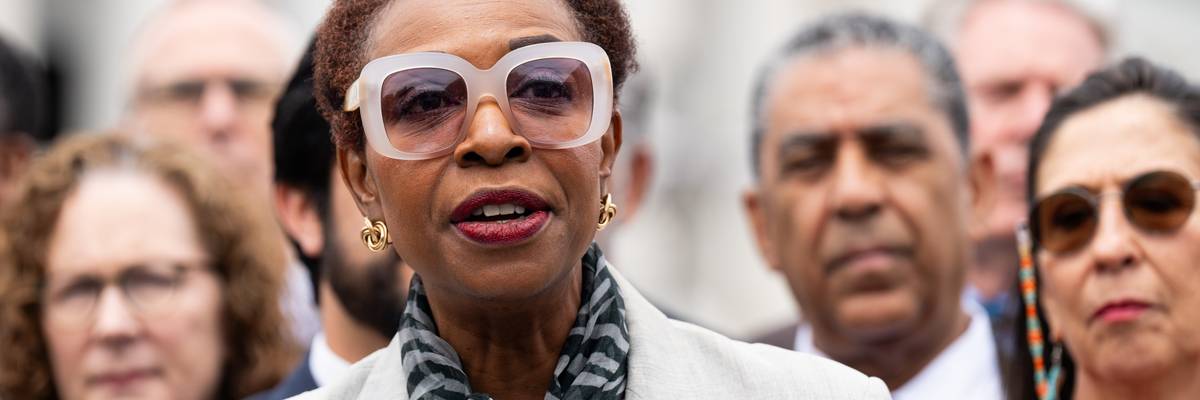
Congressional Black Caucus Chair Rep. Yvette Clarke (D-NY) speaks during the news conference outside the US Capitol on Tuesday, May 20, 2025.
The expansion of Black political representation over the past half century was the result of deliberate policy choices, sustained advocacy, and legal enforcement. As those protections are weakened, the risk is not just stagnation—it is regression.
The United States took a decisive step toward democracy with the passage of the Voting Rights Act of 1965. At the time, Black political representation was not just limited—it was nearly nonexistent. African Americans made up more than 10% of the population but held less than 2% of seats in Congress and none in the Senate.
By dismantling formal barriers to voting, the Voting Rights Act opened the door for Black political participation—and over time, representation. That progress was neither immediate nor inevitable, but it was real.
It was in this context that the Joint Center for Political and Economic Studies, the organization I lead, was founded in 1970. Our mission is to support the growth of Black political leadership and ensure that increased representation translates into meaningful policy outcomes.
More than five decades later, that mission remains urgent.
Representation alone does not guarantee equity—but without it, inequity is almost certain.
Black representation in the House has grown from fewer than 10 members in 1965 to more than 60 today, reaching roughly 14% of members—finally approaching parity with the Black share of the US population. But it took nearly 60 years to reach this point.
That underscores a critical truth: Representation requires sustained protection and intentional policy.
Even now, the progress is incomplete. Even with a record high five Black senators—just 5% of the total—Black representation in the Senate remains far below the Black population share.
Today, even these gains are under threat. Recent Supreme Court decisions have weakened the Voting Rights Act, reducing federal oversight and making it more difficult to challenge discriminatory voting practices.
The court’s most recent ruling gutted regulation designed to ensure Black representation, permitting what amounts to racial gerrymandering under the guise of partisan gerrymandering—a practice which itself badly undermines democracy for Americans of all races.
The result is a system increasingly driven by political advantage rather than fair representation. And Black representation is likely to suffer because of it.
Gerrymandering is often discussed as a partisan tactic, but it has broader structural consequences. When districts are drawn to maximize political control, they can dilute the voting power of communities of color—even without explicitly referencing race. For Black communities, whose political gains have often depended on fair districting, the erosion of these protections is particularly consequential.
This is not simply about who wins elections. It is about how policy is shaped and whose interests are represented in decisions that affect economic opportunity, education, healthcare, and wealth. Representation alone does not guarantee equity—but without it, inequity is almost certain.
The current moment demands clarity. The expansion of Black political representation over the past half century was the result of deliberate policy choices, sustained advocacy, and legal enforcement. As those protections are weakened, the risk is not just stagnation—it is regression.
At the Joint Center, our goal is clear: to ensure that the gains of the past are protected and that the path toward equitable representation remains open.
Nearly 60 years after the Voting Rights Act, Black Americans have come closer than ever to achieving representation in Congress that reflects their share of the population. But progress at this level is not self-sustaining. Without strong protections and continued commitment, it can be reversed.
The work of building a representative democracy is ongoing. And at this moment, it is clear that the work must continue.
Dear Common Dreams reader, It’s been nearly 30 years since I co-founded Common Dreams with my late wife, Lina Newhouser. We had the radical notion that journalism should serve the public good, not corporate profits. It was clear to us from the outset what it would take to build such a project. No paid advertisements. No corporate sponsors. No millionaire publisher telling us what to think or do. Many people said we wouldn't last a year, but we proved those doubters wrong. Together with a tremendous team of journalists and dedicated staff, we built an independent media outlet free from the constraints of profits and corporate control. Our mission has always been simple: To inform. To inspire. To ignite change for the common good. Building Common Dreams was not easy. Our survival was never guaranteed. When you take on the most powerful forces—Wall Street greed, fossil fuel industry destruction, Big Tech lobbyists, and uber-rich oligarchs who have spent billions upon billions rigging the economy and democracy in their favor—the only bulwark you have is supporters who believe in your work. But here’s the urgent message from me today. It's never been this bad out there. And it's never been this hard to keep us going. At the very moment Common Dreams is most needed, the threats we face are intensifying. We need your support now more than ever. We don't accept corporate advertising and never will. We don't have a paywall because we don't think people should be blocked from critical news based on their ability to pay. Everything we do is funded by the donations of readers like you. When everyone does the little they can afford, we are strong. But if that support retreats or dries up, so do we. Will you donate now to make sure Common Dreams not only survives but thrives? —Craig Brown, Co-founder |
The United States took a decisive step toward democracy with the passage of the Voting Rights Act of 1965. At the time, Black political representation was not just limited—it was nearly nonexistent. African Americans made up more than 10% of the population but held less than 2% of seats in Congress and none in the Senate.
By dismantling formal barriers to voting, the Voting Rights Act opened the door for Black political participation—and over time, representation. That progress was neither immediate nor inevitable, but it was real.
It was in this context that the Joint Center for Political and Economic Studies, the organization I lead, was founded in 1970. Our mission is to support the growth of Black political leadership and ensure that increased representation translates into meaningful policy outcomes.
More than five decades later, that mission remains urgent.
Representation alone does not guarantee equity—but without it, inequity is almost certain.
Black representation in the House has grown from fewer than 10 members in 1965 to more than 60 today, reaching roughly 14% of members—finally approaching parity with the Black share of the US population. But it took nearly 60 years to reach this point.
That underscores a critical truth: Representation requires sustained protection and intentional policy.
Even now, the progress is incomplete. Even with a record high five Black senators—just 5% of the total—Black representation in the Senate remains far below the Black population share.
Today, even these gains are under threat. Recent Supreme Court decisions have weakened the Voting Rights Act, reducing federal oversight and making it more difficult to challenge discriminatory voting practices.
The court’s most recent ruling gutted regulation designed to ensure Black representation, permitting what amounts to racial gerrymandering under the guise of partisan gerrymandering—a practice which itself badly undermines democracy for Americans of all races.
The result is a system increasingly driven by political advantage rather than fair representation. And Black representation is likely to suffer because of it.
Gerrymandering is often discussed as a partisan tactic, but it has broader structural consequences. When districts are drawn to maximize political control, they can dilute the voting power of communities of color—even without explicitly referencing race. For Black communities, whose political gains have often depended on fair districting, the erosion of these protections is particularly consequential.
This is not simply about who wins elections. It is about how policy is shaped and whose interests are represented in decisions that affect economic opportunity, education, healthcare, and wealth. Representation alone does not guarantee equity—but without it, inequity is almost certain.
The current moment demands clarity. The expansion of Black political representation over the past half century was the result of deliberate policy choices, sustained advocacy, and legal enforcement. As those protections are weakened, the risk is not just stagnation—it is regression.
At the Joint Center, our goal is clear: to ensure that the gains of the past are protected and that the path toward equitable representation remains open.
Nearly 60 years after the Voting Rights Act, Black Americans have come closer than ever to achieving representation in Congress that reflects their share of the population. But progress at this level is not self-sustaining. Without strong protections and continued commitment, it can be reversed.
The work of building a representative democracy is ongoing. And at this moment, it is clear that the work must continue.
The United States took a decisive step toward democracy with the passage of the Voting Rights Act of 1965. At the time, Black political representation was not just limited—it was nearly nonexistent. African Americans made up more than 10% of the population but held less than 2% of seats in Congress and none in the Senate.
By dismantling formal barriers to voting, the Voting Rights Act opened the door for Black political participation—and over time, representation. That progress was neither immediate nor inevitable, but it was real.
It was in this context that the Joint Center for Political and Economic Studies, the organization I lead, was founded in 1970. Our mission is to support the growth of Black political leadership and ensure that increased representation translates into meaningful policy outcomes.
More than five decades later, that mission remains urgent.
Representation alone does not guarantee equity—but without it, inequity is almost certain.
Black representation in the House has grown from fewer than 10 members in 1965 to more than 60 today, reaching roughly 14% of members—finally approaching parity with the Black share of the US population. But it took nearly 60 years to reach this point.
That underscores a critical truth: Representation requires sustained protection and intentional policy.
Even now, the progress is incomplete. Even with a record high five Black senators—just 5% of the total—Black representation in the Senate remains far below the Black population share.
Today, even these gains are under threat. Recent Supreme Court decisions have weakened the Voting Rights Act, reducing federal oversight and making it more difficult to challenge discriminatory voting practices.
The court’s most recent ruling gutted regulation designed to ensure Black representation, permitting what amounts to racial gerrymandering under the guise of partisan gerrymandering—a practice which itself badly undermines democracy for Americans of all races.
The result is a system increasingly driven by political advantage rather than fair representation. And Black representation is likely to suffer because of it.
Gerrymandering is often discussed as a partisan tactic, but it has broader structural consequences. When districts are drawn to maximize political control, they can dilute the voting power of communities of color—even without explicitly referencing race. For Black communities, whose political gains have often depended on fair districting, the erosion of these protections is particularly consequential.
This is not simply about who wins elections. It is about how policy is shaped and whose interests are represented in decisions that affect economic opportunity, education, healthcare, and wealth. Representation alone does not guarantee equity—but without it, inequity is almost certain.
The current moment demands clarity. The expansion of Black political representation over the past half century was the result of deliberate policy choices, sustained advocacy, and legal enforcement. As those protections are weakened, the risk is not just stagnation—it is regression.
At the Joint Center, our goal is clear: to ensure that the gains of the past are protected and that the path toward equitable representation remains open.
Nearly 60 years after the Voting Rights Act, Black Americans have come closer than ever to achieving representation in Congress that reflects their share of the population. But progress at this level is not self-sustaining. Without strong protections and continued commitment, it can be reversed.
The work of building a representative democracy is ongoing. And at this moment, it is clear that the work must continue.