SUBSCRIBE TO OUR FREE NEWSLETTER
Daily news & progressive opinion—funded by the people, not the corporations—delivered straight to your inbox.
5
#000000
#FFFFFF
To donate by check, phone, or other method, see our More Ways to Give page.
Daily news & progressive opinion—funded by the people, not the corporations—delivered straight to your inbox.
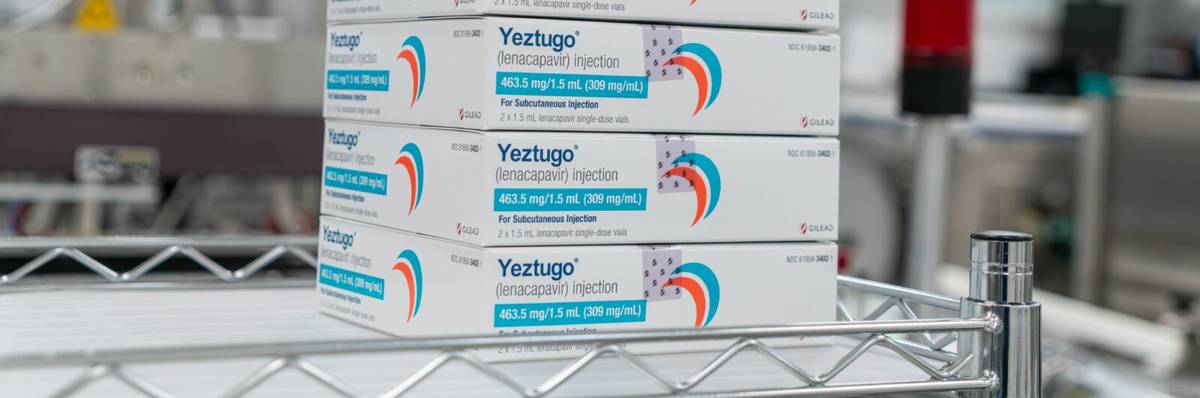
The U.S. Food and Drug Administration approved lenacapavir, which will be sold under the brand name Yeztugo, for preventing HIV infection on June 18, 2025.
"This moment calls for bold public funding, strong private sector leadership, and a shared commitment to making HIV prevention accessible, affordable, and a cornerstone of our national response," said one campaigner.
While joining Gilead Sciences in welcoming the U.S. Food and Drug Administration's Wednesday approval of a six-month shot that CEO Daniel O'Day said "offers a very real opportunity to help end the HIV epidemic," public health advocates this week have expressed concern that Big Pharma greed could impede access to lenacapavir.
Gilead announced that the FDA has approved lenacapavir—which will be sold under the brand name Yeztugo—as pre-exposure prophylaxis (PrEP) to reduce the risk of sexually acquired HIV in adults and adolescents weighing at least 77 lbs., "making it the first and only twice-yearly option available in the United States for people who need or want PrEP."
Responding in a statement, Save HIV Funding campaign manager Maxx Boykin said that "the FDA's approval of lenacapavir for HIV prevention has the potential to be a pivotal moment for the broader fight to end HIV. It's a reminder that prevention must be a national priority, backed by serious investment and political will."
"Ending the epidemic requires equal focus on prevention and treatment, delivered through equitable, community-driven systems," Boykin continued. "This moment calls for bold public funding, strong private sector leadership, and a shared commitment to making HIV prevention accessible, affordable, and a cornerstone of our national response."
"If lenacapavir has any chance of becoming a viable choice for people who could benefit from PrEP, the price will have to be low enough that safety net providers can afford to procure it."
The Save HIV Funding campaign was launched in 2023 by multiple groups, including PrEP4All, to fight proposed cuts to federal funds. PrEP4All senior policy consultant Amy Killelea and executive director Jeremiah Johnson wrote Tuesday at Health Affairs that "lenacapavir's PrEP approval comes four years after the first long-acting injectable product for PrEP—a once-every-two-month injection made by ViiV and sold under the brand name Apretude—hit the market. Despite a lot of fanfare about its ability to change the HIV prevention landscape, Apretude sales have been fairly anemic since its launch."
"This likely reflects the many barriers to PrEP access, including provider willingness to prescribe PrEP, individual awareness about HIV risk, and complicated procurement and financing considerations for provider-administered products," they explained. "Whether the fact that lenacapavir requires far fewer provider visits than Apretude will make it a better option for people remains to be seen. But regardless of whether lenacapavir truly disrupts the PrEP landscape, it provides another important tool in the HIV prevention toolbox and an option that could help anyone who might struggle with adherence to a daily pill regimen."
The FDA approval comes as congressional Republicans push a budget reconciliation package that would deprive millions of Americans of health insurance, and "given the anticipated high price tag of lenacapavir, any coverage losses could impede access," Killelea and Johnson warned. "The launch of lenacapavir also comes amidst an intentional hollowing out of governmental public health programs by the Trump administration."
"Gilead's charitable assistance programs cannot alone ensure that PrEP is available and accessible to the people who need it most," they stressed. "If lenacapavir has any chance of becoming a viable choice for people who could benefit from PrEP, the price will have to be low enough that safety net providers can afford to procure it. This is particularly true for provider-administered products, which are often covered as a medical benefit."
Given the challenging last few months, this is a bright spot - the approval of lenacapavir twice yearly to prevent HIV. Unlike past PrEP meds, it was found t be 100% protective in cisgender women.But it will only work if gets to people, especially those communities that need it most.
[image or embed]
— Oni Blackstock, MD MHS (@oniblackstock.bsky.social) June 18, 2025 at 3:54 PM
The Guardian reported Tuesday that Gilead "has not yet made the price of the drug public, but it has been estimated... that it is likely to be on par with current preventive medications at about $25,000... a year. As a treatment for people already living with HIV, it costs about $39,000 annually."
However, the "HIV-ending" injection could "be made for only $25... a year—including a 30% profit margin," the newspaper noted, citing an analysis from the University of Liverpool and others. The researchers found that "lenacapavir could be mass produced for $35 to $46 a year, if there was annual demand for 2 million doses, falling to $25 at scaled-up production of 5 million to 10 million doses each year."
The watchdog Public Citizen also highlighted that study in a Wednesday statement:
The closest drug to an HIV vaccine, lenacapavir has shown 99% efficacy in preventing HIV infection, but its manufacturer, Gilead, is overcharging for the drug and gripping tightly to its patents in certain countries.
Patented in many Latin American countries, lenacapavir as an HIV treatment is priced at more than $40,000 (U.S. dollars) per year, but experts estimate lenacapavir's production (plus a margin for profit) could price the drug as low as $25 with process improvements and an increase in demand...
Public Citizen has been working with 100 health groups across Latin America to overcome the patent barrier, issuing multiple compulsory license requests and calling on governments to take action to make long-acting PrEP more accessible.
Public Citizen Access to Medicines Director Peter Maybarduk said that "the world has an historic opportunity to end AIDS," a condition caused by HIV, but "that requires confronting the triple threat of funding cuts, stigma, and pharma power."
Reporting on the FDA approval Wednesday, The Associated Press pointed out that "global efforts at ending the HIV pandemic by 2030 have stalled. There still are more than 30,000 new infections in the U.S. each year and about 1.3 million worldwide."
This country and this world are at a monumental crossroads. US voters have an opportunity to beat back the forces of fascism and confront the billionaires who are rigging the economy, our media system, and our democracy, making it increasingly impossible for ordinary people to get by. We’re not just talking about the election. We’re talking about what must be done once these fascist elements are vanquished from power. We need a bolder set of solutions than what either major party has so far been willing to offer and a working-class movement ready to fight like hell for it. Trump didn't emerge from nowhere. The conditions that fueled MAGA authoritarianism were created by decades of radical neoliberal economic policies and a corrupt political system dominated by corporate interests. They slashed taxes on the super-rich, promising that the benefits would trickle down. They said giveaways to the corporate titans would make life more affordable for the rest of us. It was all bullshit. And when a bitter, betrayed populace searches for someone to blame, right-wing demagogues have little trouble finding scapegoats. People know when they're being lied to, but you won't hear any of this from the corporate media. Only independent journalism—powered and funded by people who believe in building a better world—can deliver truly trustworthy daily news. If you share our vision, please contribute whatever you can to sustain our work. |
While joining Gilead Sciences in welcoming the U.S. Food and Drug Administration's Wednesday approval of a six-month shot that CEO Daniel O'Day said "offers a very real opportunity to help end the HIV epidemic," public health advocates this week have expressed concern that Big Pharma greed could impede access to lenacapavir.
Gilead announced that the FDA has approved lenacapavir—which will be sold under the brand name Yeztugo—as pre-exposure prophylaxis (PrEP) to reduce the risk of sexually acquired HIV in adults and adolescents weighing at least 77 lbs., "making it the first and only twice-yearly option available in the United States for people who need or want PrEP."
Responding in a statement, Save HIV Funding campaign manager Maxx Boykin said that "the FDA's approval of lenacapavir for HIV prevention has the potential to be a pivotal moment for the broader fight to end HIV. It's a reminder that prevention must be a national priority, backed by serious investment and political will."
"Ending the epidemic requires equal focus on prevention and treatment, delivered through equitable, community-driven systems," Boykin continued. "This moment calls for bold public funding, strong private sector leadership, and a shared commitment to making HIV prevention accessible, affordable, and a cornerstone of our national response."
"If lenacapavir has any chance of becoming a viable choice for people who could benefit from PrEP, the price will have to be low enough that safety net providers can afford to procure it."
The Save HIV Funding campaign was launched in 2023 by multiple groups, including PrEP4All, to fight proposed cuts to federal funds. PrEP4All senior policy consultant Amy Killelea and executive director Jeremiah Johnson wrote Tuesday at Health Affairs that "lenacapavir's PrEP approval comes four years after the first long-acting injectable product for PrEP—a once-every-two-month injection made by ViiV and sold under the brand name Apretude—hit the market. Despite a lot of fanfare about its ability to change the HIV prevention landscape, Apretude sales have been fairly anemic since its launch."
"This likely reflects the many barriers to PrEP access, including provider willingness to prescribe PrEP, individual awareness about HIV risk, and complicated procurement and financing considerations for provider-administered products," they explained. "Whether the fact that lenacapavir requires far fewer provider visits than Apretude will make it a better option for people remains to be seen. But regardless of whether lenacapavir truly disrupts the PrEP landscape, it provides another important tool in the HIV prevention toolbox and an option that could help anyone who might struggle with adherence to a daily pill regimen."
The FDA approval comes as congressional Republicans push a budget reconciliation package that would deprive millions of Americans of health insurance, and "given the anticipated high price tag of lenacapavir, any coverage losses could impede access," Killelea and Johnson warned. "The launch of lenacapavir also comes amidst an intentional hollowing out of governmental public health programs by the Trump administration."
"Gilead's charitable assistance programs cannot alone ensure that PrEP is available and accessible to the people who need it most," they stressed. "If lenacapavir has any chance of becoming a viable choice for people who could benefit from PrEP, the price will have to be low enough that safety net providers can afford to procure it. This is particularly true for provider-administered products, which are often covered as a medical benefit."
Given the challenging last few months, this is a bright spot - the approval of lenacapavir twice yearly to prevent HIV. Unlike past PrEP meds, it was found t be 100% protective in cisgender women.But it will only work if gets to people, especially those communities that need it most.
[image or embed]
— Oni Blackstock, MD MHS (@oniblackstock.bsky.social) June 18, 2025 at 3:54 PM
The Guardian reported Tuesday that Gilead "has not yet made the price of the drug public, but it has been estimated... that it is likely to be on par with current preventive medications at about $25,000... a year. As a treatment for people already living with HIV, it costs about $39,000 annually."
However, the "HIV-ending" injection could "be made for only $25... a year—including a 30% profit margin," the newspaper noted, citing an analysis from the University of Liverpool and others. The researchers found that "lenacapavir could be mass produced for $35 to $46 a year, if there was annual demand for 2 million doses, falling to $25 at scaled-up production of 5 million to 10 million doses each year."
The watchdog Public Citizen also highlighted that study in a Wednesday statement:
The closest drug to an HIV vaccine, lenacapavir has shown 99% efficacy in preventing HIV infection, but its manufacturer, Gilead, is overcharging for the drug and gripping tightly to its patents in certain countries.
Patented in many Latin American countries, lenacapavir as an HIV treatment is priced at more than $40,000 (U.S. dollars) per year, but experts estimate lenacapavir's production (plus a margin for profit) could price the drug as low as $25 with process improvements and an increase in demand...
Public Citizen has been working with 100 health groups across Latin America to overcome the patent barrier, issuing multiple compulsory license requests and calling on governments to take action to make long-acting PrEP more accessible.
Public Citizen Access to Medicines Director Peter Maybarduk said that "the world has an historic opportunity to end AIDS," a condition caused by HIV, but "that requires confronting the triple threat of funding cuts, stigma, and pharma power."
Reporting on the FDA approval Wednesday, The Associated Press pointed out that "global efforts at ending the HIV pandemic by 2030 have stalled. There still are more than 30,000 new infections in the U.S. each year and about 1.3 million worldwide."