SUBSCRIBE TO OUR FREE NEWSLETTER
Daily news & progressive opinion—funded by the people, not the corporations—delivered straight to your inbox.
5
#000000
#FFFFFF
To donate by check, phone, or other method, see our More Ways to Give page.
Daily news & progressive opinion—funded by the people, not the corporations—delivered straight to your inbox.
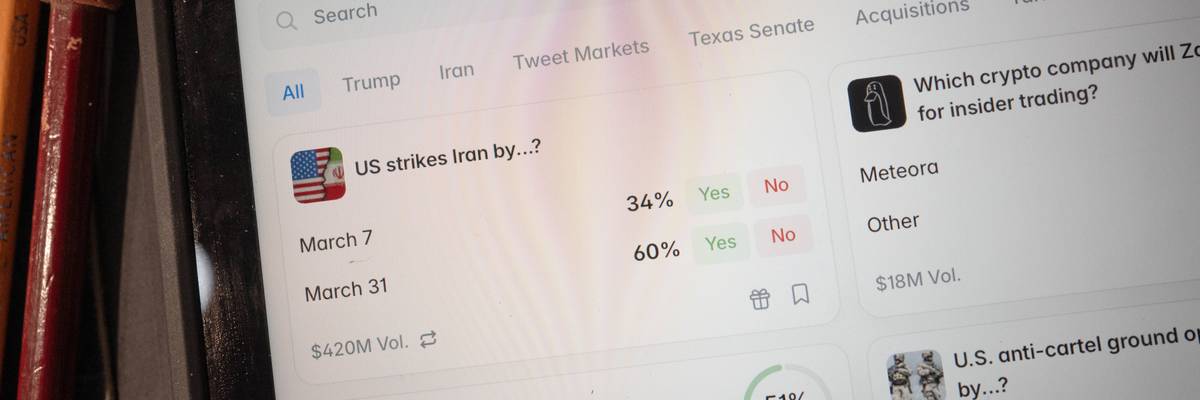
An app for Polymarket, an online prediction market site, is shown on February 25, 2026, in Chicago, Illinois.
"Several very substantial bets were placed in the last-minute moments prior to the February 28 attack," said a representative for Public Citizen.
A consumer watchdog group is calling on the federal agency that regulates prediction markets to investigate what it says are a series of "highly suspicious bets" placed on President Donald Trump's war with Iran.
In a letter sent on Thursday to Michael Selig, the chair of the Commodity Futures Trading Commission (CFTC), a representative for the group Public Citizen pointed out that users have been able to make off with six-figure winnings from betting on political outcomes using platforms like Kalshi and Polymarket, which "advertise that you can bet on almost anything, anywhere."
"While bets on the future of the Iranian regime had been sporadic and imprecise for months before the invasion, several very substantial bets were placed in the last-minute moments prior to the February 28 attack," wrote Public Citizen's government affairs lobbyist Craig Holman.
"For most of the year, bets of [Iranian Supreme Leader Ayatollah Ali Khamenei] being removed from power were long shots and low-balled guesses," Holman said. "In just the few hours before public announcement of the February 28 attacks, the odds and amount of the bets changed radically, rising from small bets at less than 25% to a few very large bets at over 50%. In the end, a few anonymous bettors hit the nail on its head and became very wealthy."
Holman pointed to a report from NPR that an anonymous account with the username “Magamyman” made more than $553,000 placing bets on Polymarket just before the Iranian leader was killed by an Israeli strike Saturday.
The Wall Street Journal, meanwhile, reported findings from the crypto analytics firm Bubblemaps, which identified “six suspected insiders” who had won a $1.2 million profit on a US strike through Polymarket. As the Journal wrote:
Most of them bet on a strike by February 28, which turned out to be the exact date of the operation, the firm said. One such user bet $26,000 and won over $200,000, a return upward of 657%.
These users’ bets were among half a billion placed on Polymarket alone regarding the precise timing of US strikes on Iran.
Sen. Chris Murphy (D-Conn.) said "it’s insane this is legal" and that "people around Trump are profiting off war and death." He added that he was "introducing legislation ASAP to ban this."
Holman asked Selig to identify the users who placed the highly lucrative bets and who, within the Trump and Netanyahu administrations, may have been privy to insider knowledge about the strikes.
The Trump family is deeply intertwined with the world of prediction markets. The president's media company, earlier this year, partnered with Crypto.com to launch its own prediction platform called "Truth Predict." Meanwhile, Donald Trump Jr. is an adviser to both Polymarket and Kalshi.
The president's CFTC chair, Selig—who has appointed the CEOs of prediction market platforms as advisers—has sought to shield betting markets from regulatory scrutiny, describing his goal as ushering in "the Golden Age of American financial markets."
Last month, facing what he called “an onslaught of state-led litigation,” Selig made the legally questionable assertion that Congress had given his agency the exclusive authority to regulate these platforms, not as tightly controlled gambling hubs but as commodities markets, which have much looser rules.
The Iran war is not the first time that mystery users have walked away with massive hauls after placing fortuitously timed bets on Trump's military operations. In January, a user won $436,000 on a bet that Venezuelan President Nicolás Maduro would be ousted by the end of the month, which they'd placed just hours before Trump's operation to remove him from power.
“Allowing prediction market platforms to bet on virtually anything, any time, is a recipe for disaster,” Holman said. “The American people should not have to wonder whether government officials are exploiting their access to classified information to make a quick buck. The CFTC must act swiftly to regulate platforms like Kalshi and Polymarket in order to protect the public.”
Dear Common Dreams reader, It’s been nearly 30 years since I co-founded Common Dreams with my late wife, Lina Newhouser. We had the radical notion that journalism should serve the public good, not corporate profits. It was clear to us from the outset what it would take to build such a project. No paid advertisements. No corporate sponsors. No millionaire publisher telling us what to think or do. Many people said we wouldn't last a year, but we proved those doubters wrong. Together with a tremendous team of journalists and dedicated staff, we built an independent media outlet free from the constraints of profits and corporate control. Our mission has always been simple: To inform. To inspire. To ignite change for the common good. Building Common Dreams was not easy. Our survival was never guaranteed. When you take on the most powerful forces—Wall Street greed, fossil fuel industry destruction, Big Tech lobbyists, and uber-rich oligarchs who have spent billions upon billions rigging the economy and democracy in their favor—the only bulwark you have is supporters who believe in your work. But here’s the urgent message from me today. It's never been this bad out there. And it's never been this hard to keep us going. At the very moment Common Dreams is most needed, the threats we face are intensifying. We need your support now more than ever. We don't accept corporate advertising and never will. We don't have a paywall because we don't think people should be blocked from critical news based on their ability to pay. Everything we do is funded by the donations of readers like you. When everyone does the little they can afford, we are strong. But if that support retreats or dries up, so do we. Will you donate now to make sure Common Dreams not only survives but thrives? —Craig Brown, Co-founder |
A consumer watchdog group is calling on the federal agency that regulates prediction markets to investigate what it says are a series of "highly suspicious bets" placed on President Donald Trump's war with Iran.
In a letter sent on Thursday to Michael Selig, the chair of the Commodity Futures Trading Commission (CFTC), a representative for the group Public Citizen pointed out that users have been able to make off with six-figure winnings from betting on political outcomes using platforms like Kalshi and Polymarket, which "advertise that you can bet on almost anything, anywhere."
"While bets on the future of the Iranian regime had been sporadic and imprecise for months before the invasion, several very substantial bets were placed in the last-minute moments prior to the February 28 attack," wrote Public Citizen's government affairs lobbyist Craig Holman.
"For most of the year, bets of [Iranian Supreme Leader Ayatollah Ali Khamenei] being removed from power were long shots and low-balled guesses," Holman said. "In just the few hours before public announcement of the February 28 attacks, the odds and amount of the bets changed radically, rising from small bets at less than 25% to a few very large bets at over 50%. In the end, a few anonymous bettors hit the nail on its head and became very wealthy."
Holman pointed to a report from NPR that an anonymous account with the username “Magamyman” made more than $553,000 placing bets on Polymarket just before the Iranian leader was killed by an Israeli strike Saturday.
The Wall Street Journal, meanwhile, reported findings from the crypto analytics firm Bubblemaps, which identified “six suspected insiders” who had won a $1.2 million profit on a US strike through Polymarket. As the Journal wrote:
Most of them bet on a strike by February 28, which turned out to be the exact date of the operation, the firm said. One such user bet $26,000 and won over $200,000, a return upward of 657%.
These users’ bets were among half a billion placed on Polymarket alone regarding the precise timing of US strikes on Iran.
Sen. Chris Murphy (D-Conn.) said "it’s insane this is legal" and that "people around Trump are profiting off war and death." He added that he was "introducing legislation ASAP to ban this."
Holman asked Selig to identify the users who placed the highly lucrative bets and who, within the Trump and Netanyahu administrations, may have been privy to insider knowledge about the strikes.
The Trump family is deeply intertwined with the world of prediction markets. The president's media company, earlier this year, partnered with Crypto.com to launch its own prediction platform called "Truth Predict." Meanwhile, Donald Trump Jr. is an adviser to both Polymarket and Kalshi.
The president's CFTC chair, Selig—who has appointed the CEOs of prediction market platforms as advisers—has sought to shield betting markets from regulatory scrutiny, describing his goal as ushering in "the Golden Age of American financial markets."
Last month, facing what he called “an onslaught of state-led litigation,” Selig made the legally questionable assertion that Congress had given his agency the exclusive authority to regulate these platforms, not as tightly controlled gambling hubs but as commodities markets, which have much looser rules.
The Iran war is not the first time that mystery users have walked away with massive hauls after placing fortuitously timed bets on Trump's military operations. In January, a user won $436,000 on a bet that Venezuelan President Nicolás Maduro would be ousted by the end of the month, which they'd placed just hours before Trump's operation to remove him from power.
“Allowing prediction market platforms to bet on virtually anything, any time, is a recipe for disaster,” Holman said. “The American people should not have to wonder whether government officials are exploiting their access to classified information to make a quick buck. The CFTC must act swiftly to regulate platforms like Kalshi and Polymarket in order to protect the public.”
A consumer watchdog group is calling on the federal agency that regulates prediction markets to investigate what it says are a series of "highly suspicious bets" placed on President Donald Trump's war with Iran.
In a letter sent on Thursday to Michael Selig, the chair of the Commodity Futures Trading Commission (CFTC), a representative for the group Public Citizen pointed out that users have been able to make off with six-figure winnings from betting on political outcomes using platforms like Kalshi and Polymarket, which "advertise that you can bet on almost anything, anywhere."
"While bets on the future of the Iranian regime had been sporadic and imprecise for months before the invasion, several very substantial bets were placed in the last-minute moments prior to the February 28 attack," wrote Public Citizen's government affairs lobbyist Craig Holman.
"For most of the year, bets of [Iranian Supreme Leader Ayatollah Ali Khamenei] being removed from power were long shots and low-balled guesses," Holman said. "In just the few hours before public announcement of the February 28 attacks, the odds and amount of the bets changed radically, rising from small bets at less than 25% to a few very large bets at over 50%. In the end, a few anonymous bettors hit the nail on its head and became very wealthy."
Holman pointed to a report from NPR that an anonymous account with the username “Magamyman” made more than $553,000 placing bets on Polymarket just before the Iranian leader was killed by an Israeli strike Saturday.
The Wall Street Journal, meanwhile, reported findings from the crypto analytics firm Bubblemaps, which identified “six suspected insiders” who had won a $1.2 million profit on a US strike through Polymarket. As the Journal wrote:
Most of them bet on a strike by February 28, which turned out to be the exact date of the operation, the firm said. One such user bet $26,000 and won over $200,000, a return upward of 657%.
These users’ bets were among half a billion placed on Polymarket alone regarding the precise timing of US strikes on Iran.
Sen. Chris Murphy (D-Conn.) said "it’s insane this is legal" and that "people around Trump are profiting off war and death." He added that he was "introducing legislation ASAP to ban this."
Holman asked Selig to identify the users who placed the highly lucrative bets and who, within the Trump and Netanyahu administrations, may have been privy to insider knowledge about the strikes.
The Trump family is deeply intertwined with the world of prediction markets. The president's media company, earlier this year, partnered with Crypto.com to launch its own prediction platform called "Truth Predict." Meanwhile, Donald Trump Jr. is an adviser to both Polymarket and Kalshi.
The president's CFTC chair, Selig—who has appointed the CEOs of prediction market platforms as advisers—has sought to shield betting markets from regulatory scrutiny, describing his goal as ushering in "the Golden Age of American financial markets."
Last month, facing what he called “an onslaught of state-led litigation,” Selig made the legally questionable assertion that Congress had given his agency the exclusive authority to regulate these platforms, not as tightly controlled gambling hubs but as commodities markets, which have much looser rules.
The Iran war is not the first time that mystery users have walked away with massive hauls after placing fortuitously timed bets on Trump's military operations. In January, a user won $436,000 on a bet that Venezuelan President Nicolás Maduro would be ousted by the end of the month, which they'd placed just hours before Trump's operation to remove him from power.
“Allowing prediction market platforms to bet on virtually anything, any time, is a recipe for disaster,” Holman said. “The American people should not have to wonder whether government officials are exploiting their access to classified information to make a quick buck. The CFTC must act swiftly to regulate platforms like Kalshi and Polymarket in order to protect the public.”