
SUBSCRIBE TO OUR FREE NEWSLETTER
Daily news & progressive opinion—funded by the people, not the corporations—delivered straight to your inbox.
5
#000000
#FFFFFF
To donate by check, phone, or other method, see our More Ways to Give page.


Daily news & progressive opinion—funded by the people, not the corporations—delivered straight to your inbox.
However, experts said the warrants are effectively unenforceable, given that the lawmakers fled to Democrat-controlled states.
Republican state lawmakers in Texas voted Monday to issue what are likely unenforceable arrest warrants for Democratic colleagues who traveled to other states in order to thwart a vote on a GOP-grerrymandered congressional map.
"I have signed the civil arrest warrants," House Speaker Dustin Burrows (R-83) told reporters following Monday's vote, adding that Republicans would work with the Texas Department of Public Safety "to locate members."
However, Chad Dunn, a longtime Texas election and voting rights lawyer, told Democracy Docket that "a warrant issued by the Texas House is not effective out of the state unless another state chooses to domesticate it and enforce it under that state's laws."
Many of the more than 50 absconding Democrats are in Illinois, whose Democratic Gov. JB Pritzker told reporters Sunday that "we're going to do everything we can to protect every single one of them."
Other Texas Democrats went to Democrat-controlled states including Massachusetts and New York, where Gov. Kathy Kochul said Monday that she is open to retaliatory redistricting in order to "fight fire with fire."
"I have newsflash for Republicans in Texas. This is no longer the Wild West," Hochul said during a Monday news conference. "We're not going to tolerate our democracy being stolen in a modern day stagecoach heist by a bunch of law breaking cowboys."
"If Republicans are willing to rewrite these rules to give themselves an advantage, then they're leaving us no choice, we must do the same," she added.
A analysis published Friday by the National Democratic Redistricting Committee found that the congressional map proposed by Texas Republicans "packs voters of color into as few districts as possible in some areas and cracks them across several districts in others, effectively reducing the overall number of districts where Black and Latino voters are able to elect candidates of their choice."
The gerrymandered Texas map would eliminate the seat currently held by Congressional Progressive Caucus Chair Greg Casar, who would likely be forced into a primary battle with Rep. Lloyd Doggett. On Monday, Casar called for an emergency march and picket outside the mansion of Republican Texas Gov. Greg Abbott, who on Sunday threatened to remove Democrats who left the state from office.
The proposed map is meant to create five more Republican-leaning districts in Texas ahead of the 2026 midterm elections. In addition to Hochul, Democratic governors including Gavin Newsom of California have expressed openness to redrawing their states' maps to create more districts likely to swing Democratic.
"It's incumbent upon Democrat governors, if they have the opportunity, to respond in kind," outgoing Kansas Gov. Laura Kelly said Friday at a Democratic Governors Association meeting in Madison, Wisconsin. "I'm not a big believer in unilateral disarmament."
If he prevails at the Supreme Court, U.S. President Donald Trump "could gain extraordinary powers to investigate and penalize private businesses and individuals, tilt elections," and more, one outlet noted.
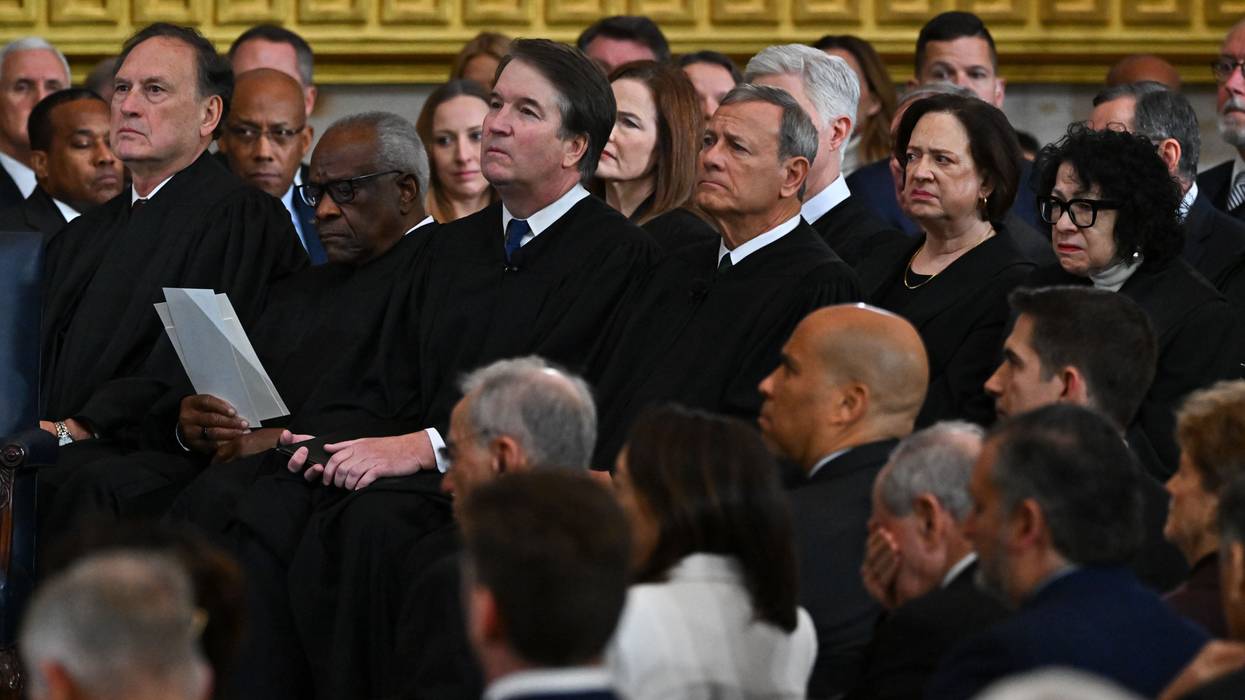
The full D.C. Circuit Court of Appeals on Monday issued a divided ruling that reinstated two members of labor-focused independent agencies whom the Trump administration had sought to remove. The ruling is likely not the end of the legal saga and the case appears headed to the U.S. Supreme Court.
The federal appeals court voted 7-4 to reverse an earlier decision by a three-member panel of the D.C. Circuit Court of Appeals that upheld the Trump administration's dismissal of National Labor Relations Board (NLRB) member Gwynne Wilcox and Merit Systems Protection Board (MSPB) member Cathy Harris.
Since Trump's return to the White House, Harris and Wilcox have been repeatedly removed and reinstated following contradictory rulings, according to The Guardian.
Monday's ruling was split along partisan lines, with the four dissenting judges all appointed to the court by Republican administrations, per The Guardian.
Wilcox was first appointed to the NLRB, which safeguards private sector workers' rights to organize, in 2021 by then-President Joe Biden and was re-confirmed for a five-year term by the Senate in 2023. Wilcox's removal meant the body did not have a quorum, because it needs three members to have a quorum. It once again has a quorum and can issue decisions.
As a member and former chair of the MSPB, Harris helped lead an agency that reviews federal employee firings, suspensions, and whistleblower claims.
According to the outlet Democracy Docket, the court ruled Monday that the administration's dismissal of Wilcox and Harris ran afoul of the U.S. Supreme Court's ruling in Humphrey's Executor v. U.S., a 1935 case that upheld removal restrictions for government officials on multimember adjudicatory boards.
"Trump's Department of Justice said it believes congressional limitations on the president's removal power are unconstitutional and that it will urge the Supreme Court to overturn Humphrey's Executor," Democracy Docket reported. "If the Supreme Court ultimately grants Trump the ability to fire members of independent bodies, he could gain extraordinary powers to investigate and penalize private businesses and individuals, tilt elections, and use monetary policy for political purposes."
One plaintiffs' attorney said the ruling "makes our democracy better and ensures that North Carolina is not able to unjustly criminalize innocent individuals with felony convictions who are valued members of our society."
Democracy defenders on Tuesday hailed a ruling from a U.S. federal judge striking down a 19th-century North Carolina law criminalizing people who vote while on parole, probation, or post-release supervision due to a felony conviction.
In Monday's decision, U.S. District Judge Loretta C. Biggs—an appointee of former Democratic President Barack Obama—sided with the North Carolina A. Philip Randolph Institute and Action NC, who argued that the 1877 law discriminated against Black people.
"The challenged statute was enacted with discriminatory intent, has not been cleansed of its discriminatory taint, and continues to disproportionately impact Black voters," Biggs wrote in her 25-page ruling.
Therefore, according to the judge, the 1877 law violates the U.S. Constitution's equal protection clause.
"We are ecstatic that the court found in our favor and struck down this racially discriminatory law that has been arbitrarily enforced over time," Action NC executive director Pat McCoy said in a statement. "We will now be able to help more people become civically engaged without fear of prosecution for innocent mistakes. Democracy truly won today!"
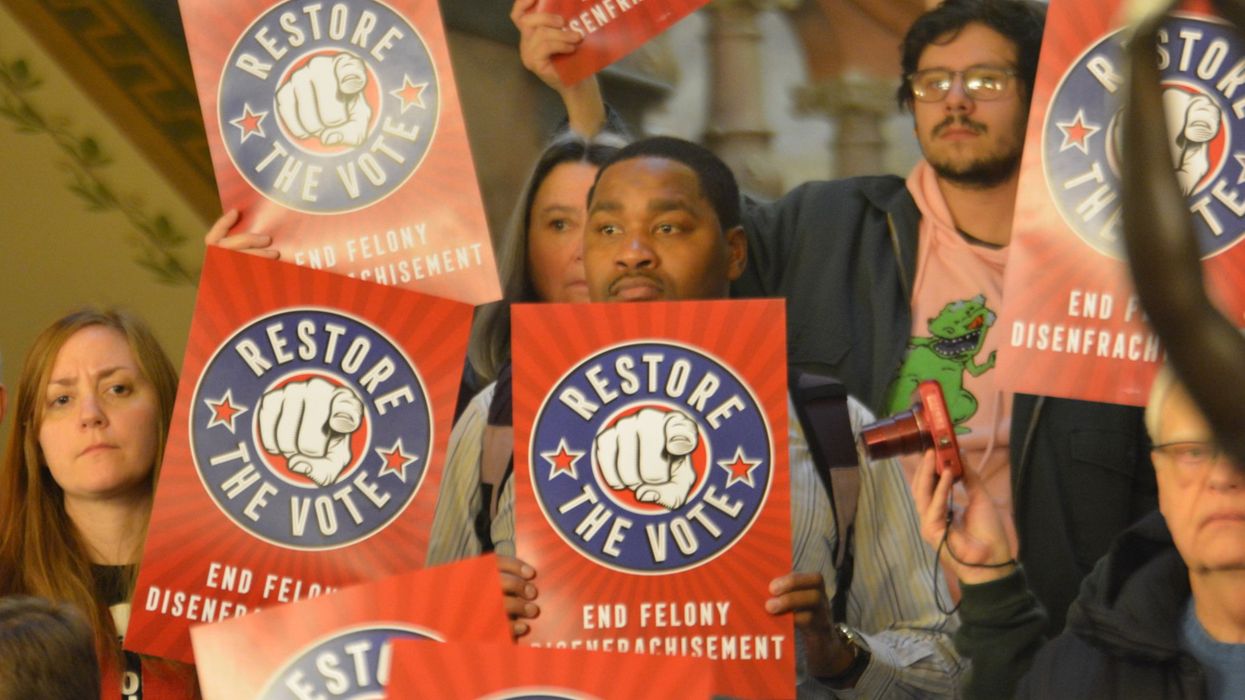
Voting rights tracker Democracy Docket noted that Monday's ruling "does not have any bearing on North Carolina's strict felony disenfranchisement law, which denies the right to vote for those with felony convictions who remain on probation, parole, or a suspended sentence—often leaving individuals without voting rights for many years after release from incarceration."
However, Mitchell Brown, an attorney for one of the plaintiffs, said that "Judge Biggs' decision will help ensure that voters who mistakenly think they are eligible to cast a ballot will not be criminalized for simply trying to reengage in the political process and perform their civic duty."
"It also makes our democracy better and ensures that North Carolina is not able to unjustly criminalize innocent individuals with felony convictions who are valued members of our society, specifically Black voters who were the target of this law," Brown added.
North Carolina officials have not said whether they will appeal Biggs' ruling. The state Department of Justice said it was reviewing the decision.
According to Forward Justice—a nonpartisan law, policy, and strategy center dedicated to advancing racial, social, and economic justice in the U.S. South, "Although Black people constitute 21% of the voting-age population in North Carolina, they represent 42% of the people disenfranchised while on probation, parole, or post-release supervision."
The group notes that in 44 North Carolina counties, "the disenfranchisement rate for Black people is more than three times the rate of the white population."
"Judge Biggs' decision will help ensure that voters who mistakenly think they are eligible to cast a ballot will not be criminalized for simply trying to re-engage in the political process and perform their civic duty."
In what one civil rights leader called "the largest expansion of voting rights in this state since the 1965 Voting Rights Act," a three-judge state court panel voted 2-1 in 2021 to restore voting rights to approximately 55,000 formerly incarcerated felons. The decision made North Carolina the only Southern state to automatically restore former felons' voting rights.
Republican state legislators appealed that ruling to the North Carolina Court of Appeals, which in 2022 granted their request for a stay—but only temporarily, as the court allowed a previous injunction against any felony disenfranchisement based on fees or fines to stand.
However, last April the North Carolina Supreme Courtreversed the three-judge panel decision, stripping voting rights from thousands of North Carolinians previously convicted of felonies. Dissenting Justice Anita Earls opined that "the majority's decision in this case will one day be repudiated on two grounds."
"First, because it seeks to justify the denial of a basic human right to citizens and thereby perpetuates a vestige of slavery, and second, because the majority violates a basic tenant of appellate review by ignoring the facts as found by the trial court and substituting its own," she wrote.
As similar battles play out in other states, Democratic U.S. lawmakers led by Rep. Ayanna Pressley of Massachusetts and Sen. Peter Welch of Vermont in December introduced legislation to end former felon disenfranchisement in federal elections and guarantee incarcerated people the right to vote.
Currently, only Maine, Vermont, and the District of Columbia allow all incarcerated people to vote behind bars.