SUBSCRIBE TO OUR FREE NEWSLETTER
Daily news & progressive opinion—funded by the people, not the corporations—delivered straight to your inbox.
5
#000000
#FFFFFF
To donate by check, phone, or other method, see our More Ways to Give page.
Daily news & progressive opinion—funded by the people, not the corporations—delivered straight to your inbox.
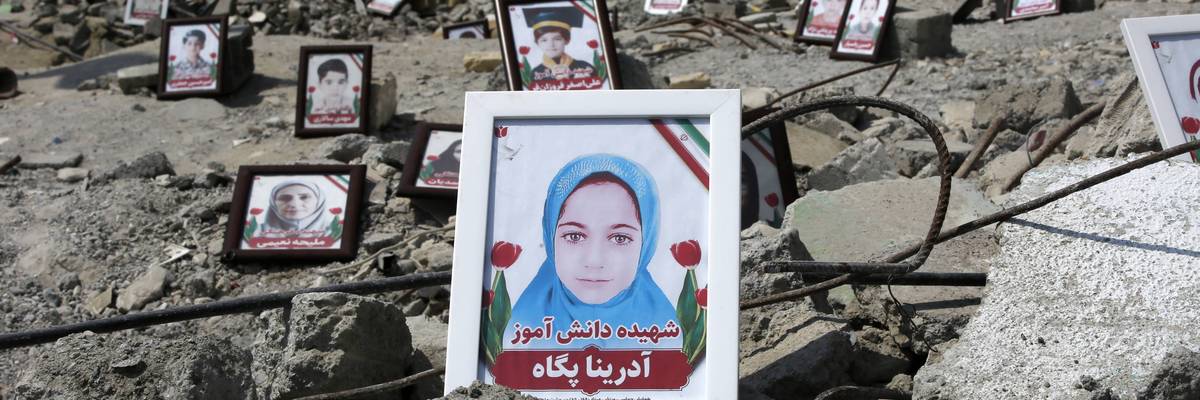
A view of a school destroyed in an attack by the United States is seen in Minab, Iran on September 11, 2026.
One policy analyst wrote sardonically that the administration doesn't "want to remind voters before the midterms of the mass killing of schoolchildren on the first day of Trump's glorious war."
The Pentagon is reportedly planning to withhold until after the midterm elections the completed findings of its investigation into a devastating US strike on an elementary school in southern Iran, which killed more than 150 people—including 120 children—on the first day of President Donald Trump's illegal and deeply unpopular war.
Bloomberg reported on Thursday that "top Pentagon officials have expressed their intention to hold off on releasing an internal report into the attack" on Shajareh Tayyebeh Elementary School in Minab until after next month's midterms "at the earliest." The internal assessment is believed to have been effectively complete for months, and preliminary findings reported in early March determined that American forces hit the school with a Tomahawk missile due to "outdated" targeting information.
According to Bloomberg, Pentagon investigators "discovered that flawed intelligence, outdated imagery, and an overreliance on AI contributed to the attack," which is regarded as one of the US military's worst atrocities against civilians in decades. Trump brushed off the massacre in remarks to reporters in June, saying: "Mistakes are made. War is nasty."
Ryan Costello, policy director at the National Iranian American Council (NIAC), said in a statement that "the refusal to come clean about the attack on Minab is not just a shameful exercise to dodge accountability for a horrific war crime; it is actively risking these errors being repeated again."
"As the administration has dodged accountability on Minab and [a deadly strike on a sports hall hours later], it has engaged in further attacks that may be war crimes, including the bombing of a civilian home on Qeshm Island that killed a family and the bombing of a wedding party in Kuhestak that killed five, including two children," said Costello. "Ensuring these tragedies don’t repeat starts with accountability on Minab.”
International policy analyst Brian Finucane wrote sardonically that the Pentagon doesn't "want to remind voters before the midterms of the mass killing of schoolchildren on the first day of Trump's glorious war."
Bloomberg's reporting came as CNN published a story detailing internal US "strike plans" that include possibly dropping the so-called "mother of all bombs" on Iranian energy infrastructure.
The GBU-43/B Massive Ordnance Air Blast Bomb (MOAB) is the largest nonnuclear bomb in the US arsenal. In 2017, Trump became the first US president to deploy the weapon, authorizing the military to drop it on Afghanistan.
Sina Toossi, a senior fellow at the Center for International Policy, warned that using the bomb against Iran would risk "triggering another major escalatory spiral, potentially including Iranian attacks on critical regional energy infrastructure, with consequences for global markets and the US economy."
"This only reinforces the fundamental problem: Trump has no viable military solution to the Iran conflict," Toossi wrote. "Is he looking for one spectacular strike to project strength and declare victory? Or is he prepared to plunge the US into an even deeper, potentially endless war that could devastate the rest of his presidency, legacy, and the economy?"
Costello of NIAC said that "the Trump administration’s threats to commit war crimes in Iran cannot be normalized."
"President Trump acts on many of his threats, necessitating more urgent action to bring this illegal war of choice to a definitive end," he added.
Dear Common Dreams reader, It’s been nearly 30 years since I co-founded Common Dreams with my late wife, Lina Newhouser. We had the radical notion that journalism should serve the public good, not corporate profits. It was clear to us from the outset what it would take to build such a project. No paid advertisements. No corporate sponsors. No millionaire publisher telling us what to think or do. Many people said we wouldn't last a year, but we proved those doubters wrong. Together with a tremendous team of journalists and dedicated staff, we built an independent media outlet free from the constraints of profits and corporate control. Our mission has always been simple: To inform. To inspire. To ignite change for the common good. Building Common Dreams was not easy. Our survival was never guaranteed. When you take on the most powerful forces—Wall Street greed, fossil fuel industry destruction, Big Tech lobbyists, and uber-rich oligarchs who have spent billions upon billions rigging the economy and democracy in their favor—the only bulwark you have is supporters who believe in your work. But here’s the urgent message from me today. It's never been this bad out there. And it's never been this hard to keep us going. At the very moment Common Dreams is most needed, the threats we face are intensifying. We need your support now more than ever. We don't accept corporate advertising and never will. We don't have a paywall because we don't think people should be blocked from critical news based on their ability to pay. Everything we do is funded by the donations of readers like you. When everyone does the little they can afford, we are strong. But if that support retreats or dries up, so do we. Will you donate now to make sure Common Dreams not only survives but thrives? —Craig Brown, Co-founder |
The Pentagon is reportedly planning to withhold until after the midterm elections the completed findings of its investigation into a devastating US strike on an elementary school in southern Iran, which killed more than 150 people—including 120 children—on the first day of President Donald Trump's illegal and deeply unpopular war.
Bloomberg reported on Thursday that "top Pentagon officials have expressed their intention to hold off on releasing an internal report into the attack" on Shajareh Tayyebeh Elementary School in Minab until after next month's midterms "at the earliest." The internal assessment is believed to have been effectively complete for months, and preliminary findings reported in early March determined that American forces hit the school with a Tomahawk missile due to "outdated" targeting information.
According to Bloomberg, Pentagon investigators "discovered that flawed intelligence, outdated imagery, and an overreliance on AI contributed to the attack," which is regarded as one of the US military's worst atrocities against civilians in decades. Trump brushed off the massacre in remarks to reporters in June, saying: "Mistakes are made. War is nasty."
Ryan Costello, policy director at the National Iranian American Council (NIAC), said in a statement that "the refusal to come clean about the attack on Minab is not just a shameful exercise to dodge accountability for a horrific war crime; it is actively risking these errors being repeated again."
"As the administration has dodged accountability on Minab and [a deadly strike on a sports hall hours later], it has engaged in further attacks that may be war crimes, including the bombing of a civilian home on Qeshm Island that killed a family and the bombing of a wedding party in Kuhestak that killed five, including two children," said Costello. "Ensuring these tragedies don’t repeat starts with accountability on Minab.”
International policy analyst Brian Finucane wrote sardonically that the Pentagon doesn't "want to remind voters before the midterms of the mass killing of schoolchildren on the first day of Trump's glorious war."
Bloomberg's reporting came as CNN published a story detailing internal US "strike plans" that include possibly dropping the so-called "mother of all bombs" on Iranian energy infrastructure.
The GBU-43/B Massive Ordnance Air Blast Bomb (MOAB) is the largest nonnuclear bomb in the US arsenal. In 2017, Trump became the first US president to deploy the weapon, authorizing the military to drop it on Afghanistan.
Sina Toossi, a senior fellow at the Center for International Policy, warned that using the bomb against Iran would risk "triggering another major escalatory spiral, potentially including Iranian attacks on critical regional energy infrastructure, with consequences for global markets and the US economy."
"This only reinforces the fundamental problem: Trump has no viable military solution to the Iran conflict," Toossi wrote. "Is he looking for one spectacular strike to project strength and declare victory? Or is he prepared to plunge the US into an even deeper, potentially endless war that could devastate the rest of his presidency, legacy, and the economy?"
Costello of NIAC said that "the Trump administration’s threats to commit war crimes in Iran cannot be normalized."
"President Trump acts on many of his threats, necessitating more urgent action to bring this illegal war of choice to a definitive end," he added.
The Pentagon is reportedly planning to withhold until after the midterm elections the completed findings of its investigation into a devastating US strike on an elementary school in southern Iran, which killed more than 150 people—including 120 children—on the first day of President Donald Trump's illegal and deeply unpopular war.
Bloomberg reported on Thursday that "top Pentagon officials have expressed their intention to hold off on releasing an internal report into the attack" on Shajareh Tayyebeh Elementary School in Minab until after next month's midterms "at the earliest." The internal assessment is believed to have been effectively complete for months, and preliminary findings reported in early March determined that American forces hit the school with a Tomahawk missile due to "outdated" targeting information.
According to Bloomberg, Pentagon investigators "discovered that flawed intelligence, outdated imagery, and an overreliance on AI contributed to the attack," which is regarded as one of the US military's worst atrocities against civilians in decades. Trump brushed off the massacre in remarks to reporters in June, saying: "Mistakes are made. War is nasty."
Ryan Costello, policy director at the National Iranian American Council (NIAC), said in a statement that "the refusal to come clean about the attack on Minab is not just a shameful exercise to dodge accountability for a horrific war crime; it is actively risking these errors being repeated again."
"As the administration has dodged accountability on Minab and [a deadly strike on a sports hall hours later], it has engaged in further attacks that may be war crimes, including the bombing of a civilian home on Qeshm Island that killed a family and the bombing of a wedding party in Kuhestak that killed five, including two children," said Costello. "Ensuring these tragedies don’t repeat starts with accountability on Minab.”
International policy analyst Brian Finucane wrote sardonically that the Pentagon doesn't "want to remind voters before the midterms of the mass killing of schoolchildren on the first day of Trump's glorious war."
Bloomberg's reporting came as CNN published a story detailing internal US "strike plans" that include possibly dropping the so-called "mother of all bombs" on Iranian energy infrastructure.
The GBU-43/B Massive Ordnance Air Blast Bomb (MOAB) is the largest nonnuclear bomb in the US arsenal. In 2017, Trump became the first US president to deploy the weapon, authorizing the military to drop it on Afghanistan.
Sina Toossi, a senior fellow at the Center for International Policy, warned that using the bomb against Iran would risk "triggering another major escalatory spiral, potentially including Iranian attacks on critical regional energy infrastructure, with consequences for global markets and the US economy."
"This only reinforces the fundamental problem: Trump has no viable military solution to the Iran conflict," Toossi wrote. "Is he looking for one spectacular strike to project strength and declare victory? Or is he prepared to plunge the US into an even deeper, potentially endless war that could devastate the rest of his presidency, legacy, and the economy?"
Costello of NIAC said that "the Trump administration’s threats to commit war crimes in Iran cannot be normalized."
"President Trump acts on many of his threats, necessitating more urgent action to bring this illegal war of choice to a definitive end," he added.