SUBSCRIBE TO OUR FREE NEWSLETTER
Daily news & progressive opinion—funded by the people, not the corporations—delivered straight to your inbox.
5
#000000
#FFFFFF
To donate by check, phone, or other method, see our More Ways to Give page.
Daily news & progressive opinion—funded by the people, not the corporations—delivered straight to your inbox.
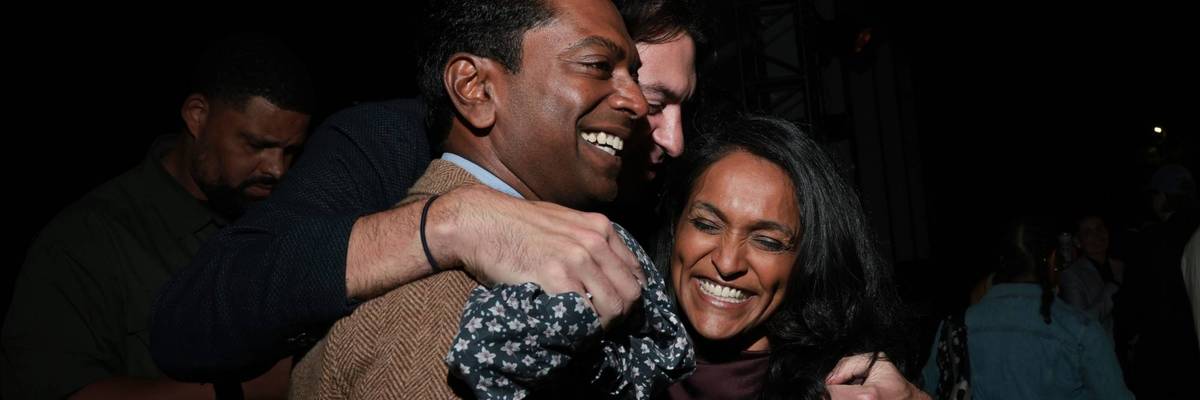
Los Angeles mayoral candidate Nithya Raman embraces her husband, Vali Chandrasekaran, and an unidentified friend at her election night party at the Greek Theater in Los Angeles on November 4, 2026.
"Even though every city councilperson said they were standing with Karen Bass, not very many of the people they represent followed them to the polls," said a labor leader who backed Raman.
With Los Angeles Council member Nithya Raman, the first democratic socialist city policymaker, leading Democratic Mayor Karen Bass by 26,000 votes or about 3 percentage points on Wednesday night, Decision Desk Headquarters projected a win for the progressive who entered the mayoral race late and centered her campaign on solving the city's homelessness crisis as well as addressing the cost of living.
With about 72% of votes cast late Wednesday, urban planner Raman had 51.7% of the vote compared to Bass' 48.3%.
Raman, who has a background in fighting homelessness and served as executive director of the anti-workplace sexual harassment group Time's Up before winning her City Council seat in 2020, was endorsed by climate action groups, the hospitality workers union UNITE Here Local 11, the public education advocacy group Eastside Padres Contra la Privatización, and the Los Angeles chapter of the Democratic Socialists of America.
Kurt Petersen, co-president of UNITE Here Local 11, told Politico that Raman's projected victory was "a monsoon, an earthquake, a leveling, a restructuring" that served as a rebuke by voters of the nation's second-largest city's political establishment, including the rest of the City Council members, all of who supported Bass.
"It was all of the above," Petersen said. “The political class of Los Angeles was absent at the Nithya Raman party because they were all with the incumbent... Even though every city councilperson said they were standing with Karen Bass, not very many of the people they represent followed them to the polls.”
Polls ahead of Election Day showed younger voters across the city leaning towards Raman, who has called for a streamlined process for approving housing projects and an end to "indefinite delays," an Office of Tenant Protections for the roughly 64% of Angelenos who are renters, and a reorganization of the city's homelessness interventions "to quickly shelter and house the largest number of people with the same dollars."
She has criticized Bass' Inside Safe anti-homelessness program as ineffective and expensive, with more than $300 million spent to house 6,000 people and 40% of those served by the program returning to the streets.
"Despite repeated efforts from the City Council to reduce costs in the program, Inside Safe costs an average of $85,000 a year for a motel room and services, and some rooms go as high as $100,000 per year," reads Raman's campaign website. "It is the most expensive temporary housing program in the city by far, and people are staying in the motel rooms for close to a year. For the same amount of money, we could rent three apartments using a short-term rental voucher and provide intensive services—housing more people in a program that has delivered much better outcomes."
Raman also highlighted a nearly 50% reduction in homelessness in her own district, even as rates have risen across the city, and pledged to reduce city-wide rates by 50% before the 2028 Olympics.
Ballot-tallying continued past Election Day, with officials counting late ballots that typically are cast by younger and more progressive voters.
“This city’s government has made solving problems look impossible for so long that I heard from people across this city who started to believe that it was impossible,” Raman told supporters who gathered at her election night party on Tuesday. “Hopelessness can be fatal for a city, but this campaign refused to accept that. You refused to accept that.”
Raman has centered efforts to make the heavily car-dependent Los Angeles safer for pedestrians and bikers, crack down on "disgraceful" delays in fixing 30,000 street lights across the city, and ramping up public transportation with "permanent, dedicated bus lanes and more buses running more often."
"Nithya Raman winning the mayor's office in the second largest city in the US is in my opinion the most important election of this season," said Matthew Lewis, communications director for California YIMBY. "Just the ground shifting on housing, transit, bicycles, and walkable urbanism."
Raman also denounced the mayor for what she called a "dysfunctional" and "indefensibly slow" recovery from the wildfires that devastated parts of Los Angeles nearly two years ago. She championed the creation of a "Recovery District" to "coordinate the recovery across jurisdictions, bring hundreds of millions of dollars into the Palisades, and ensure that local residents are at the table when decisions are made."
Bass received an endorsement from the Los Angeles Police Department's union, which poured more than $5 million into the push to defeat Raman. The union also donated $200,000 to the Republican Central Committee of Los Angeles County, which sent out anti-Raman mailers to voters.
Kenneth Meija, the progressive city controller who won his reelection bid in June, said on election night that he was “so damn proud to be the only one in City Hall who supported Mayor Raman."
“They were like, ‘Yo, the entire political establishment is supporting Mayor Bass,'" said Meija. "And I’m like, ‘So? She’s got Kenneth Mejia. She’s got the people.’”
This country and this world are at a monumental crossroads. US voters have an opportunity to beat back the forces of fascism and confront the billionaires who are rigging the economy, our media system, and our democracy, making it increasingly impossible for ordinary people to get by. We’re not just talking about the election. We’re talking about what must be done once these fascist elements are vanquished from power. We need a bolder set of solutions than what either major party has so far been willing to offer and a working-class movement ready to fight like hell for it. Trump didn't emerge from nowhere. The conditions that fueled MAGA authoritarianism were created by decades of radical neoliberal economic policies and a corrupt political system dominated by corporate interests. They slashed taxes on the super-rich, promising that the benefits would trickle down. They said giveaways to the corporate titans would make life more affordable for the rest of us. It was all bullshit. And when a bitter, betrayed populace searches for someone to blame, right-wing demagogues have little trouble finding scapegoats. People know when they're being lied to, but you won't hear any of this from the corporate media. Only independent journalism—powered and funded by people who believe in building a better world—can deliver truly trustworthy daily news. If you share our vision, please contribute whatever you can to sustain our work. |
With Los Angeles Council member Nithya Raman, the first democratic socialist city policymaker, leading Democratic Mayor Karen Bass by 26,000 votes or about 3 percentage points on Wednesday night, Decision Desk Headquarters projected a win for the progressive who entered the mayoral race late and centered her campaign on solving the city's homelessness crisis as well as addressing the cost of living.
With about 72% of votes cast late Wednesday, urban planner Raman had 51.7% of the vote compared to Bass' 48.3%.
Raman, who has a background in fighting homelessness and served as executive director of the anti-workplace sexual harassment group Time's Up before winning her City Council seat in 2020, was endorsed by climate action groups, the hospitality workers union UNITE Here Local 11, the public education advocacy group Eastside Padres Contra la Privatización, and the Los Angeles chapter of the Democratic Socialists of America.
Kurt Petersen, co-president of UNITE Here Local 11, told Politico that Raman's projected victory was "a monsoon, an earthquake, a leveling, a restructuring" that served as a rebuke by voters of the nation's second-largest city's political establishment, including the rest of the City Council members, all of who supported Bass.
"It was all of the above," Petersen said. “The political class of Los Angeles was absent at the Nithya Raman party because they were all with the incumbent... Even though every city councilperson said they were standing with Karen Bass, not very many of the people they represent followed them to the polls.”
Polls ahead of Election Day showed younger voters across the city leaning towards Raman, who has called for a streamlined process for approving housing projects and an end to "indefinite delays," an Office of Tenant Protections for the roughly 64% of Angelenos who are renters, and a reorganization of the city's homelessness interventions "to quickly shelter and house the largest number of people with the same dollars."
She has criticized Bass' Inside Safe anti-homelessness program as ineffective and expensive, with more than $300 million spent to house 6,000 people and 40% of those served by the program returning to the streets.
"Despite repeated efforts from the City Council to reduce costs in the program, Inside Safe costs an average of $85,000 a year for a motel room and services, and some rooms go as high as $100,000 per year," reads Raman's campaign website. "It is the most expensive temporary housing program in the city by far, and people are staying in the motel rooms for close to a year. For the same amount of money, we could rent three apartments using a short-term rental voucher and provide intensive services—housing more people in a program that has delivered much better outcomes."
Raman also highlighted a nearly 50% reduction in homelessness in her own district, even as rates have risen across the city, and pledged to reduce city-wide rates by 50% before the 2028 Olympics.
Ballot-tallying continued past Election Day, with officials counting late ballots that typically are cast by younger and more progressive voters.
“This city’s government has made solving problems look impossible for so long that I heard from people across this city who started to believe that it was impossible,” Raman told supporters who gathered at her election night party on Tuesday. “Hopelessness can be fatal for a city, but this campaign refused to accept that. You refused to accept that.”
Raman has centered efforts to make the heavily car-dependent Los Angeles safer for pedestrians and bikers, crack down on "disgraceful" delays in fixing 30,000 street lights across the city, and ramping up public transportation with "permanent, dedicated bus lanes and more buses running more often."
"Nithya Raman winning the mayor's office in the second largest city in the US is in my opinion the most important election of this season," said Matthew Lewis, communications director for California YIMBY. "Just the ground shifting on housing, transit, bicycles, and walkable urbanism."
Raman also denounced the mayor for what she called a "dysfunctional" and "indefensibly slow" recovery from the wildfires that devastated parts of Los Angeles nearly two years ago. She championed the creation of a "Recovery District" to "coordinate the recovery across jurisdictions, bring hundreds of millions of dollars into the Palisades, and ensure that local residents are at the table when decisions are made."
Bass received an endorsement from the Los Angeles Police Department's union, which poured more than $5 million into the push to defeat Raman. The union also donated $200,000 to the Republican Central Committee of Los Angeles County, which sent out anti-Raman mailers to voters.
Kenneth Meija, the progressive city controller who won his reelection bid in June, said on election night that he was “so damn proud to be the only one in City Hall who supported Mayor Raman."
“They were like, ‘Yo, the entire political establishment is supporting Mayor Bass,'" said Meija. "And I’m like, ‘So? She’s got Kenneth Mejia. She’s got the people.’”