SUBSCRIBE TO OUR FREE NEWSLETTER
Daily news & progressive opinion—funded by the people, not the corporations—delivered straight to your inbox.
5
#000000
#FFFFFF
To donate by check, phone, or other method, see our More Ways to Give page.
Daily news & progressive opinion—funded by the people, not the corporations—delivered straight to your inbox.
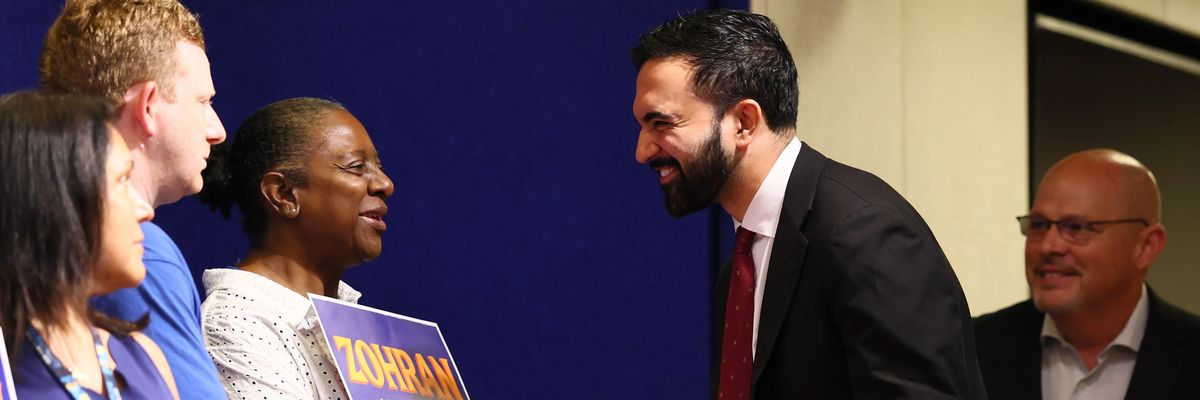
New York mayoral candidate Zohran Mamdani shakes hands with the United Federation of Teachers (UFT) during a press conference on July 9, 2025 in New York City.
A new website imagines headlines attacking New York City mayoral hopeful Zohran Mamdani—and calls out The New York Times' fixation on the progressive.
" Zohran Mamdani Texts in the Movie Theater."
"Shock Photos Reveal 'Muslim' Mamdani Without Beard as Child."
"Mamdani's Use of Oxford Comma Raises Questions Amid No Record of Attendance."
Those are just a selection of the faux controversies "reported" on by the Mamdani Times, a fictitious headline generator that appeared online Tuesday, satirizing The New York Times' recent coverage of the progressive Democratic mayoral candidate in New York City.
The website, which includes a disclaimer stating it is not affiliated with Mamdani's campaign, was presented with the tagline, "The Times' Coverage of Zohran Mamdani Is Getting Desperate."
It began allowing users to "publish" their own headlines about the democratic socialist—currently a state assemblymember—days after the Times reported on Mamdani's college application to Columbia University, on which he listed both "Asian" and "Black or African American" as his race.
Mamdani is of Indian descent and was born in Uganda, where he spent his early childhood.
For its report, the newspaper used information that it received from a source named Jordan Lasker, a "eugenicist," as Guardian columnist Margaret Sullivan wrote, who has defended "race science" and claimed Black people are mentally inferior to white people.
The report by Benjamin Ryan, Nicholas Fandos, and Dana Rubinstein led media critic Sullivan to ask at The Guardian whether New York City's venerated legacy newspaper is "trying to wreck Zohran Mamdani's mayoral bid."
After Patrick Healy, an assistant managing editor at the Times, posted on the social media platform X that the newspaper was simply trying to fulfill its "mission to help readers better know and understand top candidates for major offices," Sullivan said the incident nonetheless raised "a larger issue: the Times' apparent opposition to Mamdani's candidacy."
"On the opinion side of the paper, there's little question about that," Sullivan wrote, pointing to the editorial board's decision to advise New Yorkers not to rank Mamdani in the city's ranked-choice voting system in the June Democratic primary.
"The opinion side of the Times is entitled to its opinion, however misguided," she continued. "But straight news articles, by contrast, aren't supposed to go to bat for or against candidates. They're supposed to be neutral and non-partisan, not cheering on one candidate or kneecapping another."
Taken alongside the opinion page's editorial, the "made-up scandal" regarding Mamdani's college application has given the unmistakable appearance that the Times is "on a crusade against Mamdani," said Sullivan.
The Mamdani Times provided observers of New York's mayoral race with catharsis during an election in which the progressive candidate has won the affection of many New Yorkers by engaging with them in person during a 13-mile walk across the length of Manhattan—but has faced violent Islamophobic threats as well as attacks from the Democratic establishment and corporate media over his proposals to make childcare, public transit, and groceries more affordable.
"What a smart way to call out the absurdness of it all, kudos to whoever made it," said one X user.
Another said it was hard to see any Mamdani Times headline topping one that read, "In Mamdani, Some Democrats Recoil at the Sight of Popularity."
That fictional headline described a dynamic many commentators have observed since Mamdani stunned Cuomo in the Democratic contest, winning the most votes in a primary in New York City history.
Powerful Democratic lawmakers from Mamdani's home state, including House Minority Leader Hakeem Jeffries, Sen. Kirsten Gillibrand, and Senate Minority Leader Chuck Schumer, have declined to endorse their own party's mayoral candidate. Gillibrand garnered condemnation for attacking Mamdani over his refusal to condemn the phrase "globalize the intifada," which is associated with a call for Palestinian rights but which pro-Israel groups claim is inherently violent.
Former Democratic New York Gov. David Paterson said Monday that independent candidates must unify to defeat Mamdani, calling his proposal to freeze rent for rent-stabilized apartments—a policy that was enacted previously by former Mayor Bill de Blasio—"impossible."
As Paterson held a news conference on stopping the Democratic Party's own mayoral candidate in the nation's largest city, Mamdani's campaign released a video showing how the progressive lawmaker has regularly been approached—while trying to make campaign videos—by New Yorkers eager to talk to him.
"Mamdani has achieved the status of celebrity," said MSNBC columnist Zeeshan Aleem. "It could help him generate political capital; it also makes him an object of resentment and target for repression."
Dear Common Dreams reader, It’s been nearly 30 years since I co-founded Common Dreams with my late wife, Lina Newhouser. We had the radical notion that journalism should serve the public good, not corporate profits. It was clear to us from the outset what it would take to build such a project. No paid advertisements. No corporate sponsors. No millionaire publisher telling us what to think or do. Many people said we wouldn't last a year, but we proved those doubters wrong. Together with a tremendous team of journalists and dedicated staff, we built an independent media outlet free from the constraints of profits and corporate control. Our mission has always been simple: To inform. To inspire. To ignite change for the common good. Building Common Dreams was not easy. Our survival was never guaranteed. When you take on the most powerful forces—Wall Street greed, fossil fuel industry destruction, Big Tech lobbyists, and uber-rich oligarchs who have spent billions upon billions rigging the economy and democracy in their favor—the only bulwark you have is supporters who believe in your work. But here’s the urgent message from me today. It's never been this bad out there. And it's never been this hard to keep us going. At the very moment Common Dreams is most needed, the threats we face are intensifying. We need your support now more than ever. We don't accept corporate advertising and never will. We don't have a paywall because we don't think people should be blocked from critical news based on their ability to pay. Everything we do is funded by the donations of readers like you. When everyone does the little they can afford, we are strong. But if that support retreats or dries up, so do we. Will you donate now to make sure Common Dreams not only survives but thrives? —Craig Brown, Co-founder |
" Zohran Mamdani Texts in the Movie Theater."
"Shock Photos Reveal 'Muslim' Mamdani Without Beard as Child."
"Mamdani's Use of Oxford Comma Raises Questions Amid No Record of Attendance."
Those are just a selection of the faux controversies "reported" on by the Mamdani Times, a fictitious headline generator that appeared online Tuesday, satirizing The New York Times' recent coverage of the progressive Democratic mayoral candidate in New York City.
The website, which includes a disclaimer stating it is not affiliated with Mamdani's campaign, was presented with the tagline, "The Times' Coverage of Zohran Mamdani Is Getting Desperate."
It began allowing users to "publish" their own headlines about the democratic socialist—currently a state assemblymember—days after the Times reported on Mamdani's college application to Columbia University, on which he listed both "Asian" and "Black or African American" as his race.
Mamdani is of Indian descent and was born in Uganda, where he spent his early childhood.
For its report, the newspaper used information that it received from a source named Jordan Lasker, a "eugenicist," as Guardian columnist Margaret Sullivan wrote, who has defended "race science" and claimed Black people are mentally inferior to white people.
The report by Benjamin Ryan, Nicholas Fandos, and Dana Rubinstein led media critic Sullivan to ask at The Guardian whether New York City's venerated legacy newspaper is "trying to wreck Zohran Mamdani's mayoral bid."
After Patrick Healy, an assistant managing editor at the Times, posted on the social media platform X that the newspaper was simply trying to fulfill its "mission to help readers better know and understand top candidates for major offices," Sullivan said the incident nonetheless raised "a larger issue: the Times' apparent opposition to Mamdani's candidacy."
"On the opinion side of the paper, there's little question about that," Sullivan wrote, pointing to the editorial board's decision to advise New Yorkers not to rank Mamdani in the city's ranked-choice voting system in the June Democratic primary.
"The opinion side of the Times is entitled to its opinion, however misguided," she continued. "But straight news articles, by contrast, aren't supposed to go to bat for or against candidates. They're supposed to be neutral and non-partisan, not cheering on one candidate or kneecapping another."
Taken alongside the opinion page's editorial, the "made-up scandal" regarding Mamdani's college application has given the unmistakable appearance that the Times is "on a crusade against Mamdani," said Sullivan.
The Mamdani Times provided observers of New York's mayoral race with catharsis during an election in which the progressive candidate has won the affection of many New Yorkers by engaging with them in person during a 13-mile walk across the length of Manhattan—but has faced violent Islamophobic threats as well as attacks from the Democratic establishment and corporate media over his proposals to make childcare, public transit, and groceries more affordable.
"What a smart way to call out the absurdness of it all, kudos to whoever made it," said one X user.
Another said it was hard to see any Mamdani Times headline topping one that read, "In Mamdani, Some Democrats Recoil at the Sight of Popularity."
That fictional headline described a dynamic many commentators have observed since Mamdani stunned Cuomo in the Democratic contest, winning the most votes in a primary in New York City history.
Powerful Democratic lawmakers from Mamdani's home state, including House Minority Leader Hakeem Jeffries, Sen. Kirsten Gillibrand, and Senate Minority Leader Chuck Schumer, have declined to endorse their own party's mayoral candidate. Gillibrand garnered condemnation for attacking Mamdani over his refusal to condemn the phrase "globalize the intifada," which is associated with a call for Palestinian rights but which pro-Israel groups claim is inherently violent.
Former Democratic New York Gov. David Paterson said Monday that independent candidates must unify to defeat Mamdani, calling his proposal to freeze rent for rent-stabilized apartments—a policy that was enacted previously by former Mayor Bill de Blasio—"impossible."
As Paterson held a news conference on stopping the Democratic Party's own mayoral candidate in the nation's largest city, Mamdani's campaign released a video showing how the progressive lawmaker has regularly been approached—while trying to make campaign videos—by New Yorkers eager to talk to him.
"Mamdani has achieved the status of celebrity," said MSNBC columnist Zeeshan Aleem. "It could help him generate political capital; it also makes him an object of resentment and target for repression."
" Zohran Mamdani Texts in the Movie Theater."
"Shock Photos Reveal 'Muslim' Mamdani Without Beard as Child."
"Mamdani's Use of Oxford Comma Raises Questions Amid No Record of Attendance."
Those are just a selection of the faux controversies "reported" on by the Mamdani Times, a fictitious headline generator that appeared online Tuesday, satirizing The New York Times' recent coverage of the progressive Democratic mayoral candidate in New York City.
The website, which includes a disclaimer stating it is not affiliated with Mamdani's campaign, was presented with the tagline, "The Times' Coverage of Zohran Mamdani Is Getting Desperate."
It began allowing users to "publish" their own headlines about the democratic socialist—currently a state assemblymember—days after the Times reported on Mamdani's college application to Columbia University, on which he listed both "Asian" and "Black or African American" as his race.
Mamdani is of Indian descent and was born in Uganda, where he spent his early childhood.
For its report, the newspaper used information that it received from a source named Jordan Lasker, a "eugenicist," as Guardian columnist Margaret Sullivan wrote, who has defended "race science" and claimed Black people are mentally inferior to white people.
The report by Benjamin Ryan, Nicholas Fandos, and Dana Rubinstein led media critic Sullivan to ask at The Guardian whether New York City's venerated legacy newspaper is "trying to wreck Zohran Mamdani's mayoral bid."
After Patrick Healy, an assistant managing editor at the Times, posted on the social media platform X that the newspaper was simply trying to fulfill its "mission to help readers better know and understand top candidates for major offices," Sullivan said the incident nonetheless raised "a larger issue: the Times' apparent opposition to Mamdani's candidacy."
"On the opinion side of the paper, there's little question about that," Sullivan wrote, pointing to the editorial board's decision to advise New Yorkers not to rank Mamdani in the city's ranked-choice voting system in the June Democratic primary.
"The opinion side of the Times is entitled to its opinion, however misguided," she continued. "But straight news articles, by contrast, aren't supposed to go to bat for or against candidates. They're supposed to be neutral and non-partisan, not cheering on one candidate or kneecapping another."
Taken alongside the opinion page's editorial, the "made-up scandal" regarding Mamdani's college application has given the unmistakable appearance that the Times is "on a crusade against Mamdani," said Sullivan.
The Mamdani Times provided observers of New York's mayoral race with catharsis during an election in which the progressive candidate has won the affection of many New Yorkers by engaging with them in person during a 13-mile walk across the length of Manhattan—but has faced violent Islamophobic threats as well as attacks from the Democratic establishment and corporate media over his proposals to make childcare, public transit, and groceries more affordable.
"What a smart way to call out the absurdness of it all, kudos to whoever made it," said one X user.
Another said it was hard to see any Mamdani Times headline topping one that read, "In Mamdani, Some Democrats Recoil at the Sight of Popularity."
That fictional headline described a dynamic many commentators have observed since Mamdani stunned Cuomo in the Democratic contest, winning the most votes in a primary in New York City history.
Powerful Democratic lawmakers from Mamdani's home state, including House Minority Leader Hakeem Jeffries, Sen. Kirsten Gillibrand, and Senate Minority Leader Chuck Schumer, have declined to endorse their own party's mayoral candidate. Gillibrand garnered condemnation for attacking Mamdani over his refusal to condemn the phrase "globalize the intifada," which is associated with a call for Palestinian rights but which pro-Israel groups claim is inherently violent.
Former Democratic New York Gov. David Paterson said Monday that independent candidates must unify to defeat Mamdani, calling his proposal to freeze rent for rent-stabilized apartments—a policy that was enacted previously by former Mayor Bill de Blasio—"impossible."
As Paterson held a news conference on stopping the Democratic Party's own mayoral candidate in the nation's largest city, Mamdani's campaign released a video showing how the progressive lawmaker has regularly been approached—while trying to make campaign videos—by New Yorkers eager to talk to him.
"Mamdani has achieved the status of celebrity," said MSNBC columnist Zeeshan Aleem. "It could help him generate political capital; it also makes him an object of resentment and target for repression."