SUBSCRIBE TO OUR FREE NEWSLETTER
Daily news & progressive opinion—funded by the people, not the corporations—delivered straight to your inbox.
5
#000000
#FFFFFF
To donate by check, phone, or other method, see our More Ways to Give page.
Daily news & progressive opinion—funded by the people, not the corporations—delivered straight to your inbox.
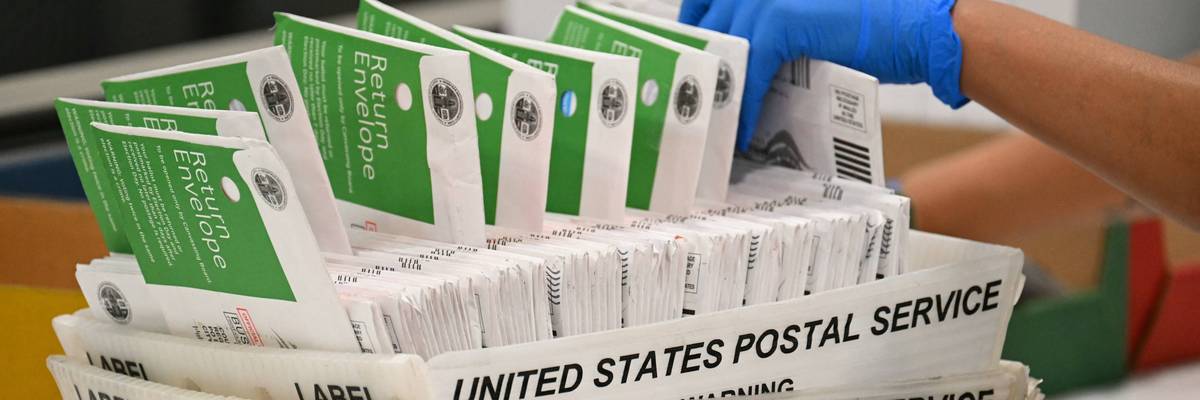
An election worker processes mail-in ballots at the Los Angeles County Ballot Processing Center during California's state primary election in the City of Industry, California, on June 2, 2026.
"This executive order was a blatant power grab designed to silence voters and undermine our elections, but it failed because the people and the law were on our side."
The US Supreme Court on Monday night rejected a bid by the Trump administration to keep onerous US Postal Service rules for mail-in ballots in place, which defenders of voting rights said risked depriving millions of people of the franchise in this year's midterm elections.
After a back-and-forth legal battle over the USPS rules that dragged on for months, the nation's highest court issued the 7-2 ruling without elaborating on its legal reasoning, though right-wing Justices Samuel Alito and Clarence Thomas issued dissents in favor of President Donald Trump's side.
The ruling in USPS v. California was in response to a legal challenge brought by the League of Women's Voters, the attorneys general of numerous states, and others who argued that newly-announced rules by the Postal Service regarding mail-in ballots, changes prompted by an executive order issued by Trump, would prevent people from having their ballots counted and cause chaos for those trying to administer this year's elections.
In response to the ruling, the plaintiffs' legal team said the decision was "a critical step to ensuring free and fair elections this November by maintaining access to mail voting for millions of eligible voters across the United States and lifting the dire threat that the Postal Service would disenfranchise them."
"Mail voting is safe, secure, and reliable—and the Trump administration has presented no evidence to the contrary, as the courts have repeatedly recognized," the statement continued. "We will remain vigilant in countering threats to free and fair elections and ensuring that every eligible voter is able to cast a ballot and have it count.”
“Today’s decision is a victory for our democracy and a powerful affirmation of the rule of law,” said California Attorney General Rob Bonta in a statement. “The stakes in this litigation could not have been higher.”
Virginia Kase Solomón, president and CEO of Common Cause, was among the other pro-democracy advocates who welcomed the decision.
“Today’s decision is a major win for the millions of everyday Americans who count on vote-by-mail—our seniors, service members, busy parents, rural voters, and voters with disabilities," said Solomón in a statement. "Vote-by-mail is safe, proven, and vital; even the president uses it. This executive order was a blatant power grab designed to silence voters and undermine our elections, but it failed because the people and the law were on our side. Our Constitution is clear: states run our elections, and voters choose their leaders—not the other way around. No administration can strip the people of their power.”
Michael McNulty, senior policy director for Issue One, a nonpartisan group that works to defend free and fair elections, also welcomed the ruling, but said vigilance would still be necessary going forward.
“The fight to preserve states’ authority to administer elections is far from over," warned McNulty.
"President Trump continuously and falsely claims fraud in mail-in voting without evidence," he added. "Despite voting multiple times with this method, he remains obsessed with centralizing control over elections to tilt the playing field. However, for now, one piece of that centralization effort is blocked, and it ensures that mail-in voting for the midterms won't be disrupted.”
Dear Common Dreams reader, It’s been nearly 30 years since I co-founded Common Dreams with my late wife, Lina Newhouser. We had the radical notion that journalism should serve the public good, not corporate profits. It was clear to us from the outset what it would take to build such a project. No paid advertisements. No corporate sponsors. No millionaire publisher telling us what to think or do. Many people said we wouldn't last a year, but we proved those doubters wrong. Together with a tremendous team of journalists and dedicated staff, we built an independent media outlet free from the constraints of profits and corporate control. Our mission has always been simple: To inform. To inspire. To ignite change for the common good. Building Common Dreams was not easy. Our survival was never guaranteed. When you take on the most powerful forces—Wall Street greed, fossil fuel industry destruction, Big Tech lobbyists, and uber-rich oligarchs who have spent billions upon billions rigging the economy and democracy in their favor—the only bulwark you have is supporters who believe in your work. But here’s the urgent message from me today. It's never been this bad out there. And it's never been this hard to keep us going. At the very moment Common Dreams is most needed, the threats we face are intensifying. We need your support now more than ever. We don't accept corporate advertising and never will. We don't have a paywall because we don't think people should be blocked from critical news based on their ability to pay. Everything we do is funded by the donations of readers like you. When everyone does the little they can afford, we are strong. But if that support retreats or dries up, so do we. Will you donate now to make sure Common Dreams not only survives but thrives? —Craig Brown, Co-founder |
The US Supreme Court on Monday night rejected a bid by the Trump administration to keep onerous US Postal Service rules for mail-in ballots in place, which defenders of voting rights said risked depriving millions of people of the franchise in this year's midterm elections.
After a back-and-forth legal battle over the USPS rules that dragged on for months, the nation's highest court issued the 7-2 ruling without elaborating on its legal reasoning, though right-wing Justices Samuel Alito and Clarence Thomas issued dissents in favor of President Donald Trump's side.
The ruling in USPS v. California was in response to a legal challenge brought by the League of Women's Voters, the attorneys general of numerous states, and others who argued that newly-announced rules by the Postal Service regarding mail-in ballots, changes prompted by an executive order issued by Trump, would prevent people from having their ballots counted and cause chaos for those trying to administer this year's elections.
In response to the ruling, the plaintiffs' legal team said the decision was "a critical step to ensuring free and fair elections this November by maintaining access to mail voting for millions of eligible voters across the United States and lifting the dire threat that the Postal Service would disenfranchise them."
"Mail voting is safe, secure, and reliable—and the Trump administration has presented no evidence to the contrary, as the courts have repeatedly recognized," the statement continued. "We will remain vigilant in countering threats to free and fair elections and ensuring that every eligible voter is able to cast a ballot and have it count.”
“Today’s decision is a victory for our democracy and a powerful affirmation of the rule of law,” said California Attorney General Rob Bonta in a statement. “The stakes in this litigation could not have been higher.”
Virginia Kase Solomón, president and CEO of Common Cause, was among the other pro-democracy advocates who welcomed the decision.
“Today’s decision is a major win for the millions of everyday Americans who count on vote-by-mail—our seniors, service members, busy parents, rural voters, and voters with disabilities," said Solomón in a statement. "Vote-by-mail is safe, proven, and vital; even the president uses it. This executive order was a blatant power grab designed to silence voters and undermine our elections, but it failed because the people and the law were on our side. Our Constitution is clear: states run our elections, and voters choose their leaders—not the other way around. No administration can strip the people of their power.”
Michael McNulty, senior policy director for Issue One, a nonpartisan group that works to defend free and fair elections, also welcomed the ruling, but said vigilance would still be necessary going forward.
“The fight to preserve states’ authority to administer elections is far from over," warned McNulty.
"President Trump continuously and falsely claims fraud in mail-in voting without evidence," he added. "Despite voting multiple times with this method, he remains obsessed with centralizing control over elections to tilt the playing field. However, for now, one piece of that centralization effort is blocked, and it ensures that mail-in voting for the midterms won't be disrupted.”
The US Supreme Court on Monday night rejected a bid by the Trump administration to keep onerous US Postal Service rules for mail-in ballots in place, which defenders of voting rights said risked depriving millions of people of the franchise in this year's midterm elections.
After a back-and-forth legal battle over the USPS rules that dragged on for months, the nation's highest court issued the 7-2 ruling without elaborating on its legal reasoning, though right-wing Justices Samuel Alito and Clarence Thomas issued dissents in favor of President Donald Trump's side.
The ruling in USPS v. California was in response to a legal challenge brought by the League of Women's Voters, the attorneys general of numerous states, and others who argued that newly-announced rules by the Postal Service regarding mail-in ballots, changes prompted by an executive order issued by Trump, would prevent people from having their ballots counted and cause chaos for those trying to administer this year's elections.
In response to the ruling, the plaintiffs' legal team said the decision was "a critical step to ensuring free and fair elections this November by maintaining access to mail voting for millions of eligible voters across the United States and lifting the dire threat that the Postal Service would disenfranchise them."
"Mail voting is safe, secure, and reliable—and the Trump administration has presented no evidence to the contrary, as the courts have repeatedly recognized," the statement continued. "We will remain vigilant in countering threats to free and fair elections and ensuring that every eligible voter is able to cast a ballot and have it count.”
“Today’s decision is a victory for our democracy and a powerful affirmation of the rule of law,” said California Attorney General Rob Bonta in a statement. “The stakes in this litigation could not have been higher.”
Virginia Kase Solomón, president and CEO of Common Cause, was among the other pro-democracy advocates who welcomed the decision.
“Today’s decision is a major win for the millions of everyday Americans who count on vote-by-mail—our seniors, service members, busy parents, rural voters, and voters with disabilities," said Solomón in a statement. "Vote-by-mail is safe, proven, and vital; even the president uses it. This executive order was a blatant power grab designed to silence voters and undermine our elections, but it failed because the people and the law were on our side. Our Constitution is clear: states run our elections, and voters choose their leaders—not the other way around. No administration can strip the people of their power.”
Michael McNulty, senior policy director for Issue One, a nonpartisan group that works to defend free and fair elections, also welcomed the ruling, but said vigilance would still be necessary going forward.
“The fight to preserve states’ authority to administer elections is far from over," warned McNulty.
"President Trump continuously and falsely claims fraud in mail-in voting without evidence," he added. "Despite voting multiple times with this method, he remains obsessed with centralizing control over elections to tilt the playing field. However, for now, one piece of that centralization effort is blocked, and it ensures that mail-in voting for the midterms won't be disrupted.”