SUBSCRIBE TO OUR FREE NEWSLETTER
Daily news & progressive opinion—funded by the people, not the corporations—delivered straight to your inbox.
5
#000000
#FFFFFF
To donate by check, phone, or other method, see our More Ways to Give page.
Daily news & progressive opinion—funded by the people, not the corporations—delivered straight to your inbox.
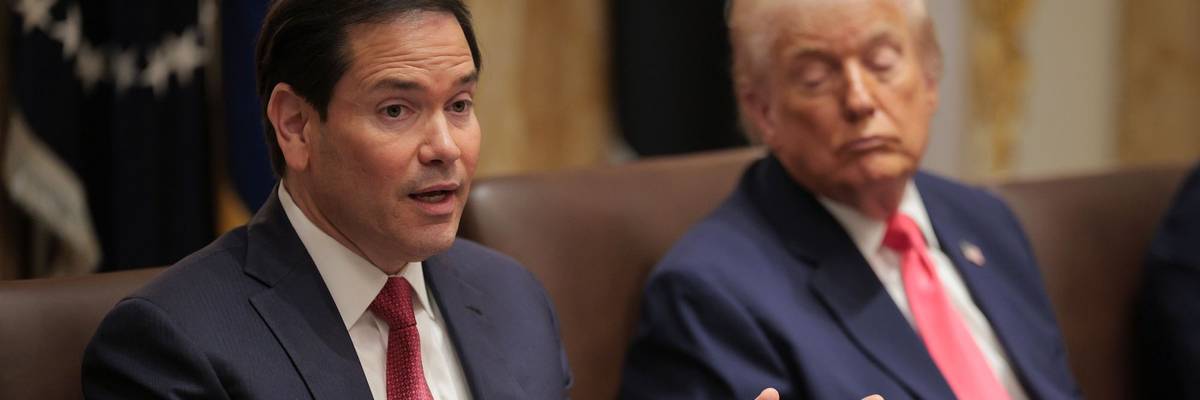
US Secretary of State Marco Rubio speaks while President Donald Trump looks on during a December 2, 2025 Cabinet meeting in the White House in Washington, DC.
"When judicial actors are threatened for applying the law, it is the international legal order itself that is placed at risk," the court said.
The International Criminal Court and human rights groups on Thursday condemned new US sanctions on two more of the tribunal's judges, which brought the total number of sanctioned ICC jurists to 11 amid the Trump administration's escalating campaign of retaliation against people and institutions seeking to hold Israel and the United States accountable for their alleged crimes.
"Today, I am designating two International Criminal Court (ICC) judges, Gocha Lordkipanidze of Georgia and Erdenebalsuren Damdin of Mongolia, pursuant to Executive Order 14203, 'Imposing Sanctions on the International Criminal Court,'" US Secretary of State Marco Rubio said in a statement, referring to President Donald Trump's February edict.
"These individuals have directly engaged in efforts by the ICC to investigate, arrest, detain, or prosecute Israeli nationals, without Israel’s consent, including voting with the majority in favor of the ICC’s ruling against Israel’s appeal on December 15," Rubio added, referencing Monday's rejection of an Israeli bid to block a probe into alleged war crimes committed during the genocidal two-year war on Gaza.
Although Israel and the US are not ICC members and do not recognize the Hague-based tribunal's jurisdiction, Palestine is a state party to the Rome Statute governing the court. The treaty says that individuals from nonsignatory nations can be held liable for crimes committed in the territory of a member state.
Last year, the ICC issued warrants for the arrest of Israeli Prime Minister Benjamin Netanyahu and former Israeli Defense Minister Yoav Gallant for alleged crimes against humanity and war crimes in Gaza, including murder and forced starvation in a war that has left more than 250,000 Palestinians dead, wounded, or missing.
The Trump administration had previously sanctioned nine other ICC jurists: Chief Prosecutor Karim Khan (United Kingdom), Deputy Prosecutor Nazhat Shameem Khan (Fiji), Deputy Prosecutor Mame Mandiaye Niang (Senegal), Judge Solomy Balungi Bossa (Uganda), Judge Luz del Carmen Ibáñez Carranza (Peru), Judge Reine Adelaide Sophie Alapini-Gansou (Benin), Judge Beti Hohler (Slovenia), Judge Nicolas Yann Guillou (France), and Judge Kimberly Prost (Canada).
The affected judges have recently described how the US sanctions have left them and their families—who are also blacklisted—"wiped out economically and socially."
Responding to the new US punitive measures, the ICC said Thursday that "these sanctions are a flagrant attack against the independence of an impartial judicial institution which operates pursuant to the mandate conferred by its states parties from across regions."
"Such measures targeting judges and prosecutors who were elected by the states parties undermine the rule of law," the court continued. "When judicial actors are threatened for applying the law, it is the international legal order itself that is placed at risk."
"As previously stated, the court stands firmly behind its personnel and behind victims of unimaginable atrocities," the ICC added. "It will continue to carry out its mandate with independence and impartiality, in full accordance with the Rome Statute and in the interest of victims of international crimes."
Human Rights Watch also slammed the new US sanctions, which the group called "the latest attempt by the Trump administration to blatantly interfere with independent justice."
The US government has imposed sanctions on two additional ICC judges in order to shield Israeli officials from charges of grave international crimes.These sanctions are the latest attempt by the Trump administration to blatantly interfere with independent justice.
[image or embed]
— Human Rights Watch (@hrw.org) December 18, 2025 at 12:01 PM
Amnesty International's Center for International Justice lamented that "once again, the US administration is attacking international justice—sanctioning two ICC judges. This cannot be normalized."
"States must firmly oppose US threats and sanctions and uphold the court’s ability to pursue accountability," the group added, "even against the most powerful perpetrators."Dear Common Dreams reader, It’s been nearly 30 years since I co-founded Common Dreams with my late wife, Lina Newhouser. We had the radical notion that journalism should serve the public good, not corporate profits. It was clear to us from the outset what it would take to build such a project. No paid advertisements. No corporate sponsors. No millionaire publisher telling us what to think or do. Many people said we wouldn't last a year, but we proved those doubters wrong. Together with a tremendous team of journalists and dedicated staff, we built an independent media outlet free from the constraints of profits and corporate control. Our mission has always been simple: To inform. To inspire. To ignite change for the common good. Building Common Dreams was not easy. Our survival was never guaranteed. When you take on the most powerful forces—Wall Street greed, fossil fuel industry destruction, Big Tech lobbyists, and uber-rich oligarchs who have spent billions upon billions rigging the economy and democracy in their favor—the only bulwark you have is supporters who believe in your work. But here’s the urgent message from me today. It's never been this bad out there. And it's never been this hard to keep us going. At the very moment Common Dreams is most needed, the threats we face are intensifying. We need your support now more than ever. We don't accept corporate advertising and never will. We don't have a paywall because we don't think people should be blocked from critical news based on their ability to pay. Everything we do is funded by the donations of readers like you. When everyone does the little they can afford, we are strong. But if that support retreats or dries up, so do we. Will you donate now to make sure Common Dreams not only survives but thrives? —Craig Brown, Co-founder |
The International Criminal Court and human rights groups on Thursday condemned new US sanctions on two more of the tribunal's judges, which brought the total number of sanctioned ICC jurists to 11 amid the Trump administration's escalating campaign of retaliation against people and institutions seeking to hold Israel and the United States accountable for their alleged crimes.
"Today, I am designating two International Criminal Court (ICC) judges, Gocha Lordkipanidze of Georgia and Erdenebalsuren Damdin of Mongolia, pursuant to Executive Order 14203, 'Imposing Sanctions on the International Criminal Court,'" US Secretary of State Marco Rubio said in a statement, referring to President Donald Trump's February edict.
"These individuals have directly engaged in efforts by the ICC to investigate, arrest, detain, or prosecute Israeli nationals, without Israel’s consent, including voting with the majority in favor of the ICC’s ruling against Israel’s appeal on December 15," Rubio added, referencing Monday's rejection of an Israeli bid to block a probe into alleged war crimes committed during the genocidal two-year war on Gaza.
Although Israel and the US are not ICC members and do not recognize the Hague-based tribunal's jurisdiction, Palestine is a state party to the Rome Statute governing the court. The treaty says that individuals from nonsignatory nations can be held liable for crimes committed in the territory of a member state.
Last year, the ICC issued warrants for the arrest of Israeli Prime Minister Benjamin Netanyahu and former Israeli Defense Minister Yoav Gallant for alleged crimes against humanity and war crimes in Gaza, including murder and forced starvation in a war that has left more than 250,000 Palestinians dead, wounded, or missing.
The Trump administration had previously sanctioned nine other ICC jurists: Chief Prosecutor Karim Khan (United Kingdom), Deputy Prosecutor Nazhat Shameem Khan (Fiji), Deputy Prosecutor Mame Mandiaye Niang (Senegal), Judge Solomy Balungi Bossa (Uganda), Judge Luz del Carmen Ibáñez Carranza (Peru), Judge Reine Adelaide Sophie Alapini-Gansou (Benin), Judge Beti Hohler (Slovenia), Judge Nicolas Yann Guillou (France), and Judge Kimberly Prost (Canada).
The affected judges have recently described how the US sanctions have left them and their families—who are also blacklisted—"wiped out economically and socially."
Responding to the new US punitive measures, the ICC said Thursday that "these sanctions are a flagrant attack against the independence of an impartial judicial institution which operates pursuant to the mandate conferred by its states parties from across regions."
"Such measures targeting judges and prosecutors who were elected by the states parties undermine the rule of law," the court continued. "When judicial actors are threatened for applying the law, it is the international legal order itself that is placed at risk."
"As previously stated, the court stands firmly behind its personnel and behind victims of unimaginable atrocities," the ICC added. "It will continue to carry out its mandate with independence and impartiality, in full accordance with the Rome Statute and in the interest of victims of international crimes."
Human Rights Watch also slammed the new US sanctions, which the group called "the latest attempt by the Trump administration to blatantly interfere with independent justice."
The US government has imposed sanctions on two additional ICC judges in order to shield Israeli officials from charges of grave international crimes.These sanctions are the latest attempt by the Trump administration to blatantly interfere with independent justice.
[image or embed]
— Human Rights Watch (@hrw.org) December 18, 2025 at 12:01 PM
Amnesty International's Center for International Justice lamented that "once again, the US administration is attacking international justice—sanctioning two ICC judges. This cannot be normalized."
"States must firmly oppose US threats and sanctions and uphold the court’s ability to pursue accountability," the group added, "even against the most powerful perpetrators."The International Criminal Court and human rights groups on Thursday condemned new US sanctions on two more of the tribunal's judges, which brought the total number of sanctioned ICC jurists to 11 amid the Trump administration's escalating campaign of retaliation against people and institutions seeking to hold Israel and the United States accountable for their alleged crimes.
"Today, I am designating two International Criminal Court (ICC) judges, Gocha Lordkipanidze of Georgia and Erdenebalsuren Damdin of Mongolia, pursuant to Executive Order 14203, 'Imposing Sanctions on the International Criminal Court,'" US Secretary of State Marco Rubio said in a statement, referring to President Donald Trump's February edict.
"These individuals have directly engaged in efforts by the ICC to investigate, arrest, detain, or prosecute Israeli nationals, without Israel’s consent, including voting with the majority in favor of the ICC’s ruling against Israel’s appeal on December 15," Rubio added, referencing Monday's rejection of an Israeli bid to block a probe into alleged war crimes committed during the genocidal two-year war on Gaza.
Although Israel and the US are not ICC members and do not recognize the Hague-based tribunal's jurisdiction, Palestine is a state party to the Rome Statute governing the court. The treaty says that individuals from nonsignatory nations can be held liable for crimes committed in the territory of a member state.
Last year, the ICC issued warrants for the arrest of Israeli Prime Minister Benjamin Netanyahu and former Israeli Defense Minister Yoav Gallant for alleged crimes against humanity and war crimes in Gaza, including murder and forced starvation in a war that has left more than 250,000 Palestinians dead, wounded, or missing.
The Trump administration had previously sanctioned nine other ICC jurists: Chief Prosecutor Karim Khan (United Kingdom), Deputy Prosecutor Nazhat Shameem Khan (Fiji), Deputy Prosecutor Mame Mandiaye Niang (Senegal), Judge Solomy Balungi Bossa (Uganda), Judge Luz del Carmen Ibáñez Carranza (Peru), Judge Reine Adelaide Sophie Alapini-Gansou (Benin), Judge Beti Hohler (Slovenia), Judge Nicolas Yann Guillou (France), and Judge Kimberly Prost (Canada).
The affected judges have recently described how the US sanctions have left them and their families—who are also blacklisted—"wiped out economically and socially."
Responding to the new US punitive measures, the ICC said Thursday that "these sanctions are a flagrant attack against the independence of an impartial judicial institution which operates pursuant to the mandate conferred by its states parties from across regions."
"Such measures targeting judges and prosecutors who were elected by the states parties undermine the rule of law," the court continued. "When judicial actors are threatened for applying the law, it is the international legal order itself that is placed at risk."
"As previously stated, the court stands firmly behind its personnel and behind victims of unimaginable atrocities," the ICC added. "It will continue to carry out its mandate with independence and impartiality, in full accordance with the Rome Statute and in the interest of victims of international crimes."
Human Rights Watch also slammed the new US sanctions, which the group called "the latest attempt by the Trump administration to blatantly interfere with independent justice."
The US government has imposed sanctions on two additional ICC judges in order to shield Israeli officials from charges of grave international crimes.These sanctions are the latest attempt by the Trump administration to blatantly interfere with independent justice.
[image or embed]
— Human Rights Watch (@hrw.org) December 18, 2025 at 12:01 PM
Amnesty International's Center for International Justice lamented that "once again, the US administration is attacking international justice—sanctioning two ICC judges. This cannot be normalized."
"States must firmly oppose US threats and sanctions and uphold the court’s ability to pursue accountability," the group added, "even against the most powerful perpetrators."