
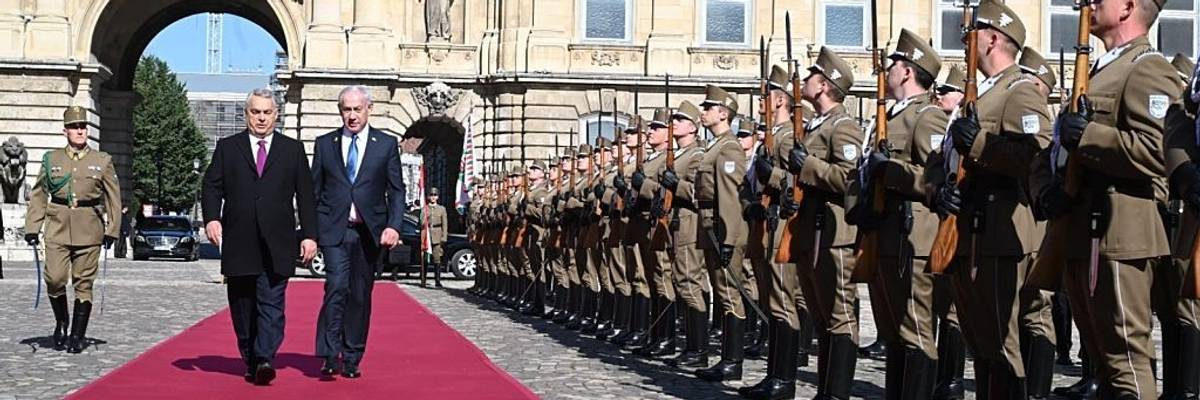
Hungarian Prime Minister Viktor Orbán (left) and Israeli Prime Minister Benjamin Netanyahu (right) walk down a red carpet as Hungarian soldiers stand at attention in Budapest, Hungary on April 3, 2025.
ICC Demands Hungary Explain Why Netanyahu Wasn't Arrested During Visit
The head of Amnesty International in Europe said the court has done "what the E.U. should have: taken legal measures against Hungary for its failure to arrest a fugitive wanted for war crimes."
The International Criminal Court on Wednesday initiated proceedings against Hungary for failing to enforce the tribunal's arrest warrant for Israeli Prime Minister Benjamin Netanyahu during his recent visit to the Central European nation.
The ICC is asking Hungary's far-right government to explain why it did not comply with its warrant for Netanyahu for alleged war crimes and crimes against humanity in Gaza. Such compliance is required under the Rome Statute, the treaty governing the ICC to which Hungary is signatory.
The tribunal's request cites Article 87 of the Rome Statute, which authorizes legal action against state parties who don't cooperate with the court, and gives Hungary until May 23 to respond.
Hungarian Prime Minister Viktor Orbán said shortly before Netanyahu's visit that Hungary would quit the ICC. Not only did Hungary reject the arrest warrant, Orbán literally rolled out the red carpet to welcome his far-right counterpart in Budapest earlier this month, prompting rebuke from the ICC and human rights groups.
In May 2021, ICC Prosecutor Karim Khan applied for warrants to apprehend Netanyahu and former Israeli Defense Minister Yoav Gallant for "crimes of causing extermination, causing starvation as a method of war, including the denial of humanitarian relief supplies, [and] deliberately targeting civilians in conflict."
Khan also sought warrants to arrest three Hamas leaders who have since been killed by Israel for alleged crimes committed during and after the October 7, 2023 attack, including "extermination, murder, taking of hostages, rape, and sexual assault in detention."
The full 18-judge ICC approved the warrants in November, prompting Republicans and dozens of Democrats in the U.S. House of Representatives to pass legislation to sanction tribunal officials. Democrats subsequently blocked the measure in the Senate. Shortly after taking office, President Donald Trump issued an executive order imposing sanctions on the ICC, prompting an ACLU-led lawsuit.
Israel and allies including the United States have either openly flouted the ICC warrant or offered dubious legal reasons for sidestepping the arrest order.
Italy and France, for example, have granted Netanyahu immunity on the grounds that he is the head of state of a country that is not an ICC member.
Trump welcomed Netanyahu to the White House a month before the Budapest trip, though the U.S. is not a party to the Rome Statute.
Although Israel is not signatory to the Rome Statute, officials from non-state parties are still subject to ICC prosecution if they commit crimes inside nations that have ratified the treaty. Palestine became an ICC member in 2015.
Just two years ago France backed the ICC arrest warrant for Russian President Vladimir Putin on Ukraine war crimes charges—even though Moscow has not signed the Rome Statute—arguing that "no one responsible for crimes committed by Russia in Ukraine, regardless of their status, should escape justice."
Last year, an ICC panel referred Mongolia to the court's oversight body after it failed to arrest Putin, who was warmly welcomed by Mongolian President Ukhnaagiin Khürelsükh and other officials in Ulaanbaatar.
Luis Moreno Ocampo, who served as the ICC's first prosecutor,
told the Emirati newspaper The National on Wednesday that Netanyahu remains free thanks to the political influence of countries including the U.S. However, Ocampo said that "this protection is temporary" and accused Netanyahu of prolonging the Gaza war to delay his own domestic criminal corruption trial.
We are at a crossroads
This country and this world are at a monumental crossroads. In a few short weeks, US voters will have an opportunity to beat back the forces of fascism and confront the billionaires who are rigging the economy, our media system, and our democracy, making it increasingly impossible for ordinary people to get by. We’re not just talking about the election. We’re talking about what must be done once these fascist elements are vanquished from power. We need a bolder set of solutions than what either major party has so far been willing to offer and a working-class movement ready to fight like hell for it. Trump didn't emerge from nowhere. The conditions that fueled MAGA authoritarianism were created by decades of radical neoliberal economic policies and a corrupt political system dominated by corporate interests. They slashed taxes on the super-rich, promising that the benefits would trickle down. They said giveaways to the corporate titans would make life more affordable for the rest of us. It was all bullshit. And when a bitter, betrayed populace searches for someone to blame, right-wing demagogues have little trouble finding scapegoats. People know when they're being lied to, but you won't hear any of this from the corporate media. Only independent journalism—powered and funded by people who believe in building a better world—can deliver truly trustworthy daily news. Our Fall Campaign is underway, and we need your help. To power our newsroom through the rest of the year, we need to raise $125,000 by midnight on October 31. So if you share our vision, please contribute whatever you can to sustain our work. |
The International Criminal Court on Wednesday initiated proceedings against Hungary for failing to enforce the tribunal's arrest warrant for Israeli Prime Minister Benjamin Netanyahu during his recent visit to the Central European nation.
The ICC is asking Hungary's far-right government to explain why it did not comply with its warrant for Netanyahu for alleged war crimes and crimes against humanity in Gaza. Such compliance is required under the Rome Statute, the treaty governing the ICC to which Hungary is signatory.
The tribunal's request cites Article 87 of the Rome Statute, which authorizes legal action against state parties who don't cooperate with the court, and gives Hungary until May 23 to respond.
Hungarian Prime Minister Viktor Orbán said shortly before Netanyahu's visit that Hungary would quit the ICC. Not only did Hungary reject the arrest warrant, Orbán literally rolled out the red carpet to welcome his far-right counterpart in Budapest earlier this month, prompting rebuke from the ICC and human rights groups.
In May 2021, ICC Prosecutor Karim Khan applied for warrants to apprehend Netanyahu and former Israeli Defense Minister Yoav Gallant for "crimes of causing extermination, causing starvation as a method of war, including the denial of humanitarian relief supplies, [and] deliberately targeting civilians in conflict."
Khan also sought warrants to arrest three Hamas leaders who have since been killed by Israel for alleged crimes committed during and after the October 7, 2023 attack, including "extermination, murder, taking of hostages, rape, and sexual assault in detention."
The full 18-judge ICC approved the warrants in November, prompting Republicans and dozens of Democrats in the U.S. House of Representatives to pass legislation to sanction tribunal officials. Democrats subsequently blocked the measure in the Senate. Shortly after taking office, President Donald Trump issued an executive order imposing sanctions on the ICC, prompting an ACLU-led lawsuit.
Israel and allies including the United States have either openly flouted the ICC warrant or offered dubious legal reasons for sidestepping the arrest order.
Italy and France, for example, have granted Netanyahu immunity on the grounds that he is the head of state of a country that is not an ICC member.
Trump welcomed Netanyahu to the White House a month before the Budapest trip, though the U.S. is not a party to the Rome Statute.
Although Israel is not signatory to the Rome Statute, officials from non-state parties are still subject to ICC prosecution if they commit crimes inside nations that have ratified the treaty. Palestine became an ICC member in 2015.
Just two years ago France backed the ICC arrest warrant for Russian President Vladimir Putin on Ukraine war crimes charges—even though Moscow has not signed the Rome Statute—arguing that "no one responsible for crimes committed by Russia in Ukraine, regardless of their status, should escape justice."
Last year, an ICC panel referred Mongolia to the court's oversight body after it failed to arrest Putin, who was warmly welcomed by Mongolian President Ukhnaagiin Khürelsükh and other officials in Ulaanbaatar.
Luis Moreno Ocampo, who served as the ICC's first prosecutor,
told the Emirati newspaper The National on Wednesday that Netanyahu remains free thanks to the political influence of countries including the U.S. However, Ocampo said that "this protection is temporary" and accused Netanyahu of prolonging the Gaza war to delay his own domestic criminal corruption trial.
The International Criminal Court on Wednesday initiated proceedings against Hungary for failing to enforce the tribunal's arrest warrant for Israeli Prime Minister Benjamin Netanyahu during his recent visit to the Central European nation.
The ICC is asking Hungary's far-right government to explain why it did not comply with its warrant for Netanyahu for alleged war crimes and crimes against humanity in Gaza. Such compliance is required under the Rome Statute, the treaty governing the ICC to which Hungary is signatory.
The tribunal's request cites Article 87 of the Rome Statute, which authorizes legal action against state parties who don't cooperate with the court, and gives Hungary until May 23 to respond.
Hungarian Prime Minister Viktor Orbán said shortly before Netanyahu's visit that Hungary would quit the ICC. Not only did Hungary reject the arrest warrant, Orbán literally rolled out the red carpet to welcome his far-right counterpart in Budapest earlier this month, prompting rebuke from the ICC and human rights groups.
In May 2021, ICC Prosecutor Karim Khan applied for warrants to apprehend Netanyahu and former Israeli Defense Minister Yoav Gallant for "crimes of causing extermination, causing starvation as a method of war, including the denial of humanitarian relief supplies, [and] deliberately targeting civilians in conflict."
Khan also sought warrants to arrest three Hamas leaders who have since been killed by Israel for alleged crimes committed during and after the October 7, 2023 attack, including "extermination, murder, taking of hostages, rape, and sexual assault in detention."
The full 18-judge ICC approved the warrants in November, prompting Republicans and dozens of Democrats in the U.S. House of Representatives to pass legislation to sanction tribunal officials. Democrats subsequently blocked the measure in the Senate. Shortly after taking office, President Donald Trump issued an executive order imposing sanctions on the ICC, prompting an ACLU-led lawsuit.
Israel and allies including the United States have either openly flouted the ICC warrant or offered dubious legal reasons for sidestepping the arrest order.
Italy and France, for example, have granted Netanyahu immunity on the grounds that he is the head of state of a country that is not an ICC member.
Trump welcomed Netanyahu to the White House a month before the Budapest trip, though the U.S. is not a party to the Rome Statute.
Although Israel is not signatory to the Rome Statute, officials from non-state parties are still subject to ICC prosecution if they commit crimes inside nations that have ratified the treaty. Palestine became an ICC member in 2015.
Just two years ago France backed the ICC arrest warrant for Russian President Vladimir Putin on Ukraine war crimes charges—even though Moscow has not signed the Rome Statute—arguing that "no one responsible for crimes committed by Russia in Ukraine, regardless of their status, should escape justice."
Last year, an ICC panel referred Mongolia to the court's oversight body after it failed to arrest Putin, who was warmly welcomed by Mongolian President Ukhnaagiin Khürelsükh and other officials in Ulaanbaatar.
Luis Moreno Ocampo, who served as the ICC's first prosecutor,
told the Emirati newspaper The National on Wednesday that Netanyahu remains free thanks to the political influence of countries including the U.S. However, Ocampo said that "this protection is temporary" and accused Netanyahu of prolonging the Gaza war to delay his own domestic criminal corruption trial.