SUBSCRIBE TO OUR FREE NEWSLETTER
Daily news & progressive opinion—funded by the people, not the corporations—delivered straight to your inbox.
5
#000000
#FFFFFF
To donate by check, phone, or other method, see our More Ways to Give page.
Daily news & progressive opinion—funded by the people, not the corporations—delivered straight to your inbox.
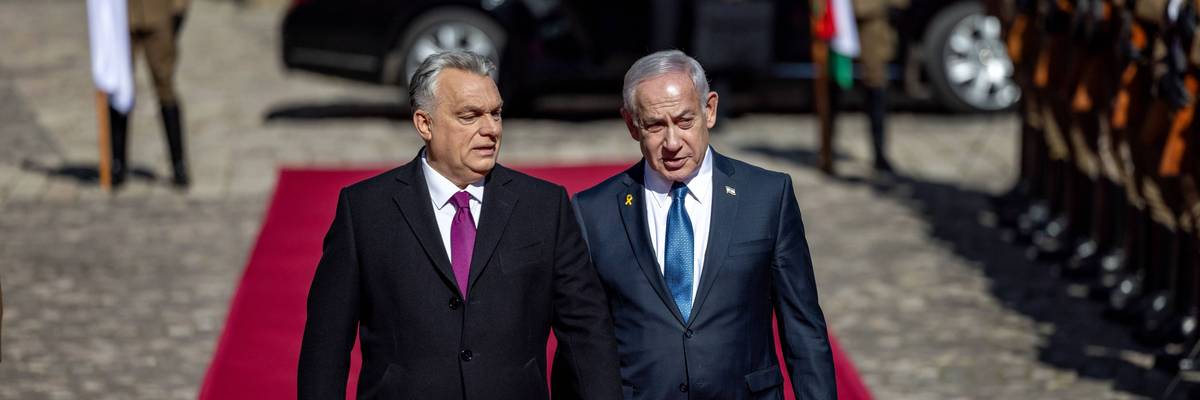
Hungarian Prime Minister Viktor Orbán welcomes Israeli Prime Minister Benjamin Netanyahu to Budapest, Hungary on April 3, 2025.
"Despite its move to leave the ICC, Hungary is still a member country and is still obligated to arrest and surrender individuals wanted by the court," one campaigner stressed.
Hungarian Prime Minister Viktor Orbán announced plans to ditch the International Criminal Court nearly a year ago, during a visit from Israeli Prime Minister Benjamin Netanyahu, the subject of an ICC arrest warrant. With Netanyahu set to return to Hungary on Saturday, and the country's exit from the tribunal not final for a few more months, Orbán faces fresh pressure to arrest Netanyahu.
"Despite its move to leave the ICC, Hungary is still a member country and is still obligated to arrest and surrender individuals wanted by the court," Alice Autin, international justice researcher at Human Rights Watch (HRW), said in a Friday statement.
"By flouting this obligation, for the second time in less than a year," Autin argued, "Hungary would further entrench impunity for serious crimes in Palestine and once again betray victims who have been denied justice for far too long."
HRW: Hungarian authorities should arrest Israeli Prime Minister Benjamin Netanyahu if he enters Hungarian territory. He is expected to travel to Hungary on March 21 to speak at the Conservative Political Action Conference, shortly before national electionswww.hrw.org/news/2026/03...
[image or embed]
— Bassam Khawaja (@khawaja.bsky.social) March 20, 2026 at 7:33 AM
In November 2024, the ICC issued warrants for Netanyahu and former Israeli Defense Minister Yoav Gallant for crimes against humanity and war crimes in the Gaza Strip since the Hamas-led October 2023 attack on Israel. Despite a ceasefire deal reached over five months ago, the Israeli assault on the Palestinian territory continues. There are at least 72,253 Palestinians confirmed dead, and 171,912 more have been injured, though global experts warn the true death toll is likely far higher.
After Netanyahu visited Hungary last April without being arrested, the Hungarian government formally notified United Nations Secretary-General António Guterres that it would withdraw from the Hague-based court in exactly one year, on June 2, 2026.
Soon after that notification, ICC judges found that "Hungary failed to comply with its international obligations" under the Rome Statute, the treaty that established the tribunal, "by not executing the court's request to provisionally arrest Mr. Netanyahu while he was present on Hungarian territory," and referred the matter to the Assembly of States Parties.
Highlighting that the assembly, the court's oversight and legislative body, "noted the judicial finding but failed to take more decisive action" during its annual session in December, HRW called on ICC state parties to "strengthen their responses to noncooperation."
The group specifically pressured members of the European Union, which have declined to "take sufficient measures to prevent Hungary's undermining of the ICC and Orbán’s broader attack on the rule of law," beyond the European Parliament's 2018 decision to initiate a procedure under Article 7 of the EU treaty to assess the bloc member.
According to HRW:
The European Commission indicated in May 2025 that it was "in the process of analyzing Hungary's announced withdrawal from the ICC in the light of the EU's acquis," that is, the body of EU law which includes respect for human rights, democracy, and the rule of law. But there is no indication that the commission's assessment has progressed.
EU leadership and member states, along with other ICC member countries, should press Hungary to reverse its withdrawal from the court, publicly remind Hungary of its ongoing obligations as an ICC member, and urge Hungarian authorities to cooperate with the court by arresting Netanyahu. If the visit takes place, they should strongly condemn Hungary's continued failure to cooperate with the court and unambiguously reaffirm their own commitment to execute all pending ICC warrants, regardless of whom they target.
The European Commission and EU member states should also consider Hungary’s decision to leave the ICC as a further risk of serious breach of fundamental EU values, and consider including the withdrawal in the scope of the current procedure under Article 7. They should also assess what other measures and action should be taken. This could include initiating a procedure that could lead to a finding that Hungary has infringed EU law.
"Orbán's government is about to roll out the red carpet again for Netanyahu, when it is obligated to arrest him," said Autin. "Silence and persistent inaction from the EU risks sending a dangerous message of acquiescence as the Israeli government continues to be responsible for atrocities."
Netanyahu notably skipped the signing of the charter for US President Donald Trump's so-called "Board of Peace" for Gaza in Davos, Switzerland, in January, after the Swiss government affirmed its commitment to arresting him.
The Israeli prime minister is set to speak at the Conservative Political Action Conference (CPAC) Hungary on Saturday, though there is a chance he will not appear in person due to security concerns related to his and Trump's war on Iran, which they launched nearly three weeks ago.
Since the US-Israeli campaign began on February 28, Israel has also ramped up its bombing of alleged Hezbollah targets in Lebanon, despite a November 2024 ceasefire agreement, and again cut off the flow of humanitarian aid into Gaza.
There have also been rumors that Trump—who has previously sent exclusive video messages to CPAC Hungary—may make an appearance, despite the security concerns. The US president has responded to the arrest warrants for Netanyahu and Gallant by sanctioning ICC judges.
Dear Common Dreams reader, It’s been nearly 30 years since I co-founded Common Dreams with my late wife, Lina Newhouser. We had the radical notion that journalism should serve the public good, not corporate profits. It was clear to us from the outset what it would take to build such a project. No paid advertisements. No corporate sponsors. No millionaire publisher telling us what to think or do. Many people said we wouldn't last a year, but we proved those doubters wrong. Together with a tremendous team of journalists and dedicated staff, we built an independent media outlet free from the constraints of profits and corporate control. Our mission has always been simple: To inform. To inspire. To ignite change for the common good. Building Common Dreams was not easy. Our survival was never guaranteed. When you take on the most powerful forces—Wall Street greed, fossil fuel industry destruction, Big Tech lobbyists, and uber-rich oligarchs who have spent billions upon billions rigging the economy and democracy in their favor—the only bulwark you have is supporters who believe in your work. But here’s the urgent message from me today. It's never been this bad out there. And it's never been this hard to keep us going. At the very moment Common Dreams is most needed, the threats we face are intensifying. We need your support now more than ever. We don't accept corporate advertising and never will. We don't have a paywall because we don't think people should be blocked from critical news based on their ability to pay. Everything we do is funded by the donations of readers like you. When everyone does the little they can afford, we are strong. But if that support retreats or dries up, so do we. Will you donate now to make sure Common Dreams not only survives but thrives? —Craig Brown, Co-founder |
Hungarian Prime Minister Viktor Orbán announced plans to ditch the International Criminal Court nearly a year ago, during a visit from Israeli Prime Minister Benjamin Netanyahu, the subject of an ICC arrest warrant. With Netanyahu set to return to Hungary on Saturday, and the country's exit from the tribunal not final for a few more months, Orbán faces fresh pressure to arrest Netanyahu.
"Despite its move to leave the ICC, Hungary is still a member country and is still obligated to arrest and surrender individuals wanted by the court," Alice Autin, international justice researcher at Human Rights Watch (HRW), said in a Friday statement.
"By flouting this obligation, for the second time in less than a year," Autin argued, "Hungary would further entrench impunity for serious crimes in Palestine and once again betray victims who have been denied justice for far too long."
HRW: Hungarian authorities should arrest Israeli Prime Minister Benjamin Netanyahu if he enters Hungarian territory. He is expected to travel to Hungary on March 21 to speak at the Conservative Political Action Conference, shortly before national electionswww.hrw.org/news/2026/03...
[image or embed]
— Bassam Khawaja (@khawaja.bsky.social) March 20, 2026 at 7:33 AM
In November 2024, the ICC issued warrants for Netanyahu and former Israeli Defense Minister Yoav Gallant for crimes against humanity and war crimes in the Gaza Strip since the Hamas-led October 2023 attack on Israel. Despite a ceasefire deal reached over five months ago, the Israeli assault on the Palestinian territory continues. There are at least 72,253 Palestinians confirmed dead, and 171,912 more have been injured, though global experts warn the true death toll is likely far higher.
After Netanyahu visited Hungary last April without being arrested, the Hungarian government formally notified United Nations Secretary-General António Guterres that it would withdraw from the Hague-based court in exactly one year, on June 2, 2026.
Soon after that notification, ICC judges found that "Hungary failed to comply with its international obligations" under the Rome Statute, the treaty that established the tribunal, "by not executing the court's request to provisionally arrest Mr. Netanyahu while he was present on Hungarian territory," and referred the matter to the Assembly of States Parties.
Highlighting that the assembly, the court's oversight and legislative body, "noted the judicial finding but failed to take more decisive action" during its annual session in December, HRW called on ICC state parties to "strengthen their responses to noncooperation."
The group specifically pressured members of the European Union, which have declined to "take sufficient measures to prevent Hungary's undermining of the ICC and Orbán’s broader attack on the rule of law," beyond the European Parliament's 2018 decision to initiate a procedure under Article 7 of the EU treaty to assess the bloc member.
According to HRW:
The European Commission indicated in May 2025 that it was "in the process of analyzing Hungary's announced withdrawal from the ICC in the light of the EU's acquis," that is, the body of EU law which includes respect for human rights, democracy, and the rule of law. But there is no indication that the commission's assessment has progressed.
EU leadership and member states, along with other ICC member countries, should press Hungary to reverse its withdrawal from the court, publicly remind Hungary of its ongoing obligations as an ICC member, and urge Hungarian authorities to cooperate with the court by arresting Netanyahu. If the visit takes place, they should strongly condemn Hungary's continued failure to cooperate with the court and unambiguously reaffirm their own commitment to execute all pending ICC warrants, regardless of whom they target.
The European Commission and EU member states should also consider Hungary’s decision to leave the ICC as a further risk of serious breach of fundamental EU values, and consider including the withdrawal in the scope of the current procedure under Article 7. They should also assess what other measures and action should be taken. This could include initiating a procedure that could lead to a finding that Hungary has infringed EU law.
"Orbán's government is about to roll out the red carpet again for Netanyahu, when it is obligated to arrest him," said Autin. "Silence and persistent inaction from the EU risks sending a dangerous message of acquiescence as the Israeli government continues to be responsible for atrocities."
Netanyahu notably skipped the signing of the charter for US President Donald Trump's so-called "Board of Peace" for Gaza in Davos, Switzerland, in January, after the Swiss government affirmed its commitment to arresting him.
The Israeli prime minister is set to speak at the Conservative Political Action Conference (CPAC) Hungary on Saturday, though there is a chance he will not appear in person due to security concerns related to his and Trump's war on Iran, which they launched nearly three weeks ago.
Since the US-Israeli campaign began on February 28, Israel has also ramped up its bombing of alleged Hezbollah targets in Lebanon, despite a November 2024 ceasefire agreement, and again cut off the flow of humanitarian aid into Gaza.
There have also been rumors that Trump—who has previously sent exclusive video messages to CPAC Hungary—may make an appearance, despite the security concerns. The US president has responded to the arrest warrants for Netanyahu and Gallant by sanctioning ICC judges.
Hungarian Prime Minister Viktor Orbán announced plans to ditch the International Criminal Court nearly a year ago, during a visit from Israeli Prime Minister Benjamin Netanyahu, the subject of an ICC arrest warrant. With Netanyahu set to return to Hungary on Saturday, and the country's exit from the tribunal not final for a few more months, Orbán faces fresh pressure to arrest Netanyahu.
"Despite its move to leave the ICC, Hungary is still a member country and is still obligated to arrest and surrender individuals wanted by the court," Alice Autin, international justice researcher at Human Rights Watch (HRW), said in a Friday statement.
"By flouting this obligation, for the second time in less than a year," Autin argued, "Hungary would further entrench impunity for serious crimes in Palestine and once again betray victims who have been denied justice for far too long."
HRW: Hungarian authorities should arrest Israeli Prime Minister Benjamin Netanyahu if he enters Hungarian territory. He is expected to travel to Hungary on March 21 to speak at the Conservative Political Action Conference, shortly before national electionswww.hrw.org/news/2026/03...
[image or embed]
— Bassam Khawaja (@khawaja.bsky.social) March 20, 2026 at 7:33 AM
In November 2024, the ICC issued warrants for Netanyahu and former Israeli Defense Minister Yoav Gallant for crimes against humanity and war crimes in the Gaza Strip since the Hamas-led October 2023 attack on Israel. Despite a ceasefire deal reached over five months ago, the Israeli assault on the Palestinian territory continues. There are at least 72,253 Palestinians confirmed dead, and 171,912 more have been injured, though global experts warn the true death toll is likely far higher.
After Netanyahu visited Hungary last April without being arrested, the Hungarian government formally notified United Nations Secretary-General António Guterres that it would withdraw from the Hague-based court in exactly one year, on June 2, 2026.
Soon after that notification, ICC judges found that "Hungary failed to comply with its international obligations" under the Rome Statute, the treaty that established the tribunal, "by not executing the court's request to provisionally arrest Mr. Netanyahu while he was present on Hungarian territory," and referred the matter to the Assembly of States Parties.
Highlighting that the assembly, the court's oversight and legislative body, "noted the judicial finding but failed to take more decisive action" during its annual session in December, HRW called on ICC state parties to "strengthen their responses to noncooperation."
The group specifically pressured members of the European Union, which have declined to "take sufficient measures to prevent Hungary's undermining of the ICC and Orbán’s broader attack on the rule of law," beyond the European Parliament's 2018 decision to initiate a procedure under Article 7 of the EU treaty to assess the bloc member.
According to HRW:
The European Commission indicated in May 2025 that it was "in the process of analyzing Hungary's announced withdrawal from the ICC in the light of the EU's acquis," that is, the body of EU law which includes respect for human rights, democracy, and the rule of law. But there is no indication that the commission's assessment has progressed.
EU leadership and member states, along with other ICC member countries, should press Hungary to reverse its withdrawal from the court, publicly remind Hungary of its ongoing obligations as an ICC member, and urge Hungarian authorities to cooperate with the court by arresting Netanyahu. If the visit takes place, they should strongly condemn Hungary's continued failure to cooperate with the court and unambiguously reaffirm their own commitment to execute all pending ICC warrants, regardless of whom they target.
The European Commission and EU member states should also consider Hungary’s decision to leave the ICC as a further risk of serious breach of fundamental EU values, and consider including the withdrawal in the scope of the current procedure under Article 7. They should also assess what other measures and action should be taken. This could include initiating a procedure that could lead to a finding that Hungary has infringed EU law.
"Orbán's government is about to roll out the red carpet again for Netanyahu, when it is obligated to arrest him," said Autin. "Silence and persistent inaction from the EU risks sending a dangerous message of acquiescence as the Israeli government continues to be responsible for atrocities."
Netanyahu notably skipped the signing of the charter for US President Donald Trump's so-called "Board of Peace" for Gaza in Davos, Switzerland, in January, after the Swiss government affirmed its commitment to arresting him.
The Israeli prime minister is set to speak at the Conservative Political Action Conference (CPAC) Hungary on Saturday, though there is a chance he will not appear in person due to security concerns related to his and Trump's war on Iran, which they launched nearly three weeks ago.
Since the US-Israeli campaign began on February 28, Israel has also ramped up its bombing of alleged Hezbollah targets in Lebanon, despite a November 2024 ceasefire agreement, and again cut off the flow of humanitarian aid into Gaza.
There have also been rumors that Trump—who has previously sent exclusive video messages to CPAC Hungary—may make an appearance, despite the security concerns. The US president has responded to the arrest warrants for Netanyahu and Gallant by sanctioning ICC judges.