SUBSCRIBE TO OUR FREE NEWSLETTER
Daily news & progressive opinion—funded by the people, not the corporations—delivered straight to your inbox.
5
#000000
#FFFFFF
To donate by check, phone, or other method, see our More Ways to Give page.
Daily news & progressive opinion—funded by the people, not the corporations—delivered straight to your inbox.
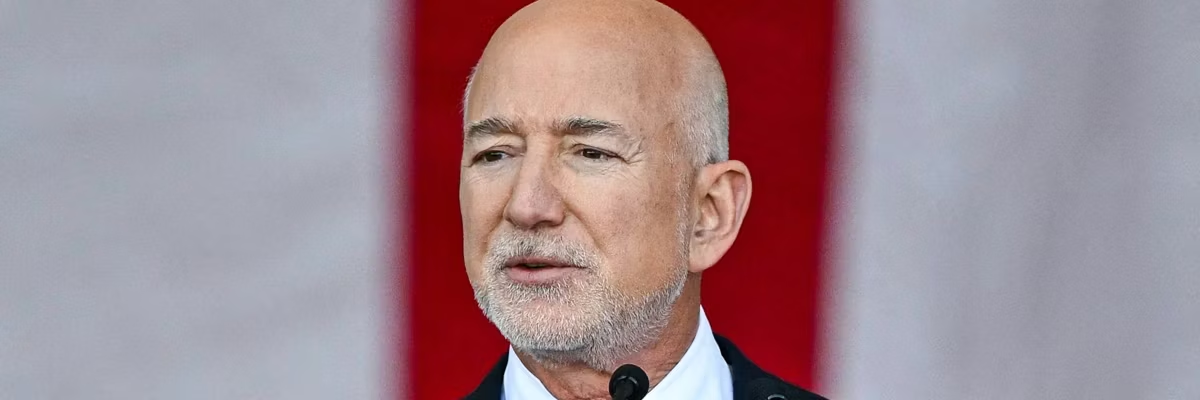
"The political danger in Bezos’ argument" to eliminate income taxes for the bottom 50% of American earners, said one op-ed, "is that it lets billionaires sound generous while leaving the structure of wealth largely untouched."
Amazon founder Jeff Bezos' decision to wade into the tax the rich debate raised eyebrows Thursday, as progressives who have long demanded a wealth tax for billionaires said they'd be happy to include him in the ongoing discussion about how the US tax system can be reformed to benefit working people.
In an interview with CNBC this week, the world's fourth-richest person claimed that doubling his taxes would do nothing to help working people, and attempted to shift the conversation on the tax system to a proposal that the bottom 50% of earners in the US should pay nothing in income taxes.
“You could double the taxes I pay, and it’s not going to help that teacher in Queens," said Bezos. "I promise you.”
New York City Mayor Zohran Mamdani replied, "I know a few teachers in Queens who would beg to differ." The democratic socialist has been relentlessly focused on making the city more affordable for working people and last month announced his plan to tax second homes valued at more than $5 million.
Critics of Bezos were quick to point out this week that the 1% effective tax rate the billionaire paid between 2014-18 was due to his avoidance of the income tax that working Americans have to pay, with the executive "offsetting earned income with other investment losses and various deductions."
Progressive leaders like Sen. Elizabeth Warren (D-Mass.) have argued that billionaires including Bezos pay a lower effective tax rate than working people because a vast amount of their wealth comes from unrealized capital gains and other investments instead of income from labor.
Bezos has also not faced a tax on his immense overall wealth of $275.4 billion, which US Sen. Bernie Sanders (I-Vt.) and other progressives have long called for, saying that taxing a relatively tiny amount of the assets held by billionaires like Bezos, Tesla founder and President Donald Trump megadonor Elon Musk, and other tech and business executives could fund essential services for the rest of society—including many that have contributed to the affordability crisis for working families.
"Let's have that debate" regarding reforms to the US tax system, Sanders said Thursday evening, addressing Bezos on Musk's platform X.
The senator has proposed a 5% annual wealth tax, which he said would leave Bezos still sitting on $269 billion in total wealth, while providing enough revenue to fund guaranteed universal childcare, an expansion of Medicare to cover dental, vision, and hearing care for senior citizens, a nationwide starting salary of $60,000 per year for public school teachers, and more.
In his interview with CNBC and on social media this week, Bezos repeatedly attempted to shift attention away from his taxes and onto the income taxes paid by the bottom 50% of earners, claiming that the "top 1% pay 40% of taxes, the bottom 50% pay 3% of taxes."
"The United States has the most progressive tax system in the world," he asserted. "We can make it even more progressive by zeroing out taxes on the bottom half. It’s a small amount of the total tax revenue but very meaningful to people in this group."
Paris School of Economics professor Gabriel Zucman, who has also called for a wealth tax and last month co-authored a Guardian op-ed with Mamdani explaining how the regressive tax system of the US has helped ensure the top 0.0001% of the global population holds the equivalent of 16% of the world's wealth, said Bezos was misrepresenting the conclusions of global economists regarding the US system.
"Your claim that the top 1% pays 40% of taxes and the bottom 50% only 3% is misleading: It captures just one tax—the federal income tax—and ignores all the rest: payroll taxes, state income taxes, sales taxes, excise duties, etc., many of which are regressive," said Zucman.
Bezos continued debating the issue on social media on Wednesday, sharing an article that explained how numerous analyses have determined he has paid an effective tax rate hovering around 1%.
"Great to see Bezos keeps bringing up his own massive tax avoidance. Keep digging! This travesty needs a real public debate," said historian Rutger Bregman, sharing a graph from Zucman's research, which shows how the average tax rate of the richest Americans has plummeted in recent decades.
At Newsweek on Wednesday, the magazine's editors wrote that Bezos was correct in his CNBC interview that "one billionaire's larger tax bill will not fund a modern state by itself."
"The deeper issue is whether the tax system asks comparable civic seriousness from wages, capital gains, inheritances, consumption, and payroll," wrote the editors. "A nurse's paycheck is easy to tax because it is visible. A billionaire's wealth can grow through assets that may remain untaxed until sale, or perhaps sheltered safely in some offshore domain."
"The political danger in Bezos’ argument" to allow the bottom 50% of American earners to pay nothing in income tax, the editors added, "is that it lets billionaires sound generous while leaving the structure of wealth largely untouched."
Thom Hartmann of The Hartmann Report said Bezos' push to eliminate income taxes for a huge swath of Americans benefits him and other billionaires in three ways, while ultimately harming those he claims to be trying to help save money:
First, it gets millions of Americans on the “we shouldn’t ever pay any income taxes at all” train that’s been rolling for billionaires ever since [former President Ronald] Reagan first gutted our tax code, leading to an explosion of the morbidly rich.
Second, it gets those same average, tax-paying voters on board with Bezos’ second claim, that America’s debt problem isn’t because we’re taxing too little but because we’re “spending too much.”
If we just got rid of—or privatized/profitized—all those pesky “socialist” programs like Medicaid, food stamps, free public highways, fire and police departments, Social Security, food and drug regulation and inspection, air traffic control and TSA, housing subsidies, Pell grants, free public schools, etc., then even billionaires could safely live tax-free.
Third, it means that Bezos will be able to reduce his own labor costs, because the marketplace in which pay rates exist are always exclusively reacting to “after tax” dollars.
Hartmann highlighted Bezos' resistance to a wealth tax and a fair tax rate with an anecdote about "a very wealthy German businessman" he once saw interviewed by an American reporter on Bloomberg News.
The businessman asked the reporter "how he could possibly live in a country" that taxes "very wealthy and successful people" at about 60%.
"Why don’t you lead a revolt against those high taxes?" he asked, his tone implying the businessman was badly in need of some good old American rebellion-making.
The German businessman paused for a long moment and then leaned forward, putting his elbows on his knees, his clasped hands in front of him pointing at the reporter as if in prayer.
He stared at the man for another long moment and then, in the tone of voice an adult uses to correct a spoiled child, said simply, "I don’t want to be a rich man in a poor country."
In contrast, Hartmann wrote, "the billionaires and foreign oligarchs who fund the Republican Party and right-wing media think it’s perfectly fine to rip the financial and political guts out of their own nation and turn its people against each other if it lets them keep a few extra bucks."
Dear Common Dreams reader, It’s been nearly 30 years since I co-founded Common Dreams with my late wife, Lina Newhouser. We had the radical notion that journalism should serve the public good, not corporate profits. It was clear to us from the outset what it would take to build such a project. No paid advertisements. No corporate sponsors. No millionaire publisher telling us what to think or do. Many people said we wouldn't last a year, but we proved those doubters wrong. Together with a tremendous team of journalists and dedicated staff, we built an independent media outlet free from the constraints of profits and corporate control. Our mission has always been simple: To inform. To inspire. To ignite change for the common good. Building Common Dreams was not easy. Our survival was never guaranteed. When you take on the most powerful forces—Wall Street greed, fossil fuel industry destruction, Big Tech lobbyists, and uber-rich oligarchs who have spent billions upon billions rigging the economy and democracy in their favor—the only bulwark you have is supporters who believe in your work. But here’s the urgent message from me today. It's never been this bad out there. And it's never been this hard to keep us going. At the very moment Common Dreams is most needed, the threats we face are intensifying. We need your support now more than ever. We don't accept corporate advertising and never will. We don't have a paywall because we don't think people should be blocked from critical news based on their ability to pay. Everything we do is funded by the donations of readers like you. When everyone does the little they can afford, we are strong. But if that support retreats or dries up, so do we. Will you donate now to make sure Common Dreams not only survives but thrives? —Craig Brown, Co-founder |
Amazon founder Jeff Bezos' decision to wade into the tax the rich debate raised eyebrows Thursday, as progressives who have long demanded a wealth tax for billionaires said they'd be happy to include him in the ongoing discussion about how the US tax system can be reformed to benefit working people.
In an interview with CNBC this week, the world's fourth-richest person claimed that doubling his taxes would do nothing to help working people, and attempted to shift the conversation on the tax system to a proposal that the bottom 50% of earners in the US should pay nothing in income taxes.
“You could double the taxes I pay, and it’s not going to help that teacher in Queens," said Bezos. "I promise you.”
New York City Mayor Zohran Mamdani replied, "I know a few teachers in Queens who would beg to differ." The democratic socialist has been relentlessly focused on making the city more affordable for working people and last month announced his plan to tax second homes valued at more than $5 million.
Critics of Bezos were quick to point out this week that the 1% effective tax rate the billionaire paid between 2014-18 was due to his avoidance of the income tax that working Americans have to pay, with the executive "offsetting earned income with other investment losses and various deductions."
Progressive leaders like Sen. Elizabeth Warren (D-Mass.) have argued that billionaires including Bezos pay a lower effective tax rate than working people because a vast amount of their wealth comes from unrealized capital gains and other investments instead of income from labor.
Bezos has also not faced a tax on his immense overall wealth of $275.4 billion, which US Sen. Bernie Sanders (I-Vt.) and other progressives have long called for, saying that taxing a relatively tiny amount of the assets held by billionaires like Bezos, Tesla founder and President Donald Trump megadonor Elon Musk, and other tech and business executives could fund essential services for the rest of society—including many that have contributed to the affordability crisis for working families.
"Let's have that debate" regarding reforms to the US tax system, Sanders said Thursday evening, addressing Bezos on Musk's platform X.
The senator has proposed a 5% annual wealth tax, which he said would leave Bezos still sitting on $269 billion in total wealth, while providing enough revenue to fund guaranteed universal childcare, an expansion of Medicare to cover dental, vision, and hearing care for senior citizens, a nationwide starting salary of $60,000 per year for public school teachers, and more.
In his interview with CNBC and on social media this week, Bezos repeatedly attempted to shift attention away from his taxes and onto the income taxes paid by the bottom 50% of earners, claiming that the "top 1% pay 40% of taxes, the bottom 50% pay 3% of taxes."
"The United States has the most progressive tax system in the world," he asserted. "We can make it even more progressive by zeroing out taxes on the bottom half. It’s a small amount of the total tax revenue but very meaningful to people in this group."
Paris School of Economics professor Gabriel Zucman, who has also called for a wealth tax and last month co-authored a Guardian op-ed with Mamdani explaining how the regressive tax system of the US has helped ensure the top 0.0001% of the global population holds the equivalent of 16% of the world's wealth, said Bezos was misrepresenting the conclusions of global economists regarding the US system.
"Your claim that the top 1% pays 40% of taxes and the bottom 50% only 3% is misleading: It captures just one tax—the federal income tax—and ignores all the rest: payroll taxes, state income taxes, sales taxes, excise duties, etc., many of which are regressive," said Zucman.
Bezos continued debating the issue on social media on Wednesday, sharing an article that explained how numerous analyses have determined he has paid an effective tax rate hovering around 1%.
"Great to see Bezos keeps bringing up his own massive tax avoidance. Keep digging! This travesty needs a real public debate," said historian Rutger Bregman, sharing a graph from Zucman's research, which shows how the average tax rate of the richest Americans has plummeted in recent decades.
At Newsweek on Wednesday, the magazine's editors wrote that Bezos was correct in his CNBC interview that "one billionaire's larger tax bill will not fund a modern state by itself."
"The deeper issue is whether the tax system asks comparable civic seriousness from wages, capital gains, inheritances, consumption, and payroll," wrote the editors. "A nurse's paycheck is easy to tax because it is visible. A billionaire's wealth can grow through assets that may remain untaxed until sale, or perhaps sheltered safely in some offshore domain."
"The political danger in Bezos’ argument" to allow the bottom 50% of American earners to pay nothing in income tax, the editors added, "is that it lets billionaires sound generous while leaving the structure of wealth largely untouched."
Thom Hartmann of The Hartmann Report said Bezos' push to eliminate income taxes for a huge swath of Americans benefits him and other billionaires in three ways, while ultimately harming those he claims to be trying to help save money:
First, it gets millions of Americans on the “we shouldn’t ever pay any income taxes at all” train that’s been rolling for billionaires ever since [former President Ronald] Reagan first gutted our tax code, leading to an explosion of the morbidly rich.
Second, it gets those same average, tax-paying voters on board with Bezos’ second claim, that America’s debt problem isn’t because we’re taxing too little but because we’re “spending too much.”
If we just got rid of—or privatized/profitized—all those pesky “socialist” programs like Medicaid, food stamps, free public highways, fire and police departments, Social Security, food and drug regulation and inspection, air traffic control and TSA, housing subsidies, Pell grants, free public schools, etc., then even billionaires could safely live tax-free.
Third, it means that Bezos will be able to reduce his own labor costs, because the marketplace in which pay rates exist are always exclusively reacting to “after tax” dollars.
Hartmann highlighted Bezos' resistance to a wealth tax and a fair tax rate with an anecdote about "a very wealthy German businessman" he once saw interviewed by an American reporter on Bloomberg News.
The businessman asked the reporter "how he could possibly live in a country" that taxes "very wealthy and successful people" at about 60%.
"Why don’t you lead a revolt against those high taxes?" he asked, his tone implying the businessman was badly in need of some good old American rebellion-making.
The German businessman paused for a long moment and then leaned forward, putting his elbows on his knees, his clasped hands in front of him pointing at the reporter as if in prayer.
He stared at the man for another long moment and then, in the tone of voice an adult uses to correct a spoiled child, said simply, "I don’t want to be a rich man in a poor country."
In contrast, Hartmann wrote, "the billionaires and foreign oligarchs who fund the Republican Party and right-wing media think it’s perfectly fine to rip the financial and political guts out of their own nation and turn its people against each other if it lets them keep a few extra bucks."
Amazon founder Jeff Bezos' decision to wade into the tax the rich debate raised eyebrows Thursday, as progressives who have long demanded a wealth tax for billionaires said they'd be happy to include him in the ongoing discussion about how the US tax system can be reformed to benefit working people.
In an interview with CNBC this week, the world's fourth-richest person claimed that doubling his taxes would do nothing to help working people, and attempted to shift the conversation on the tax system to a proposal that the bottom 50% of earners in the US should pay nothing in income taxes.
“You could double the taxes I pay, and it’s not going to help that teacher in Queens," said Bezos. "I promise you.”
New York City Mayor Zohran Mamdani replied, "I know a few teachers in Queens who would beg to differ." The democratic socialist has been relentlessly focused on making the city more affordable for working people and last month announced his plan to tax second homes valued at more than $5 million.
Critics of Bezos were quick to point out this week that the 1% effective tax rate the billionaire paid between 2014-18 was due to his avoidance of the income tax that working Americans have to pay, with the executive "offsetting earned income with other investment losses and various deductions."
Progressive leaders like Sen. Elizabeth Warren (D-Mass.) have argued that billionaires including Bezos pay a lower effective tax rate than working people because a vast amount of their wealth comes from unrealized capital gains and other investments instead of income from labor.
Bezos has also not faced a tax on his immense overall wealth of $275.4 billion, which US Sen. Bernie Sanders (I-Vt.) and other progressives have long called for, saying that taxing a relatively tiny amount of the assets held by billionaires like Bezos, Tesla founder and President Donald Trump megadonor Elon Musk, and other tech and business executives could fund essential services for the rest of society—including many that have contributed to the affordability crisis for working families.
"Let's have that debate" regarding reforms to the US tax system, Sanders said Thursday evening, addressing Bezos on Musk's platform X.
The senator has proposed a 5% annual wealth tax, which he said would leave Bezos still sitting on $269 billion in total wealth, while providing enough revenue to fund guaranteed universal childcare, an expansion of Medicare to cover dental, vision, and hearing care for senior citizens, a nationwide starting salary of $60,000 per year for public school teachers, and more.
In his interview with CNBC and on social media this week, Bezos repeatedly attempted to shift attention away from his taxes and onto the income taxes paid by the bottom 50% of earners, claiming that the "top 1% pay 40% of taxes, the bottom 50% pay 3% of taxes."
"The United States has the most progressive tax system in the world," he asserted. "We can make it even more progressive by zeroing out taxes on the bottom half. It’s a small amount of the total tax revenue but very meaningful to people in this group."
Paris School of Economics professor Gabriel Zucman, who has also called for a wealth tax and last month co-authored a Guardian op-ed with Mamdani explaining how the regressive tax system of the US has helped ensure the top 0.0001% of the global population holds the equivalent of 16% of the world's wealth, said Bezos was misrepresenting the conclusions of global economists regarding the US system.
"Your claim that the top 1% pays 40% of taxes and the bottom 50% only 3% is misleading: It captures just one tax—the federal income tax—and ignores all the rest: payroll taxes, state income taxes, sales taxes, excise duties, etc., many of which are regressive," said Zucman.
Bezos continued debating the issue on social media on Wednesday, sharing an article that explained how numerous analyses have determined he has paid an effective tax rate hovering around 1%.
"Great to see Bezos keeps bringing up his own massive tax avoidance. Keep digging! This travesty needs a real public debate," said historian Rutger Bregman, sharing a graph from Zucman's research, which shows how the average tax rate of the richest Americans has plummeted in recent decades.
At Newsweek on Wednesday, the magazine's editors wrote that Bezos was correct in his CNBC interview that "one billionaire's larger tax bill will not fund a modern state by itself."
"The deeper issue is whether the tax system asks comparable civic seriousness from wages, capital gains, inheritances, consumption, and payroll," wrote the editors. "A nurse's paycheck is easy to tax because it is visible. A billionaire's wealth can grow through assets that may remain untaxed until sale, or perhaps sheltered safely in some offshore domain."
"The political danger in Bezos’ argument" to allow the bottom 50% of American earners to pay nothing in income tax, the editors added, "is that it lets billionaires sound generous while leaving the structure of wealth largely untouched."
Thom Hartmann of The Hartmann Report said Bezos' push to eliminate income taxes for a huge swath of Americans benefits him and other billionaires in three ways, while ultimately harming those he claims to be trying to help save money:
First, it gets millions of Americans on the “we shouldn’t ever pay any income taxes at all” train that’s been rolling for billionaires ever since [former President Ronald] Reagan first gutted our tax code, leading to an explosion of the morbidly rich.
Second, it gets those same average, tax-paying voters on board with Bezos’ second claim, that America’s debt problem isn’t because we’re taxing too little but because we’re “spending too much.”
If we just got rid of—or privatized/profitized—all those pesky “socialist” programs like Medicaid, food stamps, free public highways, fire and police departments, Social Security, food and drug regulation and inspection, air traffic control and TSA, housing subsidies, Pell grants, free public schools, etc., then even billionaires could safely live tax-free.
Third, it means that Bezos will be able to reduce his own labor costs, because the marketplace in which pay rates exist are always exclusively reacting to “after tax” dollars.
Hartmann highlighted Bezos' resistance to a wealth tax and a fair tax rate with an anecdote about "a very wealthy German businessman" he once saw interviewed by an American reporter on Bloomberg News.
The businessman asked the reporter "how he could possibly live in a country" that taxes "very wealthy and successful people" at about 60%.
"Why don’t you lead a revolt against those high taxes?" he asked, his tone implying the businessman was badly in need of some good old American rebellion-making.
The German businessman paused for a long moment and then leaned forward, putting his elbows on his knees, his clasped hands in front of him pointing at the reporter as if in prayer.
He stared at the man for another long moment and then, in the tone of voice an adult uses to correct a spoiled child, said simply, "I don’t want to be a rich man in a poor country."
In contrast, Hartmann wrote, "the billionaires and foreign oligarchs who fund the Republican Party and right-wing media think it’s perfectly fine to rip the financial and political guts out of their own nation and turn its people against each other if it lets them keep a few extra bucks."