SUBSCRIBE TO OUR FREE NEWSLETTER
Daily news & progressive opinion—funded by the people, not the corporations—delivered straight to your inbox.
5
#000000
#FFFFFF
To donate by check, phone, or other method, see our More Ways to Give page.
Daily news & progressive opinion—funded by the people, not the corporations—delivered straight to your inbox.
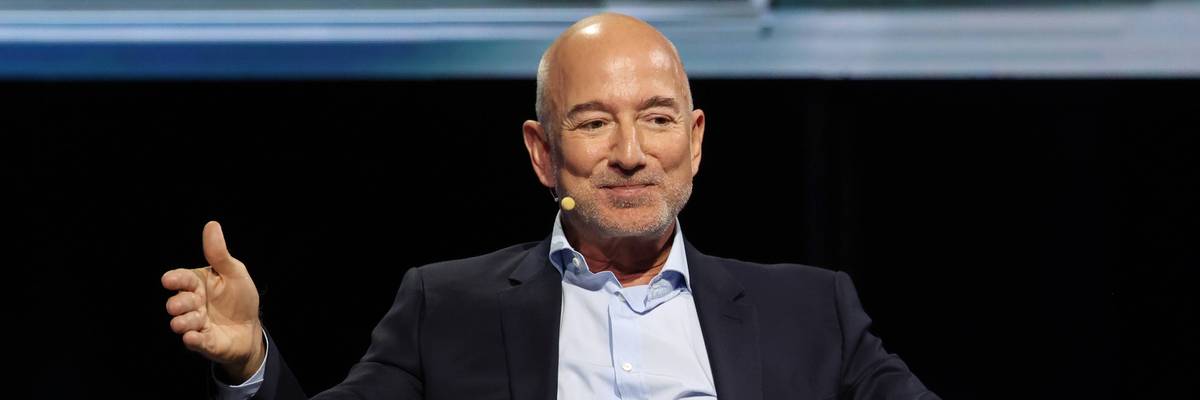
Amazon founder Jeff Bezos speaks at the America Business Forum on November 6, 2025 in Miami, Florida.
"Too much money contorts any human being," said one critic of the Amazon founder.
Amazon founder Jeff Bezos drew ridicule on Wednesday after he claimed that doubling the amount of taxes he pays wouldn't be beneficial to society.
During an interview on CNBC, journalist Andrew Ross Sorkin asked Bezos about arguments made by Sen. Elizabeth Warren (D-Mass.) that the super-rich have lower effective tax rates than average Americans given how much of their wealth comes from unrealized capital gains and not traditional income earned through actual labor.
"I pay billions of dollars in taxes," replied Bezos, whom Forbes estimates is worth $267 billion. "If people want me to pay billions more, then let's have that debate. But don't pretend, you know, that that's going to solve the problem. You could double the taxes I pay, and it's not gonna help that teacher in Queens, I promise you."
Bezos on CNBC: "You could double the taxes I pay, and it's not gonna help that teacher in Queens. I promise you." pic.twitter.com/ocbf34XZhA
— Aaron Rupar (@atrupar) May 20, 2026
A 2021 investigation by Pro Publica found that Bezos' effective tax rate of less than 1% between 2014 and 2018, as he paid a total of $973 million in taxes over a period in which his net worth grew by $99 billion.
As explained by the Institute of Taxation and Policy (ITEP), this effective tax rate was "significantly lower" than the tax rate paid by middle-class Americans over that period.
"There were multiple years where Bezos paid nothing at all in income taxes," ITEP noted. "While having billions of dollars of wealth, Bezos consistently avoided income tax by offsetting earned income with other investment losses and various deductions, all while Amazon stock was rapidly rising."
Democratic congressional candidate Melat Kiros in Colorado suggested Bezos had a point about taxation—"because we tax income, not wealth.
"Bezos takes out a tiny salary, pays the income tax, and lives off loans borrowed against his stocks, basically tax-free," said Kiros. "They all do this and now 935 billionaires hold more wealth than 170 million Americans. It’s time to tax wealth."
Melanie D'Arrigo, executive director of the Campaign for New York Health, took issue with Bezos' claim that doubling his taxes would produce no benefits.
"Jeff Bezos paid $500 million for his super-yacht and $75 million for his super-yacht’s mini-yacht—both of which he’s allowed to write off on his taxes," she wrote in a social media post. "That alone would cover $180 in classroom supplies for every public school teacher in the US."
Craig Harrington, research director at Media Matters for America, marveled at how out of touch Bezos seemed to be.
"There’s a funny thing about being uber wealthy," he observed. "They get so rich that they lose all sense of place, they essentially manifest as stateless people with no connection to or understanding of the world outside their private airports and resplendent villas."
Journalist and screenwriter David Simon expressed a similar view of the impact of immense wealth on Bezos' psyche.
"Too much money contorts any human being," Simon wrote. "And what was once a man is now, for the rest of the world, a fully metastasized cancer."
Author Hemant Mehta, meanwhile, simply wondered if Bezos "auditioning to be the next Bond villain."
Dear Common Dreams reader, It’s been nearly 30 years since I co-founded Common Dreams with my late wife, Lina Newhouser. We had the radical notion that journalism should serve the public good, not corporate profits. It was clear to us from the outset what it would take to build such a project. No paid advertisements. No corporate sponsors. No millionaire publisher telling us what to think or do. Many people said we wouldn't last a year, but we proved those doubters wrong. Together with a tremendous team of journalists and dedicated staff, we built an independent media outlet free from the constraints of profits and corporate control. Our mission has always been simple: To inform. To inspire. To ignite change for the common good. Building Common Dreams was not easy. Our survival was never guaranteed. When you take on the most powerful forces—Wall Street greed, fossil fuel industry destruction, Big Tech lobbyists, and uber-rich oligarchs who have spent billions upon billions rigging the economy and democracy in their favor—the only bulwark you have is supporters who believe in your work. But here’s the urgent message from me today. It's never been this bad out there. And it's never been this hard to keep us going. At the very moment Common Dreams is most needed, the threats we face are intensifying. We need your support now more than ever. We don't accept corporate advertising and never will. We don't have a paywall because we don't think people should be blocked from critical news based on their ability to pay. Everything we do is funded by the donations of readers like you. When everyone does the little they can afford, we are strong. But if that support retreats or dries up, so do we. Will you donate now to make sure Common Dreams not only survives but thrives? —Craig Brown, Co-founder |
Amazon founder Jeff Bezos drew ridicule on Wednesday after he claimed that doubling the amount of taxes he pays wouldn't be beneficial to society.
During an interview on CNBC, journalist Andrew Ross Sorkin asked Bezos about arguments made by Sen. Elizabeth Warren (D-Mass.) that the super-rich have lower effective tax rates than average Americans given how much of their wealth comes from unrealized capital gains and not traditional income earned through actual labor.
"I pay billions of dollars in taxes," replied Bezos, whom Forbes estimates is worth $267 billion. "If people want me to pay billions more, then let's have that debate. But don't pretend, you know, that that's going to solve the problem. You could double the taxes I pay, and it's not gonna help that teacher in Queens, I promise you."
Bezos on CNBC: "You could double the taxes I pay, and it's not gonna help that teacher in Queens. I promise you." pic.twitter.com/ocbf34XZhA
— Aaron Rupar (@atrupar) May 20, 2026
A 2021 investigation by Pro Publica found that Bezos' effective tax rate of less than 1% between 2014 and 2018, as he paid a total of $973 million in taxes over a period in which his net worth grew by $99 billion.
As explained by the Institute of Taxation and Policy (ITEP), this effective tax rate was "significantly lower" than the tax rate paid by middle-class Americans over that period.
"There were multiple years where Bezos paid nothing at all in income taxes," ITEP noted. "While having billions of dollars of wealth, Bezos consistently avoided income tax by offsetting earned income with other investment losses and various deductions, all while Amazon stock was rapidly rising."
Democratic congressional candidate Melat Kiros in Colorado suggested Bezos had a point about taxation—"because we tax income, not wealth.
"Bezos takes out a tiny salary, pays the income tax, and lives off loans borrowed against his stocks, basically tax-free," said Kiros. "They all do this and now 935 billionaires hold more wealth than 170 million Americans. It’s time to tax wealth."
Melanie D'Arrigo, executive director of the Campaign for New York Health, took issue with Bezos' claim that doubling his taxes would produce no benefits.
"Jeff Bezos paid $500 million for his super-yacht and $75 million for his super-yacht’s mini-yacht—both of which he’s allowed to write off on his taxes," she wrote in a social media post. "That alone would cover $180 in classroom supplies for every public school teacher in the US."
Craig Harrington, research director at Media Matters for America, marveled at how out of touch Bezos seemed to be.
"There’s a funny thing about being uber wealthy," he observed. "They get so rich that they lose all sense of place, they essentially manifest as stateless people with no connection to or understanding of the world outside their private airports and resplendent villas."
Journalist and screenwriter David Simon expressed a similar view of the impact of immense wealth on Bezos' psyche.
"Too much money contorts any human being," Simon wrote. "And what was once a man is now, for the rest of the world, a fully metastasized cancer."
Author Hemant Mehta, meanwhile, simply wondered if Bezos "auditioning to be the next Bond villain."
Amazon founder Jeff Bezos drew ridicule on Wednesday after he claimed that doubling the amount of taxes he pays wouldn't be beneficial to society.
During an interview on CNBC, journalist Andrew Ross Sorkin asked Bezos about arguments made by Sen. Elizabeth Warren (D-Mass.) that the super-rich have lower effective tax rates than average Americans given how much of their wealth comes from unrealized capital gains and not traditional income earned through actual labor.
"I pay billions of dollars in taxes," replied Bezos, whom Forbes estimates is worth $267 billion. "If people want me to pay billions more, then let's have that debate. But don't pretend, you know, that that's going to solve the problem. You could double the taxes I pay, and it's not gonna help that teacher in Queens, I promise you."
Bezos on CNBC: "You could double the taxes I pay, and it's not gonna help that teacher in Queens. I promise you." pic.twitter.com/ocbf34XZhA
— Aaron Rupar (@atrupar) May 20, 2026
A 2021 investigation by Pro Publica found that Bezos' effective tax rate of less than 1% between 2014 and 2018, as he paid a total of $973 million in taxes over a period in which his net worth grew by $99 billion.
As explained by the Institute of Taxation and Policy (ITEP), this effective tax rate was "significantly lower" than the tax rate paid by middle-class Americans over that period.
"There were multiple years where Bezos paid nothing at all in income taxes," ITEP noted. "While having billions of dollars of wealth, Bezos consistently avoided income tax by offsetting earned income with other investment losses and various deductions, all while Amazon stock was rapidly rising."
Democratic congressional candidate Melat Kiros in Colorado suggested Bezos had a point about taxation—"because we tax income, not wealth.
"Bezos takes out a tiny salary, pays the income tax, and lives off loans borrowed against his stocks, basically tax-free," said Kiros. "They all do this and now 935 billionaires hold more wealth than 170 million Americans. It’s time to tax wealth."
Melanie D'Arrigo, executive director of the Campaign for New York Health, took issue with Bezos' claim that doubling his taxes would produce no benefits.
"Jeff Bezos paid $500 million for his super-yacht and $75 million for his super-yacht’s mini-yacht—both of which he’s allowed to write off on his taxes," she wrote in a social media post. "That alone would cover $180 in classroom supplies for every public school teacher in the US."
Craig Harrington, research director at Media Matters for America, marveled at how out of touch Bezos seemed to be.
"There’s a funny thing about being uber wealthy," he observed. "They get so rich that they lose all sense of place, they essentially manifest as stateless people with no connection to or understanding of the world outside their private airports and resplendent villas."
Journalist and screenwriter David Simon expressed a similar view of the impact of immense wealth on Bezos' psyche.
"Too much money contorts any human being," Simon wrote. "And what was once a man is now, for the rest of the world, a fully metastasized cancer."
Author Hemant Mehta, meanwhile, simply wondered if Bezos "auditioning to be the next Bond villain."