SUBSCRIBE TO OUR FREE NEWSLETTER
Daily news & progressive opinion—funded by the people, not the corporations—delivered straight to your inbox.
5
#000000
#FFFFFF
To donate by check, phone, or other method, see our More Ways to Give page.
Daily news & progressive opinion—funded by the people, not the corporations—delivered straight to your inbox.
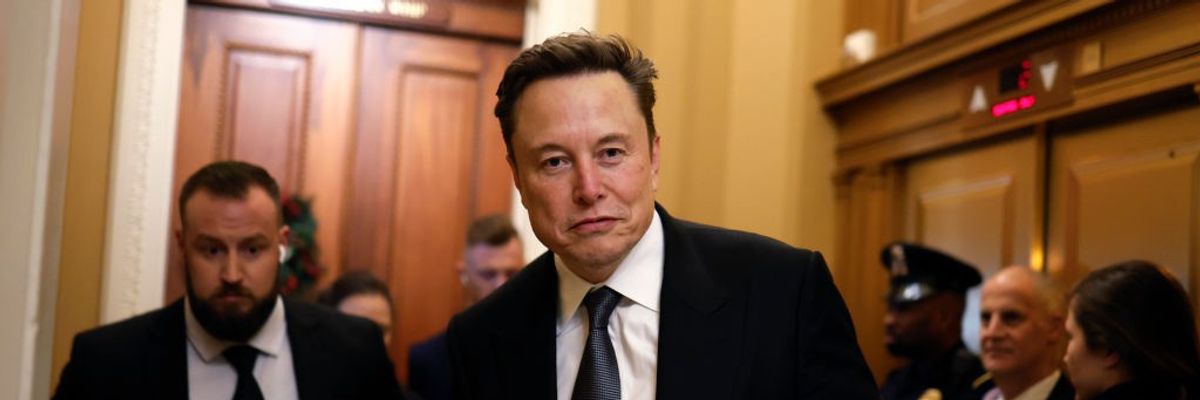
Tesla CEO Elon Musk arrives on Capitol Hill on December 5, 2024 in Washington, D.C.
"Americans see right through Musk's scheme to pay for his own tax breaks by defunding Social Security, Medicaid, and Medicare," said one critic.
Mega-billionaire Elon Musk conceded Wednesday that he's not likely to achieve his fantastical goal of slashing $2 trillion from the federal budget, an admission that one critic said underscores the folly of the so-called Department of Government Efficiency.
"President-elect [Donald] Trump hasn't even taken office and Elon Musk is already admitting failure on DOGE's deeply unpopular and unrealistic agenda," Lindsay Owens, executive director of the Groundwork Collaborative, said in a statement. "Americans see right through Musk's scheme to pay for his own tax breaks by defunding Social Security, Medicaid, and Medicare."
Musk, the world's richest man and a close ally of Trump, said in an interview Wednesday that cutting $2 trillion in federal spending would be an "epic outcome" but described it as a "best-case" scenario. Economists have dismissed Musk's $2 trillion target as absurd, given that the entire annual discretionary budget was $1.6 trillion for Fiscal Year 2024.
Bobby Kogan, senior director of federal budget policy at the Center for American Progress, said Thursday that Musk's lower target of $1 trillion in cuts is also "too large," noting that "if you protect Social Security, Medicare, vets, and defense, it would mean cutting every other program by 45% on average." Republican lawmakers have floated similarly outlandish cuts.
Opponents of the Department of Government Efficiency—an advisory commission set to be led by Musk and fellow billionaire Vivek Ramaswamy—have warned it is a thinly veiled effort to target Social Security, Medicare, Medicaid, and other nondiscretionary programs, a concern amplified by recent comments from GOP supporters of the panel.
"I am a strong advocate of discussing this and reevaluating them, and I do believe, at the end of the day, there will be some cut," Rep. Greg Lopez (R-Colo.) said of Medicare and Social Security outside of the first meeting of the House DOGE Caucus.
Musk said ahead of the 2024 elections—on which he spent heavily to influence—that spending cuts he envisions would "necessarily" bring "some temporary hardship," but he hasn't specifically detailed which programs he would target.
"If the incoming president follows through on even a fraction of the $2 trillion in cuts that Musk and his allies have promised, the pain will be felt well beyond struggling small-town America," journalist Conor Lynch wrote for Truthdig earlier this week. "Veterans, especially, who voted overwhelmingly for the president-elect, could be in for a rude awakening."
"Shortly after being tapped to be Musk's co-chair at the so-called Department of Government Efficiency, Vivek Ramaswamy posted on X that the first order of business should be to eliminate all spending on programs with expired authorizations from Congress, which amounts to over half a trillion dollars," Lynch noted. "Users were quick to point out that if Trump followed Ramaswamy's advice, he would instantly defund healthcare for veterans, which is by far the largest spending program on that list."
Dear Common Dreams reader, It’s been nearly 30 years since I co-founded Common Dreams with my late wife, Lina Newhouser. We had the radical notion that journalism should serve the public good, not corporate profits. It was clear to us from the outset what it would take to build such a project. No paid advertisements. No corporate sponsors. No millionaire publisher telling us what to think or do. Many people said we wouldn't last a year, but we proved those doubters wrong. Together with a tremendous team of journalists and dedicated staff, we built an independent media outlet free from the constraints of profits and corporate control. Our mission has always been simple: To inform. To inspire. To ignite change for the common good. Building Common Dreams was not easy. Our survival was never guaranteed. When you take on the most powerful forces—Wall Street greed, fossil fuel industry destruction, Big Tech lobbyists, and uber-rich oligarchs who have spent billions upon billions rigging the economy and democracy in their favor—the only bulwark you have is supporters who believe in your work. But here’s the urgent message from me today. It's never been this bad out there. And it's never been this hard to keep us going. At the very moment Common Dreams is most needed, the threats we face are intensifying. We need your support now more than ever. We don't accept corporate advertising and never will. We don't have a paywall because we don't think people should be blocked from critical news based on their ability to pay. Everything we do is funded by the donations of readers like you. When everyone does the little they can afford, we are strong. But if that support retreats or dries up, so do we. Will you donate now to make sure Common Dreams not only survives but thrives? —Craig Brown, Co-founder |
Mega-billionaire Elon Musk conceded Wednesday that he's not likely to achieve his fantastical goal of slashing $2 trillion from the federal budget, an admission that one critic said underscores the folly of the so-called Department of Government Efficiency.
"President-elect [Donald] Trump hasn't even taken office and Elon Musk is already admitting failure on DOGE's deeply unpopular and unrealistic agenda," Lindsay Owens, executive director of the Groundwork Collaborative, said in a statement. "Americans see right through Musk's scheme to pay for his own tax breaks by defunding Social Security, Medicaid, and Medicare."
Musk, the world's richest man and a close ally of Trump, said in an interview Wednesday that cutting $2 trillion in federal spending would be an "epic outcome" but described it as a "best-case" scenario. Economists have dismissed Musk's $2 trillion target as absurd, given that the entire annual discretionary budget was $1.6 trillion for Fiscal Year 2024.
Bobby Kogan, senior director of federal budget policy at the Center for American Progress, said Thursday that Musk's lower target of $1 trillion in cuts is also "too large," noting that "if you protect Social Security, Medicare, vets, and defense, it would mean cutting every other program by 45% on average." Republican lawmakers have floated similarly outlandish cuts.
Opponents of the Department of Government Efficiency—an advisory commission set to be led by Musk and fellow billionaire Vivek Ramaswamy—have warned it is a thinly veiled effort to target Social Security, Medicare, Medicaid, and other nondiscretionary programs, a concern amplified by recent comments from GOP supporters of the panel.
"I am a strong advocate of discussing this and reevaluating them, and I do believe, at the end of the day, there will be some cut," Rep. Greg Lopez (R-Colo.) said of Medicare and Social Security outside of the first meeting of the House DOGE Caucus.
Musk said ahead of the 2024 elections—on which he spent heavily to influence—that spending cuts he envisions would "necessarily" bring "some temporary hardship," but he hasn't specifically detailed which programs he would target.
"If the incoming president follows through on even a fraction of the $2 trillion in cuts that Musk and his allies have promised, the pain will be felt well beyond struggling small-town America," journalist Conor Lynch wrote for Truthdig earlier this week. "Veterans, especially, who voted overwhelmingly for the president-elect, could be in for a rude awakening."
"Shortly after being tapped to be Musk's co-chair at the so-called Department of Government Efficiency, Vivek Ramaswamy posted on X that the first order of business should be to eliminate all spending on programs with expired authorizations from Congress, which amounts to over half a trillion dollars," Lynch noted. "Users were quick to point out that if Trump followed Ramaswamy's advice, he would instantly defund healthcare for veterans, which is by far the largest spending program on that list."
Mega-billionaire Elon Musk conceded Wednesday that he's not likely to achieve his fantastical goal of slashing $2 trillion from the federal budget, an admission that one critic said underscores the folly of the so-called Department of Government Efficiency.
"President-elect [Donald] Trump hasn't even taken office and Elon Musk is already admitting failure on DOGE's deeply unpopular and unrealistic agenda," Lindsay Owens, executive director of the Groundwork Collaborative, said in a statement. "Americans see right through Musk's scheme to pay for his own tax breaks by defunding Social Security, Medicaid, and Medicare."
Musk, the world's richest man and a close ally of Trump, said in an interview Wednesday that cutting $2 trillion in federal spending would be an "epic outcome" but described it as a "best-case" scenario. Economists have dismissed Musk's $2 trillion target as absurd, given that the entire annual discretionary budget was $1.6 trillion for Fiscal Year 2024.
Bobby Kogan, senior director of federal budget policy at the Center for American Progress, said Thursday that Musk's lower target of $1 trillion in cuts is also "too large," noting that "if you protect Social Security, Medicare, vets, and defense, it would mean cutting every other program by 45% on average." Republican lawmakers have floated similarly outlandish cuts.
Opponents of the Department of Government Efficiency—an advisory commission set to be led by Musk and fellow billionaire Vivek Ramaswamy—have warned it is a thinly veiled effort to target Social Security, Medicare, Medicaid, and other nondiscretionary programs, a concern amplified by recent comments from GOP supporters of the panel.
"I am a strong advocate of discussing this and reevaluating them, and I do believe, at the end of the day, there will be some cut," Rep. Greg Lopez (R-Colo.) said of Medicare and Social Security outside of the first meeting of the House DOGE Caucus.
Musk said ahead of the 2024 elections—on which he spent heavily to influence—that spending cuts he envisions would "necessarily" bring "some temporary hardship," but he hasn't specifically detailed which programs he would target.
"If the incoming president follows through on even a fraction of the $2 trillion in cuts that Musk and his allies have promised, the pain will be felt well beyond struggling small-town America," journalist Conor Lynch wrote for Truthdig earlier this week. "Veterans, especially, who voted overwhelmingly for the president-elect, could be in for a rude awakening."
"Shortly after being tapped to be Musk's co-chair at the so-called Department of Government Efficiency, Vivek Ramaswamy posted on X that the first order of business should be to eliminate all spending on programs with expired authorizations from Congress, which amounts to over half a trillion dollars," Lynch noted. "Users were quick to point out that if Trump followed Ramaswamy's advice, he would instantly defund healthcare for veterans, which is by far the largest spending program on that list."