SUBSCRIBE TO OUR FREE NEWSLETTER
Daily news & progressive opinion—funded by the people, not the corporations—delivered straight to your inbox.
5
#000000
#FFFFFF
To donate by check, phone, or other method, see our More Ways to Give page.
Daily news & progressive opinion—funded by the people, not the corporations—delivered straight to your inbox.
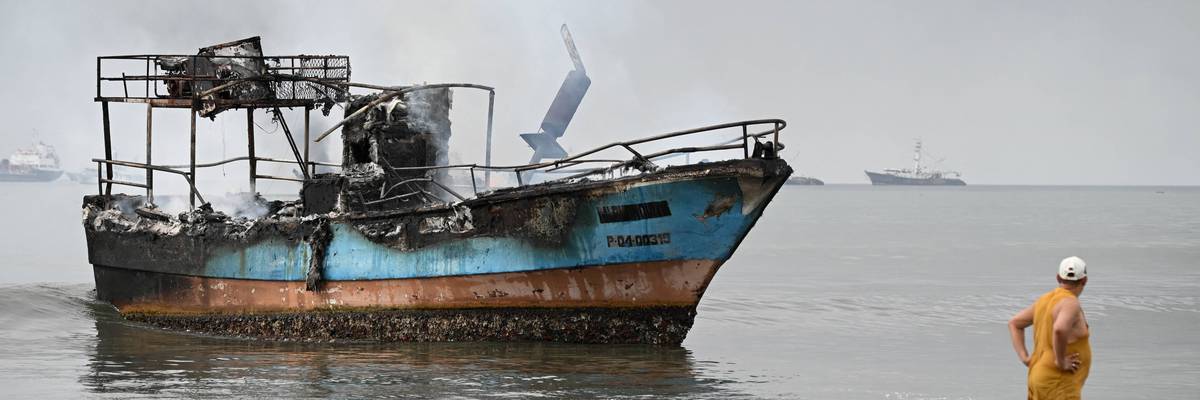
A man stands next to a burned-out fishing boat near the port of Manta, Ecuador on June 6, 2026.
“It begs the question about why you would need to do this. What would be the purpose of the secrecy?” said a former US government official.
The Washington Post reported on Thursday that recent mysterious attacks on Ecuadoran fishing boats were carried out as part of a covert CIA operation.
According to the Post, the strikes on the fishing boats, which took place in multiple instances near the Galápagos Islands earlier this year, are separate from the US Department of Defense's bombing campaign against purported drug-trafficking boats that was launched in September 2025 and has so far killed at least 220 people.
Survivors of a boat attack that occurred in March told the Post they remember coming under fire from small quadcopter drones that either dropped munitions on their vessels or directly crashed into them.
After being shipwrecked, the survivors said they were picked up by a nearby vessel, where they were taken aboard, and "hooded and cuffed by armed men, and transported to El Salvador—only to be returned later without explanation to Ecuador."
The Post noted that "no evidence has publicly emerged that the crew members were involved in drug trafficking," adding that "the Galápagos Islands have increasingly become a hub for drug traffickers, where local fishermen are known to pick up jobs delivering gas to smugglers heading to the United States."
Some former US officials with experience working in Latin America told the Post that they were bewildered about the need for a covert CIA boat strike campaign given that the Trump administration has openly boasted about its other attacks on vessels, which many human rights groups and international law experts have called acts of murder.
“It begs the question about why you would need to do this,” one former official said. “What would be the purpose of the secrecy?”
The covert boat strikes were also reported on Wednesday by The New York Times, which presented evidence that they originated in the US without naming their specific source.
Amnesty International last month raised suspicions of US involvement in the January disappearance of Ecuadoran fishing boat called Fiorella.
Amnesty's investigation of the Fiorella's disappearance found that the vessel, in the days before its disappearance, was "allegedly subjected to sustained monitoring by aircraft, patrol boats, and drones bearing United States markings," as the boat's captain sent "daily satellite messages to his family expressing his growing concern about the surveillance."
The ship vanished on January 20.
Two crew members who had departed the ship earlier in the day on a skiff to lay out fishing lines reported seeing "a large column of smoke in the distance in the direction of the Fiorella, but were unable to determine with certainty whether it was from a fire on board," wrote Amnesty.
The two crew members aboard the skiff are the only confirmed survivors of the incident, as the eight other men aboard the Fiorella are still missing.
Dear Common Dreams reader, It’s been nearly 30 years since I co-founded Common Dreams with my late wife, Lina Newhouser. We had the radical notion that journalism should serve the public good, not corporate profits. It was clear to us from the outset what it would take to build such a project. No paid advertisements. No corporate sponsors. No millionaire publisher telling us what to think or do. Many people said we wouldn't last a year, but we proved those doubters wrong. Together with a tremendous team of journalists and dedicated staff, we built an independent media outlet free from the constraints of profits and corporate control. Our mission has always been simple: To inform. To inspire. To ignite change for the common good. Building Common Dreams was not easy. Our survival was never guaranteed. When you take on the most powerful forces—Wall Street greed, fossil fuel industry destruction, Big Tech lobbyists, and uber-rich oligarchs who have spent billions upon billions rigging the economy and democracy in their favor—the only bulwark you have is supporters who believe in your work. But here’s the urgent message from me today. It's never been this bad out there. And it's never been this hard to keep us going. At the very moment Common Dreams is most needed, the threats we face are intensifying. We need your support now more than ever. We don't accept corporate advertising and never will. We don't have a paywall because we don't think people should be blocked from critical news based on their ability to pay. Everything we do is funded by the donations of readers like you. When everyone does the little they can afford, we are strong. But if that support retreats or dries up, so do we. Will you donate now to make sure Common Dreams not only survives but thrives? —Craig Brown, Co-founder |
The Washington Post reported on Thursday that recent mysterious attacks on Ecuadoran fishing boats were carried out as part of a covert CIA operation.
According to the Post, the strikes on the fishing boats, which took place in multiple instances near the Galápagos Islands earlier this year, are separate from the US Department of Defense's bombing campaign against purported drug-trafficking boats that was launched in September 2025 and has so far killed at least 220 people.
Survivors of a boat attack that occurred in March told the Post they remember coming under fire from small quadcopter drones that either dropped munitions on their vessels or directly crashed into them.
After being shipwrecked, the survivors said they were picked up by a nearby vessel, where they were taken aboard, and "hooded and cuffed by armed men, and transported to El Salvador—only to be returned later without explanation to Ecuador."
The Post noted that "no evidence has publicly emerged that the crew members were involved in drug trafficking," adding that "the Galápagos Islands have increasingly become a hub for drug traffickers, where local fishermen are known to pick up jobs delivering gas to smugglers heading to the United States."
Some former US officials with experience working in Latin America told the Post that they were bewildered about the need for a covert CIA boat strike campaign given that the Trump administration has openly boasted about its other attacks on vessels, which many human rights groups and international law experts have called acts of murder.
“It begs the question about why you would need to do this,” one former official said. “What would be the purpose of the secrecy?”
The covert boat strikes were also reported on Wednesday by The New York Times, which presented evidence that they originated in the US without naming their specific source.
Amnesty International last month raised suspicions of US involvement in the January disappearance of Ecuadoran fishing boat called Fiorella.
Amnesty's investigation of the Fiorella's disappearance found that the vessel, in the days before its disappearance, was "allegedly subjected to sustained monitoring by aircraft, patrol boats, and drones bearing United States markings," as the boat's captain sent "daily satellite messages to his family expressing his growing concern about the surveillance."
The ship vanished on January 20.
Two crew members who had departed the ship earlier in the day on a skiff to lay out fishing lines reported seeing "a large column of smoke in the distance in the direction of the Fiorella, but were unable to determine with certainty whether it was from a fire on board," wrote Amnesty.
The two crew members aboard the skiff are the only confirmed survivors of the incident, as the eight other men aboard the Fiorella are still missing.
The Washington Post reported on Thursday that recent mysterious attacks on Ecuadoran fishing boats were carried out as part of a covert CIA operation.
According to the Post, the strikes on the fishing boats, which took place in multiple instances near the Galápagos Islands earlier this year, are separate from the US Department of Defense's bombing campaign against purported drug-trafficking boats that was launched in September 2025 and has so far killed at least 220 people.
Survivors of a boat attack that occurred in March told the Post they remember coming under fire from small quadcopter drones that either dropped munitions on their vessels or directly crashed into them.
After being shipwrecked, the survivors said they were picked up by a nearby vessel, where they were taken aboard, and "hooded and cuffed by armed men, and transported to El Salvador—only to be returned later without explanation to Ecuador."
The Post noted that "no evidence has publicly emerged that the crew members were involved in drug trafficking," adding that "the Galápagos Islands have increasingly become a hub for drug traffickers, where local fishermen are known to pick up jobs delivering gas to smugglers heading to the United States."
Some former US officials with experience working in Latin America told the Post that they were bewildered about the need for a covert CIA boat strike campaign given that the Trump administration has openly boasted about its other attacks on vessels, which many human rights groups and international law experts have called acts of murder.
“It begs the question about why you would need to do this,” one former official said. “What would be the purpose of the secrecy?”
The covert boat strikes were also reported on Wednesday by The New York Times, which presented evidence that they originated in the US without naming their specific source.
Amnesty International last month raised suspicions of US involvement in the January disappearance of Ecuadoran fishing boat called Fiorella.
Amnesty's investigation of the Fiorella's disappearance found that the vessel, in the days before its disappearance, was "allegedly subjected to sustained monitoring by aircraft, patrol boats, and drones bearing United States markings," as the boat's captain sent "daily satellite messages to his family expressing his growing concern about the surveillance."
The ship vanished on January 20.
Two crew members who had departed the ship earlier in the day on a skiff to lay out fishing lines reported seeing "a large column of smoke in the distance in the direction of the Fiorella, but were unable to determine with certainty whether it was from a fire on board," wrote Amnesty.
The two crew members aboard the skiff are the only confirmed survivors of the incident, as the eight other men aboard the Fiorella are still missing.