SUBSCRIBE TO OUR FREE NEWSLETTER
Daily news & progressive opinion—funded by the people, not the corporations—delivered straight to your inbox.
5
#000000
#FFFFFF
To donate by check, phone, or other method, see our More Ways to Give page.
Daily news & progressive opinion—funded by the people, not the corporations—delivered straight to your inbox.

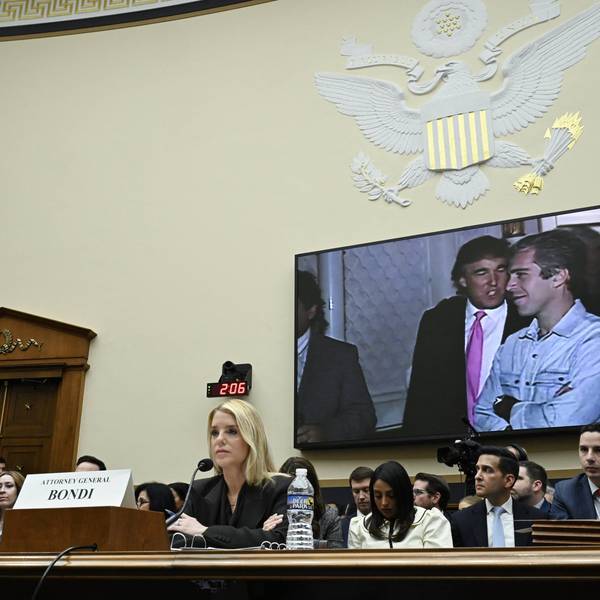
Portrait of American financier Jeffrey Epstein and future President Donald Trump as they pose together at the Mar-a-Lago estate, Palm Beach, Florida in 1997.
The leaked records also connect companies owned by President Donald Trump with a notorious Azerbaijani money laundering operation.
A group of whistleblowers has released more than 15 million internal documents from Deutsche Bank that reveal what the Financial Times described in a Tuesday social media post as "bad behavior, systemic failures, and incompetence."
In a video summarizing the documents' most important revelations, Financial Times investigative reporter Dan McCrum said they expose the German bank's "hidden losses, secret payments to a Qatari, and money laundering at an industrial scale."
How was it possible for Deutsche Bank to become so dysfunctional? Our journalists have combed through millions of documents and found hidden losses, secret payments to a Qatari royal and how the lender accidentally leaked Donald Trump’s tax records https://t.co/GTwCCIB9mo https://t.co/hDesX4sRS0
— Financial Times (@FT) November 17, 2026
A Tuesday Financial Times report zeroed in on the bank's role in financing Jeffrey Epstein, as leaked records reveal the bank processed nearly $600 million of payments related to the late financier and convicted sex offender.
Specifically, the records show that internal regulators at the bank filed suspicious activity reports on $582 million worth of Epstein-related money transfers, including "payments to women, suspected misuse of charitable donations, and transfers from wealthy individuals such as Apollo Global Management co-founder Leon Black and hedge fund billionaire Glenn Dubin."
Although a report released in August by the office of US Sen. Ron Wyden (D-Ore.) accused Deutsche Bank of ignoring "massive withdrawals of cash for questionable purposes from Epstein's accounts," the leaked internal documents show that transfers enabled by the bank were far larger than previously known.
Epstein was far from the only infamous Deutsche Bank client, and Le Monde on Tuesday published an investigation into the bank's long financial relationship with President Donald Trump.
According to Le Monde, the leaked documents "provide for the first time direct evidence of suspicious transactions connecting companies owned by Trump" and a notorious Azerbaijani money laundering operation, which "was used throughout the 2010s to buy political influence and siphon off public funds for the benefit of Azerbaijan's elite."
The records reveal a number of suspicious transactions related to a Trump luxury hotel project in the Azerbaijani capital of Baku in the spring of 2015, just weeks before the real estate mogul and reality TV star would announce his first presidential campaign.
Le Monde singled out records showing attempts by entities at the heart of the "Azerbaijani Laundromat" to wire precisely $141,261.82 to DT Marks Baku LLC, a Delaware based firm responsible for collecting Trump licensing fees, in April 2015.
Le Monde explained that seeing "the same sum bouncing between four different bank accounts in just two weeks, with three different explanations" is "typical of how money-laundering operations function."
"By multiplying transfers and altering payment descriptions," Le Monde reported, "those behind the transactions obscure the financial chain and make tracing the origin of the funds nearly impossible. The complexity blurs the link between the often illicit origin of the money and its final beneficiary."
The New York Times reported on Tuesday that the internal Deutsche Bank records show the institution also blew off multiple internal warnings and continued financing oligarchs with ties to Russian President Vladimir Putin.
At least two divisions within the bank warned about the risks of continuing to do business with Russian billionaire Oleg Deripaska, as an internal report documented the many allegations against him, including money laundering, tax evasion, ties to organized crime, and using the legal system to "bully his competitors."
Despite this, the bank continued maintaining its relationship with Deripaska, whom it describe in an internal memo as "a reputable businessman and well-established business partner with a significant pipeline of further transactions."
Deutsche Bank finally broke off its ties to Russian oligarchs after Putin invaded Ukraine in 2022, but the Times noted it only did so after its competitors announced plans to exit the Russian market.
This country and this world are at a monumental crossroads. US voters have an opportunity to beat back the forces of fascism and confront the billionaires who are rigging the economy, our media system, and our democracy, making it increasingly impossible for ordinary people to get by. We’re not just talking about the election. We’re talking about what must be done once these fascist elements are vanquished from power. We need a bolder set of solutions than what either major party has so far been willing to offer and a working-class movement ready to fight like hell for it. Trump didn't emerge from nowhere. The conditions that fueled MAGA authoritarianism were created by decades of radical neoliberal economic policies and a corrupt political system dominated by corporate interests. They slashed taxes on the super-rich, promising that the benefits would trickle down. They said giveaways to the corporate titans would make life more affordable for the rest of us. It was all bullshit. And when a bitter, betrayed populace searches for someone to blame, right-wing demagogues have little trouble finding scapegoats. People know when they're being lied to, but you won't hear any of this from the corporate media. Only independent journalism—powered and funded by people who believe in building a better world—can deliver truly trustworthy daily news. If you share our vision, please contribute whatever you can to sustain our work. |
A group of whistleblowers has released more than 15 million internal documents from Deutsche Bank that reveal what the Financial Times described in a Tuesday social media post as "bad behavior, systemic failures, and incompetence."
In a video summarizing the documents' most important revelations, Financial Times investigative reporter Dan McCrum said they expose the German bank's "hidden losses, secret payments to a Qatari, and money laundering at an industrial scale."
How was it possible for Deutsche Bank to become so dysfunctional? Our journalists have combed through millions of documents and found hidden losses, secret payments to a Qatari royal and how the lender accidentally leaked Donald Trump’s tax records https://t.co/GTwCCIB9mo https://t.co/hDesX4sRS0
— Financial Times (@FT) November 17, 2026
A Tuesday Financial Times report zeroed in on the bank's role in financing Jeffrey Epstein, as leaked records reveal the bank processed nearly $600 million of payments related to the late financier and convicted sex offender.
Specifically, the records show that internal regulators at the bank filed suspicious activity reports on $582 million worth of Epstein-related money transfers, including "payments to women, suspected misuse of charitable donations, and transfers from wealthy individuals such as Apollo Global Management co-founder Leon Black and hedge fund billionaire Glenn Dubin."
Although a report released in August by the office of US Sen. Ron Wyden (D-Ore.) accused Deutsche Bank of ignoring "massive withdrawals of cash for questionable purposes from Epstein's accounts," the leaked internal documents show that transfers enabled by the bank were far larger than previously known.
Epstein was far from the only infamous Deutsche Bank client, and Le Monde on Tuesday published an investigation into the bank's long financial relationship with President Donald Trump.
According to Le Monde, the leaked documents "provide for the first time direct evidence of suspicious transactions connecting companies owned by Trump" and a notorious Azerbaijani money laundering operation, which "was used throughout the 2010s to buy political influence and siphon off public funds for the benefit of Azerbaijan's elite."
The records reveal a number of suspicious transactions related to a Trump luxury hotel project in the Azerbaijani capital of Baku in the spring of 2015, just weeks before the real estate mogul and reality TV star would announce his first presidential campaign.
Le Monde singled out records showing attempts by entities at the heart of the "Azerbaijani Laundromat" to wire precisely $141,261.82 to DT Marks Baku LLC, a Delaware based firm responsible for collecting Trump licensing fees, in April 2015.
Le Monde explained that seeing "the same sum bouncing between four different bank accounts in just two weeks, with three different explanations" is "typical of how money-laundering operations function."
"By multiplying transfers and altering payment descriptions," Le Monde reported, "those behind the transactions obscure the financial chain and make tracing the origin of the funds nearly impossible. The complexity blurs the link between the often illicit origin of the money and its final beneficiary."
The New York Times reported on Tuesday that the internal Deutsche Bank records show the institution also blew off multiple internal warnings and continued financing oligarchs with ties to Russian President Vladimir Putin.
At least two divisions within the bank warned about the risks of continuing to do business with Russian billionaire Oleg Deripaska, as an internal report documented the many allegations against him, including money laundering, tax evasion, ties to organized crime, and using the legal system to "bully his competitors."
Despite this, the bank continued maintaining its relationship with Deripaska, whom it describe in an internal memo as "a reputable businessman and well-established business partner with a significant pipeline of further transactions."
Deutsche Bank finally broke off its ties to Russian oligarchs after Putin invaded Ukraine in 2022, but the Times noted it only did so after its competitors announced plans to exit the Russian market.