SUBSCRIBE TO OUR FREE NEWSLETTER
Daily news & progressive opinion—funded by the people, not the corporations—delivered straight to your inbox.
5
#000000
#FFFFFF
To donate by check, phone, or other method, see our More Ways to Give page.
Daily news & progressive opinion—funded by the people, not the corporations—delivered straight to your inbox.
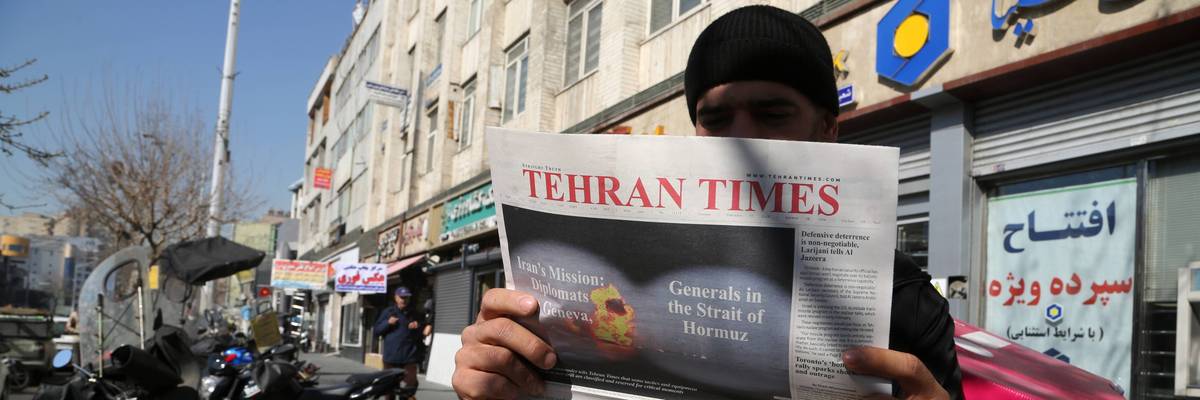
A man reads a newspaper as second round of indirect negotiations between Iran and the US in Geneva is widely covered in Iranian newspapers on February 17, 2026 in Tehran, Iran.
"Like the votes before the Iraq War, this could be one of the most consequential foreign policy decisions in a generation."
Anti-war groups are turning up the pressure on Congress to support a war powers resolution that would limit President Donald Trump's ability to wage war against Iran.
Amid reports that the US is rapidly mobilizing military hardware to the Middle East, Reps. Ro Khanna (D-Calif.) and Thomas Massie (R-Ky.) announced on Wednesday that they'd attempt to force a House vote on a resolution that would prohibit Trump from striking Iran without congressional authorization.
According to a Thursday conversation between Drop Site News journalist Jeremy Scahill and Robert Malley, a former senior US Middle East envoy and lead negotiator of the 2015 Iran nuclear deal, Trump's intention to launch a US attack on Iran is nearly a forgone conclusion at this point.
"Part of the strategy being discussed within the administration," said Scahill, based on sources and conversations over recent months, is that Trump and his team are putting an "ultimatum on the table," but there's actually not a belief that a real negotiation over terms is taking place.
"It's not actually playing out in public this way," said Scahill, "but what I understand is that Trump's people are basically saying to the Iranians: 'We're not just going to deal with the nuclear [issues] here. This has to involve ballistic missile capacity. It has to involve your alliances with armed resistance groups [in places like Syria, Yemen, Lebanon, and Gaza.]'"
"The Iranians have said these are red lines and they're not going to accept this," he continued. "So it seems like what's happening is that Trump is issuing an ultimatum, they know there is almost zero chance the Iranians are going to take it, and then they're going to bomb them. That's really what I'm hearing from inside sources."
Iran's response to Trump's bombing of three nuclear sites in June was measured, but Iranian officials have signaled they are not going to hold back in the event of a broader US strike.
Fouad Isadi, an Iranian professor with knowledge of the government's inner workings, told Scahill last month that in the event of a large-scale strike by Trump, the military was planning a retaliatory strike aimed at killing at least 500 US soldiers.
"We could see the Iranians really hit hard in a way that blows the Americans away on a psychological level and that Trump hasn't had to deal with before," Scahill said on Thursday. "I assume that President Trump's response would be even more enraged and even more brutal than anything one could imagine."
With hope for a deal between Trump and Iran dimming, anti-war groups are saying that Congress may be the only thing standing in the way of a massive conflict.
The Council on American-Islamic Relations (CAIR) urged Americans to contact their members of Congress to oppose what they called an "Israel First War on Iran," noting the heavy involvement of Israeli Prime Minister Benjamin Netanyahu in pressuring President Donald Trump to pursue an aggressive, uncompromising posture toward Iran.
“We call on all Americans to tell their members of Congress to oppose another US regime change war; we call on the media to ask the tough questions it failed to ask in the march to the Iraq invasion; and we call on the Trump administration to put American interests first—not the interests of Netanyahu’s rogue, warmongering government," CAIR wrote in a statement published Thursday.
The Friends Committee on National Legislation, a Quaker group, told its followers to bombard Congress with messages, warning that "strikes on Iran risk widespread civilian suffering inside Iran and could ignite a catastrophic regional war."
Alix Fraser, vice president of the anti-corruption group Issue One, said Trump's threats to carry out "unilateral military action" against Iran "is not an isolated incident but part of a broader troubling pattern."
"Without consulting Congress, the administration is practicing gunboat diplomacy and has gone so far with it as to bring about regime change in Venezuela," Fraser said. "Rep. Khanna’s and Rep. Massie’s bipartisan war powers Resolution is a good first step, but the problem of Congress ceding its war powers goes back decades."
Medea Benjamin, founder of the anti-war women's group CodePink, said that "regardless of how you feel about Iran’s government, another war in the Middle East would be devastating and avoidable," and put US troops "at grave risk of retaliation."
"We've seen this before in Iraq. We can't let history repeat itself," she said. "The people of Iran, whether they like their government or detest it, are terrified of a US attack."
"Congress must act now," she added. "Like the votes before the Iraq War, this could be one of the most consequential foreign policy decisions in a generation."
Dear Common Dreams reader, It’s been nearly 30 years since I co-founded Common Dreams with my late wife, Lina Newhouser. We had the radical notion that journalism should serve the public good, not corporate profits. It was clear to us from the outset what it would take to build such a project. No paid advertisements. No corporate sponsors. No millionaire publisher telling us what to think or do. Many people said we wouldn't last a year, but we proved those doubters wrong. Together with a tremendous team of journalists and dedicated staff, we built an independent media outlet free from the constraints of profits and corporate control. Our mission has always been simple: To inform. To inspire. To ignite change for the common good. Building Common Dreams was not easy. Our survival was never guaranteed. When you take on the most powerful forces—Wall Street greed, fossil fuel industry destruction, Big Tech lobbyists, and uber-rich oligarchs who have spent billions upon billions rigging the economy and democracy in their favor—the only bulwark you have is supporters who believe in your work. But here’s the urgent message from me today. It's never been this bad out there. And it's never been this hard to keep us going. At the very moment Common Dreams is most needed, the threats we face are intensifying. We need your support now more than ever. We don't accept corporate advertising and never will. We don't have a paywall because we don't think people should be blocked from critical news based on their ability to pay. Everything we do is funded by the donations of readers like you. When everyone does the little they can afford, we are strong. But if that support retreats or dries up, so do we. Will you donate now to make sure Common Dreams not only survives but thrives? —Craig Brown, Co-founder |
Anti-war groups are turning up the pressure on Congress to support a war powers resolution that would limit President Donald Trump's ability to wage war against Iran.
Amid reports that the US is rapidly mobilizing military hardware to the Middle East, Reps. Ro Khanna (D-Calif.) and Thomas Massie (R-Ky.) announced on Wednesday that they'd attempt to force a House vote on a resolution that would prohibit Trump from striking Iran without congressional authorization.
According to a Thursday conversation between Drop Site News journalist Jeremy Scahill and Robert Malley, a former senior US Middle East envoy and lead negotiator of the 2015 Iran nuclear deal, Trump's intention to launch a US attack on Iran is nearly a forgone conclusion at this point.
"Part of the strategy being discussed within the administration," said Scahill, based on sources and conversations over recent months, is that Trump and his team are putting an "ultimatum on the table," but there's actually not a belief that a real negotiation over terms is taking place.
"It's not actually playing out in public this way," said Scahill, "but what I understand is that Trump's people are basically saying to the Iranians: 'We're not just going to deal with the nuclear [issues] here. This has to involve ballistic missile capacity. It has to involve your alliances with armed resistance groups [in places like Syria, Yemen, Lebanon, and Gaza.]'"
"The Iranians have said these are red lines and they're not going to accept this," he continued. "So it seems like what's happening is that Trump is issuing an ultimatum, they know there is almost zero chance the Iranians are going to take it, and then they're going to bomb them. That's really what I'm hearing from inside sources."
Iran's response to Trump's bombing of three nuclear sites in June was measured, but Iranian officials have signaled they are not going to hold back in the event of a broader US strike.
Fouad Isadi, an Iranian professor with knowledge of the government's inner workings, told Scahill last month that in the event of a large-scale strike by Trump, the military was planning a retaliatory strike aimed at killing at least 500 US soldiers.
"We could see the Iranians really hit hard in a way that blows the Americans away on a psychological level and that Trump hasn't had to deal with before," Scahill said on Thursday. "I assume that President Trump's response would be even more enraged and even more brutal than anything one could imagine."
With hope for a deal between Trump and Iran dimming, anti-war groups are saying that Congress may be the only thing standing in the way of a massive conflict.
The Council on American-Islamic Relations (CAIR) urged Americans to contact their members of Congress to oppose what they called an "Israel First War on Iran," noting the heavy involvement of Israeli Prime Minister Benjamin Netanyahu in pressuring President Donald Trump to pursue an aggressive, uncompromising posture toward Iran.
“We call on all Americans to tell their members of Congress to oppose another US regime change war; we call on the media to ask the tough questions it failed to ask in the march to the Iraq invasion; and we call on the Trump administration to put American interests first—not the interests of Netanyahu’s rogue, warmongering government," CAIR wrote in a statement published Thursday.
The Friends Committee on National Legislation, a Quaker group, told its followers to bombard Congress with messages, warning that "strikes on Iran risk widespread civilian suffering inside Iran and could ignite a catastrophic regional war."
Alix Fraser, vice president of the anti-corruption group Issue One, said Trump's threats to carry out "unilateral military action" against Iran "is not an isolated incident but part of a broader troubling pattern."
"Without consulting Congress, the administration is practicing gunboat diplomacy and has gone so far with it as to bring about regime change in Venezuela," Fraser said. "Rep. Khanna’s and Rep. Massie’s bipartisan war powers Resolution is a good first step, but the problem of Congress ceding its war powers goes back decades."
Medea Benjamin, founder of the anti-war women's group CodePink, said that "regardless of how you feel about Iran’s government, another war in the Middle East would be devastating and avoidable," and put US troops "at grave risk of retaliation."
"We've seen this before in Iraq. We can't let history repeat itself," she said. "The people of Iran, whether they like their government or detest it, are terrified of a US attack."
"Congress must act now," she added. "Like the votes before the Iraq War, this could be one of the most consequential foreign policy decisions in a generation."
Anti-war groups are turning up the pressure on Congress to support a war powers resolution that would limit President Donald Trump's ability to wage war against Iran.
Amid reports that the US is rapidly mobilizing military hardware to the Middle East, Reps. Ro Khanna (D-Calif.) and Thomas Massie (R-Ky.) announced on Wednesday that they'd attempt to force a House vote on a resolution that would prohibit Trump from striking Iran without congressional authorization.
According to a Thursday conversation between Drop Site News journalist Jeremy Scahill and Robert Malley, a former senior US Middle East envoy and lead negotiator of the 2015 Iran nuclear deal, Trump's intention to launch a US attack on Iran is nearly a forgone conclusion at this point.
"Part of the strategy being discussed within the administration," said Scahill, based on sources and conversations over recent months, is that Trump and his team are putting an "ultimatum on the table," but there's actually not a belief that a real negotiation over terms is taking place.
"It's not actually playing out in public this way," said Scahill, "but what I understand is that Trump's people are basically saying to the Iranians: 'We're not just going to deal with the nuclear [issues] here. This has to involve ballistic missile capacity. It has to involve your alliances with armed resistance groups [in places like Syria, Yemen, Lebanon, and Gaza.]'"
"The Iranians have said these are red lines and they're not going to accept this," he continued. "So it seems like what's happening is that Trump is issuing an ultimatum, they know there is almost zero chance the Iranians are going to take it, and then they're going to bomb them. That's really what I'm hearing from inside sources."
Iran's response to Trump's bombing of three nuclear sites in June was measured, but Iranian officials have signaled they are not going to hold back in the event of a broader US strike.
Fouad Isadi, an Iranian professor with knowledge of the government's inner workings, told Scahill last month that in the event of a large-scale strike by Trump, the military was planning a retaliatory strike aimed at killing at least 500 US soldiers.
"We could see the Iranians really hit hard in a way that blows the Americans away on a psychological level and that Trump hasn't had to deal with before," Scahill said on Thursday. "I assume that President Trump's response would be even more enraged and even more brutal than anything one could imagine."
With hope for a deal between Trump and Iran dimming, anti-war groups are saying that Congress may be the only thing standing in the way of a massive conflict.
The Council on American-Islamic Relations (CAIR) urged Americans to contact their members of Congress to oppose what they called an "Israel First War on Iran," noting the heavy involvement of Israeli Prime Minister Benjamin Netanyahu in pressuring President Donald Trump to pursue an aggressive, uncompromising posture toward Iran.
“We call on all Americans to tell their members of Congress to oppose another US regime change war; we call on the media to ask the tough questions it failed to ask in the march to the Iraq invasion; and we call on the Trump administration to put American interests first—not the interests of Netanyahu’s rogue, warmongering government," CAIR wrote in a statement published Thursday.
The Friends Committee on National Legislation, a Quaker group, told its followers to bombard Congress with messages, warning that "strikes on Iran risk widespread civilian suffering inside Iran and could ignite a catastrophic regional war."
Alix Fraser, vice president of the anti-corruption group Issue One, said Trump's threats to carry out "unilateral military action" against Iran "is not an isolated incident but part of a broader troubling pattern."
"Without consulting Congress, the administration is practicing gunboat diplomacy and has gone so far with it as to bring about regime change in Venezuela," Fraser said. "Rep. Khanna’s and Rep. Massie’s bipartisan war powers Resolution is a good first step, but the problem of Congress ceding its war powers goes back decades."
Medea Benjamin, founder of the anti-war women's group CodePink, said that "regardless of how you feel about Iran’s government, another war in the Middle East would be devastating and avoidable," and put US troops "at grave risk of retaliation."
"We've seen this before in Iraq. We can't let history repeat itself," she said. "The people of Iran, whether they like their government or detest it, are terrified of a US attack."
"Congress must act now," she added. "Like the votes before the Iraq War, this could be one of the most consequential foreign policy decisions in a generation."