SUBSCRIBE TO OUR FREE NEWSLETTER
Daily news & progressive opinion—funded by the people, not the corporations—delivered straight to your inbox.
5
#000000
#FFFFFF
To donate by check, phone, or other method, see our More Ways to Give page.
Daily news & progressive opinion—funded by the people, not the corporations—delivered straight to your inbox.
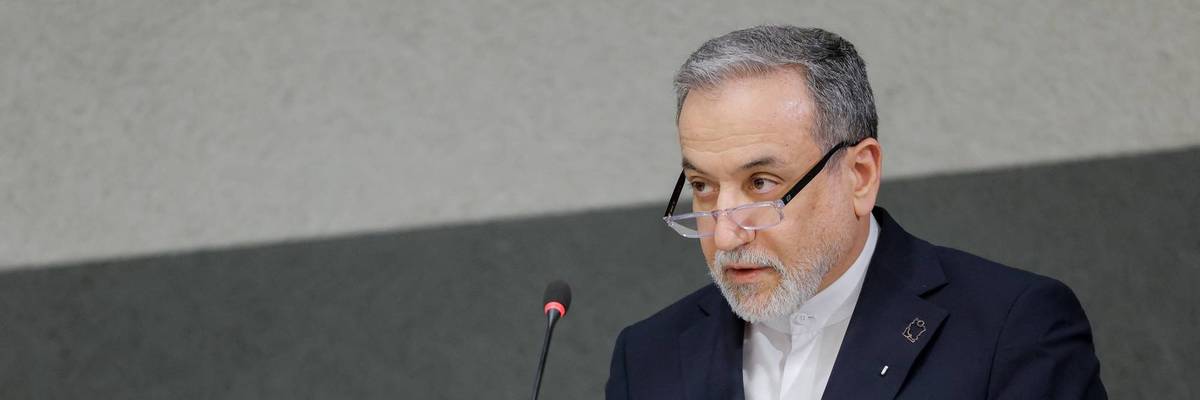
Iranian Foreign Minister Abbas Araghchi delivers a speech during a session of the United Nations Conference on Disarmament, on the sidelines of a second round of US-Iranian talks with Washington pushing Tehran to make a deal to limit its nuclear program, in Geneva, on February 17, 2026.
"I know that a deal is achievable, but it should be fair and based on a win-win solution," said Abbas Araghchi. "A military option would only complicate this, would only bring about disastrous consequences."
As President Donald Trump continued to threaten a potentially massive war, Iran's foreign minister stressed his commitment to peaceful negotiations over Iran's nuclear program.
Amid the largest military buildup in the Middle East since the invasion of Iraq, Trump said on Thursday that he was weighing an initial, limited strike in order to force Iran to negotiate a new deal to limit its nuclear enrichment and would launch a broader attack—potentially aimed at toppling the entire government—if the country refused to do so.
Iranian Foreign Minister Abbas Araghchi responded to these demands in a lengthy interview on MS NOW's "Morning Joe" on Friday, discussing recent talks with the US in Geneva.
"One thing I have to emphasize is that there is no military solution for Iran's nuclear program," Araghchi said. "That was tested last year, and there was a huge attack on our facilities. They killed and assassinated our scientists, but they couldn't kill our nuclear program."
After his strikes on three Iranian nuclear sites in June, Trump claimed to have “obliterated” Iran's nuclear program and enrichment capabilities. But less than a year later, he is once again threatening a much bigger attack on Iran using the same justification.
Iran's Masoud Pezeshkian insisted earlier this week that his country is “absolutely not seeking nuclear weapons” and invited international inspectors in to verify it. Supreme Leader Ali Khamenei, meanwhile, has reiterated that Iran has the right to a nuclear industry.
"If they want a solution for Iran's nuclear program, if they want to ensure that Iran's nuclear program would remain peaceful forever," Araghchi said on Friday, "the only solution is diplomatic negotiation."
Although Iran is allowed to pursue nuclear power for peaceful means under the Nuclear Nonproliferation Treaty (NPT), Trump publicly declared that he would not accept a deal that allows "any enrichment” by Iran.
Araghchi, however, said that's not what the discussion has looked like behind the scenes. "The US side has not asked for zero enrichment,” he said.
Instead, he said they discussed "political commitments and technical measures" to "make sure that this program is only for peaceful purposes" and said the International Atomic Energy Agency (IAEA), the UN's nuclear watchdog, was involved in helping to craft them.
"This is what we have already done in 2015," Araghchi said, referring to the first nuclear deal between Iran and the US, which Trump ripped up during his first term, even though Iran was complying with its strict enrichment limits. "I believe that we can do it again, even a better one," he said.
Although the US president warned on Thursday that Iran must agree to a deal within 10 days or "bad things happen," Araghchi said there has been "no ultimatum" from Trump and that the only discussion between the two sides was on how to reach a "fast deal."
"We are under sanctions. Obviously, any day the sanctions are terminated sooner would be better for us. So we have no reason to delay a possible deal," Araghchi said. "For the US side also, President Trump and his team are interested in a quick deal. So we agreed to work with each other to achieve a deal as soon as possible. The only question is how to make it a fair deal, a win-win deal, an equitable deal."
Trump has also demanded that Iran surrender its ballistic missile program and support for regional allies in Gaza, Lebanon, and Yemen, which Iran has said are nonstarters. Israeli Prime Minister Benjamin Netanyahu has nudged Trump keep pushing these maximal demands and has been accused of attempting to goad the US into war with its number one adversary by injecting "poison pills" into the negotiations.
Araghchi did not clarify the extent to which these demands have come up as sticking points during recent talks.
"I know that a deal is achievable, but it should be fair and based on a win-win solution," Araghchi said. "[A] military option would only complicate this, would only bring about disastrous consequences, not only for us, perhaps for the whole region and for the whole international community, which is fed up with different escalations and wars in our region and beyond."
Soon after Araghchi's interview aired, Trump told reporters he was considering a military strike to force Iran into a deal.
“I guess I can say I am considering that,” he said at the start of a meeting with governors at the White House.
This country and this world are at a monumental crossroads. US voters have an opportunity to beat back the forces of fascism and confront the billionaires who are rigging the economy, our media system, and our democracy, making it increasingly impossible for ordinary people to get by. We’re not just talking about the election. We’re talking about what must be done once these fascist elements are vanquished from power. We need a bolder set of solutions than what either major party has so far been willing to offer and a working-class movement ready to fight like hell for it. Trump didn't emerge from nowhere. The conditions that fueled MAGA authoritarianism were created by decades of radical neoliberal economic policies and a corrupt political system dominated by corporate interests. They slashed taxes on the super-rich, promising that the benefits would trickle down. They said giveaways to the corporate titans would make life more affordable for the rest of us. It was all bullshit. And when a bitter, betrayed populace searches for someone to blame, right-wing demagogues have little trouble finding scapegoats. People know when they're being lied to, but you won't hear any of this from the corporate media. Only independent journalism—powered and funded by people who believe in building a better world—can deliver truly trustworthy daily news. If you share our vision, please contribute whatever you can to sustain our work. |
As President Donald Trump continued to threaten a potentially massive war, Iran's foreign minister stressed his commitment to peaceful negotiations over Iran's nuclear program.
Amid the largest military buildup in the Middle East since the invasion of Iraq, Trump said on Thursday that he was weighing an initial, limited strike in order to force Iran to negotiate a new deal to limit its nuclear enrichment and would launch a broader attack—potentially aimed at toppling the entire government—if the country refused to do so.
Iranian Foreign Minister Abbas Araghchi responded to these demands in a lengthy interview on MS NOW's "Morning Joe" on Friday, discussing recent talks with the US in Geneva.
"One thing I have to emphasize is that there is no military solution for Iran's nuclear program," Araghchi said. "That was tested last year, and there was a huge attack on our facilities. They killed and assassinated our scientists, but they couldn't kill our nuclear program."
After his strikes on three Iranian nuclear sites in June, Trump claimed to have “obliterated” Iran's nuclear program and enrichment capabilities. But less than a year later, he is once again threatening a much bigger attack on Iran using the same justification.
Iran's Masoud Pezeshkian insisted earlier this week that his country is “absolutely not seeking nuclear weapons” and invited international inspectors in to verify it. Supreme Leader Ali Khamenei, meanwhile, has reiterated that Iran has the right to a nuclear industry.
"If they want a solution for Iran's nuclear program, if they want to ensure that Iran's nuclear program would remain peaceful forever," Araghchi said on Friday, "the only solution is diplomatic negotiation."
Although Iran is allowed to pursue nuclear power for peaceful means under the Nuclear Nonproliferation Treaty (NPT), Trump publicly declared that he would not accept a deal that allows "any enrichment” by Iran.
Araghchi, however, said that's not what the discussion has looked like behind the scenes. "The US side has not asked for zero enrichment,” he said.
Instead, he said they discussed "political commitments and technical measures" to "make sure that this program is only for peaceful purposes" and said the International Atomic Energy Agency (IAEA), the UN's nuclear watchdog, was involved in helping to craft them.
"This is what we have already done in 2015," Araghchi said, referring to the first nuclear deal between Iran and the US, which Trump ripped up during his first term, even though Iran was complying with its strict enrichment limits. "I believe that we can do it again, even a better one," he said.
Although the US president warned on Thursday that Iran must agree to a deal within 10 days or "bad things happen," Araghchi said there has been "no ultimatum" from Trump and that the only discussion between the two sides was on how to reach a "fast deal."
"We are under sanctions. Obviously, any day the sanctions are terminated sooner would be better for us. So we have no reason to delay a possible deal," Araghchi said. "For the US side also, President Trump and his team are interested in a quick deal. So we agreed to work with each other to achieve a deal as soon as possible. The only question is how to make it a fair deal, a win-win deal, an equitable deal."
Trump has also demanded that Iran surrender its ballistic missile program and support for regional allies in Gaza, Lebanon, and Yemen, which Iran has said are nonstarters. Israeli Prime Minister Benjamin Netanyahu has nudged Trump keep pushing these maximal demands and has been accused of attempting to goad the US into war with its number one adversary by injecting "poison pills" into the negotiations.
Araghchi did not clarify the extent to which these demands have come up as sticking points during recent talks.
"I know that a deal is achievable, but it should be fair and based on a win-win solution," Araghchi said. "[A] military option would only complicate this, would only bring about disastrous consequences, not only for us, perhaps for the whole region and for the whole international community, which is fed up with different escalations and wars in our region and beyond."
Soon after Araghchi's interview aired, Trump told reporters he was considering a military strike to force Iran into a deal.
“I guess I can say I am considering that,” he said at the start of a meeting with governors at the White House.