SUBSCRIBE TO OUR FREE NEWSLETTER
Daily news & progressive opinion—funded by the people, not the corporations—delivered straight to your inbox.
5
#000000
#FFFFFF
To donate by check, phone, or other method, see our More Ways to Give page.
Daily news & progressive opinion—funded by the people, not the corporations—delivered straight to your inbox.
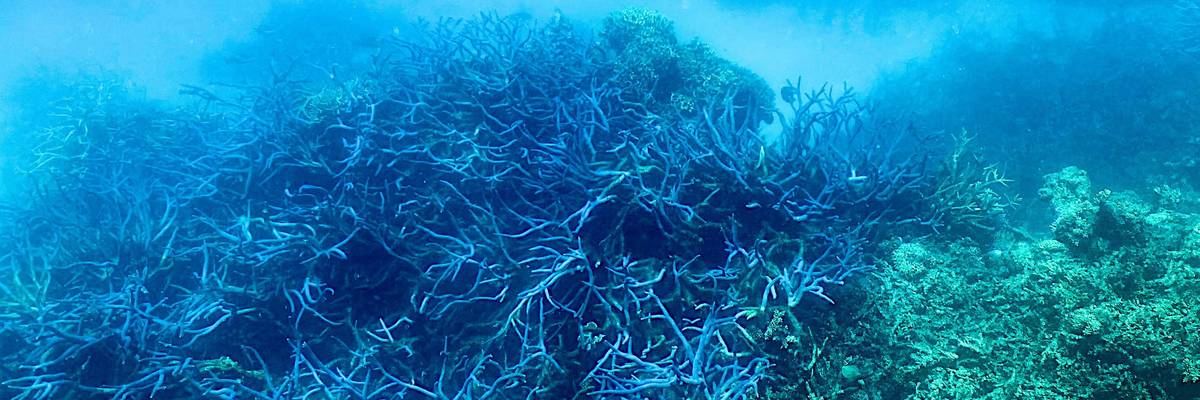
This picture taken on March 7, 2022 shows the condition of the coral on the Great Barrier Reef, off the coast of the Australian state of Queensland.
Persistent marine heatwaves are causing a "staircase of decline that becomes harder to reverse with every bleaching event," said one scientist.
The destruction of coral reef cover, cataloged in the largest global assessment of the reefs ever completed, was distressing to scientists, with the world's reefs declining by nearly 10% between 2020-24, compared with 1980-2009.
The authors of the report released Monday by Global Coral Reef Monitoring Network (GCRMN), however, emphasized that coral bleaching events driven by ocean heating was not the most worrisome finding of the analysis—but rather, the fact oceans have become so warm that stressed reefs have less and less time to recover.
Historically, coral bleaching events—in which changes in conditions such as ocean temperatures and pollution cause coral to expel its symbiotic algae and become completely white and more vulnerable to mortality—have taken place about once in a decade, giving the reefs years to recover.
Now, the reefs are “lucky to get five or six years,” as water temperatures are remaining high and making it more difficult to regain hard coral cover, explained Manuel González Rivero of the Australian Institute of Marine Science, the lead author of the report, titled “Status of Coral Reefs of the World: 2025.”
“After decades of studying coral reefs, what concerns me most isn’t the current loss of hard coral cover; it’s that we’re steadily eroding the conditions they need to recover,” said González Rivero. “Climate change is driving more frequent and severe marine heatwaves, but local pressures such as poor water quality, overfishing, and coastal development are making reefs even less able to withstand them."
The study compiled 21.1 million observations from 36,886 reef sites across 124 countries and territories, drawing on more than 40 years of data from across the globe.
But scientists cautioned that because the research did not include the most recent and intense global bleaching event, which lasted from 2023-25, it may not provide a full picture of the danger coral reefs are in—as well as the coastal communities they help protect and the thousands of marine species they serve as a habitat for.
Carlos Duarte, a marine scientist at the Coral Research and Development Accelerator Platform, told The New York Times that this year's El Niño warming trend is likely to cause another global bleaching event next year, which reefs will likely struggle to recover from as ocean temperatures have been recorded as getting hotter and hotter in recent years.
The Intergovernmental Panel on Climate Change has projected that the Earth will lose 70-90% of its coral reef cover if the planet gets 1.5°C hotter than its preindustrial level.
"For many reefs affected by the unprecedented marine heatwaves in 2024, this year’s El Niño likely means they’ll have had little more than a year to begin recovering before being hit again," said González Rivero. "This is creating a staircase of decline that becomes harder to reverse with every bleaching event.“
The report emphasizes that reefs have maintained their ability to regain hard coral cover "when disturbances are reduced and sufficient recovery time is available," such as after the third major global coral bleaching event since 1998, which took place from 2016-17 and saw a 6.6% decline in coral.
After the event, scientists observed a "relative increase of approximately 6% between 2017 and 2019," said the GCRMN.
"That recovery matters because the benefits coral reefs provide extend far beyond the reef itself. Coral reefs cover less than 0.2% of the ocean floor," said the organization. "Yet, they support at least 25% of all marine species and underpin food security, livelihoods, coastal protection, tourism, and cultural heritage of close to one billion people worldwide."
Scientists including Terry Hughes, a former director of coral reef studies at James Cook University in Australia, who was not involved in the analysis, emphasized that reducing planet-heating emissions is the top solution to the crisis of coral reef recovery, as the pollution from fossil fuel extraction is linked to increasingly hot oceans.
Allowing coral reefs to recover from bleaching events "really depends on how much more greenhouse gases go into the atmosphere and the amount of warming that causes," Hughes told the Times, while local solutions including reducing water pollution are also crucial for maintaining reef health.
David Obura, chair of the Intergovernmental Science-Policy Platform on Biodiversity and Ecosystem Services, expressed hope that the report will "shake us out of our persistent inertia."
The long-term monitoring by GCRMN, said Obura, "tracks not just the pulse of coral reefs, but of our planet too. It shows which regions are under the greatest pressure, that actions to date have not been sufficient, and warns where reefs will be under increasing threat in years to come."
"We must act now to halt this decline and invest in solutions that reduce pressures and build resilience, while sustaining the monitoring that turns good intentions into effective policy," he said. "The 40 years of data in this report provide a strident warning that delayed action risks locking in irreversible losses—not just to reefs, but also to the economies and people that depend on them.”
Dear Common Dreams reader, It’s been nearly 30 years since I co-founded Common Dreams with my late wife, Lina Newhouser. We had the radical notion that journalism should serve the public good, not corporate profits. It was clear to us from the outset what it would take to build such a project. No paid advertisements. No corporate sponsors. No millionaire publisher telling us what to think or do. Many people said we wouldn't last a year, but we proved those doubters wrong. Together with a tremendous team of journalists and dedicated staff, we built an independent media outlet free from the constraints of profits and corporate control. Our mission has always been simple: To inform. To inspire. To ignite change for the common good. Building Common Dreams was not easy. Our survival was never guaranteed. When you take on the most powerful forces—Wall Street greed, fossil fuel industry destruction, Big Tech lobbyists, and uber-rich oligarchs who have spent billions upon billions rigging the economy and democracy in their favor—the only bulwark you have is supporters who believe in your work. But here’s the urgent message from me today. It's never been this bad out there. And it's never been this hard to keep us going. At the very moment Common Dreams is most needed, the threats we face are intensifying. We need your support now more than ever. We don't accept corporate advertising and never will. We don't have a paywall because we don't think people should be blocked from critical news based on their ability to pay. Everything we do is funded by the donations of readers like you. When everyone does the little they can afford, we are strong. But if that support retreats or dries up, so do we. Will you donate now to make sure Common Dreams not only survives but thrives? —Craig Brown, Co-founder |
The destruction of coral reef cover, cataloged in the largest global assessment of the reefs ever completed, was distressing to scientists, with the world's reefs declining by nearly 10% between 2020-24, compared with 1980-2009.
The authors of the report released Monday by Global Coral Reef Monitoring Network (GCRMN), however, emphasized that coral bleaching events driven by ocean heating was not the most worrisome finding of the analysis—but rather, the fact oceans have become so warm that stressed reefs have less and less time to recover.
Historically, coral bleaching events—in which changes in conditions such as ocean temperatures and pollution cause coral to expel its symbiotic algae and become completely white and more vulnerable to mortality—have taken place about once in a decade, giving the reefs years to recover.
Now, the reefs are “lucky to get five or six years,” as water temperatures are remaining high and making it more difficult to regain hard coral cover, explained Manuel González Rivero of the Australian Institute of Marine Science, the lead author of the report, titled “Status of Coral Reefs of the World: 2025.”
“After decades of studying coral reefs, what concerns me most isn’t the current loss of hard coral cover; it’s that we’re steadily eroding the conditions they need to recover,” said González Rivero. “Climate change is driving more frequent and severe marine heatwaves, but local pressures such as poor water quality, overfishing, and coastal development are making reefs even less able to withstand them."
The study compiled 21.1 million observations from 36,886 reef sites across 124 countries and territories, drawing on more than 40 years of data from across the globe.
But scientists cautioned that because the research did not include the most recent and intense global bleaching event, which lasted from 2023-25, it may not provide a full picture of the danger coral reefs are in—as well as the coastal communities they help protect and the thousands of marine species they serve as a habitat for.
Carlos Duarte, a marine scientist at the Coral Research and Development Accelerator Platform, told The New York Times that this year's El Niño warming trend is likely to cause another global bleaching event next year, which reefs will likely struggle to recover from as ocean temperatures have been recorded as getting hotter and hotter in recent years.
The Intergovernmental Panel on Climate Change has projected that the Earth will lose 70-90% of its coral reef cover if the planet gets 1.5°C hotter than its preindustrial level.
"For many reefs affected by the unprecedented marine heatwaves in 2024, this year’s El Niño likely means they’ll have had little more than a year to begin recovering before being hit again," said González Rivero. "This is creating a staircase of decline that becomes harder to reverse with every bleaching event.“
The report emphasizes that reefs have maintained their ability to regain hard coral cover "when disturbances are reduced and sufficient recovery time is available," such as after the third major global coral bleaching event since 1998, which took place from 2016-17 and saw a 6.6% decline in coral.
After the event, scientists observed a "relative increase of approximately 6% between 2017 and 2019," said the GCRMN.
"That recovery matters because the benefits coral reefs provide extend far beyond the reef itself. Coral reefs cover less than 0.2% of the ocean floor," said the organization. "Yet, they support at least 25% of all marine species and underpin food security, livelihoods, coastal protection, tourism, and cultural heritage of close to one billion people worldwide."
Scientists including Terry Hughes, a former director of coral reef studies at James Cook University in Australia, who was not involved in the analysis, emphasized that reducing planet-heating emissions is the top solution to the crisis of coral reef recovery, as the pollution from fossil fuel extraction is linked to increasingly hot oceans.
Allowing coral reefs to recover from bleaching events "really depends on how much more greenhouse gases go into the atmosphere and the amount of warming that causes," Hughes told the Times, while local solutions including reducing water pollution are also crucial for maintaining reef health.
David Obura, chair of the Intergovernmental Science-Policy Platform on Biodiversity and Ecosystem Services, expressed hope that the report will "shake us out of our persistent inertia."
The long-term monitoring by GCRMN, said Obura, "tracks not just the pulse of coral reefs, but of our planet too. It shows which regions are under the greatest pressure, that actions to date have not been sufficient, and warns where reefs will be under increasing threat in years to come."
"We must act now to halt this decline and invest in solutions that reduce pressures and build resilience, while sustaining the monitoring that turns good intentions into effective policy," he said. "The 40 years of data in this report provide a strident warning that delayed action risks locking in irreversible losses—not just to reefs, but also to the economies and people that depend on them.”
The destruction of coral reef cover, cataloged in the largest global assessment of the reefs ever completed, was distressing to scientists, with the world's reefs declining by nearly 10% between 2020-24, compared with 1980-2009.
The authors of the report released Monday by Global Coral Reef Monitoring Network (GCRMN), however, emphasized that coral bleaching events driven by ocean heating was not the most worrisome finding of the analysis—but rather, the fact oceans have become so warm that stressed reefs have less and less time to recover.
Historically, coral bleaching events—in which changes in conditions such as ocean temperatures and pollution cause coral to expel its symbiotic algae and become completely white and more vulnerable to mortality—have taken place about once in a decade, giving the reefs years to recover.
Now, the reefs are “lucky to get five or six years,” as water temperatures are remaining high and making it more difficult to regain hard coral cover, explained Manuel González Rivero of the Australian Institute of Marine Science, the lead author of the report, titled “Status of Coral Reefs of the World: 2025.”
“After decades of studying coral reefs, what concerns me most isn’t the current loss of hard coral cover; it’s that we’re steadily eroding the conditions they need to recover,” said González Rivero. “Climate change is driving more frequent and severe marine heatwaves, but local pressures such as poor water quality, overfishing, and coastal development are making reefs even less able to withstand them."
The study compiled 21.1 million observations from 36,886 reef sites across 124 countries and territories, drawing on more than 40 years of data from across the globe.
But scientists cautioned that because the research did not include the most recent and intense global bleaching event, which lasted from 2023-25, it may not provide a full picture of the danger coral reefs are in—as well as the coastal communities they help protect and the thousands of marine species they serve as a habitat for.
Carlos Duarte, a marine scientist at the Coral Research and Development Accelerator Platform, told The New York Times that this year's El Niño warming trend is likely to cause another global bleaching event next year, which reefs will likely struggle to recover from as ocean temperatures have been recorded as getting hotter and hotter in recent years.
The Intergovernmental Panel on Climate Change has projected that the Earth will lose 70-90% of its coral reef cover if the planet gets 1.5°C hotter than its preindustrial level.
"For many reefs affected by the unprecedented marine heatwaves in 2024, this year’s El Niño likely means they’ll have had little more than a year to begin recovering before being hit again," said González Rivero. "This is creating a staircase of decline that becomes harder to reverse with every bleaching event.“
The report emphasizes that reefs have maintained their ability to regain hard coral cover "when disturbances are reduced and sufficient recovery time is available," such as after the third major global coral bleaching event since 1998, which took place from 2016-17 and saw a 6.6% decline in coral.
After the event, scientists observed a "relative increase of approximately 6% between 2017 and 2019," said the GCRMN.
"That recovery matters because the benefits coral reefs provide extend far beyond the reef itself. Coral reefs cover less than 0.2% of the ocean floor," said the organization. "Yet, they support at least 25% of all marine species and underpin food security, livelihoods, coastal protection, tourism, and cultural heritage of close to one billion people worldwide."
Scientists including Terry Hughes, a former director of coral reef studies at James Cook University in Australia, who was not involved in the analysis, emphasized that reducing planet-heating emissions is the top solution to the crisis of coral reef recovery, as the pollution from fossil fuel extraction is linked to increasingly hot oceans.
Allowing coral reefs to recover from bleaching events "really depends on how much more greenhouse gases go into the atmosphere and the amount of warming that causes," Hughes told the Times, while local solutions including reducing water pollution are also crucial for maintaining reef health.
David Obura, chair of the Intergovernmental Science-Policy Platform on Biodiversity and Ecosystem Services, expressed hope that the report will "shake us out of our persistent inertia."
The long-term monitoring by GCRMN, said Obura, "tracks not just the pulse of coral reefs, but of our planet too. It shows which regions are under the greatest pressure, that actions to date have not been sufficient, and warns where reefs will be under increasing threat in years to come."
"We must act now to halt this decline and invest in solutions that reduce pressures and build resilience, while sustaining the monitoring that turns good intentions into effective policy," he said. "The 40 years of data in this report provide a strident warning that delayed action risks locking in irreversible losses—not just to reefs, but also to the economies and people that depend on them.”