SUBSCRIBE TO OUR FREE NEWSLETTER
Daily news & progressive opinion—funded by the people, not the corporations—delivered straight to your inbox.
5
#000000
#FFFFFF
To donate by check, phone, or other method, see our More Ways to Give page.
Daily news & progressive opinion—funded by the people, not the corporations—delivered straight to your inbox.
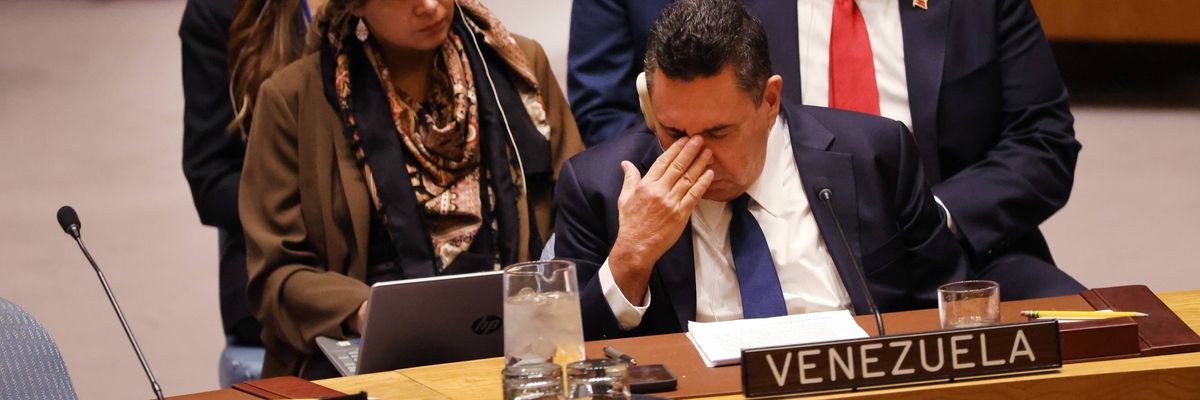
Samuel Reinaldo Moncada Acosta, the Permanent Representative of Venezuela to the United Nations, reacts during an emergency United Nations (U.N.) Security Council meeting regarding the situation in Venezuela on December 23, 2025 at UN headquarters in New York City. Venezuelan officials formally requested the meeting last week, pointing to U.S. maritime actions and oil sanctions.
"The illegal use of force, and threats to use further force at sea and on land, gravely endanger the human right to life and other rights in Venezuela and the region."
Experts at the United Nations on Wednesday issued a scathing rebuke to US President Donald Trump's aggression toward Venezuela, saying attempts to impose an oil blockade based on US-imposed sanctions and a series of bombings of alleged drug-trafficking vessels at sea are clear violations of international law.
“There is no right to enforce unilateral sanctions through an armed blockade,” said the UN experts.
According to their statement:
A blockade is a prohibited use of military force against another country under article 2(4) of the UN Charter. “It is such a serious use of force that it is also expressly recognized as illegal armed aggression under the General Assembly’s 1974 Definition of Aggression,” the experts said.
“As such, it is an armed attack under article 51 of the Charter – in principle giving the victim State a right of self-defence,” they said.
“The illegal use of force, and threats to use further force at sea and on land, gravely endanger the human right to life and other rights in Venezuela and the region,” the experts said.
Aggression is a crime attracting universal jurisdiction under international law, which gives all countries the power to prosecute it, although the most senior government leaders retain immunity from foreign prosecution while still in office.
The experts behind the joint statement were: Ben Saul, Special Rapporteur on the promotion and protection of human rights and fundamental freedoms while countering terrorism; George Katrougalos, Independent Expert on the promotion of a democratic and equitable international order; Surya Deva, Special Rapporteur on the right to development; and Gina Romero, Special Rapporteur on the rights to freedom of peaceful assembly and of association.
Their statement notes that the US sanctions imposed on Venezuela may be "unlawful" because they are "disproportionate and punitive" under international statute. The Trump administration has used alleged violations of US sanctions to justify its blockade and the seizure of vessels.
"The threat is not Venezuela. The threat is the US government." —Venezuela UN Ambassador Samuel Moncada
The aggression of the US government toward Venezuela was also rebuked at an emergency meeting of the UN Security Council on Tuesday, with China, Russia, Cuba, Colombia, and others backing Venezuela's call for an end to the series of criminal boat bombings against alleged drug traffickers in the Caribbean and eastern Pacific and the unlawful seizure of oil tankers as a way to coerce the government of President Nicolas Maduro.
Venezuela's UN Ambassador Samuel Moncada equated Trump's Dec. 16 order that the US was establishing a "total and complete blockade of all sanctioned oil tankers" coming into or out of Venezuela an admission of "a crime of aggression" by the US president, who Moncada said wants to “turn back the clock of history 200 years to establish a colony" in the Latin American country.
Moncada characterized the recent US seizure of two oil tankers in international waters as "worse than piracy" and "robbery carried out by military force," warning that such brazen acts set "an extremely serious precedent for the security and navigation of international trade" in the region and worldwide.
"We are in the presence of a power that acts outside of international law," he said of the US delegation, "demanding that Venezuelans vacate our country and hand it over. We are talking about pillaging, looting, and recolonization of Venezuela."
During his comments to the council, Mike Waltz, the US Representative to the UN, defended Trump's policies by calling the threat of "transnational terrorist and criminal groups" the "single most serious threat" in the hemisphere. Waltz repeatedly claimed, without providing evidence, that Maduro's government is part of a criminal gang called "Cartel de Los Soles," which Moncada said was "ridiculous" as the group is "non-existent," an invention of the Trump administration.
Human rights groups, UN experts, and scholars of international have all stated that Trump's extrajudicial targeting of alleged drug boats—which have now left over 100 people killed—are nothing short of "murder" on the high seas.
In their Wednesday statement, the four UN experts said the killings at sea ordered by Trump "amount to violations of the right to life," citing the International Covenant on Civil and Political Rights, which the US government ratified in 1992.
The experts called on all UN member states "to urgently take all feasible measures to stop the blockade and illegal killings" by the US government, "including through diplomatic protest, General Assembly resolutions, and peaceful counter-measures—and bring perpetrators justice."
“Collective action by States is essential to uphold international law,” they said. “Respect for the rule of law, sovereignty, non-use of force, non-intervention, and the peaceful settlement of disputes are essential to preserving peace and stability worldwide.”
In his remarks, Moncada said Venezuela would defend itself against aggression but did not consider itself at war with the United States.
"Let it be clear once and for all that there is no war in the Caribbean, there is no international armed conflict, nor is there a non-international one, which is why it is absurd for the US government to seek to justify its actions by applying the rules of war," Moncada told the council.
"The threat is not Venezuela," he said. "The threat is the US government."
Dear Common Dreams reader, It’s been nearly 30 years since I co-founded Common Dreams with my late wife, Lina Newhouser. We had the radical notion that journalism should serve the public good, not corporate profits. It was clear to us from the outset what it would take to build such a project. No paid advertisements. No corporate sponsors. No millionaire publisher telling us what to think or do. Many people said we wouldn't last a year, but we proved those doubters wrong. Together with a tremendous team of journalists and dedicated staff, we built an independent media outlet free from the constraints of profits and corporate control. Our mission has always been simple: To inform. To inspire. To ignite change for the common good. Building Common Dreams was not easy. Our survival was never guaranteed. When you take on the most powerful forces—Wall Street greed, fossil fuel industry destruction, Big Tech lobbyists, and uber-rich oligarchs who have spent billions upon billions rigging the economy and democracy in their favor—the only bulwark you have is supporters who believe in your work. But here’s the urgent message from me today. It's never been this bad out there. And it's never been this hard to keep us going. At the very moment Common Dreams is most needed, the threats we face are intensifying. We need your support now more than ever. We don't accept corporate advertising and never will. We don't have a paywall because we don't think people should be blocked from critical news based on their ability to pay. Everything we do is funded by the donations of readers like you. When everyone does the little they can afford, we are strong. But if that support retreats or dries up, so do we. Will you donate now to make sure Common Dreams not only survives but thrives? —Craig Brown, Co-founder |
Experts at the United Nations on Wednesday issued a scathing rebuke to US President Donald Trump's aggression toward Venezuela, saying attempts to impose an oil blockade based on US-imposed sanctions and a series of bombings of alleged drug-trafficking vessels at sea are clear violations of international law.
“There is no right to enforce unilateral sanctions through an armed blockade,” said the UN experts.
According to their statement:
A blockade is a prohibited use of military force against another country under article 2(4) of the UN Charter. “It is such a serious use of force that it is also expressly recognized as illegal armed aggression under the General Assembly’s 1974 Definition of Aggression,” the experts said.
“As such, it is an armed attack under article 51 of the Charter – in principle giving the victim State a right of self-defence,” they said.
“The illegal use of force, and threats to use further force at sea and on land, gravely endanger the human right to life and other rights in Venezuela and the region,” the experts said.
Aggression is a crime attracting universal jurisdiction under international law, which gives all countries the power to prosecute it, although the most senior government leaders retain immunity from foreign prosecution while still in office.
The experts behind the joint statement were: Ben Saul, Special Rapporteur on the promotion and protection of human rights and fundamental freedoms while countering terrorism; George Katrougalos, Independent Expert on the promotion of a democratic and equitable international order; Surya Deva, Special Rapporteur on the right to development; and Gina Romero, Special Rapporteur on the rights to freedom of peaceful assembly and of association.
Their statement notes that the US sanctions imposed on Venezuela may be "unlawful" because they are "disproportionate and punitive" under international statute. The Trump administration has used alleged violations of US sanctions to justify its blockade and the seizure of vessels.
"The threat is not Venezuela. The threat is the US government." —Venezuela UN Ambassador Samuel Moncada
The aggression of the US government toward Venezuela was also rebuked at an emergency meeting of the UN Security Council on Tuesday, with China, Russia, Cuba, Colombia, and others backing Venezuela's call for an end to the series of criminal boat bombings against alleged drug traffickers in the Caribbean and eastern Pacific and the unlawful seizure of oil tankers as a way to coerce the government of President Nicolas Maduro.
Venezuela's UN Ambassador Samuel Moncada equated Trump's Dec. 16 order that the US was establishing a "total and complete blockade of all sanctioned oil tankers" coming into or out of Venezuela an admission of "a crime of aggression" by the US president, who Moncada said wants to “turn back the clock of history 200 years to establish a colony" in the Latin American country.
Moncada characterized the recent US seizure of two oil tankers in international waters as "worse than piracy" and "robbery carried out by military force," warning that such brazen acts set "an extremely serious precedent for the security and navigation of international trade" in the region and worldwide.
"We are in the presence of a power that acts outside of international law," he said of the US delegation, "demanding that Venezuelans vacate our country and hand it over. We are talking about pillaging, looting, and recolonization of Venezuela."
During his comments to the council, Mike Waltz, the US Representative to the UN, defended Trump's policies by calling the threat of "transnational terrorist and criminal groups" the "single most serious threat" in the hemisphere. Waltz repeatedly claimed, without providing evidence, that Maduro's government is part of a criminal gang called "Cartel de Los Soles," which Moncada said was "ridiculous" as the group is "non-existent," an invention of the Trump administration.
Human rights groups, UN experts, and scholars of international have all stated that Trump's extrajudicial targeting of alleged drug boats—which have now left over 100 people killed—are nothing short of "murder" on the high seas.
In their Wednesday statement, the four UN experts said the killings at sea ordered by Trump "amount to violations of the right to life," citing the International Covenant on Civil and Political Rights, which the US government ratified in 1992.
The experts called on all UN member states "to urgently take all feasible measures to stop the blockade and illegal killings" by the US government, "including through diplomatic protest, General Assembly resolutions, and peaceful counter-measures—and bring perpetrators justice."
“Collective action by States is essential to uphold international law,” they said. “Respect for the rule of law, sovereignty, non-use of force, non-intervention, and the peaceful settlement of disputes are essential to preserving peace and stability worldwide.”
In his remarks, Moncada said Venezuela would defend itself against aggression but did not consider itself at war with the United States.
"Let it be clear once and for all that there is no war in the Caribbean, there is no international armed conflict, nor is there a non-international one, which is why it is absurd for the US government to seek to justify its actions by applying the rules of war," Moncada told the council.
"The threat is not Venezuela," he said. "The threat is the US government."
Experts at the United Nations on Wednesday issued a scathing rebuke to US President Donald Trump's aggression toward Venezuela, saying attempts to impose an oil blockade based on US-imposed sanctions and a series of bombings of alleged drug-trafficking vessels at sea are clear violations of international law.
“There is no right to enforce unilateral sanctions through an armed blockade,” said the UN experts.
According to their statement:
A blockade is a prohibited use of military force against another country under article 2(4) of the UN Charter. “It is such a serious use of force that it is also expressly recognized as illegal armed aggression under the General Assembly’s 1974 Definition of Aggression,” the experts said.
“As such, it is an armed attack under article 51 of the Charter – in principle giving the victim State a right of self-defence,” they said.
“The illegal use of force, and threats to use further force at sea and on land, gravely endanger the human right to life and other rights in Venezuela and the region,” the experts said.
Aggression is a crime attracting universal jurisdiction under international law, which gives all countries the power to prosecute it, although the most senior government leaders retain immunity from foreign prosecution while still in office.
The experts behind the joint statement were: Ben Saul, Special Rapporteur on the promotion and protection of human rights and fundamental freedoms while countering terrorism; George Katrougalos, Independent Expert on the promotion of a democratic and equitable international order; Surya Deva, Special Rapporteur on the right to development; and Gina Romero, Special Rapporteur on the rights to freedom of peaceful assembly and of association.
Their statement notes that the US sanctions imposed on Venezuela may be "unlawful" because they are "disproportionate and punitive" under international statute. The Trump administration has used alleged violations of US sanctions to justify its blockade and the seizure of vessels.
"The threat is not Venezuela. The threat is the US government." —Venezuela UN Ambassador Samuel Moncada
The aggression of the US government toward Venezuela was also rebuked at an emergency meeting of the UN Security Council on Tuesday, with China, Russia, Cuba, Colombia, and others backing Venezuela's call for an end to the series of criminal boat bombings against alleged drug traffickers in the Caribbean and eastern Pacific and the unlawful seizure of oil tankers as a way to coerce the government of President Nicolas Maduro.
Venezuela's UN Ambassador Samuel Moncada equated Trump's Dec. 16 order that the US was establishing a "total and complete blockade of all sanctioned oil tankers" coming into or out of Venezuela an admission of "a crime of aggression" by the US president, who Moncada said wants to “turn back the clock of history 200 years to establish a colony" in the Latin American country.
Moncada characterized the recent US seizure of two oil tankers in international waters as "worse than piracy" and "robbery carried out by military force," warning that such brazen acts set "an extremely serious precedent for the security and navigation of international trade" in the region and worldwide.
"We are in the presence of a power that acts outside of international law," he said of the US delegation, "demanding that Venezuelans vacate our country and hand it over. We are talking about pillaging, looting, and recolonization of Venezuela."
During his comments to the council, Mike Waltz, the US Representative to the UN, defended Trump's policies by calling the threat of "transnational terrorist and criminal groups" the "single most serious threat" in the hemisphere. Waltz repeatedly claimed, without providing evidence, that Maduro's government is part of a criminal gang called "Cartel de Los Soles," which Moncada said was "ridiculous" as the group is "non-existent," an invention of the Trump administration.
Human rights groups, UN experts, and scholars of international have all stated that Trump's extrajudicial targeting of alleged drug boats—which have now left over 100 people killed—are nothing short of "murder" on the high seas.
In their Wednesday statement, the four UN experts said the killings at sea ordered by Trump "amount to violations of the right to life," citing the International Covenant on Civil and Political Rights, which the US government ratified in 1992.
The experts called on all UN member states "to urgently take all feasible measures to stop the blockade and illegal killings" by the US government, "including through diplomatic protest, General Assembly resolutions, and peaceful counter-measures—and bring perpetrators justice."
“Collective action by States is essential to uphold international law,” they said. “Respect for the rule of law, sovereignty, non-use of force, non-intervention, and the peaceful settlement of disputes are essential to preserving peace and stability worldwide.”
In his remarks, Moncada said Venezuela would defend itself against aggression but did not consider itself at war with the United States.
"Let it be clear once and for all that there is no war in the Caribbean, there is no international armed conflict, nor is there a non-international one, which is why it is absurd for the US government to seek to justify its actions by applying the rules of war," Moncada told the council.
"The threat is not Venezuela," he said. "The threat is the US government."