5
#000000
#FFFFFF
To donate by check, phone, or other method, see our More Ways to Give page.
Daily news & progressive opinion—funded by the people, not the corporations—delivered straight to your inbox.
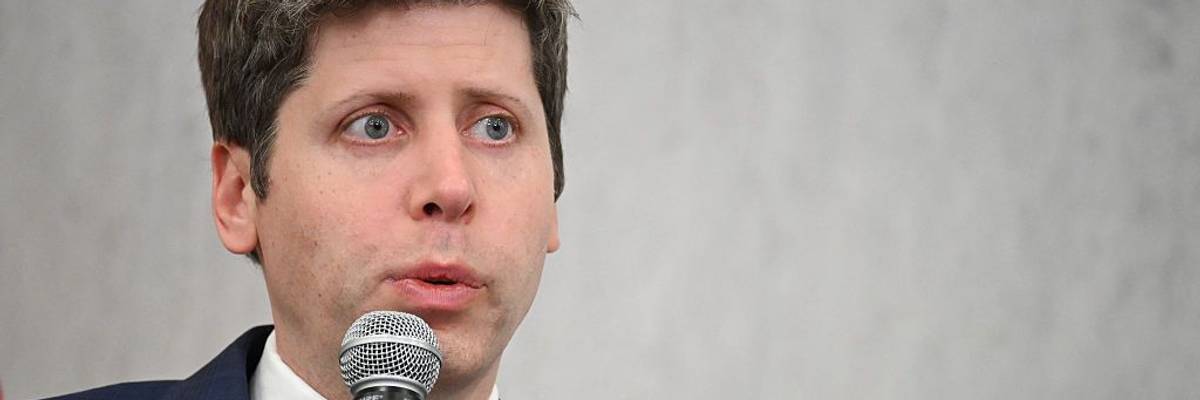
"If a foreign government or terrorist group did the kind of hacking and IP theft being done by AI giants, America would declare a national security emergency and start a war," said one journalist.
Publicly, billionaire artificial intelligence executives have denied that their product will ultimately replace people in jobs they've spent decades working at, with OpenAI CEO Sam Altman declaring that "AI won't replace humans, but humans who use AI will replace those who don't," in one effort to convince the public to embrace the deeply unpopular expansion of the technology.
But internal documents from OpenAI and Microsoft, unsealed as part of a lawsuit The New York Times and other news outlets filed against the two companies over their scraping of news content in order to train their AI models, tell a different story—one in which executives and workers at the tech giants were fully aware that the practice was meant to result in a "substitutive" product to replace journalists, after stealing millions of articles they'd written.
As the Times reported, employees at Microsoft wrote that by scraping the news content, they were committing the “largest theft of labor in human history.”
Nick Turley, the head of OpenAI's AI chatbot, ChatGPT, wrote that the technology posed an "existential threat" to news publishers and that the goal was for AI products to get "more and more substitutive"—although other employees said the stealing of news content could ultimately negatively impact the quality of the large language models (LLM) they were creating.
“It is highly unusual that an end-product threatens the economic foundations of its essential suppliers, but that is the situation we have created for our LLM business with respect to its ‘content supply chain,’” one document says.
Executives painted a picture of the companies gathering up news content from across the internet, ultimately leaving nothing behind.
Brent Hecht, Microsoft's director of applied science, wrote in an internal memo that eventually, an LLM is "a product that destroys its supply chain."
“Millions of people around the world will soon consider large models ‘hoovering up’ all their work to be an astonishing theft of unprecedented proportions,” Hecht wrote.
Although officials at the two companies expressed these views privately from 2020-24, in response to the lawsuit filed in late 2023 by the Times they have claimed that their use of news content is covered by "fair use" rules pertaining to copyrighted material, and that the articles were turned into new work and are therefore not substitutes for the original articles.
But the unsealed documents, said reporter Shawn Setaro of Complex, show that OpenAI and Microsoft "KNEW they were stealing, and KNEW they were destroying news outlets."
Hecht wrote in one memo that the companies' practice was making “a complete mockery of the idea of ‘fair use.’”
The internal memos were unsealed by Judge Sidney H. Stein of the District Court for the Southern District of New York, who is considering motions for a summary judgment in the lawsuit.
The Times and 11 other outlets that have joined the suit argue that OpenAI and Microsoft violated copyright laws.
One document showed that the companies even developed "a hack" to circumvent paywalls in order to collect paid content.
OpenAI President Greg Brockman replied, "Ah nice" to a note from a staffer telling him about the tool, but Microsoft DEO Satya Nadella said in a deposition that had he been aware that AI teams were scraping paywalled articles, he would have required that OpenAI retrain the models.
"If a foreign government or terrorist group did the kind of hacking and IP theft being done by AI giants, America would declare a national security emergency and start a war," said David Sirota of The Lever. "But because the crime is being done by Silicon Valley billionaires, we’re told by politicians and corporate media that it’s fine, that it should be accelerated, and that we should consider granting them new legal protections/exemptions, as well as new tax subsidies."
In 2020, then-OpenAI policy director Jack Clark wrote to Brockman and Altman that he was concerned the company's AI development practices would "increasingly lead to us creating systems that substitute for the labor of the people that define the ‘culture’ of society.”
While tech executives have spent recent years extolling the virtues of AI—and, recently, threatening that their technology has the capacity to wipe out humanity—Matt Stoller of the American Economic Liberties Project said the documents exposed AI as "an elite crime spree."
"From copyright violations to hacking to monopolization to sex trafficking, the companies behind AI violate the law," he said. "The problem isn't a lack of regulations, it's that the law doesn't apply to the powerful."
Dear Common Dreams reader, It’s been nearly 30 years since I co-founded Common Dreams with my late wife, Lina Newhouser. We had the radical notion that journalism should serve the public good, not corporate profits. It was clear to us from the outset what it would take to build such a project. No paid advertisements. No corporate sponsors. No millionaire publisher telling us what to think or do. Many people said we wouldn't last a year, but we proved those doubters wrong. Together with a tremendous team of journalists and dedicated staff, we built an independent media outlet free from the constraints of profits and corporate control. Our mission has always been simple: To inform. To inspire. To ignite change for the common good. Building Common Dreams was not easy. Our survival was never guaranteed. When you take on the most powerful forces—Wall Street greed, fossil fuel industry destruction, Big Tech lobbyists, and uber-rich oligarchs who have spent billions upon billions rigging the economy and democracy in their favor—the only bulwark you have is supporters who believe in your work. But here’s the urgent message from me today. It's never been this bad out there. And it's never been this hard to keep us going. At the very moment Common Dreams is most needed, the threats we face are intensifying. We need your support now more than ever. We don't accept corporate advertising and never will. We don't have a paywall because we don't think people should be blocked from critical news based on their ability to pay. Everything we do is funded by the donations of readers like you. When everyone does the little they can afford, we are strong. But if that support retreats or dries up, so do we. Will you donate now to make sure Common Dreams not only survives but thrives? —Craig Brown, Co-founder |
Publicly, billionaire artificial intelligence executives have denied that their product will ultimately replace people in jobs they've spent decades working at, with OpenAI CEO Sam Altman declaring that "AI won't replace humans, but humans who use AI will replace those who don't," in one effort to convince the public to embrace the deeply unpopular expansion of the technology.
But internal documents from OpenAI and Microsoft, unsealed as part of a lawsuit The New York Times and other news outlets filed against the two companies over their scraping of news content in order to train their AI models, tell a different story—one in which executives and workers at the tech giants were fully aware that the practice was meant to result in a "substitutive" product to replace journalists, after stealing millions of articles they'd written.
As the Times reported, employees at Microsoft wrote that by scraping the news content, they were committing the “largest theft of labor in human history.”
Nick Turley, the head of OpenAI's AI chatbot, ChatGPT, wrote that the technology posed an "existential threat" to news publishers and that the goal was for AI products to get "more and more substitutive"—although other employees said the stealing of news content could ultimately negatively impact the quality of the large language models (LLM) they were creating.
“It is highly unusual that an end-product threatens the economic foundations of its essential suppliers, but that is the situation we have created for our LLM business with respect to its ‘content supply chain,’” one document says.
Executives painted a picture of the companies gathering up news content from across the internet, ultimately leaving nothing behind.
Brent Hecht, Microsoft's director of applied science, wrote in an internal memo that eventually, an LLM is "a product that destroys its supply chain."
“Millions of people around the world will soon consider large models ‘hoovering up’ all their work to be an astonishing theft of unprecedented proportions,” Hecht wrote.
Although officials at the two companies expressed these views privately from 2020-24, in response to the lawsuit filed in late 2023 by the Times they have claimed that their use of news content is covered by "fair use" rules pertaining to copyrighted material, and that the articles were turned into new work and are therefore not substitutes for the original articles.
But the unsealed documents, said reporter Shawn Setaro of Complex, show that OpenAI and Microsoft "KNEW they were stealing, and KNEW they were destroying news outlets."
Hecht wrote in one memo that the companies' practice was making “a complete mockery of the idea of ‘fair use.’”
The internal memos were unsealed by Judge Sidney H. Stein of the District Court for the Southern District of New York, who is considering motions for a summary judgment in the lawsuit.
The Times and 11 other outlets that have joined the suit argue that OpenAI and Microsoft violated copyright laws.
One document showed that the companies even developed "a hack" to circumvent paywalls in order to collect paid content.
OpenAI President Greg Brockman replied, "Ah nice" to a note from a staffer telling him about the tool, but Microsoft DEO Satya Nadella said in a deposition that had he been aware that AI teams were scraping paywalled articles, he would have required that OpenAI retrain the models.
"If a foreign government or terrorist group did the kind of hacking and IP theft being done by AI giants, America would declare a national security emergency and start a war," said David Sirota of The Lever. "But because the crime is being done by Silicon Valley billionaires, we’re told by politicians and corporate media that it’s fine, that it should be accelerated, and that we should consider granting them new legal protections/exemptions, as well as new tax subsidies."
In 2020, then-OpenAI policy director Jack Clark wrote to Brockman and Altman that he was concerned the company's AI development practices would "increasingly lead to us creating systems that substitute for the labor of the people that define the ‘culture’ of society.”
While tech executives have spent recent years extolling the virtues of AI—and, recently, threatening that their technology has the capacity to wipe out humanity—Matt Stoller of the American Economic Liberties Project said the documents exposed AI as "an elite crime spree."
"From copyright violations to hacking to monopolization to sex trafficking, the companies behind AI violate the law," he said. "The problem isn't a lack of regulations, it's that the law doesn't apply to the powerful."
Publicly, billionaire artificial intelligence executives have denied that their product will ultimately replace people in jobs they've spent decades working at, with OpenAI CEO Sam Altman declaring that "AI won't replace humans, but humans who use AI will replace those who don't," in one effort to convince the public to embrace the deeply unpopular expansion of the technology.
But internal documents from OpenAI and Microsoft, unsealed as part of a lawsuit The New York Times and other news outlets filed against the two companies over their scraping of news content in order to train their AI models, tell a different story—one in which executives and workers at the tech giants were fully aware that the practice was meant to result in a "substitutive" product to replace journalists, after stealing millions of articles they'd written.
As the Times reported, employees at Microsoft wrote that by scraping the news content, they were committing the “largest theft of labor in human history.”
Nick Turley, the head of OpenAI's AI chatbot, ChatGPT, wrote that the technology posed an "existential threat" to news publishers and that the goal was for AI products to get "more and more substitutive"—although other employees said the stealing of news content could ultimately negatively impact the quality of the large language models (LLM) they were creating.
“It is highly unusual that an end-product threatens the economic foundations of its essential suppliers, but that is the situation we have created for our LLM business with respect to its ‘content supply chain,’” one document says.
Executives painted a picture of the companies gathering up news content from across the internet, ultimately leaving nothing behind.
Brent Hecht, Microsoft's director of applied science, wrote in an internal memo that eventually, an LLM is "a product that destroys its supply chain."
“Millions of people around the world will soon consider large models ‘hoovering up’ all their work to be an astonishing theft of unprecedented proportions,” Hecht wrote.
Although officials at the two companies expressed these views privately from 2020-24, in response to the lawsuit filed in late 2023 by the Times they have claimed that their use of news content is covered by "fair use" rules pertaining to copyrighted material, and that the articles were turned into new work and are therefore not substitutes for the original articles.
But the unsealed documents, said reporter Shawn Setaro of Complex, show that OpenAI and Microsoft "KNEW they were stealing, and KNEW they were destroying news outlets."
Hecht wrote in one memo that the companies' practice was making “a complete mockery of the idea of ‘fair use.’”
The internal memos were unsealed by Judge Sidney H. Stein of the District Court for the Southern District of New York, who is considering motions for a summary judgment in the lawsuit.
The Times and 11 other outlets that have joined the suit argue that OpenAI and Microsoft violated copyright laws.
One document showed that the companies even developed "a hack" to circumvent paywalls in order to collect paid content.
OpenAI President Greg Brockman replied, "Ah nice" to a note from a staffer telling him about the tool, but Microsoft DEO Satya Nadella said in a deposition that had he been aware that AI teams were scraping paywalled articles, he would have required that OpenAI retrain the models.
"If a foreign government or terrorist group did the kind of hacking and IP theft being done by AI giants, America would declare a national security emergency and start a war," said David Sirota of The Lever. "But because the crime is being done by Silicon Valley billionaires, we’re told by politicians and corporate media that it’s fine, that it should be accelerated, and that we should consider granting them new legal protections/exemptions, as well as new tax subsidies."
In 2020, then-OpenAI policy director Jack Clark wrote to Brockman and Altman that he was concerned the company's AI development practices would "increasingly lead to us creating systems that substitute for the labor of the people that define the ‘culture’ of society.”
While tech executives have spent recent years extolling the virtues of AI—and, recently, threatening that their technology has the capacity to wipe out humanity—Matt Stoller of the American Economic Liberties Project said the documents exposed AI as "an elite crime spree."
"From copyright violations to hacking to monopolization to sex trafficking, the companies behind AI violate the law," he said. "The problem isn't a lack of regulations, it's that the law doesn't apply to the powerful."