
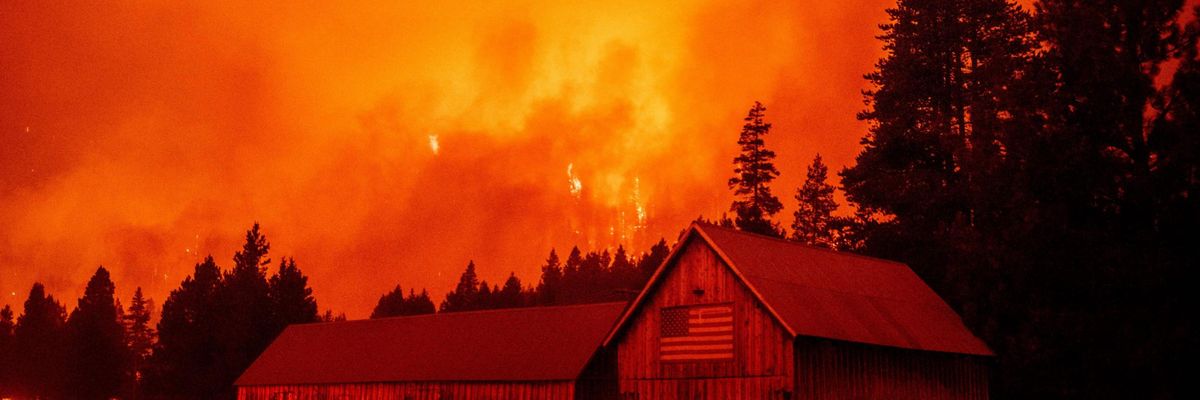
Flames rip across a hillside behind a building as the Caldor Fire pushes into South Lake Tahoe, California on August 30, 2021. (Photo: Josh Edelson/AFP via Getty Images)
NOAA Report Shows 310 Climate-Linked Disasters Cost US Over $2 Trillion Since 1980
"This report underscores the reality of how the climate crisis is already affecting people's lives and the economy."
As new statistics published Monday by the U.S. National Oceanic and Atmospheric Administration revealed the United States has sustained more than $2 trillion in damages wrought by over 300 weather and climate disasters since 1980, a leading economist specializing in equitable climate solutions reiterated the need for urgent action--starting with passing Democrats' flagship Build Back Better Act--to mitigate the planetary emergency.
"Policymakers must take drastic actions to rein in global warming emissions across all sectors of the economy."
According to NOAA, there were 310 U.S. weather and climate disasters since 1980 whose inflation-adjusted costs each exceeded $1 billion, with total damages topping $2.155 trillion. Economic damages from last year's disasters alone exceeded $145 billion, making 2021 the third-costliest in the time period studied. These events claimed 688 human lives and injured scores more.
"The sobering power of NOAA's annual data on billion-dollar disasters highlights a worsening and undeniable trend," Rachel Cleetus, policy director and lead economist for the Climate and Energy Program at the Union of Concerned Scientists (UCS), said in a statement. "This report underscores the reality of how the climate crisis is already affecting people's lives and the economy."
"Additionally, the devastating toll and trauma imposed by extreme weather and climate disasters have, and continue to, hit some people harder than others, with communities of color, low-income communities, and communities that have endured multiple disasters often bearing the brunt of its impacts," she continued. "We simply cannot adapt to runaway climate change."
"Fossil fuel companies and their allies shouldn't be allowed to stand in the way of desperately needed climate action."
NOAA says 2021 was the fourth-warmest ever recorded in the U.S. Additionally, Copernicus, the European Union's Earth observation program, reported Monday that the last seven years were the hottest on record worldwide as the atmospheric concentration of greenhouse gases carbon dioxide and methane continue to rise, despite a slight decline early during the Covid-19 pandemic.
Cleetus stressed that "to curtail the worst climate and extreme weather disasters, policymakers must take drastic actions to rein in global warming emissions across all sectors of the economy during this consequential decade and invest in climate resilience."
She referenced as one step President Joe Biden's flagship Build Back Better Act, which has been weakened by right-wing Democrats like Sen. Joe Manchin (D-W.Va.) and remains stalled in the U.S. Senate
The legislation, said Cleetus, could be "a crucial step to shift sharply away from fossil fuels toward clean energy and ensure communities are better prepared for disasters before they strike."
"Fossil fuel companies and their allies shouldn't be allowed to stand in the way of desperately needed climate action," she added.
We are at a crossroads
This country and this world are at a monumental crossroads. In a few short weeks, US voters will have an opportunity to beat back the forces of fascism and confront the billionaires who are rigging the economy, our media system, and our democracy, making it increasingly impossible for ordinary people to get by. We’re not just talking about the election. We’re talking about what must be done once these fascist elements are vanquished from power. We need a bolder set of solutions than what either major party has so far been willing to offer and a working-class movement ready to fight like hell for it. Trump didn't emerge from nowhere. The conditions that fueled MAGA authoritarianism were created by decades of radical neoliberal economic policies and a corrupt political system dominated by corporate interests. They slashed taxes on the super-rich, promising that the benefits would trickle down. They said giveaways to the corporate titans would make life more affordable for the rest of us. It was all bullshit. And when a bitter, betrayed populace searches for someone to blame, right-wing demagogues have little trouble finding scapegoats. People know when they're being lied to, but you won't hear any of this from the corporate media. Only independent journalism—powered and funded by people who believe in building a better world—can deliver truly trustworthy daily news. Our Fall Campaign is underway, and we need your help. To power our newsroom through the rest of the year, we need to raise $125,000 by midnight on October 31. So if you share our vision, please contribute whatever you can to sustain our work. |
As new statistics published Monday by the U.S. National Oceanic and Atmospheric Administration revealed the United States has sustained more than $2 trillion in damages wrought by over 300 weather and climate disasters since 1980, a leading economist specializing in equitable climate solutions reiterated the need for urgent action--starting with passing Democrats' flagship Build Back Better Act--to mitigate the planetary emergency.
"Policymakers must take drastic actions to rein in global warming emissions across all sectors of the economy."
According to NOAA, there were 310 U.S. weather and climate disasters since 1980 whose inflation-adjusted costs each exceeded $1 billion, with total damages topping $2.155 trillion. Economic damages from last year's disasters alone exceeded $145 billion, making 2021 the third-costliest in the time period studied. These events claimed 688 human lives and injured scores more.
"The sobering power of NOAA's annual data on billion-dollar disasters highlights a worsening and undeniable trend," Rachel Cleetus, policy director and lead economist for the Climate and Energy Program at the Union of Concerned Scientists (UCS), said in a statement. "This report underscores the reality of how the climate crisis is already affecting people's lives and the economy."
"Additionally, the devastating toll and trauma imposed by extreme weather and climate disasters have, and continue to, hit some people harder than others, with communities of color, low-income communities, and communities that have endured multiple disasters often bearing the brunt of its impacts," she continued. "We simply cannot adapt to runaway climate change."
"Fossil fuel companies and their allies shouldn't be allowed to stand in the way of desperately needed climate action."
NOAA says 2021 was the fourth-warmest ever recorded in the U.S. Additionally, Copernicus, the European Union's Earth observation program, reported Monday that the last seven years were the hottest on record worldwide as the atmospheric concentration of greenhouse gases carbon dioxide and methane continue to rise, despite a slight decline early during the Covid-19 pandemic.
Cleetus stressed that "to curtail the worst climate and extreme weather disasters, policymakers must take drastic actions to rein in global warming emissions across all sectors of the economy during this consequential decade and invest in climate resilience."
She referenced as one step President Joe Biden's flagship Build Back Better Act, which has been weakened by right-wing Democrats like Sen. Joe Manchin (D-W.Va.) and remains stalled in the U.S. Senate
The legislation, said Cleetus, could be "a crucial step to shift sharply away from fossil fuels toward clean energy and ensure communities are better prepared for disasters before they strike."
"Fossil fuel companies and their allies shouldn't be allowed to stand in the way of desperately needed climate action," she added.