
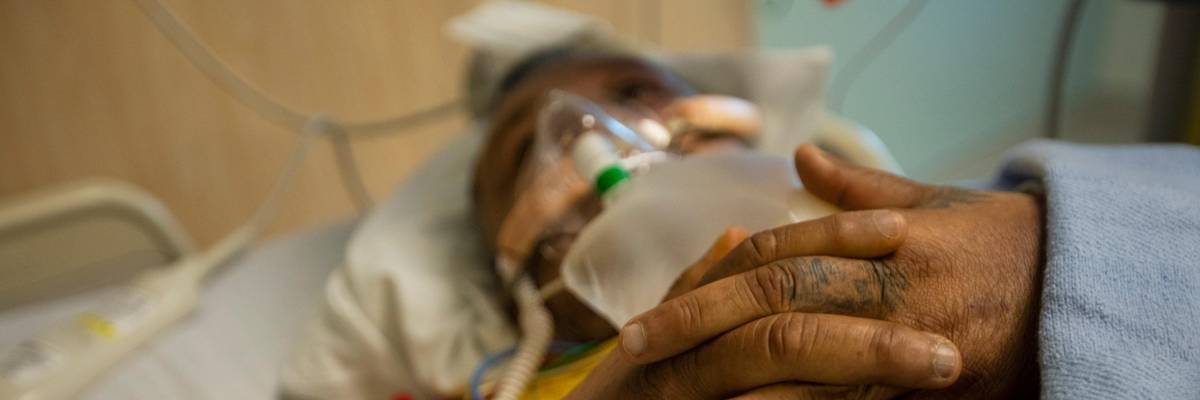
Covid-19 patient Mariano Zuniga-Anaya lies in the ICU at Martin Luther King Jr. Community Hospital on February 1, 2021 in the Willowbrook neighborhood of southern Los Angeles County, California. (Photo: Francine Orr / Los Angeles Times via Getty Images)
CDC's Covid-19 Vaccine Push Threatens Americans With Exorbitant Hospital Bills
"I'm all for promoting vaccination, but we should all be able to agree that it's not super great for government to boast about a for-profit system that medically bankrupts people."
The latest push by the U.S. government to encourage Americans to get vaccinated against Covid-19 took on a "dark and dystopian" appearance, healthcare advocates said Tuesday, after the Centers for Disease Control and Prevention released an ad warning those who are hospitalized could face exorbitant medical bills.
"Only in the United States could the government run a public health campaign centered on fears of large, unexpected medical bills," tweeted Sarah Kliff, a health policy reporter for the New York Times.
In its new ad, the CDC says hospital stays for Covid-19 have been known to "cost thousands of dollars," while vaccines are free.
"I'm all for promoting vaccination, but we should all be able to agree that it's not super great for government to boast about a for-profit system that medically bankrupts people," journalist David Sirota said.
According to the Times, with insurance companies no longer waiving costs associated with Covid-19 treatment as they did early in the pandemic, the average hospital stay totals about $40,000. Insured patients are responsible for an average of $3,800 with insurers paying the rest--still a financial burden for millions of Americans.
"There were some patients where it was $10,000 and others where it was $500," Dr. Kao-Ping Chua, a pediatrician at University of Michigan who published a study on Covid-19 bills earlier this year, told the Times in September. "It gives you some semblance of what things will now look like without the waivers."
Another analysis by FAIR Health last year found that uninsured patients paid an average of more than $45,000 if they were between the ages of 51 and 60 and more than $34,000 if they were between 23 and 30.
Kliff, who has reported on exorbitant Covid-19 medical bills, said the CDC's threat to unvaccinated people was "accurate... Just not a message you could pull off pretty much anywhere else."
Instead of accepting at face value and appearing to embrace a system in which the nation's biggest for-profit health insurance companies raked in more than $11 billion in the second quarter of 2021 as the country entered the second year of the pandemic, one critic suggested, the CDC "should be focused on leveraging its institutional weight to help guarantee Americans can afford to visit the hospital when they are ill."
"CDC is a broken agency in a broken state in a broken country," tweeted policy analyst Anthony LaMesa. "Doesn't make their awful communications strategy any less embarrassing, though."
Making the case for a Medicare for All system, a report by consumer advocacy group Public Citizen found in March that a third of Covid-19 deaths in the first year of the pandemic were associated with a lack of health insurance, which prevented hundreds of thousands of people from seeking medical care.
An Urgent Message From Our Co-Founder
Dear Common Dreams reader, It’s been nearly 30 years since I co-founded Common Dreams with my late wife, Lina Newhouser. We had the radical notion that journalism should serve the public good, not corporate profits. It was clear to us from the outset what it would take to build such a project. No paid advertisements. No corporate sponsors. No millionaire publisher telling us what to think or do. Many people said we wouldn't last a year, but we proved those doubters wrong. Together with a tremendous team of journalists and dedicated staff, we built an independent media outlet free from the constraints of profits and corporate control. Our mission has always been simple: To inform. To inspire. To ignite change for the common good. Building Common Dreams was not easy. Our survival was never guaranteed. When you take on the most powerful forces—Wall Street greed, fossil fuel industry destruction, Big Tech lobbyists, and uber-rich oligarchs who have spent billions upon billions rigging the economy and democracy in their favor—the only bulwark you have is supporters who believe in your work. But here’s the urgent message from me today. It's never been this bad out there. And it's never been this hard to keep us going. At the very moment Common Dreams is most needed, the threats we face are intensifying. We need your support now more than ever. We don't accept corporate advertising and never will. We don't have a paywall because we don't think people should be blocked from critical news based on their ability to pay. Everything we do is funded by the donations of readers like you. When everyone does the little they can afford, we are strong. But if that support retreats or dries up, so do we. Will you donate now to make sure Common Dreams not only survives but thrives? —Craig Brown, Co-founder |
The latest push by the U.S. government to encourage Americans to get vaccinated against Covid-19 took on a "dark and dystopian" appearance, healthcare advocates said Tuesday, after the Centers for Disease Control and Prevention released an ad warning those who are hospitalized could face exorbitant medical bills.
"Only in the United States could the government run a public health campaign centered on fears of large, unexpected medical bills," tweeted Sarah Kliff, a health policy reporter for the New York Times.
In its new ad, the CDC says hospital stays for Covid-19 have been known to "cost thousands of dollars," while vaccines are free.
"I'm all for promoting vaccination, but we should all be able to agree that it's not super great for government to boast about a for-profit system that medically bankrupts people," journalist David Sirota said.
According to the Times, with insurance companies no longer waiving costs associated with Covid-19 treatment as they did early in the pandemic, the average hospital stay totals about $40,000. Insured patients are responsible for an average of $3,800 with insurers paying the rest--still a financial burden for millions of Americans.
"There were some patients where it was $10,000 and others where it was $500," Dr. Kao-Ping Chua, a pediatrician at University of Michigan who published a study on Covid-19 bills earlier this year, told the Times in September. "It gives you some semblance of what things will now look like without the waivers."
Another analysis by FAIR Health last year found that uninsured patients paid an average of more than $45,000 if they were between the ages of 51 and 60 and more than $34,000 if they were between 23 and 30.
Kliff, who has reported on exorbitant Covid-19 medical bills, said the CDC's threat to unvaccinated people was "accurate... Just not a message you could pull off pretty much anywhere else."
Instead of accepting at face value and appearing to embrace a system in which the nation's biggest for-profit health insurance companies raked in more than $11 billion in the second quarter of 2021 as the country entered the second year of the pandemic, one critic suggested, the CDC "should be focused on leveraging its institutional weight to help guarantee Americans can afford to visit the hospital when they are ill."
"CDC is a broken agency in a broken state in a broken country," tweeted policy analyst Anthony LaMesa. "Doesn't make their awful communications strategy any less embarrassing, though."
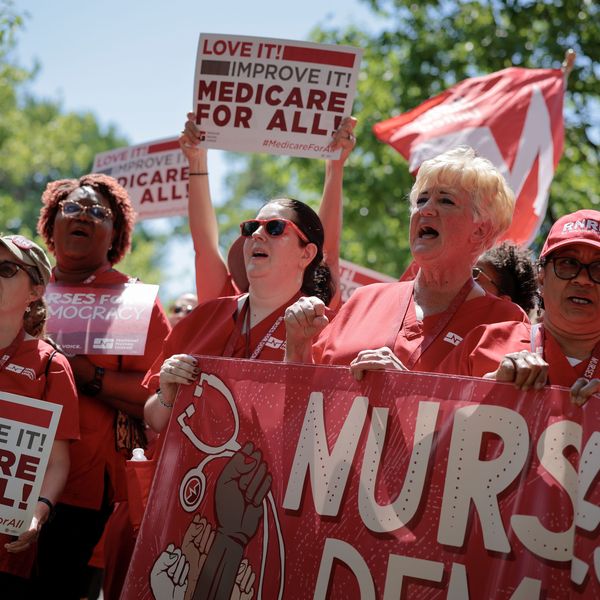
Making the case for a Medicare for All system, a report by consumer advocacy group Public Citizen found in March that a third of Covid-19 deaths in the first year of the pandemic were associated with a lack of health insurance, which prevented hundreds of thousands of people from seeking medical care.
The latest push by the U.S. government to encourage Americans to get vaccinated against Covid-19 took on a "dark and dystopian" appearance, healthcare advocates said Tuesday, after the Centers for Disease Control and Prevention released an ad warning those who are hospitalized could face exorbitant medical bills.
"Only in the United States could the government run a public health campaign centered on fears of large, unexpected medical bills," tweeted Sarah Kliff, a health policy reporter for the New York Times.
In its new ad, the CDC says hospital stays for Covid-19 have been known to "cost thousands of dollars," while vaccines are free.
"I'm all for promoting vaccination, but we should all be able to agree that it's not super great for government to boast about a for-profit system that medically bankrupts people," journalist David Sirota said.
According to the Times, with insurance companies no longer waiving costs associated with Covid-19 treatment as they did early in the pandemic, the average hospital stay totals about $40,000. Insured patients are responsible for an average of $3,800 with insurers paying the rest--still a financial burden for millions of Americans.
"There were some patients where it was $10,000 and others where it was $500," Dr. Kao-Ping Chua, a pediatrician at University of Michigan who published a study on Covid-19 bills earlier this year, told the Times in September. "It gives you some semblance of what things will now look like without the waivers."
Another analysis by FAIR Health last year found that uninsured patients paid an average of more than $45,000 if they were between the ages of 51 and 60 and more than $34,000 if they were between 23 and 30.
Kliff, who has reported on exorbitant Covid-19 medical bills, said the CDC's threat to unvaccinated people was "accurate... Just not a message you could pull off pretty much anywhere else."
Instead of accepting at face value and appearing to embrace a system in which the nation's biggest for-profit health insurance companies raked in more than $11 billion in the second quarter of 2021 as the country entered the second year of the pandemic, one critic suggested, the CDC "should be focused on leveraging its institutional weight to help guarantee Americans can afford to visit the hospital when they are ill."
"CDC is a broken agency in a broken state in a broken country," tweeted policy analyst Anthony LaMesa. "Doesn't make their awful communications strategy any less embarrassing, though."
Making the case for a Medicare for All system, a report by consumer advocacy group Public Citizen found in March that a third of Covid-19 deaths in the first year of the pandemic were associated with a lack of health insurance, which prevented hundreds of thousands of people from seeking medical care.